Tuesday, September 30, 2008
Awesome new search engine
by Larry Geller
There’s lots of cool stuff on the Internet. Can cool actually become overwhelming?
Try out MSE360 for its speed and visual presentation. Click here for a sample search.


A bailout reader
by Larry Geller
Here are snippets from three alternative bailout plans collected by MR Zine (the Monthly Review Foundation), and one detailed discussion of how other countries have handled their financial crises:
A Bailout We Don't Need
by James K. GalbraithNow that all five big investment banks -- Bear Stearns, Merrill Lynch, Lehman Brothers, Goldman Sachs and Morgan Stanley -- have disappeared or morphed into regular banks, a question arises.
Is this bailout still necessary?
The point of the bailout is to buy assets that are illiquid but not worthless. But regular banks hold assets like that all the time. They're called "loans."
With banks, runs occur only when depositors panic, because they fear the loan book is bad. Deposit insurance takes care of that. So why not eliminate the pointless $100,000 cap on federal deposit insurance and go take inventory? If a bank is solvent, money market funds would flow in, eliminating the need to insure those separately. If it isn't, the FDIC has the bridge bank facility to take care of that.
. . .
Michael Perelman is professor of economics at California State University at Chico, and the author of fifteen books.
An Alternative Bailout Plan
by Michael PerelmanInstead of giving a couple trillion dollars to the financial institutions, how about instituting a financial holiday -- something like what FDR did -- and using the trillions of dollars to create infrastructure and affordable housing?
We could also raise some more money by ending the wars and cutting back military spending.
Some of the money would be left over to create national health care, alternative energy, and tuition support.
If we needed more money beyond that, we could raise taxes. With all the spying on ordinary people, the NSA must certainly know where the fat cats are hiding their money in tax shelters.
. . .
Travis Fast is a political scientist.
Simple Solution to a Financial Crisis
by Travis FastSeeing how the Democrats seem incapable of figuring out the boondoggle Bernake and Paulson are in the process of engineering, I thought I might outline a modest proposal for a fair resolution to the present financial crisis.
Buy two trillion dollar toxic sub-prime at 40 cents on the dollar; disaggregate, repackage and sell back to existing home owner for 50 cents of the original face value. The taxpayer realizes a 25% ROI, and average Joe gets his house for half the price of its originally bloated asking price. That effectively puts a floor on valuations and ensures that those who took the risks suffer the losses.
Maybe the haircut could be a little less severe, say 60 cents and resold at 70 cents for an ROI to the taxpayer of 16.66%. But whatever the discount, the plan covers all the bases: it both socializes the risks and the profits.
The plan can be defended against all criticism by simply repeating the following phrase:
It might be costly but it is less costly than doing nothing.
Dan La Botz is a Cincinnati-based teacher, writer, and activist.
The Financial Crisis:
Will the U.S. Nationalize the Banks?
by Dan La Botz. . .
The political conflict over the Bush administration's plan for a bailout of the banks, brought about both by differences with the Democrats and even more intensely with rightwing Republicans, makes it highly unlikely that Congress will be able to pass a bailout plan that can stabilize the financial situation along the lines that Secretary of the Treasury Henry Paulson originally asked for.
. . .
When Governments Nationalize the BanksIn recent history governments have nationalized banks when the pressures of internationalized financial markets and international competition have made it difficult for them to control and stabilize their finances and currency. During the last couple of decades, countries as different as Mexico, France, Sweden, and Japan carried out partial or more or less complete bank nationalizations to regain control of the financial situation.
Japan's experience more than a decade ago was much like that of the United States in many ways. After a period of great productivity and prosperity in the 1980s, in the early 1990s, Japan's housing bubble burst, leaving Japanese banks holding sheaves of bad loans. The Japanese housing boom collapsed just as China began to become an export competitor.1 After neglecting the problem for some time the Japanese government intervened, spending $440 billion dollars of its taxpayers' money to nationalize the weakest banks, infuse capital into the stronger banks, and to protect depositors.2 Japanese banks were required to create a Business Revitalization Plan, at the center of which was a capital/asset ratio. Some economists and journalists have suggested that Japan's solution -- partial nationalization and partial financial support for private banks -- could provide a model for the United States in the current crisis.
. . .
Bailouts, markets, and socialism
by Larry Geller
The USA is not collapsing despite the current Wall Street crisis. When the Soviet Union actually did collapse, people could still buy bread, and when they went to work they still were paid. This is because a directed (“socialist”) economy was good at structure. Farms and factories just kept grinding away, according to plan. So at the bottom levels of society safety nets and in fact normal life could continue, even as the upper levels of government were disintegrating. This is a generality, but I think it fairly describes the situation for a time after the end of the empire.
Without even coming near collapse, here in America, homes, jobs, savings, retirements, everything to do with the average person, is at risk of stopping due to corporate greed.
Food prices are up, gasoline is soaring, life is getting tough. People are losing their health insurance, adding to the numbers of those already uninsured. And no, we’re not collapsing, the stock market, despite its ups and downs, is alive and well. CEOs are making fabulous incomes. Politicians have no problem collecting obscene campaign contributions. It may be that the banks will be bailed out, even as ordinary people lose their homes and livelihoods.
Some, particularly Republican congresspeople, have blasted the proposed bailout bill as “socialism,” implying that it’s a bad thing. To the extent that jobs on Wall Street may be preserved, it’s socialism, but for everyone else, it’s capitalism as usual.
We couldn’t be doing something more opposite to socialism. We’re extending welfare to corporations while people starve.
Just my two cents worth. Can’t do anything else with two cents these days.
Caveat emptor--Educating Hewlett-Packard Tech Support
by Larry Geller
Sheesh. If I hear one more HP tech support person ask me to “make a copy on your machine” (one of those all-in-ones), I feel I might pick the thing up, and still connected to my HP computer, throw the lot out the window so he/she can hear it crash loudly into a thousand pieces on the concrete below.
I’ve spent a total of about nine hours, I think, educating them (this time). When I call back, or when they call me, starting over from scratch is not helpful. My Officejet Pro L7555 seems not to be a bargain after all. It was cheap at Costco, but if I put any reasonable valuation on my time, it has turned out to be a very expensive machine.
And it’s not running yet.
Yesterday, using the remote help feature where they help you out from New Delhi by sharing your screen, I watched as the technician deleted all my printer drivers—not just the Officejet drivers, but all the pdf drivers, the Microsoft document drivers, everything. It all happened before I could grab the mouse to stop him. And he was a “supervisor” of some sort, too. Afterwards, he said, “you don’t need those.”
He crippled my machine. Nothing would run. I couldn’t even open Microsoft Word.
And guess what—when I called back (the line dropped after he deleted my drivers), they say they can’t connect me to the same person. Even though only that person knows what he did to my registry and files. Oh, and could I please see if my machine can make a copy?
This is only the latest episode. I document it here in case you are thinking of buying a reasonably-priced HP product. They are fancy, they seem to do a lot for the money, but beware of the Tech Support Trap. You could be lucky, or, in order to get it working on your new Vista system, your cost in time and frustration may be many times the cost of the machine. Are you a professional? How much is three or more hours of your time worth?
And you’ll have to educate each new technician, because HP has not.
May Google share this post with 10,000 potential HP customers. And with that tech support “supervisor” who got me into this mess. And no, system restore has not worked.
In fact, I found the IP address conflict that was part of the problem, not them. You can know what you’re doing and they can still put you out of commission.
This afternoon I will spend restoring my system. The Officejet is still not working with it (works fine on another computer). I will call HP. Why? Because stupidly I threw away the box and so I don’t think I can return it to Costco. I’m at HP’s mercy for the moment.
There’s another caveat: it’s good to buy from Costco where you have 90 days to waste your time with HP tech support before returning it. Save the box, and save your receipt. Don’t lose the disks. Be prepared to cut your losses and send it back.
Grrrr. Google, Yahoo, find this message and spread the word. Maybe HP will notice and fix their tech support.
Public protests over the bailout continue even if the papers won’t report it
by Larry Geller
What your newspaper won’t tell you is that protests continue on Wall Street and elsewhere against Congress’ unpopular bailout plan. For example:
Unions Protest Against Wall Street Bailout
Opposition on Main Street to the federal bailout continues to mount. On Monday, labor unions held another rally on Wall Street. Speakers include Ed Ott of the New York City Labor Council.
Ed Ott: “It was irresponsible what was done here. And if we put it back together, we want assurances that someone is going to watch the till. For twenty-five years, both parties have been complicit in undermining our protections, under the guise of deregulation. They have now cost us tens of thousands of jobs. It is unacceptable.” [Democracy Now, 9/30/2008]
The Bush administration and congressional leaders are hard at work planning the next version of the bill.
Will it contain provisions re-regulating banks and investment firms?
Will it allow people facing foreclosure to retain their homes?
Will it provide appropriate punishment to firms and CEOs who caused this mess with their greed and risky bets against homeowners (instead of rewarding them)?
If Congress would draft a bill that provided benefits and protections to taxpayers, protest would likely melt and Wall Street could recover in a sane, rational manner.
To support the current bailout process is a form of insanity without re-regulation and protections. IMHO and apparently many, many others.
It’s business as usual between Wall Street and Congress, by the way. In closing, here’s an interesting corollary:
Finance Sector Gave 51 Percent More to House Bailout Backers
The Center for Responsive Politics is reporting members of the House of Representatives who supported bailing out the financial sector have received 51 percent more in campaign contributions from the finance, insurance and real estate sector in their congressional careers than those who opposed the emergency legislation. [Democracy Now, 9/30/2008]
In effect, Wall Street is trying to bribe its way to a bailout. No need to pay now, they’ve been paying all along (and will, of course, continue to fund their supporters in government).
Second Superferry oozes into the water at Austal’s Mobile Alabama shipyard
by Larry Geller
This time potential military use is admitted up front:
At 113 meters (373 feet) long, the vessel launched Monday is 6 meters (19.8 feet) longer than Alakai, thanks to a ramp Austal added to its stern, making it suitable for military use. Industry watchers have said leasing the vessel to the military is a possibility, though the company said it is sticking by its plan to operate it commercially. [Alabama Press Register, Austal turns out second Hawaii Superferry, 9/30/2008]
The article has a capsule history of the first Superferry but mistakenly reports that it is operating between Oahu, Maui and Kauai.
Another article includes more detailed technical information, particularly on the engines.
Maui attorney Lance Collins breaks through Attorney General’s veil of secrecy
by Larry Geller
The Lingle administration has been emulating the secrecy policy of her mentor, GW Bush, and has kept a lid on Attorney General opinions given to state agencies. The number released to the public is reported to be way down when compared to the number her predecessors released.
The opinions are withheld with a claim of “attorney-client privilege.”
But this hides the operation of a state agency from the public whom they serve. In the Akaku case, it’s hard to go up against an opinion that no one is allowed to see.
Maui attorney Lance Collins has achieved a breakthrough. An opinion received today from Circuit Judge Joel August will break loose an AG opinion on whether or not the public access TV contracts must go out to public bidding. He gave the state until November 15 to get a copy of the opinion to him for his review.
Aside from its value to Akaku, to the other public access providers and to those who have supported them with hundreds of individual testimonies, the judge’s opinion may result in the AG having to file (and therefore make available) many of the other opinions that it has refused to share with the public.
You can read the opinion here. It’s a short (13 pages) pdf file. In a nutshell:
Based on the record and the Findings of Fact and the Conclusions of Law, the Court
Grants Plaintiff AKAKU; MAUI COMMUNITY TELEVISION'S Motion for Summary Judgment, in part, against Defendants MARK BENNETT and LAWRENCE REIFURTH. Defendants must submit the opinion letter for in camera review by November 15, 2008. The Court reserves the right to redact portions of the opinion letter which are either protected by the attorney-client privilege or should be kept confidential to avoid the frustration of a legitimate government function. After its in camera review and redaction, if any, the opinion letter will be issued in a subsequent order,
Lance Collin’s success in this case is certainly a victory for Akaku and the people of Hawaii who value their public access TV. It may be useful also for other organizations that have been stonewalled by secret AG opinions.
Monday, September 29, 2008
Please call Obama’s Hawaii HQ and fight the bailout
by Larry Geller
Ok, here’s the number that I couldn’t find before. Obama’s Hawaii HQ doesn’t list a phone number on their website, but someone called me with it:
Obama Hawaii HQ: 593-9757
It works, I just made my phone call. Please make yours!
And the New York Times seems to agree with me that representatives are afraid of us because they are up for election:
Among opponents of the rescue plan, some Republicans cited ideological objections to government intervention, and liberal Democrats said they were of no mind to race to aid Wall Street tycoons. Other critics complained about haste and secrecy in assembling the plan.
But lawmakers on both sides pointed to an outpouring of opposition from deeply hostile constituents just five weeks before every seat in the House was up for election as a fundamental reason that the measure was defeated. House members in potentially tough races and those seeking Senate seats fled from the plan in droves.
So for a change they are listening! To us deeply hostile constituents! Amazing.
Feel your power. Call now.
What to say when you call? Probably you get an answering machine, so not to worry. Say anything you like. You could say:
I don’t think this bailout bill is a good idea, tell Obama not to support it.
You don’t want Congress to pass any bill like this one, that uses taxpayer money to pay back the banks and investment firms for their bad bets.
You don’t want any bill passed that does not protect homeowners and stop foreclosures.
You could ask Obama to support voters instead of the big money financial firms.
Tell him you don’t want Paulson to make himself rich over this crisis which he helped create.
Or try something like others have said:
“I am hoping Congress can find the backbone to stand on their feet and not their knees before BIG BUSINESS,” one correspondent wrote to Representative Jim McDermott of Washington.
“NO BAILOUT, I am a registered republican,” one constituent wrote. “I will vote and campaign hard against you if we have to subsidize the very people that have sold out MY COUNTRY.”
“The last time that Congress hurriedly passed legislation that the administration presented as ‘urgent’ we got the Patriot Act, with its mix of necessary reforms and onerous civil rights abuses,” one of Senator Brown’s constituents wrote. “Do not fall into this trap again.”
(from a NY Times article)
Yes, we can make a difference. Please call today and leave a message.
And thank you!
Democrats supported bailout, fearful Republicans opposed
by Larry Geller
The vote on the bailout bill was interesting. A majority of Democrats supported it, but a majority of Republicans opposed. Here’s a description of the tug-of-war from the BBC:
Members of Congress have been dealing with two powerful conflicting forces over the last week.
The first was remorseless pressure from the White House - the argument that the country faced a crisis so profound that unless they approved the government's plans, American capitalism would grind to a halt as funds flowing between the banks began to dry up.
But the second pressure which is much harder to measure came from ordinary voters writing or emailing their own members of Congress angrily demanding that they reject a scheme which is universally perceived here as a bail-out of Wall Street bankers.
They are perceived as greedy, incompetent fat cats who have created this crisis themselves and who are now being allowed to pick the pockets of American voters to fix it.
So why did Democrats support and Republicans oppose? There are certainly multiple reasons. The one that hasn’t been given enough credit in the commercial press is this one: Democrats felt secure in getting re-elected, Republicans are not so sure. The public, at least those contacting Congress, are so firmly opposed to this that I suggest the Republicans were afraid of losing seats in November.
Still, we need to keep vigilant. You never know what they will try next.
Finding how your representative voted on the bailout bill
by Larry Geller
You were looking for this bill that they are debating in Congress, that just failed, perhaps to see how your congressperson voted?
It’s hard to find. It’s correct title is:
“HR3997 PROVIDING FOR CONSIDERATION OF THE SENATE AMENDMENT TO THE BILL (H.R. 3997) TO AMEND THE INTERNAL REVENUE CODE OF 1986 TO PROVIDE EARNINGS ASSISTANCE AND TAX RELIEF TO MEMBERS OF THE UNIFORMED SERVICES, VOLUNTEER FIREFIGHTERS, AND PEACE CORPS VOLUNTEERS, AND FOR OTHER PURPOSES”
The relief measure is contained in an amendment. See House Report 110-903 located here.
The roll call vote is #674, and it is here.
Your phone calls did the trick—House rejects bailout
by Larry Geller
You called, you emailed, and the House today rejected the bad, bad bailout bill.
He [Rep. Neil Abercrombie] said that of the nearly 1,500 people who called, faxed or e-mailed his offices in Honolulu and Washington, only 11 people supported the bailout plan. [Honolulu Advertiser, Abercrombie, Hirono both vote no on bailout, 9/29/2008]
 Why isn’t this man smiling?
Both House leadership and the Bush administration were confounded by resistance to passing the controversial $700 billion bailout bill.
The measure, which is designed to get battered U.S. credit markets working normally again, needed 218 votes for passage. But it came up 13 votes short of that target, as the final vote was 228 to 205 against. About 60% of Democrats and fewer than 33% of Republicans voted for the measure. [cnnmoney.com, Bailout plan rejected - supporters scramble, 9/29/2008]
Many bloggers, advocacy groups and even Michael Moore urged ordinary people to contact their congressional representatives and oppose the bailout as it is now formulated. In a huge e-mailing, Moore said:
NOTHING in this "bailout" package will lower the price of the gas you have to put in your car to get to work. NOTHING in this bill will protect you from losing your home. NOTHING in this bill will give you health insurance.
As long as he said it, let me interject his next two paragraphs, which link healthcare to the financial crisis:
Health insurance? Mike, why are you bringing this up? What's this got to do with the Wall Street collapse?
It has everything to do with it. This so-called "collapse" was triggered by the massive defaulting and foreclosures going on with people's home mortgages. Do you know why so many Americans are losing their homes? To hear the Republicans describe it, it's because too many working class idiots were given mortgages that they really couldn't afford. Here's the truth: The number one cause of people declaring bankruptcy is because of medical bills . Let me state this simply: If we had had universal health coverage, this mortgage "crisis" may never have happened.
Relief for individuals was taken out of the bill. Dennis Kucinich snitched on the Democratic Caucus in his interview with Amy Goodman on Democracy Now this morning:
AMY GOODMAN: Congressman Kucinich, can you explain how it is that the Democrats are in charge, yet the Democrats back down on their demand to give bankruptcy judges authority to alter the terms of mortgages for homeowners facing foreclosure, that Democrats also failed in their attempt to steer a portion of any government profits from the package to affordable housing programs?
REP. DENNIS KUCINICH: Well, I mean, those are two of the most glaring deficiencies in this bill. And I would maintain there was never any intention to—you know, well, many members of Congress had the intention of helping people who were in foreclosure. You know, this—Wall Street doesn’t want to do that. Wall Street wants to grab whatever change they can and equity that’s left in these properties. So—
AMY GOODMAN: Right, but the Democrats are in charge of this.
REP. DENNIS KUCINICH: Right. You know, I’ll tell you something that we were told in our caucus. We were told that our presidential candidate, when the negotiations started at the White House, said that he didn’t want this in this bill. Now, that’s what we were told.
AMY GOODMAN: You were told that Barack Obama did not want this in the bill?
REP. DENNIS KUCINICH: That he didn’t want the bankruptcy provisions in the bill. Now, you know, that’s what we were told. And I don’t understand why he would say that, if he did say that. And I think that there is a—the fact that we didn’t put bankruptcy provisions in, that actually we removed any hope for judges to do any loan modifications or any forbearance. There’s no moratorium on mortgage foreclosures in here. So, who’s getting—who’s really getting helped by this bill? This is a bailout, pure and simple, of Wall Street interests who have been involved in speculation.
And I don’t, for the life of me, understand why this is going to do anything to address the underlying problems in the economy, which actually had to do with the recklessness. This is what the president of the Federal Reserve Bank in Dallas said, that—and, you know, I might have the actual quote here. Listen to this quote: he said, “The seizures and convulsions we’ve experienced in the debt and equity markets have been the consequences of a sustained orgy of excess and reckless behavior, not a too tight monetary policy.” This is the Dallas Federal Reserve Bank president, Richard Fisher.
So, you know, we’re getting stampeded here to vote for something that doesn’t help homeowners, that doesn’t do anything about foreclosures, that doesn’t help those people who have been in bankruptcy and are looking for a way out. As a matter of fact, it made sure they can’t get out. So, who’s this for? It’s for speculators. It’s to play a game that provides some temporary help in the market, and, you know, you might see an uptick today if this passes the House. On the other hand, if it doesn’t, we need to be ready to find a way for Wall Street to address its problems without having to tap the increasingly diminishing resources of the federal taxpayers.
I would like to suggest one more call I’d like you to make. Please contact the Obama campaign. Their email form is here. Or email them at Hawaii@BarackObama.com. (I can’t find a phone number for the Obama campaign in Hawaii—does anyone have it?) Tell them that people’s homes must be protected, and the bankruptcy provisions and other protections must be included in any bailout bill.
Sheesh. Are we back to choosing the lessor of two evils again? Get Obama on the right track, please call.
The Associated Press understated public opposition to the bailout plan. In the article chosen for today’s Advertiser lead story, we find only
Lawmakers had to navigate between angry voters with little regard for Wall Street and administration officials who warned that inaction would cause the economy to seize up and spiral into recession.
“Angry voters with little regard for Wall Street?” Give me a break. It’s a government that has little regard for voters. It’s not only average people who objected:
Senator Richard Shelby went to the White House armed with a letter. The letter is signed by 200 economists, including three Nobel Prize winners, and warns Congress not to back the bailout. [ABC, Chicago area economists lead opposition to bailout, 9/25/2008]
For up-to-the minute news and the occasional action alert, keep on surfin’. The real news is out there if you look for it.
(please consider also supporting Democracy Now so that they can continue their great work.)
If you want to go further, here’s the list of congressional contacts again, it wouldn’t hurt to call them again and ask them to include protections for taxpayers and homeowners in any future bill:
Sen. Daniel Inouye:
Honolulu Office:
300 Ala Moana Boulevard, #7-212
Honolulu, Hawaii 96850
Phone: (808) 541-2542
Fax: (808) 541-2549
Hilo Office:
101 Aupuni Street, #205
Hilo, Hawaii 96720
Phone: (808) 935-0844
Fax: (808) 961-5163
Wailuku Office:
24 North Church Street, #407
Wailuku, Hawaii 96793
Phone: (808) 242-9702
Fax: (808) 242-7233
Kaunakakai Office:
PO Box 573
Kaunakakai, Hawaii 96748
Phone: (808) 642-0203
Fax: (808) 560-3385
Lihue Office:
1840 A Leleiona Street
Lihue, Hawaii 96766
Phone: (808) 245-4611
Fax: (808) 246-9515
Kealakekua Office:
PO Box 4l
Kealakekua, Hawaii 96750
Phone: (808) 935-0844
Fax: (808) 961-5163
Mililani Office:
94-403 Punono Street
Mililani, Hawaii 96789
Phone: (808) 623-8334
Fax:
Sen. Daniel Akaka
Honolulu Office:
300 Ala Moana Boulevard, Room 3-106
Honolulu, Hawaii 96850
Phone: (808) 522-8970
Fax: (808) 545-4683
Hilo Office:
101 Aupuni Street, #213
Hilo, Hawaii 96720
Phone: (808) 935-1114
Fax: (808) 935-9064
Rep. Neil Abercrombie
Honolulu Office:
300 Ala Moana Boulevard, #4-104
Honolulu, Hawaii 96850
Phone: (808) 541-2570
Fax: (808) 533-0133
Rep. Mazie Hirono
Honolulu Office:
5-104 Prince Kuhio Bldg., 300 Ala Moana Boulevard
Honolulu, Hawaii 96813
Phone: (808) 541-1986
Fax: (808) 538-0233
Sunday, September 28, 2008
Tina Fey for VP
by Larry Geller
I’ll get to more serious stuff later (though the possibility that Sarah Palin could one day be president is pretty darn serious and scary). My time is being stolen away by HP technical support this weekend.
Last night Tina Fey did a darn good job, IMHO, in her mock interview with Amy Poehler.
I was amazed at how much like Palin Fey looked. If Palin should become VP (or Yikes!, president), and needs to rush out to check on the kids, Fey could substitute for her and no one might know.
It’s possible that Fey put more study time into her appearance than Palin did for her debacle with Katie Couric. She might have been reading lines from a screen off-camera because her eye were focused intently forward. She looked straight at Poehler as she answered. If you check the video of the genuine Palin, her eyes hinted that she was grasping to remember (if you follow or believe in NLP you probably got that).
I was also impressed that Fey could use Palin’s actual words so effectively for the spoof. I liked this setup in particular: Fey/Palin was asked about how she would promote democratic values overseas, and responded, "Katie, I'd like to use one of my lifelines. I want to phone a friend." But that wasn’t allowed, so came the reality quote: "Well, in that case, I'm just gonna have to get back to ya."
Here is the second, followed by the first SNL Palin skit, in case you missed it or want to send them to someone.
Friday, September 26, 2008
Thanks for your phone calls on bailout
by Larry Geller
Hawaii's Congressional delegates bombarded by anti-bailout calls, e-mails
I’m sure at least a couple of those calls came from Disappeared News readers. Thank you!
Charges still pending against independent journalists after RNC
by Larry Geller
This comment was posted today to my article, St. Paul promises to drop charges against 40 journalists including Amy Goodman, and deserves prime time exposure:
Charges against Portland Indymedia journalists have not been dropped. Portland Indymedia videographers Wendy Binion and Alex Lilly, as of Monday 22nd, are still facing charges and are "under investigation". Wendy Binion (videographer) is facing felony conspiracy to riot charges(the charges being dropped are misdemeanors). She was arrested in a park on her way to use a restroom after filming key note speakers(before the permitted march even started). She was clearly marked as Press with a press pass and clearly covered in media equipment. Her arm was fractured in her arrest even though she was shouting "I am press. I am not resisting". Alex Lilly(videographer & artist), as well as members of Glass Bead Media, are currently working on a documentary film in St Paul about the RNC and as a result are still under heavy surveillance and subject to harassment including raids and excessive detainment. There may be other independent journalists still facing charges and similar harassment. Please do not forget them.
Indeed we should not forget them. We cannot let police be selective in who they will allow to cover public events. I’m copying the Portland Indymedia message to a few organizations that have been supportive, and hope that a renewed campaign can be mounted to get all charges dropped against journalists and end police harassment.
Another debate opportunity for online media multitaskers
by Larry Geller
Ok, if you’re a real multitasker you’ll be watching the debate in one window of your computer screen, have another open to FactCheck’s live expose of lies/distortions, and now you can give your own feedback in a third window.
Rate the Debates is all set to take your input:
A citizen-driven guide to better media coverage of the issues that matter most
While anchors and pundits concentrate on how to spin the candidates' performances in the upcoming debates, Free Press and the Tyndall Report want you to rate the media themselves. We have created a "Citizens Media Scorecard" so viewers can respond in real-time to the performance of the debate moderators.
. . .
Debates are marquee media moments in American elections. The few journalists selected to participate -- and the media narrative that follows -- play a major role in determining our next president. Don't miss this rare opportunity to hold our future leaders -- and the media who cover them -- accountable.
Factcheck.org to live blog tonight’s debate
by Larry Geller
McCain has made multiple false representations of Obama's tax proposals. Obama has made false claims about McCain's stance on Social Security. Both McCain and Obama have traded some whoppers about their energy policies, about Iraq, and about Iran, and about supporting troops. [factcheck.org, The Whoppers of 2008, 9/25/2008]
It might be interesting to print a copy of the printer-friendly version of the above article and keep it handy during tonight’s debate, just in case the whoppers are repeated.
Or, if your computer is near your TV, follow along with The FactCheck Wire. Many browsers let you right-click and set the page refresh interval down to even a few seconds.
From their email:
If the candidates try to recycle old, misleading claims in new, misleading ways or distill complicated issues into deceptive sound bites, we’ll be on top of it.
Palin pales, Couric shines, Lingle leaves, McCain returns
by Larry Geller
The CBS Palin interviews only get better worse.
From today’s Democracy Now, after a short clip of the Katie Couric interview with Palin that was played on the Early Show:
AMY GOODMAN: Republican vice-presidential candidate Sarah Palin on CBS. Paul Krugman, your response?
PAUL KRUGMAN: You know, I’m sorry, but, you know, I am a college teacher, and that sounds like nothing so much as a freshman who hasn’t actually done any of the—read any of the readings and is confronted with an essay question on the exam, and so he throws in sort of random paragraphs of stuff that he thinks kind of sounds like economics. That was incredible. That was totally incoherent.
In this YouTube clip, at least she promises to do some homework afterwards:
You’d think that Palin would have received a crash course in economics, foreign policy, and anything else a vice president might need to know before her handlers let her speak to a reporter again.
After watching this, I’d advise John McCain to drop Sarah from the ticket and choose Katie Couric instead. It’s not my original idea, it’s a repeated theme in comments on the video. Couric may get a boost from this interview, McCain may get sick.
Lingle leaves to join the circus
Linda Lingle left last night:
Hawaii Governor Linda Lingle was on her way to the mainland Thursday night where she will be campaigning for the Repuclican presidential ticket. Hawaii Democrats claim Lingle is leaving just when Hawaii needs her most, during a time of economic turmoil.
Lingle is not scheduled to return until October 7. Island Democrats say 12 days is too long for her to be gone. The claim Hawaii's Republican Governor should be at home working to improve the state's crumbling economy. [KGMB, Dems Criticize Lingle Campaign Trip, 9/25/2008]
The article mentions Lingle positions that differ from McCain/Palin’s. But we know why she is going. It’s not for McCain, it’s for LIngle.
Also so Corky’s cartoon in today’s Star-Bulletin.
McCain comes back from not not campaigning
The word is out that McCain has decided to participate in tonight’s debate. As the alternative media has noted, the Republican campaign never stopped, so he’s just keeping to his schedule on this one.
Perhaps the debate will be able to compete for viewer attention with CBS’s next release of Palin interviews.
Thursday, September 25, 2008
Lying 101: How to run a campaign while saying it is suspended
by Larry Geller
How do you know Bush is lying? His lips are moving. An old joke (sorry), and in the case of GW Bush, not so funny. Strangely, it doesn’t seem to matter to a large chunk of the American people whether he lies all the time or not, nor is the press willing to use the L-word.
That’s important to know. Get to be president and anything you say is just fine. Why wait. Start now. It must take some special talent to be able to lie so easily.
And so we have fact-check websites and watchdog groups. They pounce on and catalog the lies. Good thing, too, because otherwise we might not know.
McCain is practicing up. He said, and I’m sure many people believe, that he won’t participate in the debate Friday night and has suspended his campaign, as he said, until the economic crisis is resolved.
"Tomorrow morning, I will suspend my campaign and return to Washington after speaking at the Clinton Global Initiative. I have spoken to Sen. Obama and informed him of my decision and have asked him to join me." [yahoonews.com, 9/25/2008]
Except that he did no such thing, as several news sources report:
McCain said on Wednesday he was "suspending" his campaign to return to Washington for the negotiations. But he gave a speech in New York on Thursday, continued airing ads and sent his vice presidential nominee, Alaska Gov. Sarah Palin, and surrogates out on the campaign trail. [Reuters, Stage is set but will U.S. debate go on?, 9/26/2008]
Elsewhere, there were other signs that the presidential campaign was very much in swing.
Trailed by camera crews and reporters, Palin visited the former World Trade Center site in Manhattan to tour a museum built as a tribute to the victims of the 9/11 attacks.
McCain's campaign website still allowed supporters to volunteer or contribute. His national headquarters in Arlington, Va., as well as local, state and regional field offices remained open. And on Capitol Hill, McCain was joined by his senior campaign team, including strategist Steve Schmidt, campaign manager Rick Davis, aide Mark Salter and policy advisor Douglas Holtz-Eakin. [LA Times, Obama and McCain fail to spur financial bailout deal, 9/26/2008]
A funny one:
On Morning Joe, Nicolle Wallace, senior adviser to Sen. John McCain's campaign, stated that "our campaign is suspended" pending agreement on legislation to address the country's current financial situation, and later accused Sen. Barack Obama of having "done exactly zero" to produce bipartisan legislation. Hosts Joe Scarborough and Mika Brzezinski did not ask Wallace to reconcile her appearance and her attack on Obama with her claim that McCain's campaign is "suspended." [mediamatters.org,9/25/2008]
If Obama hopes to be president, can he do it without learning this special skill?
Brooklyn cops tase and kill a mentally ill man
by Larry Geller
New York Times, Brooklyn Man Dies After Police Use a Taser Gun, 9/24/2008
This man was no threat to the police. He was obviously mentally ill and (as it turned out, off his meds).
The cops had Tasers. They used one on him. He’s dead. See pics in this story:
Police fired a Taser at a naked Brooklyn man armed with only a fluorescent light tube yesterday, sending him falling to his death from a second-floor ledge after he went on a 40-minute rant.
Iman Morales' mom begged cops not to hurt her son, telling them he's sick - then watched in horror as he plunged from the top of the roll-down gate on which he'd been perched.
An Emergency Services officer, acting on the orders of his boss, fired at the 35-year-old man at around 2 p.m., as he waved the 8-foot fluorescent light tube, police sources said. [New York Post, Cops in nude taser slay, 9/24/2008]
According to an eyewitness report aired on radio station WBAI this evening, police at the top of the building were preparing to let down the fire escape ladder to the street so that the man could continue walking downwards. But then the police on the sidewalk tased him.
There will be an investigation, and predictably, no cop will be convicted of anything.
I’m still hoping to get the video of Honolulu police tasing a man with possible mental health issues. We either pay attention to each situation or the police will be more and more casual with the use of these weapons. And yes, they can kill, either from the jolt of electricity itself, or from a fall, as apparently in the Brooklyn situation.
What to do instead of a bialout
by Larry Geller
There are actually a number of suggestions put forth by a number of organizations that you can find circulating around. Here is one published in the New Labor Forum and posted here. It begins:
This mortgage crisis was preventable. Like most economic problems, it was due to corporate greed. Top executives at major banks, mortgage companies, and rating agencies saw an opportunity to increase corporate income and their own compensation by engaging in risky practices. In the short term, their personal compensation was not connected to corporate performance, so they could get away with irresponsible behavior.
If you scroll way down, there is a proposal that seems reasonable to me:
The entire financial and housing food chain -brokers, appraisers, mortgage companies, bankers, investors, and credit agencies-participated in this greedy shell game. Some of what they did was illegal. But most of it was simply business as usual.
The Job for the Next Congress
So, what to do now?
Washington needs to put a short-term tourniquet on the banking industry to stem the damage, and to get back into the business of protecting consumers, employees, and investors from corporate greed.
First, the federal government should help homeowners who have already lost their homes or are at risk of foreclosure. It should create an agency comparable to the Depression-era's Home Owners' Loan Corporation (HOLC), buy the mortgages, and remake the loans at reasonable rates, backed by federal insurance. Created in 1933, the HOLC helped distressed families avert foreclosures by replacing mortgages that were in or near default with new ones that homeowners could afford. A modern version of the HOLC would focus on owner-occupied homes, not homes purchased by absentee speculators.
Second, Washington should not bail out any investors or banks, including Bear Stearns and its suitor, JP Morgan, that do not agree to these new ground rules. The Fed brokered the deal between Bear Stearns and JP Morgan without any conditions for the consumers who were ripped off. There will be more Bear Stearns-like failures in the foreseeable future-institutions that the Fed considers "too big to fail." But if the federal government is about to provide hundreds of billions from the Federal Reserve, as well as from Fannie Mae, Freddie Mac, and the Federal Home Loan Banks, to prop up Wall Street institutions, it should require the industry to be held accountable for its misdeeds. Specifically, such lenders should agree to underwrite all loans for the full terms of the loan, not just for the initial teaser rate (this should apply to originators and purchasers), eliminate all pre-payment penalties, and recommend loan products that are suitable and in the financial interests of borrowers.
Third, Washington should consolidate the crazy-quilt of federal agencies that oversee banks and financial institutions into one agency. Federal oversight has not kept pace with the dramatic transformation of the financial services industry. Four federal agencies-the Federal Reserve, the Office of the Comptroller of the Currency, the Office of Thrift Supervision, and the Federal Deposit Insurance Corporation-have some jurisdiction over mortgage lending. States have jurisdiction over the growing number of non-bank mortgage lenders (which accounted for about 40 percent of new subprime loans) and have no agreed-upon standards for regulating them. States are responsible for regulating the insurance industry (including homeowner insurance), and do so with widely different levels of effectiveness. It is absurd to have so many competing and overlapping agencies involved in regulating these financial services institutions, often at cross purposes.
Fourth, the federal government should be a financial services industry watchdog, not a lapdog. Part of that effort involves supporting (financially and otherwise) initiatives currently being implemented or proposed by several advocacy groups.
The Community Reinvestment Act (CRA), a federal ban on redlining, should be strengthened to sanction institutions that engage in predatory practices and to reward those that engage in responsible lending. The CRA now applies only to federally-chartered depositories (e.g. banks and thrifts). This statute should be expanded to cover credit unions, independent mortgage bankers, insurers, and other entities that now account for well over half of all mortgage loans. The Community Reinvestment Modernization Act of 2007, introduced by Eddie Bernice Johnson (D-TX) and Luis Gutierrez (D-IL) would accomplish this objective. In addition, the Home Mortgage Disclosure Act (HMDA), which facilitates enforcement of the CRA, should be expanded to include pricing information on all loans.
A strong national anti-predatory lending law should also be enacted. Currently 36 states and Washington, D.C., along with 17 other local jurisdictions have such laws, leaving most consumers in other states less protected. Again, this statute should apply to those who originate loans and those who purchase loans and mortgage-backed securities for investment purposes.
As of this writing (May 2008), the Fed had issued proposed regulations and Congress has debated several bills to address the immediate foreclosure problems and mitigate their recurrence, but so far no final regulations have been issued and no legislation has been passed.
Congressman Barney Frank and Senator Chris Dodd (chair of the Senate Banking Committee) introduced legislation to address some but not all of these concerns. In May, the House voted 266-154 in favor of Frank's bill. Although the vote went mostly along partisan lines-all 227 Democrats voted "yes" and 154 Republicans voted "no"-39 Republicans bucked pressure from their party leaders and from the White House and voted "yes." (Thirteen members didn't vote.) Most of the Republicans who supported the bill represent districts that have been particularly hard-hit by the mortgage meltdown. The bill would allow homeowners to shift from subprime mortgages they can no longer afford to federally backed mortgages. It would provide $300 billion in federal loan guarantees to lenders who agree to reduce the outstanding principal on loans. In exchange for a new mortgage, backed by the FHA, homeowners must share profits on a subsequent sale of their home with the government. The bill also includes a one-time $7,500 tax credit for new homeowners to be paid back over 15 years, and $15 billion for states and localities to buy and rehabilitate foreclosed properties.
Frustrated with the delayed federal response, many states have acted on their own. Nine states have created refinance funds to help borrowers avoid foreclosure. Ten have banned or limited pre-payment penalties. Twenty have created consumer counseling programs. Nine require lenders to represent the interests of borrowers. And 14 states have created foreclosure task forces bringing together lenders, consumers, regulators, and other experts to develop solutions.
There is a critical role for state and local governments to play. But an effective, comprehensive solution will require a far more active federal government.
They just made up that number, and don’t you laugh, they are serious about it
by Larry Geller
More web gems.
You’ve seen a certain number several times over the past couple of days: 700 billion dollars. Where did that come from exactly?
We poor sheep aren’t in a position to question those guys in Washington, we just go by what we read or watch on TV. Everyone seems to say a fix will cost taxpayers $700 billion. At least.
Forbes asked about the number, though:
In fact, some of the most basic details, including the $700 billion figure Treasury would use to buy up bad debt, are fuzzy.
"It's not based on any particular data point," a Treasury spokeswoman told Forbes.com Tuesday. "We just wanted to choose a really large number."
Wow. If it wants to see a bailout bill passed soon, the administration's going to have to come up with some hard answers to hard questions. Public support for it already seems to be waning. According to a Rasmussen Reports poll released Tuesday, 44% of those surveyed oppose the administration's plan, up from 37% Monday.
"We just wanted to choose a really large number."
You didn’t miss that, I know. I just wanted to repeat it in bold face type. Surreal.
Public support has slipped further, I understand, though I don’t know if the polls are to be believed.
Now, if that number was simply made up, then Congress won’t have to agree to anything like it. I assume they read Forbes.
Keep on surfin’ the web, that’s where the info seems to be.
Disappeared debate—will McCain show?
by Larry Geller
Just lightweight stuff today. I just liked the cartoon in this article:

Click here to go to the Christian Science Monitor article.
Palin clarifies her Russian foreign policy experience
by Larry Geller
This is not disappeared news, but maybe McCain wishes it would be…
Update: I found this New York Times article with a transcript of the interview (and more, click and read).
On the “CBS Evening News” on Thursday, Katie Couric asked Ms. Palin, Senator John McCain’s running mate, what she meant when she cited Alaska’s proximity to Russia as foreign affairs experience. Ms. Palin could have anticipated the question — the topic of their interview, pegged to her visit to the United Nations, was foreign affairs. Yet Ms. Palin’s answer was surprisingly wobbly: her words tumbled out fast and choppily, like an outboard motor loosened from the stern.
“That Alaska has a very narrow maritime border between a foreign country, Russia, and on our other side, the land — boundary that we have with — Canada,” she replied. She mentioned the jokes made at her expense and seemed for a moment at a loss for the word “caricature.” “It — it’s funny that a comment like that was — kind of made to — cari — I don’t know, you know? Reporters —”
Ms. Couric stepped in. “Mocked?” Ms. Palin looked relieved and even grateful for the help. “Yeah, mocked, I guess that’s the word, yeah.”
Ms. Couric pressed her again to explain the geographic point. “Well, it certainly does,” Ms. Palin said, “because our, our next-door neighbors are foreign countries, there in the state that I am the executive of.”
Ms. Couric asked the governor if she had ever been involved in negotiations, for example, with her Russian neighbors.
“We have trade missions back and forth,” Ms. Palin said. “We — we do — it’s very important when you consider even national security issues with Russia as Putin rears his head and comes into the airspace of the United States of America, where — where do they go? It’s Alaska. It’s just right over the border.”
Ms. Palin, looking at Ms. Couric intently, kept on going. “It is from Alaska that we send those out to make sure that an eye is being kept on this very powerful nation, Russia, because they are right there. They are right next to — to our state.”
That exchange was so startling it ricocheted across the Internet several hours before it appeared on CBS and was picked up by rival networks.
While it is quite likely, and perhaps understandable, that Ms. Palin felt nervous and spooked by all the media attention, it wasn’t a reassuring performance. Ms. Palin looked more steady and confident when she took a few questions from reporters after a visit to ground zero in Lower Manhattan, her first, gingerly encounter with campaign reporters since her nomination.
The CBS interview, shown partly on Wednesday and partly on Thursday, was only a first taste — Ms. Couric is scheduled to go out on the campaign trail with the Palin team early next week. But it may be hard for Mr. McCain’s running mate to recoup. It wasn’t her first interview on national television, but in some ways it was the worst.
Bailout protests not newspaper fodder
by Larry Geller
Around the country, Republican and Democratic voters are rising up in outright opposition to the White House plan… [see below]
You’d never know it from our daily paper, though, in Honolulu.
What you are aware of depends on where you live and which paper you read, of course, and which articles the local paper where you live wishes to purchase and print. They decide what they want you to know and not know.
If your paper runs AP stories, you get one view. It looks like everyone agrees on a bailout. How would you know otherwise?
If you surf the web or read the New York Times, you might read this:
Constituents Make Their Bailout Views Known
By SHERYL GAY STOLBERG
WASHINGTON — Americans’ anger is in full bloom, jumping off the screen in capital letters and exclamation points, in the e-mail in-boxes of elected representatives in the nation’s capital.“I am hoping Congress can find the backbone to stand on their feet and not their knees before BIG BUSINESS,” one correspondent wrote to Representative Jim McDermott of Washington.
“I’d rather leave a better world to my children — NOT A BANKRUPT NATION. Whew! Pardon my shouting,” wrote another.
Mr. McDermott is a liberal Democrat, but his e-mail messages look a lot like the ones that Representative Candice S. Miller, a conservative Republican from Michigan, is receiving. “NO BAILOUT, I am a registered republican,” one constituent wrote. “I will vote and campaign hard against you if we have to subsidize the very people that have sold out MY COUNTRY.”
The backlash, in phone calls as well as e-mail messages, is putting lawmakers in a quandary as they weigh what many regard as the most consequential decision of their careers: whether to agree to President Bush’s request to spend an estimated $700 billion in taxpayer money to rescue the financial services system.
Around the country, Republican and Democratic voters are rising up in outright opposition to the White House plan or, at the very least, to express concern that it is being pushed through Congress in haste.
. . .
What’s not in the papers does get on TV. For example, there’s an ABC video here, if you click, of consumer group protests.
"It's like give us the money and it's a slush fund for Wall Street paid for by Main Street. That's outrageous. The consumer needs some kinds of protections as well. After all they're the ones paying the bill," says Joan Claybrook, the Public Citizen president.
The advocates said taxpayers should not have to give away money without getting a great deal in return.
"If Congress is going to bail out Wall Street banks and financial companies, that got us into this mess, the least they can do is put a cap on how much money these companies can take of our money and then loan it back to us with interest," says Harvey Rosenfield, from Consumer Watchdog.
Bailouts in the air?
Did you read that the Advertiser is going to increase the newsstand price of the paper? (When the article was posted yesterday, it collected a bunch of really nasty comments). How come we’ll be asked to pay more for less news, when readership is actually up? Are Hawaii readers supposed to bail out Gannett? Will they give us something other than sanitized AP stories in return? Or will some people just decide to take their advice and go to the web instead of buying the paper?
Will fired reporters (and cartoonists) be rehired? Why am I asking these silly questions? Of course not.
We’ll pay the extra quarter, of course. We’ll let Congress bail out their CEO buddies on Wall Street. And our newspapers will keep us uninformed that we really can protest these things if we want to.
P.S. You can still get a ‘way cheaper subscription at Costco.
Viral email igniting protests against Wall Street handout
by Larry Geller
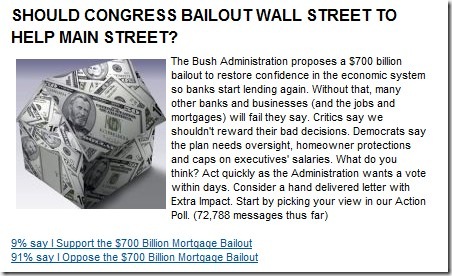 I see Hawaii’s parks and streets crowded with people who were not bailed out, who have no place to live. Yet millionaires, through their CEO buddies who are embedded at the top of the Bush administration (with more lurking to take over when either Obama or McCain is elected), expect to be able to use our tax money to make sure their yachts stay afloat.
-- Arun Gupta
One email has gone viral on the Internet. Sent out Monday, it calls for a demonstration on Wall Street today. The email was written by Arun Gupta, an editor and reporter at New York’s The Indypendent newspaper.
People are supposed to bring their own personal junk, things that have lost value, and dump them in front of the bronze bull sculpture near Wall Street. Protests are forming in other cities and towns around the country.
September 22, 2008, 5:09 pm
Filed under: UncategorizedForward widely…
Everyone,
This week the White House is going to try to push through the biggest robbery in world history with nary a stitch of debate to bail out the Wall Street bastards who created this economic apocalypse in the first place.
This is the financial equivalent of September 11. They think, just like with the Patriot Act, they can use the shock to force through the “therapy,” and we’ll just roll over!
Think about it: They said providing healthcare for 9 million children, perhaps costing $6 billion a year, was too expensive, but there’s evidently no sum of money large enough that will sate the Wall Street pigs. If this passes, forget about any money for environmental protection, to counter global warming, for education, for national healthcare, to rebuild our decaying infrastructure, for alternative energy.
This is a historic moment. We need to act now while we can influence the debate. Let’s demonstrate this Thursday at 4pm in Wall Street (see below).
We know the congressional Democrats will peep meekly before caving in like they have on everything else, from FISA to the Iraq War.
With Bear Stearns, Fannie and Freddie, AIG, the money markets and now this omnibus bailout, well in excess of $1 trillion will be distributed from the poor, workers and middle class to the scum floating on top.
This whole mess gives lie to the free market. The Feds are propping up stock prices, directing buyouts, subsidizing crooks and swindlers who already made a killing off the mortgage bubble.
Worst of all, even before any details have been hashed out, The New York Times admits that “Wall Street began looking for ways to profit from it,” and its chief financial correspondent writes that the Bush administration wants “Congress to give them a blank check to do whatever they want, whatever the cost, with no one able to watch them closely.”
It’s socialism for the rich and dog-eat-dog capitalism for the rest of us.
Let’s take it to the heart of the financial district! Gather at 4pm, this Thursday, Sept. 25 in the plaza at the southern end of Bowling Green Park, which is the small triangular park that has the Wall Street bull at the northern tip.
By having it later in the day we can show these thieves, as they leave work, we’re not their suckers. Plus, anyone who can’t get off work can still join us downtown as soon as they are able.
There is no agenda, no leaders, no organizing group, nothing to endorse other than we’re not going to pay! Let the bondholders pay, let the banks pay, let those who brought the “toxic” mortgage-backed securities pay!
On this list are many key organizers and activists. We have a huge amount of connections – we all know many other organizations, activists and community groups. We know P.R. folk who can quickly write up and distribute press releases, those who can contact legal observers, media activists who can spread the word, the videographers who can film the event, etc.
Do whatever you can – make and distribute your own flyers, contact all your groups and friends. This crime is without precedence and we can’t be silent! What’s the point of waiting for someone else to organize a protest two months from now, long after the crime has been perpetrated?
We have everything we need to create a large, peaceful, loud demonstration. Millions of others must feel the same way; they just don’t know what to do. Let’s take the lead and make this the start!
AGAIN:
When: 4pm – ? Thursday, September 25.
Where: Southern end of Bowling Green Park, in the plaza area
What to bring: Banners, noisemakers, signs, leaflets, etc.
Why: To say we won’t pay for the Wall Street bailout
Who: Everyone!
The email has ignited interest in every corner of the blogosphere. Example:
. . .
"People are going to bring their own personal junk that they think is worth as much as the junk financial instruments that the government is proposing to buy from the Wall Street banks," says Andrew Boyd, an activist and freelance online-video artist for nonprofit groups in Manhattan. "We're hoping that people show up with their 8-track cassette collections, their old Spice Girl CDs, their surf boards that got bit by sharks and old Enron stock certificates."
Boyd is just one of thousands of Americans from all over the political spectrum who the Bush Administration has angered with its vague proposal to hand $700 billion over to Treasury Secretary Henry Paulson to restore U.S. financial markets' health. That anger has manifested itself online through e-mail, web sites and other online chatter, with one site, BuyMyShitPile.com, going rapidly viral this week. The site, a parody of the dire financial situation, is what is inspiring the self-organizing group of activists to show up in downtown Manhattan Thursday evening with all their junk. They hope to make their simmering fury palpable to Wall Streeters getting off work.
(over at that website, they’re demanding a bailout so far of: Current Value
Of Our Shit: $558,385,530,841.63)
I don’t know of any protests in Hawaii, or what particular spot could be the focal point here. The most obvious symbol of the Bush administration we have is the governor herself, who is about to desert Hawaii’s own economic problems and go off to campaign for McCain (who, at this writing, is claiming to call off his own campaign due to the economic “crisis”. Go figure.)
For anyone moved by this controversy one way or the other, you might call the local offices of our Congressional delegation and urge them to act responsibly. Here’s a list of phone numbers.
Sen. Daniel Inouye:
Honolulu Office:
300 Ala Moana Boulevard, #7-212
Honolulu, Hawaii 96850
Phone: (808) 541-2542
Fax: (808) 541-2549
Hilo Office:
101 Aupuni Street, #205
Hilo, Hawaii 96720
Phone: (808) 935-0844
Fax: (808) 961-5163
Wailuku Office:
24 North Church Street, #407
Wailuku, Hawaii 96793
Phone: (808) 242-9702
Fax: (808) 242-7233
Kaunakakai Office:
PO Box 573
Kaunakakai, Hawaii 96748
Phone: (808) 642-0203
Fax: (808) 560-3385
Lihue Office:
1840 A Leleiona Street
Lihue, Hawaii 96766
Phone: (808) 245-4611
Fax: (808) 246-9515
Kealakekua Office:
PO Box 4l
Kealakekua, Hawaii 96750
Phone: (808) 935-0844
Fax: (808) 961-5163
Mililani Office:
94-403 Punono Street
Mililani, Hawaii 96789
Phone: (808) 623-8334
Fax:
Sen. Daniel Akaka
Honolulu Office:
300 Ala Moana Boulevard, Room 3-106
Honolulu, Hawaii 96850
Phone: (808) 522-8970
Fax: (808) 545-4683
Hilo Office:
101 Aupuni Street, #213
Hilo, Hawaii 96720
Phone: (808) 935-1114
Fax: (808) 935-9064
Rep. Neil Abercrombie
Honolulu Office:
300 Ala Moana Boulevard, #4-104
Honolulu, Hawaii 96850
Phone: (808) 541-2570
Fax: (808) 533-0133
Rep. Mazie Hirono
Honolulu Office:
5-104 Prince Kuhio Bldg., 300 Ala Moana Boulevard
Honolulu, Hawaii 96813
Phone: (808) 541-1986
Fax: (808) 538-0233
Wednesday, September 24, 2008
Newspaper meltdown 13: bias by omission
by Larry Geller
The Advertiser’s selection of questionable AP stories deprives Hawaii readers of complete views on important issues. They have a choice when they outsource an article, and I can only assume that they read widely enough so that they know what the issues are in their fullness.
The editors also make choices when they snip off negative parts of articles and improve headlines, as they did in today’s paper.
By the editors’ selective omission, those who only read their paper are mislead, and those who already know a little more are driven to look elsewhere for their news.
We’ll look at two stories that ran in today’s paper.
Take today’s front-page AP story (please). I think this is the same as the story the Advertiser ran.
The AP omits a key objection to the Administration bailout plan that the Advertiser could have brought us from other sources. The New York Times, for example.
September 23, 2008
A Bailout Above the Law
By ANDREW ROSS SORKINThe passage is stunning.
“Decisions by the Secretary pursuant to the authority of this Act are non-reviewable and committed to agency discretion, and may not be reviewed by any court of law or any administrative agency,” the original draft of the proposed bill says.
And with those words, the Treasury secretary — whoever that may be in a few months — will be with vested with perhaps the most incredible powers ever bestowed on one person over the economic and financial life of the nation. It is the financial equivalent of the Patriot Act.
Treasury Secretary Henry M. Paulson Jr.’s $700 billion proposal to bail out Wall Street is both the biggest rescue and the most amazing power grab in the history of the American economy. [New York Times Dealbook, The Mother of All Power Grabs, 9/23/2008]
While Hawaii readers will be kept in the dark, this issue is a key part of Congress’ objection to the Administration plan. It was the first issue raised in the floor debate, according to this article:
DeFazio, the first speaker on the first day of floor debate, warned about a rush to act, citing another urgent vote in the fall of 2002.
Treasury Secretary Henry Paulson, DeFazio said, is asking for "an immediate financial authorization for use of force. Does this remind anybody of anything? Like the rush into Iraq on election eve a number of years ago? It's all too familiar."
DeFazio noted that the bill before Congress is only three pages long and fails to answer the most basic questions about how $700 billion in federal dollars will be spent. Those question include how much oversight will be in place to ensure the response is proper and that it works. Those concerns are only expected to harden as debate commences.
"Secretary Paulson has submitted a simple proposal to the Congress. This is it," DeFazio said, waving the three-page bill.
"And it waives all laws. All laws! No oversight; no one looking over his shoulder, no conflict-of-interest rules. Not even court review," DeFazio said. "He insists this has to be done without meaningful discussion or debate or any change." [The Oregonian, DeFazio urges Congress to go slow on the financial bailout, 9/22/2008]
Readers who feel cheated of the full story can Google. There are also alternative media reports that beat any AP wire story, or a selection of overseas press viewpoints, all there for those who want to know more.
Recommended: Naomi Klein’s article and today’s Democracy Now! program, also available on the web at democracynow.org.
But back to our slipping “paper of record.”
A short-short article on page A9, by but not attributed to the AP, described Palin’s attempt to improve her foreign policy credentials.
You’ll recall that her image suffered after her foreign policy goof on ABC News, when she said that "you can actually see Russia from land here in Alaska." That’s hardly the same as speaking with Vladmir Putin.
The AP headline on the web is “Palin meets her first world leaders in New York”, but the Advertiser headline was “Palin meets with world leaders.” True, but it is a spin nevertheless. The fact is that Palin has never met with world leaders before, which was clear in the AP headline but masked by the Advertiser.
The complete story includes some real news, which the Advertiser kept from its readers but which can be found easily elsewhere. Here’s one bit from the AP story that was omitted:
Sen. John McCain's presidential campaign has shielded Palin for weeks from spontaneous questions from voters and reporters, and went to striking lengths yesterday to maintain that distance as Palin made her diplomatic debut.
The Republican campaign, applying more restrictive rules on access than even President George W. Bush uses in the White House, banned reporters from the start of the meetings, so as not to risk a question being asked of Palin.
McCain aides relented after news organizations objected and CNN, which was supplying TV footage to a variety of networks, decided to pull its TV crew from Palin's meeting with Karzai.
AP stories often display clear bias. This article was revised by AP approximately two hours (according to Google News) after it’s original release.
The original wire story:
Palin sat down with Afghan President Hamid Karzai and Colombian President Alvaro Uribe. The private conversation and public pictures were meant to pad her resume for voters concerned about her lack of experience in world affairs.
The revised version, which ran in the Advertiser:
Palin sat down with Afghan President Hamid Karzai and Colombian President Alvaro Uribe. The private conversation and public pictures were meant to build her resume for voters concerned about her lack of experience in world affairs.
The edit is far from subtle. “Build her resume” is a positive action, but the original story had “pad her resume,” which has many negative connotations. So they changed it. One can argue that “pad” is an unwarranted assumption on the part of the reporter, though supported in the rest of the article.
The article notes at its end that “Palin, 44, has been to neighboring Canada and to Mexico, and made a brief trip to Kuwait and Germany to see Alaska National Guard troops.” True, but she “padded” her resume there also:
This from a piece by Bryan Bender in Saturday's Boston Globe:
Sarah Palin's visit to Iraq in 2007 consisted of a brief stop at a border crossing between Iraq and Kuwait, the vice presidential candidate's campaign said yesterday, in the second official revision of her only trip outside North America.
Following her selection last month as John McCain's running mate, aides said Palin had traveled to Ireland, Germany, Kuwait, and Iraq to meet with members of the Alaska National Guard. During that trip she was said to have visited a "military outpost" inside Iraq. The campaign has since repeated that Palin's foreign travel included an excursion into the Iraq battle zone.
But in response to queries about the details of her trip, campaign aides and National Guard officials in Alaska said by telephone yesterday that she did not venture beyond the Kuwait-Iraq border when she visited Khabari Alawazem Crossing, also known as "K-Crossing," on July 25, 2007.
Note that this is the second revision—the first was acknowledging that the Ireland leg of the trip was in fact just a fueling stop. [US News and World Report, Sarah Palin's "Iraq Trip"—All the Way up to the Border, 9/15/2008]
The Advertiser’s selection of only part of this story was a distortion of the actual event. Nor can it erase the fact that Palin has no foreign policy creds at all simply by spinning a headline or snipping off the negative parts of a story.
Check out version 1 or version 2 in their entirety.
We deserve the full story, don’t we? We can handle it, if only they would print it.
Tuesday, September 23, 2008
The end of privacy as we know it
by Larry Geller
This is a Fox News video, so it must be true. And they now want to read your mind.
MALINTENT, the brainchild of the cutting-edge Human Factors division in Homeland Security's directorate for Science and Technology, searches your body for non-verbal cues that predict whether you mean harm to your fellow passengers. [Homeland Security Detects Terrorist Threats by Reading Your Mind, 9/23/2008]
Your vote, your identity, at risk on Maui
by Larry Geller
We always appreciate leaks. Please send to leak =at= disappearednews.com.
This leak should concern voters anywhere, but particularly those in the 13th precinct in Maui County. The photographer will remain anonymous, and for you clever detectives, I’ve removed identifying information embedded in the pictures. The photos contain enough detail to confirm that the pictures were taken at the Haiku Community Center, right near the kitchen. According to the leak source, they were taken several days before the election. These things were just dumped there, not secured in any way. Anyone could mess with them.
There were items out in the open also at Paia Community Center and at Precinct 13-4 in Huelo. Maybe more than that. Did you see anything? Let me know.

(click for larger)
This stuff was just left around for anyone to mess with or even take home.
In the center is a precinct-level Hart eScan optical scanner. If you voted with a paper ballot, you’ll remember it as the thing that ate and supposedly made a record of your vote. The grey thing is the Hart eSlate electronic voting computer. The box contains precinct supplies, including the Hart memory cards and pollbooks.
 Now, suppose someone wanted to, umm, study the election process and just took that little brown box home with them? Or if some kid needed something for show and tell at school? No election at that precinct.
Suppose some geek wanted to play with the memory cards on their computer? Then McCain could be elected as mayor of Maui. Ha, ha.
No joke. This is your election process at work, Banana Republic style.
In fact, we do not know that no one messed with this box. Look how easy it would be:

Opening the box (which confirms that they were not secured) the photographer was able to identify Hart memory cards, ballots, security seals, provisional ballots and registration forms. Yup, anyone could have rummaged through the box and even taken some ballots home, or stuck the memory cards in their own computer. Did anyone meddle? We cannot say they did not.
Now read this:
The pollbooks have names (addresses?) and social security numbers for every registered voter in the precincts.
Do you live on Maui? What about identity theft? It appears that your personal information was left around for anyone to copy, for days before the election.
No one was protecting these things. The integrity of the election at these three precincts in the 13th House District on Maui cannot be assured. Voters personal information was not protected.
How many other precincts left their equipment and supplies unsecured?
And what will happen in November?
A couple of days ago we mentioned that an electronic voting machine was apparently reprogrammed after the polls were open. This didn’t seem to bother anyone. Who checked to be sure the correct program was loaded? Just another questionable aspect of voting in Hawaii.
You can make a difference. If this bothers you, write to the newspapers, the Maui County Clerk, or the State Office of Elections. Feel free to send them any of these pictures.
Or make a fuss in any way you think will help.
 And please keep sending your leaks. Please send tips and leaks to leak-[at]-disappearednews-[dot]-com. Thank you!
State appeals court rejects call for injunction on Stop Rail Now ballot question
by Larry Geller
The Star-Bulletin has a breaking news item, Court rejects Stop Rail Now's appeal, leads with this:
The state appeals court this afternoon rejected a request to place on the Nov. 4 general election ballot a question about whether the city should be banned from building a train or rail transit system.
But my reading of the opinion, which can be found here, is that the appeal is still pending. It’s the preliminary injunction that has been turned down. The court balanced the relative harm that would be done to the election process and decided that the City Council’s amendment, which would be on the ballot anyway, would do the trick. So no injunction, but the appeal can go forward.
On page 11 of the opinion we find this statement:
To be clear, this is not a decision on an expedited appeal from the orders(s) and judgment of the Circuit Court. The appeal from the Circuit Court has not been briefed. The deadline for a cross-appeal has not expired. The matter before this court is a motion for an injunction pending an appeal…
See also page 32, the conclusion, where it states that the request for a preliminary injunction is denied.
Since an appeal won’t be heard for some time, this may settle the issue anyway. The ballots will be printed by the time an appeal is heard. I guess the ball is now in Stop Rail Now’s court as to what they do now.
Update: An Advertiser breaking news story posted while I was writing this seems to have it right.
Monday, September 22, 2008
Michael Moore giving away his latest film
by Larry Geller
Downloads began (kind of) at midnight Eastern time, or 6 p.m. today Hawaii time. Immediately, servers were swamped.
But they added bit torrent trackers, and two high-quality torrents are working fine. If you don’t want to know anything about bit torrents, skip to the end of this article.
To get your copy, best to try here. The mp4 torrent has some peers and is already very healthy, the higher quality DIvX should be healthy in a couple of hours. My download was running at an amazing 247 kB/s for a short while but has settled down now to about 126kB/s. So I’m about 20 minutes away from having my own copy of the film.
For anyone not into torrents, you can right-click and save as usual. By morning it could be on your hard disk.
If all that sounds like a lot of trouble, just click here, break out the popcorn, and relax.
It doesn’t take a rocket scientist
by Larry Geller
Found on the back cover of the February 19, 2007 New Yorker:

 I wonder if all of these executives simply assumed that they would be made whole by the feds when the bubble burst. It’s not rocket science to think they’d be rescued. It’s the way things work in this country.
Sunday, September 21, 2008
Outrage in Europe, anyway, as GWB sleeps
by Larry Geller
Price Waterhouse Coopers (PWC), the administrator to Lehman’s European operation has demanded that the firm repay £4.4 billion that was transferred from the UK to Lehman’s US holding company just hours before the firm collapsed. This left London with no money to pay staff. [The Times (London), Fury at $2.5bn Lehman bonus, 9/21/2008]
Remember, the New York staff of Lehman Bros. will share a $2.5 billion bonus.
In Italy:
The finance minister of Italy's conservative and pro-U.S. government warned of nothing less than a systemic breakdown. Giulio Tremonti excoriated the "voracious selfishness" of speculators and "stupid sluggishness" of regulators. And he singled out Alan Greenspan, the former chairman of the U.S. Federal Reserve, with startling scorn.
"Greenspan was considered a master," Tremonti declared. "Now we must ask ourselves whether he is not, after [Osama] bin Laden, the man who hurt America the most. . . . It is clear that what is happening is a disease. It is not the failure of a bank, but the failure of a system. Until a few days ago, very few were willing to realize the intensity and the dramatic nature of the crisis.". . [LA Times, Europeans on left and right ridicule U.S. money meltdown, 9/20/2008]
That’s from one of our closest allies! I wonder if this strong reaction could portend an isolation of the US dollar, further driving down its value.
On this week’s Wait Wait Don’t Tell Me (NPR), they quipped something like, the dollar is rapidly becoming worthless, might be a good time to put George W. Bush’s picture on it.
We might need that to remind us of what he looks like. Notice that as all this transpires, George is keeping away from the action, hiding out so to speak. See: Bush Absent on Financial Crisis as Paulson Leads:
For three days, as the Dow Jones Industrial Average fell more than 800 points, the president's absence had been conspicuous.
George Who?
``It's George W. Who?'' Fred Greenstein, a presidential historian at Princeton University in New Jersey, said yesterday.
or President Bush Goes AWOL During Financial Crisis":
Where’s George? The president, I mean.
You remember him. Dubya. No. 43. Won a second term a few years ago. It was in all the papers.
But where has he been lately? Where has he been during America’s worst financial crisis since the Great Depression?
Nowhere. AWOL. Every now and then, when the stock market takes yet another sickening plunge, a few words issue forth from the presidential lips. A very few words. Delivered with the greatest reluctance.
“I will continue to closely monitor the situation in our financial markets and consult with my economic advisers,” President Bush said Thursday in a two-minute address from the Rose Garden.
That’s right, two minutes. Delivered, according to the official White House transcript, from 10:15 a.m. EDT to 10:17 a.m. EDT. Maybe you missed it. Maybe you were at work. Maybe the president doesn’t care.
Maybe that’s the problem.
George W. Bush will continue to draw a paycheck until noon on Jan. 20, 2009. (If there is still any money left in the U.S. Treasury to pay him, that is.)
Perhaps candidate McCain prefers that Bush basically disappear. At this point, he wouldn’t want to be associated with the guy at all.
The rest of the world is watching, though, and America may need its support to pull through this one. We ought to behave better.
Obama as “The Maskmaker”
by Larry Geller
As the country teeters on the brink of economic disaster, I read that McCain as president would bring more of the same and Obama would deliver us from the grip of depression. But Obama is from the Chicago School of economics, dedicated not to saving us but for growing corporate power and profit at our expense.
So how is he to “save” us? After the election he is supposed to rip off the mask he wears to win votes, and the true liberal is to be revealed.
Fat chance. I was reminded of the late Marcel Marceau’s famous piece, “The Maskmaker,” and how the mask can take over:

In "The Maskmaker," Marceau molds one tragic and one comic face out of thin air. Trying on his creations, the mask maker alternates between the two. Switching masks at a breathtaking speed in this virtuoso contortion exercise, the comic mask gets stuck. He cannot remove it. He becomes increasingly frustrated and eventually desperate. His body expresses frustration, anger, despair, yet his face remains a haunting grin. Ultimately the comic mask is dislodged, revealing a shattered, terrified artist behind. [Misha Aster, A Face for the Ages]
Obama may just keep the mask, because it is actually his true face. Alexander Cockburn reminded me today, in his article on Counterpunch, Is This the Stake Through Neoliberalism's Heart? It Should Be, But ..., that Obama has raised more money from Wall Street than has McCain. Obama will be their man, you can count on it.
Cockburn is also thinking mask:
If Obama becomes president what advisors will he recruit? Will he keep Rubin at his side along with his passel of Chicago School economists? His left supporters hope that he has a secret plan under wraps, that a populist T-shirt lies under the decorous mask of bipartisanship. I doubt it. Caution and respectability seem integral to Obama’s political persona. His core political task has been to assure the big-money funders of his campaign that as concerns maintenance of the present system his are a safe pair of hands. “Secret plan” theorists have some notion of “the real Obama” ripping off his mask on Inauguration Day. It doesn’t work like that. The political system is designed to ensure that the mask becomes the man.
Over the past quarter century the US manufacturing economy went offshore. Lately the so-called New Economy of the “Information Age” has been moving offshore too. Free trade has left millions without decent jobs or prospects of ever getting one above the $15 an hour tier.
Below a thin upper crust of the richest people in the history of the planet there’s the rest of America which in varying degrees of desperation, can barely get by. Millions are so close to the edge an extra 25 cents a gallon of fuel is a household budget-breaker.
Wages have stagnated. Decade after decade the bargaining power of workers has dwindled. We’ve had the macabre spectacle of American=based workers ordered to train their overseas replacements before being fired.
Bipartisan ruses like the Clinton-inspired exclusion of energy and food costs from the measures of “core inflation” ensure that social security payments don’t keep up with real inflation, which – if you take in the soaring costs of groceries and fuel for heat and transport – is double the official rate, the same way real employment – now officially just above 6 per cent – is actually around 12 per cent.
The system is in dire crisis, nowhere more balefully manifest that in present and scheduled Pentagon spending, barely mentioned in these days of crisis. Stick it to the imprudent home buyers, not to the arms manufacturers and their gigantic pigsty, seeping its sewage across the planet.
Certainly Obama must be elected if we are to have positive change. But his election alone won’t be enough. It may take demonstrations, popular pressure, and who knows what, to get him to perform. If he brings his current corral of advisors with him to the White House, the electorate may end up like Marceau’s character, shattered and terrified in the end—because our hero turns out not to be wearing a mask after all. It’s the real Obama that we see today. We’re stuck with what we think is a mask.
So step one is to get through the November election with a positive future still an option, and step two, still undefined, will be to wring that positive future out of the present improbability.
Switch your money to a credit union
by Larry Geller
So you’ve been a loyal bank depositor all these years, despite mounting fees and disappearing interest. Maybe now’s the time to re-think your loyalty.
It seems your bank doesn’t care about you, only about their profit (no surprise, of course, but I mention it in case you’ve been fooled by the commercials. The ones with the friendly banker faces who claim to love you).
They don’t love you. They love only themselves. And your money, of course.
WASHINGTON -- With as few as 72 hours before Congress votes on a federal financial-markets rescue, the financial industry has launched a ferocious effort to shape key provisions, in a fight that could yet stall the bill.
Lobbyists and financial-services executives are working deep connections within the administration to ensure as many institutions as possible benefit from a $700 billion federal mechanism to buy distressed assets, then sell them off in better times. In a particularly controversial move, they also oppose proposals by Democrats in Congress to provide mortgage reductions for homeowners facing bankruptcy. . . . [Wall Street Journal, Banks Rush to Shape Rescue Plan, 9/22/2008]
Did you get that last part??? More in the article
Here’s a plan. Open an account at a credit union. Many are open to anyone. From the Wikipedia:
A credit union is a cooperative financial institution that is owned and controlled by its members, and operated for the purpose of promoting thrift, providing credit at reasonable rates, and providing other financial services to its members.[1] Many credit unions exist to further community development or sustainable international development on a local level.
More:
Credit unions differ from banks and other financial institutions in that the members who have accounts in the credit union are the owners of the credit union and they elect their board of directors in a democratic one person-one vote system regardless of the amount of money invested in the credit union. A credit union's policies governing interest rates and other matters are set by a volunteer Board of Directors elected by and from the membership itself. Credit unions offer many of the same financial services as banks, often using a different terminology; common services include: share accounts (savings accounts), share draft (checking) accounts, credit cards, share term certificates (certificates of deposit), and online banking. Normally, only a member of a credit union may deposit money with the credit union, or borrow money from it. As such, credit unions have historically marketed themselves as providing superior member service and being committed to helping members improve their financial health.
But isn’t there a disadvantage? Yes, a few, but there are also workarounds.
For example, credit unions often have a very small network of ATMs. Workaround? If there is no credit union ATM near you, keep your bank account, but only let the leeches keep enough of your money that you would take out of the ATM in a month or two. When the well is about to run dry, write a check from your credit union to yourself and deposit it in the ATM at the same time you’re visiting it for a withdrawal.
Online banking? No problem. I can access my account from my computer just the same as I do my bank account. I get statements in the mail, same as my bank sends me.
Now, how do credit unions do with home mortgages? Very well. Also from the Wikipedia article:
2006 Home Mortgage Disclosure Act data shows that U.S. credit unions approved 69% of low- and moderate-income borrowers' mortgage applications that they received, versus a 47% low/mod-income borrower approval rate for other U.S. mortgage lenders, and also that U.S. credit unions approved 62% of minority members' mortgage applications, versus a 51% minority approval rate for other U.S. mortgage lenders. The 2006 Home Mortgage Disclosure Act data also shows that 25.2% of all U.S. credit union mortgage originations were mortgages for low- or moderate-income borrowers, versus a 20.6% low- or moderate-income borrower mortgage origination percentage for other U.S. mortgage lenders. The National Credit Union Administration, however, has long discouraged U.S. credit unions from giving members loans that they may not be able to afford to repay and has forbidden other types of predatory lending and abusive credit practices. Federal credit unions are also forbidden from charging prepayment penalties on loans.
As we see from the Wall Street Journal article, banks have no love for us. Let’s start a revolution and show them how much we appreciate their attitude.
Taking care of their own, not those who lost their homes
by Larry Geller

One measure under consideration would restrain bonus packages for leaders of failed companies. Senior executives at Lehman Brothers, a venerable Wall Street firm that went bankrupt last week, were awarded multi-million dollar compensation. [The Hill, Dodd to seek changes to Treasury relief package, 9/21/2008]
Lord Turner told Sky News that while regulators should not get directly involved in what people were paid, they had a right to ask whether banks were paying too much for “unreal” profits and trading practices that stored up problems for the future.
He was commenting after reports that Barclays was set to honour a $2.5 billion (£1.4bn) bonus pot for Lehman Brothers, the US investment bank that collapsed a week ago, sparking days of global turmoil. [The Times (London), Spot checks to curb ‘greedy’ City bonuses, 9/22/2008]
A firing squad comprising Gordon Brown, Lord Adair Turner, newly installed as chairman of the FSA, and French economics minister Christine Lagarde yesterday attacked the huge bonuses that senior bankers pay themselves even as their empires crumble about their heads. [The Birmingham Post, We have to live with boom and bust in a free market, 9/21/2008]
Expensive private clubs favoured by bankers are facing a flood of membership cancellations. [Gulf Times, Nannies first to go as pay cuts, job losses bite, 9/21/2008]
For just one glaring and disgusting example of many who profited, troubled Lehman Brothers’ ex-boss Dick Fuld pocketed nearly $500 million pre-tax before the 158-year-old firm filed for bankruptcy a few days ago. [The News of the North, The U.S. printing presses are running 24/7 to bail out Wall Street fat cats, 9/21/2008]
Newspaper meltdown 12: Advertiser firings unnecessary?
by Larry Geller
A couple of weeks ago I asked, Newspaper Meltdown 11: Is Gannett foolish or wise? Advertiser editor Mark Platte points us to an answer in his column today, Advertiser readership up, survey shows. And the answer he suggests is “extremely foolish.”
Every two years, The Advertiser gets the results of its comprehensive market survey, measuring reader satisfaction with our news content, Web site, custom publications, special sections and even advertisements.
AdvertisementThanks to our loyal readers, the numbers once again were excellent. While readership is declining across the country, weekly readership is up at The Advertiser. Some 76 percent of those surveyed — representing 530,000 O'ahu adults — said they read the newspaper over the previous seven days, a 3 percent increase from 2006.
The question that must be asked, and I’ll ask it here, is, “Well, Mark, if readership is up, not down, then why did the Advertiser fire 54 of its staff?
Reader satisfaction with news topics has increased over two years in almost every area that was measured. . . .
. . . but now, you’ve let go many of the people who made that possible!
On July 16 the layoffs were announced:
The Honolulu Advertiser said it will reduce its payroll by 54 positions, joining the list of newspapers nationwide that have been forced to cut jobs in wake of the weakening economy.
The reductions were announced to the Advertiser staff by Publisher Lee Webber."We do not take this action lightly," said Webber. "But we are not immune to the national trends affecting the newspaper industry, nor from the downturn in our local economy."
It seems that this reading was totally off, if the Advertiser’s own survey is accurate. Higher readership brings with it higher ad revenue. The job reductions now seem unjustified.
Ok, Mr. Webber, over to you. Any plans to hire back Dick Adair and the others? Will an Advertiser that shops for and prints stories by Mainland syndicates satisfy readers for the next two years?
You were doing things right, perhaps, and were indeed immune to the national trends that affect and afflicted other papers. And now you’ve possibly undone it.
Is Gannett killing the Advertiser’s golden goose (Webster's New Millennium™ Dictionary of English: “a continuous resource, esp. of wealth or profit, but which can disappear if misused”)?
Saturday, September 20, 2008
This doesn’t compute
by Larry Geller
According to an Advertiser breaking news report, one of the electronic voting machines was reprogrammed after the polls were opened and it was found not to be working:
"One of the cords wasn't working," said May Fujii Foo, precinct chairwoman. "It was out for the first two hours. The trouble shooter came to fix it, and to reprogram it. It's working fine now.
Was the machine checked after “reprogramming” to be sure that the approved program was loaded? And what does programming have to do with “one of the cords wasn’t working?” Is there any supervision of the “troubleshooter?”
Charges dropped against Kauai reporter
by Larry Geller
Kauai isn’t St. Paul, but independent journalists seem to be as endangered there as the species is on the Mainland.
Reporter Joan Conrow learned on Friday that a warrant had been issued for her arrest. She was being charged, along with three other persons, with trespassing related to a protest against burial desecration on August 7 at Naue. Joan covered the story for the Honolulu Weekly (see Unearthing burial laws) and for her blog.
Reporters were also present from the Honolulu Star-Bulletin and The Garden Island, but were not similarly charged.
Joan contacted civil rights attorney Dan Hempey, who assisted her in fighting the charge.
Unlike St. Paul police, Kauai police chief Darryl Perry understood that journalists have rights under the law, and after review, he requested that the prosecutor drop the charges:
Based on her credentials as a media representative; her complicity in the alleged trespassing charge is in doubt as she is covered by both State of Hawaii, and U.S. Constitutional Bill of Rights under the First Amendment with respect to Freedom of the Press to report relevant public issues.
Absent exigent circumstances, in this instant matter the applicability of Criminal Trespass in the 2nd degree, HRS, Section 708-814 did not raise to the level that out weighed her Rights to be present at or on the Brescia property located at 7342 Alealea Road, Haena. [from Joan’s article Off the Hook, 9/19/2008]
As Hempey observed, charges would have to be dropped, because if it went before a judge,
. . . we’d be looking at a trial where the Chief of Police would be the first witness for the defense.
Readers on the Mainland may find this to be odd and perhaps refreshing police behavior. It must be as hard for them to understand as it is for us when we read about police brutality against journalists on the Mainland.
While this was undoubtedly traumatic for Joan, it demonstrated that Kauai has certain qualities to it that deserve preservation.
Friday, September 19, 2008
St. Paul promises to drop charges against 40 journalists including Amy Goodman
by Larry Geller
If you depend only on our daily paper you may not have even known that there was police violence during the Republican National Convention and that 40 journalists were unlawfully arrested.
Today the St. Paul city attorney said that the journalists would not be prosecuted. Among the journalists were Amy Goodman and two other Democracy Now journalists.
Many of the arrests were quite violent and pain and injuries were inflicted. It’s now the journalists’ turn to pursue lawsuits against the city. Why not—the city has a $10 million insurance policy saying it can ignore the Constitution. Its damages and legal fees will be covered. Might as well go for it, I say. Perhaps the damages will exceed the $10 million and St. Paul will think more about whether it really pays to encourage police violence against ordinary civilians.
The YouTube video of Goodman’s arrest was the most watched YouTube video during the convention week. It has now been viewed over 830,000 times. [Nicole] Salazar’s video of her own violent arrest is also available on YouTube.
Thursday, September 18, 2008
Don’t be dumb like Palin—how to protect your password
by Larry Geller
Yeah, someone who is aspires to be a heartbeat away from being president should have known better.
You can be smarter than Sarah Palin. Choose good passwords and obscure answers to challenge questions.
Want advice? A good place to start is this Lifehacker article. Be sure to follow the links, especially to blogger Danah Boyd's suggestion on creating answers to security questions.
The Lifehacker article also suggests checking out password managers and a link recommends five of them. My favorite is the free program KeePass, but I’ll check into Skipper also, after just reading about it for the first time.
Now, security is more than just passwords. Do you want me to scare you? Read this:
Suppose someone broke into your home tonight and stole your computer….?
But how many of us lock down our computers to discourage outright theft? There are solutions out there. For example, here.
Sarah Palin’s emails hacked, better check your own security
by Larry Geller
Sarah Palin’s Yahoo emails have been hacked using readily available information and simple guesses about her. Now her personal stuff, for example, this picture, has been circulating on the Web. Several of the sites carrying some of the emails and a couple of Palin’s family pictures are slow today as people pounce on them to get their own copies. For example:

I can’t really tell if that is her (or is it a younger person? Her daughter?), but the picture has been posted along with a few of her emails (click thumbnail for link). The picture could, of course, be photoshopped. Or it could be genuine.
Now’s the time to check your own email security. Here’s an article on precisely how it was done. Could someone do the same for your account?
Another story on how it was done is here. With all this discussion of how to hack email accounts circulating, you better check your email security!! And check also your online bank account access. Can someone guess your access information?
This forum post points to screenshots of some of the mail (including larger of the above pic) and has some related links. An alternate source of some of the screenshots is here. A Wired story includes more info about and from the hacker.
This Washington Post story has background on the larger controversy regarding use of Palin’s Yahoo accounts:
The episode focuses attention on Palin's use of her personal e-mail account as lawmakers in Alaska look into whether she fired the state's public safety commissioner, Walter Monegan, because he refused to take action against her brother-in-law, a state trooper at the time.
Palin has been criticized in recent days for using a personal e-mail account to conduct state business. An Alaska activist has filed a Freedom of Information Act request seeking disclosure of e-mails from another Yahoo account Palin used, gov.sarah@yahoo.com.
. . .
Andrée McLeod, who filed the FOIA request, said yesterday evening that Palin should have known better than to conduct state business using an unsecured e-mail account."If this woman is so careless as to conduct state business on a private e-mail account that has been hacked into, what in the world is she going to do when she has access to information that is vital to our national security interests?" she asked.
McLeod's Anchorage attorney, Donald C. Mitchell, said Palin declined to comply with a public records request in June to divulge 1,100 e-mails sent to and from her personal accounts, citing executive privilege.
Well, the two Yahoo accounts may now have been deleted, which would be interesting, since they are the subject of investigation. Are the emails still there, or have they been disappeared? Will investigators have to get copies from the hackers?
There is more on Wikileaks, including this article from Time (dated Thursday September 17, 2008).
Wednesday, September 17, 2008
Google and GE—strange but potentially powerful energy bedfellows
by Larry Geller
It seems Google can and will do almost anything. Did you hear that Google is supposed to announce an iPhone competitor on Tuesday, the first phone that will use Google's own open-source operating system.
That’s not what I’m writing about, but it illustrates that Google seems to be able to do whatever it wants to do, and it wants to do practically everything.
Ok, now that I’ve chased you away from this article, what I really want to let you know is that Google and General Electric are getting together on an electric power grid and clean energy to put on it.
Here in Hawaii, our grid is operated by the power companies, and that’s an obstacle to energy independence. At least, if you believe as I do, that there won’t be much progress until we find a way to remove the current utilities from the process of cutover to alternative sources.
So this is interesting news.
The companies said they will work together on green energy technologies and lobby US political leaders to support "visionary policies" on renewable energy.
Yes! So there may be hope.
The benefits of renewable electricity can't fully be realized without updating US power transmission lines into a "smart grid" that lets people track and control what types of power they use and when, according to Google.
. . .
Smart power grids would allow people to conduct tasks such as recharging electric cars at times of day when demand is not high, and enable them to sell solar or other renewable energy back to utility companies.
Yes. They took the words right out of my mouth. Well, I wish I had said exactly that.
During the past two years, Google has launched a series of clean energy initiatives that include investing in geothermal, solar and wind-generated electricity.
Hey, let’s get them here as fast as possible. We have a problem, maybe they have a solution.
In fact, they walk their talk:
Major automobile makers have announced they will market plug-in electric cars in the United States no later than 2010.
Google has a fleet of plug-in vehicles it has been testing and invests in the technology.
Check out this article, and yes, you can Google for more information.
Hoku Scientific, darling of the dailies, lands a big contract--for Idaho jobs
by Larry Geller
I’m not sure why they always make headlines in the two Honolulu daily papers. You’d think this was something good for Hawaii. I suggest it’s about time that we recognize that Hoku Scientific is really an Idaho company.
Today’s Star-Bulletin celebrates with the headline Hoku lands another contract, and yay, good for them.
A subsidiary of Hoku Scientific Inc. has signed a second contract with the same Chinese company - this one worth $227 million - for polysilicon production, bolstering financing for the Kapolei-based company's new Idaho plant.
Yup, more jobs for Idaho.
The company also has invested $47 million of its own cash into its Pocatello, Idaho, plant, bringing total funding to about $353 million. The $390 million plant is scheduled to begin commercial shipments in 2009.
The objective of Hawaii’s high-tech “revolution” should be to generate jobs in Hawaii.
Of course, venture capitalists hope their investments will pay off, but more often than not, the companies that win funding must move to the Mainland to become successful.
I suppose it’s ok that the papers keep highlighting Hoku’s Idaho successes. It keeps awareness going.
Maybe, when more tax breaks for corporations or other corporate welfare proposals reach the Hawaii State Legislature, we might encourage all those Idaho beneficiaries to send in testimony in grateful support. It would be the least they could do.
Tuesday, September 16, 2008
World doesn’t agree on who was responsible for 9/11 attacks
by Larry Geller
This is another site that is useful to follow the buzz around the world: WorldPublicOpinion.org. Amazingly, their top story today is similar to the previous post. Well, not so amazing, after all it is the seventh anniversary of the attack on the World Trade Center and the Pentagon.
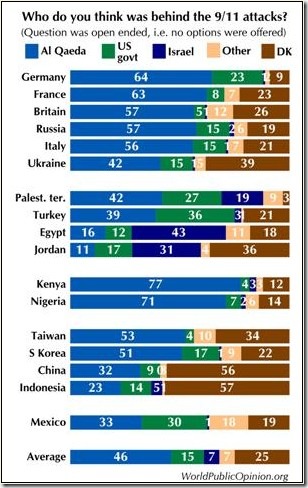
From the article:
A new WorldPublicOpinion.org poll of 17 nations finds that majorities in only nine of them believe that al Qaeda was behind the 9/11 terrorist attacks on the United States.
In no country does a majority agree on another possible perpetrator, but in most countries significant minorities cite the US government itself and, in a few countries, Israel. These responses were given spontaneously to an open-ended question that did not offer response options.
On average, 46 percent say that al Qaeda was behind the attacks while 15 percent say the US government, seven percent Israel, and seven percent some other perpetrator. One in four say they do not know.
The article includes the questionnaire methodology.
Another article (click to go there):
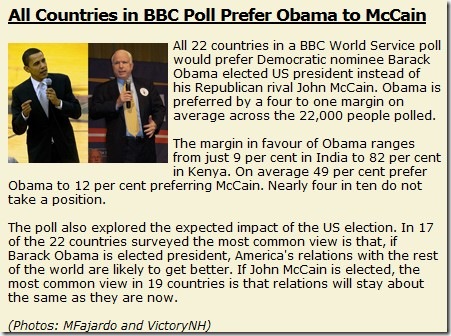
The world watches America: what do they think of us?
by Larry Geller
A promising website, WatchingAmerica.com, features translations of news stories plucked from around the world. Each is translated into English. Here’s a snippet (the links are not live):

Today’s featured translation is an article from Norway discussing the apparently widespread belief in the Arab world that the US government itself was responsible for 9/11. A small snippet from the translation:
Maybe the people who executed the operation were Arab, but the brains? Not possible. This was organized by others. By the U.S. and the Israelis, says Mohammed Ibrahim, the proprietor of a clothes shop in Cairo to The New York Times. This attitude is widespread. It also reveals a failing Arab self-image. They simply doubt their own people’s ability to execute such a well planned and complicated attack against a superpower like the United States.
. . .
It is claimed that the final proof that the U.S. did it is the war in Iraq. In Arab eyes, the U.S. only needed an excuse to secure Iraqi oil. The fact that Iraq and Saddam Hussein had no connection to 9/11 whatsoever is taken as further circumstantial evidence that this was merely the reason George W. Bush and his people needed – and therefore created.These Arab beliefs expose a very serious communication problem. It speaks of two worlds who do not understand each other, and who cannot speak in a way that increases their understanding. This is dangerous, because the gulf will only become wider unless these problems are solved.
In the wider parts of the population in the Muslim countries, the Bush administration has lost all trust. It is too late to rectify this and George W. Bush started badly. We remember the overwhelming outpouring of sympathy to America hours and days after the attacks of 9/11. This included Arab nations. But Bush did not just declare “war on terror,” he declared a crusade. It was a catastrophic use of words that instantly took the attention away from the common fight on terrorism everyone initially supported. The crusade was perceived as a war cry against Islamic culture. The attempts to rectify the blunder were never heard.
The website is quirky—I couldn’t find how to get to the news except from this URL: http://watchingamerica.com/News/. The RSS feed did not work for me either (I prefer to get news updates in my RSS newsreader). And I wish the articles showed dates before you click on them so I can see if they are fresh or not (they seem to be, and there is a date after you click).
Watching America is an ambitious undertaking. I hope they succeed—we could use a continuous reminder of how the world views us these days.
At least some of us care.
Naue decision may mean building permits could be revoked after unauthorized capping of graves
by Larry Geller
Joan Conrow’s coverage is better than the two newspaper article she references. In a nutshell:
Turns out, after a protracted hearing and “very difficult” deliberations, that the iwi-defenders were right all along. State archaeologist and county council candidate Nancy McMahon made a big boo-boo when she approved the final burial treatment plan for the project without first consulting the Kauai-Niihau Island Burial Council, lineal descendants of the iwi, Hawaiian groups and even [developer] Brescia.
Now the matter must go back before the Burial Council for the proper review. That ought to be one highly-charged meeting, with all kinds of fancy footwork going on behind the scenes to get the Council to rubber stamp what Nancy already approved.
Joan discusses the question of whether developer Brescia’s building permits can now be revoked. I suggest you jump on over to her article for details.
Monday, September 15, 2008
Caveat emptor: Did you buy a Sears range that can tip over on you?
by Larry Geller
I should have posted something earlier—there are only three more days to act—but I put the wrong date in my calendar. Sorry, I thought there was more time.
Here’s the problem, in a nutshell (see the linked article for more):
It's estimated that 15 to 20 million kitchens in the United States are equipped with a range that can tip over and crush, scald or burn whoever is standing in front of it. The problem is caused by the use of lightweight material in modern stoves, which makes them top-heavy and thus prone to tip over when the oven door is open. [consumeraffairs.com]
A claim form is here. But it must be postmarked on or before September 18, 2008, so there’s not much time.
If the Proposed Settlement is approved, Sears will offer free installation of anti-tip brackets to eligible Class Members who do not have brackets installed or, if the Class Member wants, a gift card towards the purchase of a new Sears range instead of a bracket installation. Sears will also offer reimbursement to those Class Members who, after Sears delivered their range, arranged and paid to have a bracket installed.
From what I have read on the web, the problem for owners is to determine if the anti-tip brackets have already been installed or not.
Naue burials case ruling due this afternoon
by Larry Geller
The grave desecration case on Kauai is moving towards an expected conclusion this afternoon, even as the developer has been allowed to pour concrete foundations over the Native Hawaiian burials. For information on this ongoing disgrace, I suggest following Joan Conrow’s KauaiEclectic blog.
Today Joan mused about hurricanes, victims who haven’t the money to evacuate (and of course, assistance is inadequate), and how that relates to Hawaii. Although it isn’t the main thrust of her article, I’ll snip out this part that relates to the Naue situation because I saw the same picture in this morning’s paper that Joan comments on, of coffins floating away in Texas. I made a similar connection to the controvresy in Naue, where the developer, and who knows, maybe even the court, won’t give those graves the same respect we commonly have for our own dead:
”I just don't know what to say," the 75-year-old [George] Levias said as he walked gingerly among open graves filled with water. "Loved ones being disturbed like that."
Once again we see how it bothers most mainland folks to see burials disturbed, but here in Hawaii, it’s just par for the course. Anyway, it seemed apropos to include that in today’s musing, since Judge Watanabe is scheduled to hand down her ruling this afternoon in the Naue burials case.
Democracy Now! program today on bin Laden family
by Larry Geller
Tune in to Democracy Now! for Steve Coll on "The Bin Ladens: An Arabian Family in the American Century", an hour-long interview with the author of this new book.
If you see this in time and you’re on Oahu, try channel 54 7-8 a.m., or tonight channel 56 10 p.m., or anytime on the web for audio, video or a transcript.
From the web promo:
Nearly seven years after the first bombs were dropped on Afghanistan, the US war there continues to escalate. President Bush recently announced he will send an additional 5,000 troops to Afghanistan. Both major party presidential candidates, John McCain and Barack Obama, have pledged to send more troops if elected. The United States launched the war in Afghanistan in response to the 9/11 attacks. The stated purpose of the invasion was to capture Osama bin Laden and remove the Taliban regime, which had provided support and safe harbor to al-Qaeda. Osama bin Laden is known worldwide as the founder of al-Qaeda and the mastermind of 9/11. But much less is known of his sprawling Saudi family and their multiple ties to the United States. A new book by award-winning journalist Steve Coll details the complicated family history of Osama bin Laden, one of 54 children born to Mohammed bin Laden. [includes rush transcript]
There is a lot that was new to me in this program. For example:
The bin Ladens, by the 1980s, were sort of the Halliburton of Saudi Arabia. They had a tradition of doing no-bid contracts on sensitive defense and intelligence projects. In the ’60s, they had built the entire kingdom’s defense infrastructure along the Yemen border during a war with Egypt, and in Afghanistan they were doing the same thing. There was a lot of government support for what he was doing.
There is some discussion of bin Laden’s relationship with the Taliban. Just a snippet:
And, of course, the Taliban—one difference between Osama and the Taliban was that Osama has always been a student of technology and sort of a gadget hound in his own way, and he’s used technology to be very effective in his violent operations. He used satellite phones in a very innovative way to create a lot of his attacks. And the Taliban, on the other hand, adhering to a different school of Islamic theology, believe that all of this technology is forbidden, because it wasn’t present during the life of Mohammed, and so, therefore, it shouldn’t be used.
I haven’t finished listening to the podcast yet, but thought I’d post this just in case you see it in time to tune in this morning.
Saturday, September 13, 2008
Whoopie to McCain: Should I have to worry about becoming a slave?
by Larry Geller
No softball for McCain here, very worth a few minutes of your time to view (click on pic) (the second video is real short, but powerful IMHO) (now, how come the corporate media is not asking the same questions of this guy? Hmm?):

(article from Alternet contains two videos)
Perhaps because of this particular audience, McCain all but evaded the direct question about whether he would overturn Roe vs. Wade:
“What we’d be doing is nominating justices to the Supreme Court and other courts who strictly interpret Constitution,” McCain said. “We would not impose a litmus test on any issue.”
On his website, though, his position is clear:
John McCain believes Roe v. Wade is a flawed decision that must be overturned, and as president he will nominate judges who understand that courts should not be in the business of legislating from the bench.
[For you trivia fans, hearing “We would not impose a litmus test on any issue,” do you know what “litmus” is, and where it comes from?]
Help the polar bears defeat Sarah Palin
by Larry Geller
You know, and I know, that human activity contributes to global warming. Sarah Palin, who could end up a heartbeat away from the most powerful office in the world, does not. Check the “Information” link on this game to find out why a UK software firm created it. It’s spreading virally all over the Internet because they allow embedding (see their website or steal the code from this post).
Enjoy!
(Thanks to Viviane Lerner, who finds so much that is interesting and important around the web.)
I enjoy clever approaches such as this. Perhaps they counter, in a small way, the 78% of its airtime that Fox News is granting the Republican ticket.
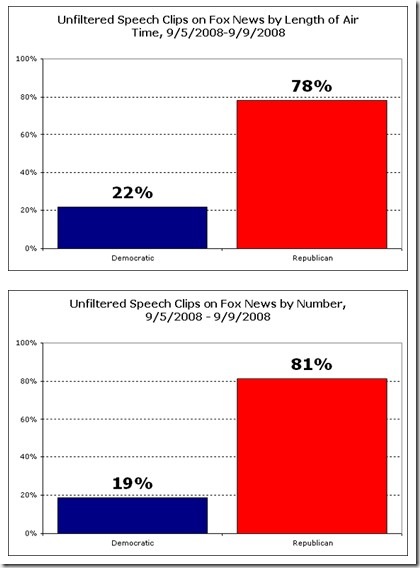
(Graphic from Media Matters for America. They deserve your support. At least, I suggest you might subscribe to their email summaries.)
Disappeared flight (not really)
by Larry Geller
Instead of finishing a couple of half-written articles last night as planned, I found myself stuck to the picture tube flat screen monitor staring at something silly, which nevertheless sucked up my spare time. Or rather, I let it.
A friend left Hawaii for the Mainland on an American Airlines flight last night. We had mentioned to her how to track the flight via text messages from a popular website, flightstats.com. So I set it up via their webpage, and then idly clicked on the display that shows how the flight progresses as it leaves Honolulu International Airport. The display shows a map, rotating through various views, just like the map you see on the cabin TV monitor.
The flight was AA102, which has the worst on-time record for that slot, Honolulu to Dallas Ft. Worth, according to the helpful data screen. A really pathetic performance.
I thought the flight would just turn around and head for DFW, but for some reason it wobbled all over the place. So I was hooked. Did the pilot party too late last night? What could have been up there that the plane was avoiding? Weather?
Just idle curiosity. Of course pilots don’t party before a flight. Of course they get enough sleep. Nothing to worry about.
And then the screen went blank. Then this message appeared:
“Do not be alarmed,” it said. Right. Try not to be alarmed. Don’t even think of what might be going wrong. In my mind was the recent incident in which an American Airlines pilot already over the Pacific after leaving DFW for HNL decided it would be best to turn back to the Mainland and made an unscheduled landing in Los Angeles to top off his gas tank.
In just a moment, the display will be back. No panic, just wait.
Or better, turn off the computer and go to sleep, there’s nothing wrong with the flight, like they said. Nothing. Don’t worry about it.
But I know too much. I went to another tracking system.

Now, maybe the data for this one comes from the same place, but it seems the airplane, which should have been kind of moving along, was stuck at 337 miles out. I waited. It remained stuck. Of course, I said, the plane is ok.
Before you know it, about an hour had passed. I was wondering where to find disaster or exception reports, or maybe I should call American Airlines or the FAA. I didn’t, because of course the plane is ok, they would think I’m some kind of nut and put me on some FBI list. Why would I think something is supposed to be wrong with this flight? These days you can ask an innocent question and have Homeland Security busting down your door before the night is over.
But no true geek is ever deprived of data. You gotta be persistent and all will be revealed. But wait—finally the display changed! Yay!

Oh no! Over on the right side, just below the middle, it no longer says 337 miles, now it says “No recent position”. Yikes! So off in search of alternate data.

It is possible to find out all kinds of tracking information for just about any flight (maybe even those CIA flights to black hole locations, if you know the tail number). In fact, you can probably track your Christmas present across the Pacific in a FedEx jet. And the display showed a handoff from Honolulu air traffic control to Oakland at 02:24 a.m. Eastern time. Latitude, longitude, air speed, and altitude were there and non-zero. Whew!
So I turned everything off and went to sleep knowing that all was well, except possibly with what I thought was a reliable tracking service. Who knows what went wrong. I no longer cared. The airplane is ok.
My obsession to track the flight ended up costing me time I could have spent more productively.
And now, for some reason, you’ve read all about it. Sorry about that.
Friday, September 12, 2008
Gas gouging rampant across the country
Check it out with this Google search.
The price of oil is down, and the gasoline in tanks under stations has not suddenly become more expensive.
What's happening is "disaster capitalism." It probably always existed. If the storm is coming, raise prices and take advantage. People will buy rice, toilet paper, bottled water, batteries, no matter how high you price them. Oil companies seem particularly adept at this, though. Their computers are tuned and optimized to separate us from our money as efficiently as possible.
That Google search reveals that some states have laws against price gouging, more or less effective. Thanks to our governor and compliant legislature (with particular thanks to the House leadership for screwing us out of the original law), we have no protective gas caps. Maybe it's time to re-think how to do that effectively.
Thursday, September 11, 2008
Newspaper Meltdown 11: Is Gannett foolish or wise?
by Larry Geller
The series on diabetes just concluding in the Advertiser is an excellent example of why we still need them around as a daily paper. It was local, it was relevant, it was detailed, it was informative, and it was persuasive. The editors gave the subject a generous amount of space. To the extent that it may influence many readers to change their lifestyle choices, it will literally save lives.
So you’ll see why the current trend to emphasize the paper’s website at the expense of the paper concerns me greatly. Had there been only a website and no paper, there would be less point in doing such a comprehensive campaign to educate the public on what is a major health challenge to so many in this state. The web is full of campaigns. Doing it in the daily paper is what makes it effective.
At least as far as I can see reading the Honolulu Advertiser, Gannett is bailing to the web at a breakneck pace. They are directly investing in and heavily promoting web services. They’re using space in the paper to push people away from the paper.
If it works, then maybe they can ultimately move out from under the burden of print. In the meantime, the paper can be filled with imported and wire-service articles to keep the ads from bumping up against each other.
I was thrilled this evening to play a video of a presentation by Manolis Kelaidis at the 2007 O’Reilly Tools of Change conference in which he demonstrated hyperlinked books. Yes, you can touch a word in his book and it will take some action, or play or speak something. He uses conductive ink. The book knows which words or which picture you have touched. The electronics are in the spine of the book and it communicates with Bluetooth.
So print may still have a future. People do love their books.
At the same conference, Adobe CEO Bruce Chizen said that print will eventually go away. His advice is: “Experiment. Be flexible with your business model. Some of your content, people will pay for rightout, some will pay through subscription, some of them will pay through advertising dollars. Some of them won’t pay for some of your content, so make that available for free. But experiment. And get there quickly.”
So print has no future?
Earlier Chizen spoke about the need for immediacy. While he was referring to desktop publishing as it has evolved to publishing on the web and other platforms, the same need for immediacy pushes people from a print newspaper or magazine to the web.
It’s impossible, for example, to give us breaking news in the paper that was dropped at our doorstep at 4:30 a.m. It was obsolete even as the presses were rolling to create it.
Chizen also said that print does not allow user generated content or allow people to collaborate. Ok, but thinking of newspapers, they are supposed to bring us news, opinions, features, etc., and in my humble opinion, they are basically doing fine with it. On the web we can find user generated content, but a good deal of that (for example, comments linked to a news article) is basically junk. The community can report on itself to a limited extent, it’s true. Like the guy said, experiment, experiment.
In my next post, tomorrow I hope, I’ll show how the Advertiser has been sacrificing its limited print resources to push people onto the web. Are they foolish or wise? They are foolish if they discover the web is a tough place to make lots of money. They are wise if daily papers have no future anyway.
The cost of production on the web is a tiny fraction of the production cost of a daily newspaper. Newsprint costs are up, shipping costs are up. Wouldn’t it be great not to need newsprint any longer? Or beat or investigative reporters, or food editors, or nearly anyone?
A couple of days ago, Ian Lind leaked an email sent by Sandy Oshiro, an Advertiser editor, to a striking blogger, which included this:
Unfortunately, we cannot survive as a company if our financial situation doesn’t change. Actions like the blog strike clearly are aimed at hurting us when we are suffering as an ongoing operation. That is the cause you chose to join.
If we do not win this fight to survive, the community will lose the best journalistic voice that it has, the only one that puts public service journalism at the top of its priorities. I hope you think about the role you played in all of this.
Reading between the lines, though, the Advertiser wishes of course to survive as a company, but as a web-service company. I hope to get back to this in tomorrow’s article. Employees probably sense that they are almost all expendable (except for sports writers, without whom neither a local daily paper nor a website could survive).
If their push to the web is successful, they will need fewer people (hardly any at all). They also won’t need to buy newsprint or to hang onto that giant precision German-made press in Kapolei.
So I’ll keep checking Craigslist for that “press for sale” ad: “lovingly used and in excellent condition, near future transit stop.”
Friday, September 05, 2008
Can your plane run out of gas before it gets to Honolulu? Yes!
by Larry Geller
In an August 13 article, How about a fuel tip jar at airport counters?, I wondered if commercial flights to Hawaii might run out of fuel enroute. Here’s the problem in a nutshell:
The U.S. Federal Aviation Administration requires that an aircraft carry enough fuel to reach its destination and the most distant alternate airport, plus an extra 45 minutes’ worth. It’s not to an airline’s advantage to carry any more than the minimum requirement: more fuel means a heavier plane, and a heavier plane gets worse mileage.
But there’s a helpful loophole. A plane can carry less fuel and simply file a “minimum fuel declaration.”
I did contact the FAA and asked about the frequency of “minimal fuel declaration” filings for flights arriving in Honolulu, but they have not yet responded.
 (click for larger)
In the meantime, check out this flight path for American Airlines flight 123 from Dallas/Ft. Worth, originally scheduled to arrive at Honolulu at 2:45 p.m. on September 4, but which finally got here at 6:21 p.m. Why the 216 minute delay?
While heading to Honolulu over the Pacific, the pilot decided there wasn’t enough fuel to make it safely to Honolulu! So he diverted to Los Angeles to refuel. Logically, if the pilot was aware of conditions needing more fuel earlier, the plane would have landed directly at LAX instead of continuing out to sea. But there was this plane, looking at a couple of thousand miles of water, and deciding it was better to go back while it could. Was the tank less than full when it left DFW?
The actual decision was reached as follows:
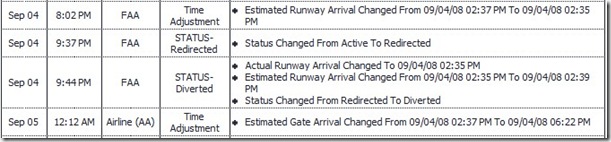
(data from flightstats.com, map from flightaware.com )
Now, what would have happened if the plane had progressed farther along over the Pacific and couldn’t return to LAX?
I’ll follow up with the FAA to get data on “minimum fuel declarations,” but in the meantime I thought you’d like to know that your airplane may, indeed, not have enough gas to get you back to Honolulu.
Thursday, September 04, 2008
Local papers omit news of journalists arrests, protests, police brutality
Those who are following events inside and outside the Republican National Convention must be disappointed in the coverage by our local papers.
The YouTube video of journalist Amy Goodman’s arrest has been viewed more than 702,447 times and was the most-viewed clip on YouTube the day she and two Democracy Now producers were assaulted and arrested by police. But of course, nothing in Honolulu’s papers about this or other protests (yes, there were about three column inches of useless copy in yesterday’s Advertiser).
There were more journalists arrested today. Here is an article from a local station (thanks to Brad Parsons for spotting this):
Police Surround Crowd On Bridge, Arrest Hundreds
ST. PAUL (WCCO) ―
Police in riot gear skirmished with a rowdy band of protesters around the state Capitol and Xcel Center in St. Paul, firing tear gas and " crowd. the control and disperse to trying canisters bang? flash>At 11 p.m. Thursday, officials said 88 people had been arrested. Officials said they still had to process about 200 more people, bringing the total number of people arrested in St. Paul Thursday night to nearly 300. Officers closed in on groups throughout the night, taking some into custody then swirling around other pockets of people roaming the streets.
Police surrounded about 300 people, including WCCO photojournalist Tom Aviles, AP reporters Amy Forliti and Jon Krawczynski and reporters from other news outlets. Officers ordered them to sit on the pavement on a bridge over Interstate 94 and to keep their hands over their heads as they were led away two at a time.
…
The article includes a video of the scene today.
You’ve probably seen the Amy Goodman arrest video before (though not on our newspapers’ websites). This clip includes a press conference with local authorities on the illegal arrests (if you’ve seen the first part, just push the slider over a bit for the press conference).
Yup, if you want to be informed, don’t count on our papers to do it, either in their print editions or on their websites. They want us to visit their websites, but by their omissions they send us elsewhere.
I find that I’m concerned about the survival of two papers in Honolulu. Gannett keeps investing in the web (it just purchased a majority interest in CareerBuilder (thanks to Mike Reitz for tip). If you skim through the printed paper, you’ll see so many “articles” pushing you to their website that it’s beginning to look like the paper is a front for what Gannett would really like to do. They’re free to do whatever they want, of course, but how long can it be before the Star-Bulletin becomes our paper of record? The Advertiser is getting pretty light weight.
It seems also that more and more pages devote space to sending readers to the web, even though many (I’ll hazard “most”) readers would prefer a quality newspaper experience. That’s why we pay money for the paper! Think about it. I wish the publisher would.
Once a newspaper chases its readers off to its website they are also free to go where they like. Since the website omits news of importance to their readers, they’ll have to go elsewhere, of course, to get it.
Back to the news.
Check out this video of the GOP partying with its lobbyists when they were told to tone things down due to the hurricane:
So they party on, while outside the police round up journalists and charge them with felonies for practicing their trade.
You’d think journalists everywhere would be concerned.
But if you have to read about this on Disappeared News (or elsewhere on the web) instead of in your daily paper, what does that say about the state of journalism in this state?
Honolulu Community-Media Council condemns arrests of journalists in St. Paul
by Larry Geller
The Hawaii Community-Media Council circulated this statement today:
HONOLULU COMMUNITY-MEDIA COUNCIL (HCMC) CONDEMNS HARRASMENT AND ARRESTS OF JOURNALISTS BY ST. PAUL POLICE AT THE REPUBLICAN NATIONAL CONVENTION!
HCMC president, Chris Conybeare says that the actions of the police at the Republican National convention are the same tactics used by government forces during the election campaign in Zimbabwe. "We must stand up to police actions that threaten a free press whether at home or abroad. A democracy depends on freedom of expression and the free flow of information. Please read the statement below and follow the links to see what happens when basic rights are ignored. Please join the campaign by signing on to the letter of protest that will be sent to officials in St.Paul and to the Republican National Committee." Thank you.
The statement was followed by a message from Free Press (freepress.net) to sign on to a letter asking that charges against Amy Goodman, host of Democracy Now! and two other DN producers be dropped (note: the letter is being delivered tomorrow (Friday) morning, so if you’d like to sign, go there quickly).
The Hawaii Community-Media Council was founded in 1970 and is the oldest of the five remaining media councils in this country. I believe only three of them are still active.
Monday, September 01, 2008
Amy Goodman and Democracy Now! producers released
Action Alert: Update on Arrest Of Amy Goodman and DN! Producers
September 1, 2008
Contact: Mike Burke: mike@democracynow.org
**UPDATE**
Democracy Now!'s Amy Goodman, Sharif Abdel Kouddous and Nicole Salazar Released After Illegal Arrest at RNC
Goodman Charged with Obstruction; Felony Riot Charges Pending Against Kouddous and Salazar
ST. PAUL--Democracy Now! host Amy Goodman and producers Sharif Abdel Kouddous and Nicole Salazar have all been released from police custody in St. Paul following their illegal arrest by Minneapolis Police on Monday afternoon.
All three were violently manhandled by law enforcement officers. Abdel Kouddous was slammed against a wall and the ground, leaving his arms scraped and bloodied. He sustained other injuries to his chest and back.
Salazar's violent arrest by baton-wielding officers, during which she was slammed to the ground while yelling, "I'm Press! Press!," resulted in her nose bleeding, as well as causing facial pain. Goodman's arm was violently yanked by police as she was arrested.
On Tuesday, Democracy Now! will broadcast video of these arrests, as well as the broader police action. These will also be available on: www.democracynow.org
Goodman was arrested while questioning police about the unlawful detention of Kouddous and Salazar who were arrested while they carried out their journalistic duties in covering street demonstrations at the Republican National Convention. Goodman's crime appears to have been
defending her colleagues and the freedom of the press.
Ramsey County Sheriff Bob Fletcher told Democracy Now! that Kouddous and Salazar were arrested on suspicion of rioting, a felony. While the three have been released, they all still face charges stemming from their unlawful arrest. Kouddous and Salazar face pending charges of suspicion of felony riot, while Goodman has been officially charged with obstruction of a legal process and interference with a "peace officer."
Democracy Now! forcefully rejects all of these charges as false and an attempt at intimidation of these journalists. We demand that the charges be immediately and completely dropped.
Democracy Now! stands by Goodman, Kouddous and Salazar and condemns this action by Twin Cities' law enforcement as a clear violation of the freedom of the press and the First Amendment rights of these journalists.
During the demonstration in which the Democracy Now! team was arrested, law enforcement officers used pepper spray, rubber bullets, concussion grenades and excessive force against protesters and journalists. Several dozen demonstrators were also arrested during this action, including a photographer for the Associated Press.
Amy Goodman is one of the most well-known and well-respected journalists in the United States. She has received journalism's top honors for her reporting and has a distinguished reputation of bravery and courage. The arrest of Goodman, Kouddous and Salazar and the subsequent criminal
charges and threat of charges are a transparent attempt to intimidate journalists.
Democracy Now! is a nationally-syndicated public TV and radio program that airs on over 700 radio and TV stations across the US and the globe.
Video of Amy Goodman's Arrest: http://www.youtube.com/watch?v=oYjyvkR0bGQ
Amy Goodman unlawfully arrested
by Larry Geller
For more information and how you can help, see here.
Update: I got through on the phone to the jail where Amy Goodman was being held, and after waiting on hold quite a while, they said that she has been released.
Gustav bloggers—live news from the storm center
by Larry Geller
Follow Gustav tweets over in the left column of Disappeared News
Hook yourself into the Gustav Blogger network. Blog posts, live webcams, twitter. It should all be focused on the coming storm from the ground in New Orleans. It should be coverage you won’t find in the media, at least until some time later.
Here are the links. Don’t be surprised if some of them are slow (Firefox users may time out). Much of the blogosphere is watching these sites, so the network load must be huge.
Gustav Bloggers: http://gustavbloggers.com/
New Orleans Live Cams: http://neworleanswebsites.com/cat/en/lc/lc.html
Even commercial media is tuning in to the New Orleans twitter users for breaking news—such as this just in:
Tchefuncte River tops banks at Madisonville
…
David Galloway looked over the rising tide, while perched with flashlight and knee-high boots underneath the awning of the Riverside Bar on, fittingly, Water Street."It's coming now, worried about my house," he said, fidgeting slightly with the flashlight.
…
New Orleans weather (there are many other sources): http://www.nola.com/weather/
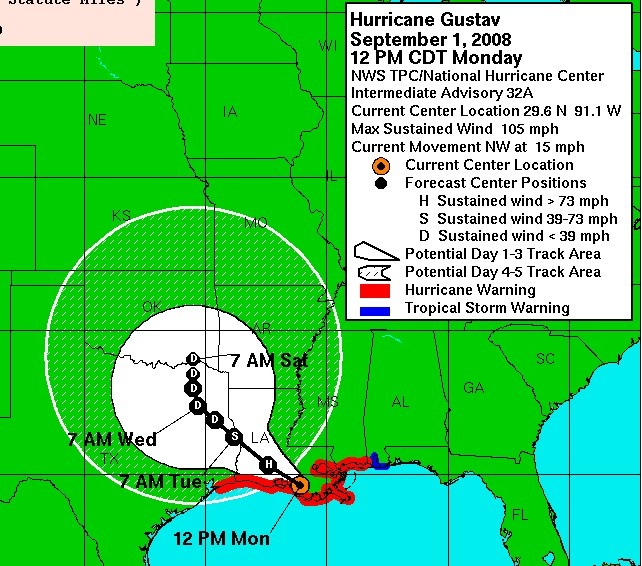
(click for larger)
(not a live image)
[Disappeared News itself disappeared for a couple of days three years ago as Katrina flood waters devastated New Orleans—turns out that the domain registrar (which also handles the redirect to Blogger.com) was located there. They got things running again quickly, and at the same time I learned that there were bloggers staying in town throughout the emergency. Their jobs were considered essential, because they ran a key data center.]