Thursday, July 31, 2008
This does not compute
by Larry Geller
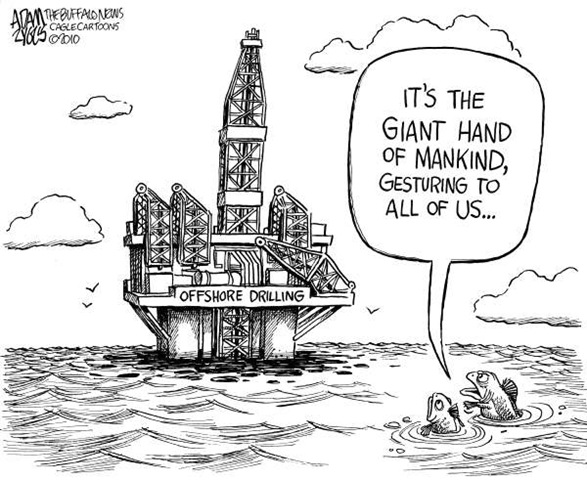
What is wrong, wrong, wrong with this picture?
ExxonMobil Profit Record: Investors Unimpressed
Shares fall 3% even after the oil giant broke its own quarterly profit record. Investors are concerned about future growthExxonMobil (XOM) beat its own record for the highest profits ever by a U.S. company, but that wasn't good enough for Wall Street, which traded down the company's shares July 31. The trouble in part was expectations: Analysts surveyed by Thomson Reuters (TRI) thought Exxon would report earnings of $2.52 a share for the second quarter, but the $2.22-per-share profit announced was 12% below that. In all, Exxon reported profit of $11.68 billion, 14% more than the $10.3 billion, or $1.83 a share, in the same period last year.
Indeed, it was the second consecutive quarter in which ExxonMobil has missed analysts' expectations. In mid-afternoon trading, the company's shares were down around 4.7%, to 80.43. [Business Week, 7/31/2008]
What's wrong is that high oil prices are wrecking the US economy and endangering the viability of families across the country.
Exxon soaks us at the pump, makes world-record profits, and Wall Street would have them soak us for even more?
Now, it's not "supply and demand" keeping prices up. You can google for discussions debunking that argument, which is a mantra of the commercial media.
Exxon and other oil companies have chosen to hold back on research and exploration and instead take profits. Hey, it works for them. So they are the winners. In fact, the biggest winners in the whole wide world.
And we are the losers.
If corporations really run this country, how come they're not hopping mad also, and banging on politicians' doors to control these obscene profits and get the oil market under better control?
This does not compute.


Does military adaptation of Superferry deserve its spot on the obituary page?
by Larry Geller
I found my name on the obituary page today! Yes, it’s there. Scary, huh?
It’s at the bottom of a story on the Superferry, Ramp will give next Superferry vessel increased flexibility, based on an interview with Superferry CEO Admiral Thomas Fargo by Advertiser government reporter Derrick DePledge. At the end of the story DePledge credited Disappeared News with turning up a mention of the ramp plan on BYM Marine & Maritime News.
And the Advertiser, reverting to past practice, placed his story on the obituary page. Shouldn’t it have been in the funny sideways business section?
Of course, in terms of content, my blog post was never as alive as DePledge’s. If I were to phone Adm. Fargo and ask for an interview, I doubt I’d get it (“Disappeared News?? Go disappear then!”). All I did was take a few moments to quote a paragraph, DePledge did actual work to create his story. And then they buried it at the bottom of the obits!
On the other hand, maybe that has deeper meaning. Maui activist Dick Mayer emailed comments on Joan Conrow’s article yesterday, pondering whether the installation of loading ramps could be an "Exit Strategy."
Update: Joan Conrow adds additional detail from an article in the Alabama Press-Register. I haven’t linked it, because Joan has developed the context, so it’s better if you read her article. [Aside: I love the freedom of a blog to send you to the best place to read a story. Will KHON ever send viewers over to KITV, or the Advertiser send you to the Star-Bulletin? If it happens at all, it can’t be very common.]
In case you don’t go there, here’s a snippet from Joan that I think sums up well why so many bloggers follow the Superferry closely:
Now I don’t mind if HSF 2, or even the Alakai, for that matter, is made into a military ship, although it bothers me that the HSF spent so much money lobbying in an effort to get us taxpayers to pick up the tab. But I’m a fan of full disclosure, and when Hawaii Superferry came to town, asking for all sorts of state help and public acceptance for what is proving to be a rather dubious commercial enterprise, I think they should have been totally up front about their military aspirations.
Then we all could have weighed the issue more carefully, and asked such probing questions as whether HSF really is committed to the state for the long haul, or if we’ll be left holding the bag for those expensive harbor improvements, tugboat operations and litigation — and have no alternative form of transportation to show for it.
Well put, Joan. No one wants to be “used.” Let’s see how this turns out.
Update Update: Ok, someone emailed me. The reason you might want to jump on over to Joan’s article linking to the Alabama news story is summed up in this tiny snippet, ambiguously referring to either the current or second Hawaii Superferry vessel:
…company officials could be positioning the vessel for sale to a third party.
So go there, read, be informed.
Wednesday, July 30, 2008
Newspaper meltdown 4: Rise of the free dailies--a paradigm with promise?
by Larry Geller
There is always hope . Could this be it?
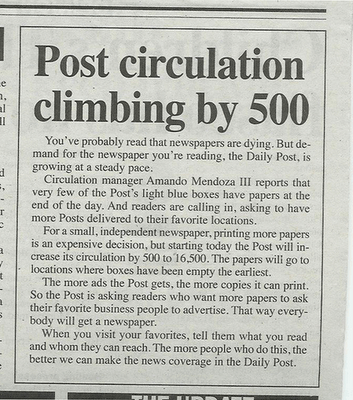 (Click for larger)
This clipping is snatched from the blog free-daily.com. Stay tuned through that blog ("Covering the emerging free daily newspaper industry") and other sources of information on this growing counter-trend to the meltdown of traditional paid-circulation papers.
Residents of Palo Alto, California, can't get enough of the free daily newspapers available in their town. The first free daily was the Daily News, which started in 1995 after the collapse of the town's paid circulation daily. The founders of the Daily News, after selling to Knight Ridder four years ago, returned in late May to start the Daily Post. So Palo Alto — the home of Stanford University and many high-tech firms like Hewlett Packard — is seeing a rebound in printed newspapers. It's what the techies might call "Old Media." And, as the Post reports in its July 22 issue, demand for the printed word is soaring. [Readers love free daily newspapers, freedaily.com, 7/24/2008]
But it's free, you say, how can they make money (an old family joke: "They make it up in volume"). Ads, of course. Just like the paid papers. There must be something different, though, to make it work. Lots different. (I don't know how to account for all the free papers the Star-Bulletin gives away. Maybe they can be considered a partially-free daily(?). )
Another article on the Post from the blog Newspaper Innovation ("Daily blogging on free daily newspapers"):
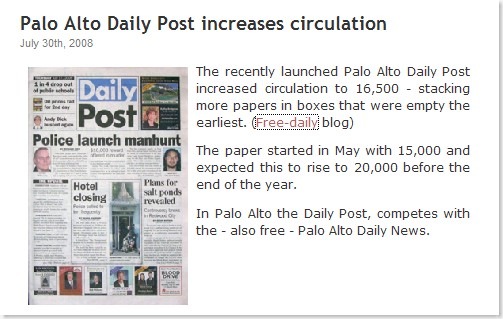
- In less than 10 years free daily newspapers have been introduced in almost every European country and in several markets in the United States, Canada, South America, Australia and Asia. As of December 2007, there were free newspapers in 52 countries.
- Market leader Metro distributes more than eight million copies daily, while other companies publish more than 32 million. These copies are read by at least 70 million people daily.
- In four European countries (Iceland, Denmark, Spain and Portugal) more free than paid papers are distributed from Monday to Friday, while in more than a dozen European countries, the newspaper with the highest circulation is a free paper.

Why can "free" save the news biz? Maybe because it's in sync with the times. While older generations expect to pay for quality, younger folks are used to getting things free. More than just strangely-named Internet services. Everything. Really. Read more about this in the Wired article: Free! Why $0.00 Is the Future of Business.
I think this bears watching, anyway.
Newspaper meltdown 3: No alternatives
by Larry Geller
To produce a public print newspaper generally requires a printing press (though one can conceive of alternative technologies, they're not here yet). So competition is hard to find; new papers can't just spring up to compete with old.
In the past, a reporter might go elsewhere. With 6,000 newsroom layoffs in the past few months, there may be no elsewhere anymore.
The work of the 54 Advertiser staffers to be axed by Gannett likely will be largely lost to us as news consumers. So no more Dick Adair cartoons, at least in print (I'd like to be wrong about this).
We can expect the paper to be filled with more imported stories like the feature today on boutique chocolate, taken from the LA Times. It omits anything about Hawaii's own chocolate industry. Not a mention. But I guess it's cheaper to buy the story than to pay a reporter. Couldn't we have had even a tiny little box on the state of the local cocoa bean biz? Nothing.
But check the back of the Taste section, the one with the chocolate article: A full page ad on the Advertiser's 2007 Journalism awards. A space filler. Yup, Dick Adair's name is there, he's an award-winning cartoonist, the kind you want to have in your daily paper.
Speaking of cartoons, don't miss cartoonist John Pritchett's color thumbnail of his Lee Webber caricature. You can find it in Ian Lind's story, here. I like it better than the original.
No alternative press either
Speaking of alternatives, Hawaii is also suffering a meltdown in the alternative press department. First the loss of the Big Island Journal, and now the Honolulu Weekly. Has the Weekly gone out of business? No, but it's not looking very much like an alternative any more.
It still has the ads, movie reviews and is a good reference for movie, music and art schedules, but I wonder whether it can be counted as an "alternative" paper any longer.
This week's article on the scramble to file election papers is already old news and has been covered better in the dailies and the blogs. The other feature informs us that they are playing classical music on Fort Street Mall near Hotel Street, and there's a mini-article about babies booming at Tripler, 9 months after four 25th Infantry Division units came back from Iraq. Hey, hot alternative news! Babies!
And a strange quote from Mufi about how rail transit bids will be broken into packages so that local firms can get some of the work. Gee, Mufi said a lot last week but I somehow missed that, good thing it's in the weekly, where all the contractors go for their alternative transit news. Sorry. I'm caught up in grieving over the loss of my alternative political news.
In retrospect, we never had much, compared to other cities with fatter weeklies, chock full of local news and features.
What's supposed to fill the vacuum, as the dailies become less local? TV? We're doomed.
Newspaper meltdown 2: Town Square podcast, Democracy Now
by Larry Geller
The audio file of Thursday's Town Square program is available for a few weeks here. Get it soon, because Hawaii Public Radio takes it down after awhile. The program featured Mark Bowden, correspondent for the Atlantic Monthly and author of Black Hawk Down: A Story of Modern War, journalist and blogger Ian Lind, administrative officer of the Hawaii Newspaper Guild Wayne Cahill, and former long-time Star-Bulletin reporter Crystal Kua.
On yesterday's Democracy Now (video just a click away on their web pages), host Juan Gonzales hosted a discussion: Newspapers Suffer Spate of Layoffs, Decline in Circulation, Ad Revenue, Stock Price: A Roundtable Discussion on the State of the Industry. Guests were Bernard Lunzer, President of the Newspaper Guild, Chris Hedges, senior fellow at the Nation Institute and co-author of the book Collateral Damage, and Linda Jue, past president of the Society of Professional Journalists, Northern California Chapter.
Austal contract confirms military use of the Superferry is intended
by Larry Geller
In a BYM Marine & Maritime News report today on Austal’s final Joint High Speed Vessel proposal to the US Navy, we find this:
Austal was recently awarded a new contract to provide additional features and equipment on the second Hawaii Superferry to facilitate its use by the military. This follows on from the long term charter, since 2001, of the Austal built 101 metre vehicle-passenger catamaran “WestPac Express” by the III Marine Expeditionary Force (MEF) based on Okinawa, Japan. As an adapted commercial vessel “WestPac Express” has demonstrated the enormous flexibility, cost savings and efficiencies achievable by commercial fast ferry technology over conventional air or sea transport.
See also: Superferry lobbies for military upgrade:Company spends $210K on lobbyists to obtain funds for vehicle ramp, Advertiser, June 18, 2008.
Tuesday, July 29, 2008
Neocons vs. Japan’s homeless population, a struggle for corporate happiness
by Larry Geller
In Japan, homeless people organize and often win:
A staggering 30,000 people live on the streets of Japan, most of whom are single, older men. Not only are they faced with precarious working conditions and diminished welfare programs, but the Japanese government works aggressively to hide them away, forcibly removing them from the parks, sidewalks, and other public spaces where they live. In addition, private developers and corporations run massive work programs which "hire" these same people who have been displaced, to work on job sites where they have to pay for every meal as well as their housing. At the end of a job, workers often have little or no money left, having spent all of it to pay for the meager living conditions they were provided.
In response to these conditions, several communities of homeless people have organized amongst themselves, building tight-knit encampments where people look out for each other, share resources, and fight against government attempts at eviction. In some cases, NGOs have joined in the chorus of voices advocating for the rights of the homeless to maintain their communities.
The organizers we met last night took us to the site of a government "beautification" project. They explained that over the past year, the government has been trying to "clean up" the area around Miyashita Park, commissioning art students to paint the walls beneath a nearby bridge where homeless people sleep. Of course this entailed evicting the residents of the neat row of cardboard boxes that lined the underpass. But homeless organizers fought the eviction and eventually won back their camp.
As we walked under the bridge, we were struck by the orderliness of the cardboard houses, some beautifully decorated by their inhabitants with dangling chimes or painted images. One cardboard house - belonging to a homeless activist - was built out of Nike boxes, with painted yellow stars covering the black swooshes. [G8 Dispatches: What Does Nike Have to do with Tokyo's Homeless?]
The Japanese government has found a way to get even, though:
Used for a wide range of activities by the community and activists during the day, Miyashita Park is home to dozens of people by night. But change is on the horizon for the park: it has been sold by the municipality to Nike.
Yup, Nike. The brand name, the sneaker, the swoosh that just does it. Nike has bought the park. It is private now, no longer the domain of the people of the neighborhood. Nike is in the process of building walls to keep out the community, and of course closing it at night so it is no longer anyone's home. Privatization of parks by international corporations, causing more displacement and homelessness - thanks, Nike, for helping us make the connection.
So next time you see that swoosh and are tempted, remember that Nike is responsible not only for sweatshop labor but now it builds walls to keep people out of their parks. As the article points out:
The Japanese economy is characterized by free market trade policies, an overwhelming private sector, low tax rates, and a minimal social safety net. At virtually every bump in the road over the past several decades, from the world oil crisis of 1973 to the bubble burst and economic recession of the 1990s, the Japanese government has responded with aggressive privatization measures. Safety nets for the poor and elderly have been stripped away while public goods and spaces have been sold off to large corporations. Such policies have made Japan the darling of transnational organizations like the G8, WTO, IMF, and World Bank, who claim that Japan's aggressive pursuit of neo-liberal policies have transformed it into a prosperous nation.
We don’t often read about conditions in Japan. Our papers no longer have overseas bureaus, and anyway, they wouldn’t say anything mean about neocons/neo-liberals, would they.
In Hawaii, it’s like we’re not part of the wide world out there. Who would know the extent that our corporations are playing in the Japanese economy? We never get that picture.
There is life outside Hawaii and the United States, and transnational corporations are big players out there.
We no longer manufacture much in this country, and as economic conditions worsen, we won’t be much of a market for the goods and services of our own corporations. But they’re not worried, they know that economic life exists elsewhere in the universe.
Nike buying a park!
We’re in trouble. American corporations don’t need us anymore. As we lose jobs and healthcare, and our purchasing power, so what.
The American worker and the American consumer are both expendable. Nike can be happy in Japan.
Monday, July 28, 2008
TSA bad for tourism but good for farmers
by Larry Geller
Air travel is getting really inconvenient. It's bad enough to be put through TSA's demeaning, invasive and probably useless searches (I say "useless" because it seems that when they test the system, all kinds of stuff can get through). It's bad enough that you have to be afraid of having a name the same as someone on the infamous No Fly list, or that they make no secret that they engage in racial profiling.
But it really hurts to know that while they are checking through my belongings so carefully, any number of others have found they can easily get through TSA with their shoes on.
A July 22 Associated Press story reported the arrest in Waipahu of 33 undocumented ("illegal") farm workers:
Immigration and Customs special agent-in-charge Wayne Wills says it was the largest arrest in a single raid so far this year. He says all of the men worked for a business called the Farms.
Earlier immigration arrests included 22 restaurant workers on Maui and 19 construction workers in Honolulu.
Wills says the arrests are part of a crackdown on employers who use illegal immigrants.
I want to know where was TSA when all these folks arrived in Hawaii? Were they distracted by the smell of all the shoes they were processing?
Basically, why are they harassing innocent travelers while anyone who wants to get into Hawaii can do so easily?
Farm workers aren't my concern. If we hadn't forced NAFTA on their country, chances are they would have job opportunities there. Maybe a few of them would be able to afford holidays in Hawaii. No, I'm wondering why our government tells us Hawaii is safe, when they can't even keep non-threatening farm workers from arriving in large numbers.
Implications for transit project
Farmers said more places hire illegal immigrants than most people might think.
"There are probably more today then there were five years ago, and I mean it's because they're needed," says Dean Okimoto, Hawaii Farm Bureau.
Okimoto says many local farmers can't find workers to do the hard labor anymore - not at a wage they can afford.
"I need at least probably eight more, and I can't even find one," he says.
Many farmers feel forced to look elsewhere.
"It's not surprising at all because just to keep the farms going or to expand, it's really difficult," says Okimoto. "I do think immigrant workers are key to the agriculture industry. It's how it's survived all these years, even on the mainland." [seattlepi.com, 7/22/2008]
Won't companies that land lucrative construction contracts for Mufi's heavy rail system find that they, too, need to look elsewhere for their labor needs? And who will clean the tracks and the stations?
Sunday, July 27, 2008
What, your newspaper didn’t cover the impeachment hearing?
Thanks to Patricia Blair for spotting a list of links to these videos. They may be out of order.
Friday, July 25, 2008
Election irregularities require investigation of Honolulu City Clerk's offic
by Larry Geller
It's good that Rep. Kirk Caldwell is asking for a review of whether he properly filed as a candidate for the Honolulu City Council yesterday (see: Caldwell asks for review of his filing for City Council seat).
There's another angle to this that I haven't seen in the newspaper yet: the City Clerk's office itself should be investigated.
Why? According to the Star-Bulletin article by Richard Borreca Wednesday,
After 4 p.m., Trudi Saito, city deputy managing director and one of Hannemann's closest advisers, started organizing city employees who live in Manoa to sign the petition for Caldwell to run for Kobayashi's open seat.
At 4:29 p.m., one minute before the filing deadline, Caldwell submitted his petition with 18 signatures. Twenty minutes later, City Clerk Denise De Costa informed him that he had just enough signatures -- 15 -- but only 14 of the signatures he turned in were valid.
A Manoa resident working in the City Clerk's Office signed the petition to ensure Caldwell had enough signatures. "We want everything to be legal," De Costa told Caldwell.
If this is accurate, then on City time and in a City office, City workers worked on behalf of Caldwell's election.
Ian Lind suggests that adding a signature after the petition has been accepted could be considered to be tampering with an official document.
Summing up, it seems that someone should investigate the City Clerk's office for
1. Use of city facilities on behalf of a candidate
2. City workers spending work time on behalf of a candidate
3. Tampering with official documents
4. Accepting candidate petitions after the legal deadline.
I'm not sure who investigates this. Anyone know?
Thursday, July 24, 2008
How come desecrating someone else’s graves is ok in Hawaii?
by Larry Geller
Would you agree to a new shopping center going up in Punchbowl Crater (National Memorial Cemetery of the Pacific)?
I know that I would be very upset if someone were about to build a house over the graves of my parents, in Queens New York. Let them build someplace else.
Most people understand this, I think. If you want to build something, it's not ok to choose a graveyard as your site. That's called "desecration" and is even prohibited under state law.
But this seems to be what's happening on Kauai.
Check over at KauaeEclectic for the current situation. A site with at least 30 sets of remains is about to be covered over with a house, unless the community is successful in stopping it. 30 sets means that the location was more than just a backyard family plot. Some people have expressed outrage, disappointment, grief, and more over this, so it’s not like nobody cares.
Andy Parx described in detail an Office of Hawaiian Affairs (OHA) request that the attorney general’s office send a cease and desist order to halt all construction there. (Andy’s blog, Got Windmills? is an excellent source of Kauai news, but he’s not exactly trapped on his island, his news takes us anywhere he thinks we should go.)
In an earlier article, Parx described what a builder has to do to get a desecration permit:
Hello, Office of Desecration Authorization and Permitting.
Yes I’d like to perform some desecration. Have I reached the right person?
You sure have. What can I help you defile today?
Well it seems like I have these old bones on my property and those jerks put them right where I want to put my obscenely obtrusive illegal vacation rental....
Are they Hawaiian bones?
Yes – they aren’t even white people!
Well nonetheless you have to have a permit to commit sacrilege in this state even against those godless Hawaiians.
…

As you will read, the desecration goes on. Even the local chief of police doesn’t agree this is ok. It looks like it will take legal action, which thankfully is just beginning.
Update: Check out Joan Conrow's article:
Details of Naue Burials Lawsuit, 7/29/2008
Wednesday, July 23, 2008
Newspapers are melting down nationwide and in Hawaii—find out more on Town Square, Thursday 7/24, 5-6 p.m. 89.3 FM KIPO
by Larry Geller
It’s not just the Advertiser, which recently announced a round of layoffs. Something like 6,000 journalists nationwide have lost their jobs, and overseas bureaus have been shuttered. Print papers are fleeing to rushing to the web as their business model falters. Property advertising has deserted them, followed by employment ad revenue. The cost of newsprint (and shipping it to Hawaii) has increased.
What to do? What does the future hold for national and local papers? Will there be any investigative reporting after newsrooms are further depleted?
Tune in to Town Square on Hawaii Public Radio on Thursday, 5-6 p.m. on 89.3 FM or streaming via the web at hawaiipublicradio.org.
Beth-Ann’s guests will be Mark Bowden, correspondent for the Atlantic Monthly and author of Black Hawk Down: A Story of Modern War, and Hawaii journalists Ian Lind and Crystal Kua.
 | Black Hawk Down: A Story of Modern War by Mark Bowden Read more about this title... |
Will you still be reading a newspaper 5, 10, 15 years from now? Where will you get your news?
Tune in, call in, they’ll be talking about disappeared news(papers).
Elections in our Banana Republic
by Larry Geller
Doug beat me to it with a good article on his Poinography blog on the shenanigans over at the City Clerk’s office yesterday. You can read his account here. Both Doug’s article and mine are based on Richard Borreca’s story in today’s Star-Bulletin.
If Borreca’s story is correct, and there’s no reason to doubt it, Rep. Kirk Caldwell, hoping to run for the City Council seat vacated by Ann Kobayashi, failed to come up with the required 15 signatures by the 4:30 filing deadline yesterday. He needed one more valid signature. After the legal deadline passed, the City Clerk, Denise De Costa, arranged for or allowed a staff member to provide the missing signature. Can you beat that?
This is an example of how things are run in our Banana Republic. If the law is to have any meaning, it looks like Caldwell didn’t make it. His name should not be on the ballot.
There’s more:
On the state side, [Chrystn] Eads said she was standing in line to get her filing papers at 3:50 p.m. but didn't get them until 4:25.
Her friends, waiting to sign her nomination papers, were crowded outside when election officials closed the door at 4:30 p.m.
At first, election officials said Eads could not file, but Hawaii Democratic Party Chairman Brian Schatz told an election official they should "err on the side of allowing people to be candidates."
"The line was backed up and it was not the candidate's fault," Schatz said.
Of course, it was the candidate’s fault. She should have showed up in time. Schatz’ appeal was a good try but should have been refused, IMHO. Instead, again, the law seems to have been violated so Eads could qualify.
If someone files a lawsuit over this, the city will be spending taxpayer’s money to defend the Clerk’s illegal actions. The city should just admit that their clerk acted in error. Of course, then, there could be lawsuits from the other side (sigh).
Finally, the city should be looking for a new clerk, one who can understand the meaning of a legally mandated “deadline.”
Monday, July 21, 2008
Plaintiff’s statement on why suit was filed to block Hawaii from using Hart voting computers
by Larry Geller
I’ll repeat a suggestion I’ve made before: why doesn’t Hawaii (or any other state) commission the writing of open-source voting software so we know what these machines are doing? Hmmm? Or could it be that the powers that be really want a machine that can manipulate the vote?
An article appeared in OpEd News by Bob Babson of Maui,the lead plaintiff in the lawsuit to block the use of Hart machines in the upcoming election in Hawaii:
We filed a lawsuit on July 14, 2008, asking the Court to order the Hawaii Chief Elections Officer to stop using telephone lines or the internet for transmitting ballot counts and election results for final tabulation until such time as administrative rules can be legally promulgated in accordance with Hawaii Administrative Law, Chapter 91, HRS, and all other laws can also be legally followed.
Hart InterCivic (Hart) of Austin, Texas, has the contract to conduct elections for the State of Hawaii. They write the software and design the hardware and it is top secret. No one can inspect it because it is "proprietary property." They claim the version they are using has been inspected by an independent testing agency (ITA) on the mainland. But we don't know if what they inspected is the same as what is
actually used here in Hawaii. We must blindly trust them to be honest.Each voting machine at the precincts has a memory card with votes on it. After the polls close on election day, the current procedure is to forward all memory cards to the county count center (8th floor of the Maui County Building for Maui) and hand them to the Hart technician who then "reads" them into the Hart tabulator (a laptop in 2006). The laptop is connected to a telephone line and the vote count files are then supposedly transmitted directly to the State count center using a wide area network (WAN). WAN's use the internet. We believe the transmission method is either by email with files attached or file transfer protocol (FTP).
Not only can outsiders hack into anything on the internet but we believe Hart itself, our election vendor, could actually transmit the files to a bogus remote email address or a remote website where the files could be flipped and immediately transmitted directly onto the State count center. Flipping votes means taking votes from one candidate and giving them to another. Since the total vote count remains the same, no one would know the difference. On top of all of this, the Office of Elections never manually counts the absentee ballots precinct (aka AB-Mail) because it is "too big." So there you have it. Hart could easily flip votes in the AB-Mail precinct and no one would ever know. AB-Mail is the biggest precinct in all four counties.
…
Why impeachment matters, but will we ever get there?
by Larry Geller
[Dennis Kucinich, in a statement last week] "Our Constitution is being destroyed. We are losing our nation to a war based on lies. I am determined to get this bill to committee for a hearing," he said. "The President has conducted the affairs of the nation in a manner which cries out for justice and it is the Constitutional obligation of Congress to check his wanton abuses of U.S. and international law. We have troops whose lives were put on the line because the President told them Iraq was a threat to the United States and it was not. The loss of lives of our troops and of innocent Iraqi civilians is a direct result of the lies this president told to Congress. He must be held accountable."
Judiciary Chairman John Conyers will hold a hearing on Bush’s “imperial presidency.” The vote was 238-180:
There were no Democratic votes against holding the hearing. While 180 Republicans voted to follow their Dear Leader lock-step over the cliff, 10 Republicans abstained and nine Republican members of Congress voted with the Democrats.
…
Kucinich, who earlier this week smartly summarized why Impeachment matters, promises a surprise witness against Bush. Also from CQ Politics: "An unidentified government official of a U.S. ally wants to participate if and when Rep. Dennis J. Kucinich makes his case to impeach President Bush before the House Judiciary Committee, according to the Ohio Democrat."[article in bradblog.com, 7/17/2008]
Nancy Pelosi will resist letting the hearings move towards impeachment if she can. Maybe it depends on who squawks at the hearing.
I wonder who the surprise witness might be?
This could feel so good if it moves forward, but so bad if the Democrats protect Bush. And they will. They funded his war, remember, and gave him unprecedented powers to spy on us. It’s like they love the guy.
Sunday, July 20, 2008
Richard Borreca calls it like it is on Honolulu transit bulldozer
by Larry Geller
It’s not fair snipping from Rich’s column today. Please click on over to read the complete article, City forgot 3 little words: We the people.
Although most cities let the electorate decide in one form or another about issues as big as building a new transit system, Honolulu plunged ahead without any citizen approval.
First there was the jerry-built coalition stapled together by Mayor Mufi Hannemann to convince the Legislature and the governor to allow the city to raise taxes to fund a transit system. Implied in the tax increase was the acknowledgment that Honolulu wanted a transit system, but nothing letting the people say yes or no.
Then the Council busied itself for a year with the "whither rail" question and never said "Hey, what do you people think?"
Maybe I’m among the few who say it’s not right to steamroller over us (and the communities we live in). Maybe we don’t want that. Maybe we would like to plan our own communities first.
The question of whether We the People want transit is premature. We the People could use some time to talk together, and then we’ll let you know, Mufi. Maybe we will come up with a train. Maybe not.
If the community were allowed to weigh in, perhaps we’d also ask for bus maps and even route numbers on the bus stop poles. Maybe they’d ask for buses that don’t show up early, or for convenient locations based on the needs of the riders. Maybe we’d like to have some transit connect to the airport to start with. Maybe we’d like it to connect to UH Manoa to start with. The city doesn’t know what we want, hence all this opposition. Heck, we don’t even know what our neighbors want.
Maybe we’d ask for free buses and light-rail in town, the way Portland has. How come the mayor isn’t offering us those free rides? Wouldn’t that help get cars off the streets? He could do that now, no need to wait for his buddies to make their profits building a system that much of the public had no part in choosing.
I’m sure even those who support rail would have liked to have their say about it.
I thank Richard Borreca for getting down to basics on this.
Thursday, July 17, 2008
Failure to use the technology we have
by Larry Geller
SF IT System Lockout Continues
Administrators still cannot access San Francisco's main IT system, thanks to a now jailed employee who changed all the passwords and won't give them to authorities.
An IT employee who is charged with gumming up the works at the City and County of San Francisco's main data center by changing access passwords for administrators could have been stopped short of crippling access to the system if IT management had had the right security software in place.
…
[Terry} Childs, who was arrested July 13, refuses to divulge to authorities the new secret password he concocted—even four days after his arrest.
…
A city spokesperson estimated that this internal breakdown will cost millions of dollars in repairs. Though the network is running, there is still no way for IT administrators to access it at this time.
I thought waterboarding was legal. So what are they waiting for? Either get the information out of this guy or impeach Bush. Those seem to be the choices.
Or, why can’t he be sent to Syria?
C’mon, you guys in San Francisco, get with the technology we Americans use in such circumstances.
On the bright side, this is going to make a great movie one day.
Obama—Not an agent of change, but the beneficiary of change
by Larry Geller
Many insights from Sam Smith in Undernews on Obama and the Black Ivies. Of course, I recommend that you read his entire article:
Michael Niebauer of the DC Examiner called the other day with a question that had been wandering aimlessly around in my head for some time: what did Barack Obama and DC Mayor Adrian Fenty have in common?
I suggested that he expand the question to include Deval Patrick, the governor of Massachusetts, and Cory Booker, the mayor of Newark, NJ.
They all share two big things. First, they are of the first generation of modern black leaders who have gotten where they were by passing exams rather than crossing police lines and, second, they are of the first generation of black leaders to have been both educated and vetted by the white establishment.
Or, to put it another way, they are the first generation of modern black leaders who are not agents of change, but primarily beneficiaries of change.
…
Read what Sam has to say about Obama’s move to the right. It’s a long, comprehensive article. When done, you can go back and read today’s articles, that one was from yesterday. He starts with Obama has some explaining to do.
Don’t take me wrongly on this, but I am grateful for Sam Smith’s longer view so that I can adjust my expectations of our next president.
Letter from Advertiser publisher Lee Webber
I'm honored that Lee Webber, president and publisher of the Advertiser, answered a letter from a humble blogger. I assume it's ok to reproduce his reply here.
Dear Mr. Geller -- Thank you for, subscribing, writing and sharing your views.
As publisher of the Honolulu Advertiser and someone who has lived in the Pacific region since 1967, I am mindful of the critical role our newspaper plays in the political, social and economic life of our island and state. The Advertiser is a private enterprise, but our newspaper also serves a vital public purpose - to inform readers like you to participate effectively in the civic processes that set our common course as an isolated community in the middle of the Pacific Ocean. So, in addition to my private, fiduciary obligation to the owners of our newspaper, I also have an important public obligation to those who rely on our newspaper for information.
As the steward of an important institution, I have a duty to look out for the long-term health of our newspaper and to act prudently to ensure the organization will remain stable and viable into the future, so it can continue to support quality journalism. To support a staff of professional journalists is no small task, but to fail in this responsibility would have serious adverse effects on our community. I believe actions such as these will help ensure the enterprise remains to serve Hawai'i.
The Advertiser has served the people of this state for more than 151 years and it is my responsibility to ensure that fine service and quality journalism continues for another 150 years.
Aloha
Lee Webber
Letter to the Advertiser
by Larry Geller
17 July 2008
Mr. Lee P. Webber, President and Publisher
Honolulu Advertiser
Dear Mr. Webber:
I got a bill in the mail at the beginning of this month for renewal of my Advertiser subscription. The charge for 52 weeks delivery was listed as $208.00.
Yesterday I read the lead article in the funny sideways Business section, Advertiser laying off 54 workers, and wondered what kind of a paper will I get for my money in the future. I don’t know the details of who has been let go, except for Dick Adair. So you’ll be using someone else’s cartoons, I imagine, probably someone on the Mainland. Or maybe there will be no cartoon at all. That’s a loss, he’s an award winning resource for readers.
What else will be missing from my paper? Shouldn’t you offer discounts? Say, the same 9% that staff is being cut, at least?
The closing paragraphs of the story bothered me also:
[Gannett Chief Executive Officer Craig] Dubow, while noting the difficult environment for newspapers, said the current situation should not overshadow the progress in transforming the company into a world-class digital business while making enhancements to its newspaper and television operations.
As such Gannett has been building up its Internet business. Locally, the Honolulu Advertiser Web site has been growing and is now the largest online news site in Hawai'i with the most page views and unique visitors.
Good for you, you’re getting more page views! But I am paying for a print paper. You may become a digital business, but I want quality in that paper dropped at my door each day.
I expect more investigative reporting, more attention to Hawaii’s political scene. More of the news that a local paper is supposed to deliver to its readers.
As for the web page, before long you’ll be running that out of India, no doubt. There’s nothing about a web site that needs to be local. Heck, from India they can monitor Hawaii events and probably write not bad stories for the web.
It also appears that Gannett doesn’t like unions. Here in Hawaii, we do like unions. If they didn’t exist, we’d have to invent them. I wish you could get used to that. Everyone deserves a living wage with adequate benefits. If I am paying for your newspaper, I expect that it will be operated according to the values we expect in our community. You can say it’s none of my business, but someone has to buy your paper. That’s me, among others.
Remember, we have choices.
Sure, the newspaper business is under pressure in the USA, the UK, Spain and probably elsewhere as well. A paradigm shift is taking place, and audiences are shifting. I can tell you what keeps me subscribing, though: good journalism, including incisive and informed articles by experienced local hands. Take that away and you might as well fold up your presses and leave town. That would be a shame, though.
Hope you can fix this somehow and stick around. And good luck.
Sincerely,
Larry Geller
Today on KKCR 4-5:30 p.m.: Funding social change in Hawaii
From Katy Rose on Kauai:
TODAY ON KKCR
Today, Thursday, July 17, 2008, from 4 – 5:30, Katy will be discussing grassroots
social change organizations in Hawai’i and the funding opportunities available to
them with Richard Rodrigues of the Hawai’i People’s Fund. (Jimmy Trujillo is on
vacation.)
Also joining us will be Kat Brady of Community Alliance on Prisons and Life of the
Land, and Darlene Rodrigues (no relation to Richard) of CHOICES, an O’ahu-based
organization which provides public high school students with an alternative point
of view on military recruitment and war. The organizations these women represent
are grantees of Hawai’i People’s Fund. We will discuss the valuable work they are
doing.
Richard Rodrigues is a long-time community organizer and fundraiser for social change.
About Hawai’i People’s Fund:
“Hawai‘i People's Fund is a publicly supported community fund established in
1972 to provide grants to progressive grassroots social change organizations
working in Hawai‘i. We are a unique partnership of donors, activist
grantmakers and grantees committed to positive social change and a more
equitable distribution of wealth, resources and power. Hawai‘i People's
Fund assists groups considered too small, too new, or too controversial by
traditional funding agencies. Hawaii‘ People's Fund brings together those
who want to invest in justice with those who are actively pursuing justice
in a united vision for social change. Our philosophy of community-based
strategic philanthropy offers a unique alternative to traditional charitable
giving. Individuals who contribute to Hawai‘i People's Fund are investing
in our community's future by supporting projects that seek out the root
causes of social problems and pose new solutions.”
Please join us from 4 – 5:30 today. Your calls are welcome at 826-7771 or
866-275-1112.
The program can be heard at 90.9, 91.9, and 92.7, or at kkcr.org.
Advertiser cuts look like labor action
by Larry Geller
The main article in the Advertiser’s funny sideways business section is no joke—it looks like war against the union. Advertiser's 54 layoffs reflect industry trend doesn’t jibe with the facts, as Ian Lind points out today in an extensive analysis of the situation (see also his short Wednesday article).
There are two ways to frame these cuts. One is the larger newspaper industry woes, but the other is the labor problems here at the Advertiser which is one of the last Gannett newspaper with strong unions representing most of its workforce in the newsroom as well as in sales, production, and distribution.
As Ian notes (in an excerpt from KHON’s coverage), Gannett did not announce layoffs in any of its other papers, only the strongly unionized Advertiser.
He also speculates that Dick Adair will be back on the job soon as the union moves to have him reinstated (assuming Dick wants his job back). I hope to see his cartoons back again soon. I’ve been following Adair’s cartoons since the Pacific Stars and Stripes when we lived in Japan.
At the very end of the Advertiser article today is this indication of what’s to come:
Dubow, while noting the difficult environment for newspapers, said the current situation should not overshadow the company's progress in transforming the company into a world-class digital business while making enhancements to its newspaper and television operations.
As such, Gannett has been building up its Internet business. Locally, The Honolulu Advertiser Web site has been growing and is now the largest online news site in Hawai'i with the most page views and unique visitors.
Gannett obviously looks to the web to replace its traditional news business. This is bad for readers, but also bad for Gannett. Sooner or later Advertisers themselves will notice that the browsers they use increasingly skip ads. The second most popular add-in for Firefox, for example, is Adblock Plus:

Yup, right up there after video downloading is ad blocking. The program that does it is free. The Advertiser site is particularly vulnerable to some of the other available ad blocking programs. All of their ads disappear.
So what will happen as they decimate their core news business at the same time as web readers decimate their web advertising? This is not just a question for the Advertiser, of course, but they seem hell-bent on moving to a web presence that may not work out for them economically in the long run.
The lesson for the newspapers may be that the gods of the Internet are fickle. As are web surfers. Print paper subscribers may be for life, but a web audience can disappear at whim.
Of course, if they can buy their national news cheaply and get rid of local reporters, it could still be viable for the three or four people they’d need to run a website instead of a print operation. Would that skeleton staff even need to be located in Hawaii? I wonder. Websites can be managed from anywhere. Even from another country…
That would be sad.
Wednesday, July 16, 2008
Poinography discovers a promising stop-rail strategy
by Larry Geller
Doug White (poinography.com) is exceptionally good at digging down to the basic rule, regulation, law or (in this case) charter as the basis of his nightly analysis of the news. While I was pondering, along with many Honolulu newspaper readers no doubt, “what is gonna happen next with this stop-rail petition, now that the city clerk won’t accept it?” Doug has discovered what might be the stop-rail conspirators’ hidden strategy.
If they haven’t actually thought of this on their own, they owe Doug big time.
This is a snippet from his article this evening:
I see nothing in the charter language about the duties of the clerk to prohibit the clerk from simply accepting or taking any action on a petition for a special initiative election within 180 days of a general election. The charter only says that a special initiative election may not be held if an election is scheduled within 180 days of the submission of the proposal. Further, the charter also says that the duties of the clerk are to verify the signatures, reject petition pages that are not accompanied by the proper affadavit, and that the clerk shall process the petition within 20 days. That’s it. There is no language prohibiting the clerk from processing, rejecting unaffadavited pages, and verifying signatures within 180 days.
Ironically, since the petition has been described in the media as being short a few thousand signatures of the 15% threshold, that “failure” would seem to work to the petitioners’ advantage here. The
charter also says “provided that if the clerk certifies less than fifteen percent but at least ten percent, the proposed [special initiative election] ordinance shall be submitted at the next general election or scheduled special election.”Thus, if I were a lawyer or advising the petitioners (and I’m not either of those things), I would suggest that they submit the signatures already on hand (greater than 10% but less than 15%) and thereby become entitled to a spot on the next general election ballot. Which is what they want anyway, so far as I understand it.
Since everyone important reads Doug’s blog, let’s see what both sides make of this.
… and they want to bomb Iran?
by Larry Geller
 I don’t think most Americans have any sense of the beauty, complexity and sophistication of the area of the world that they look upon simply as a source of oil.
Check out, for example, this recent article on one of my favorite art forms, Persian calligraphy:
Persian calligraphy: Gentle curves of beauty
Iranians have always been known for their appreciation of beauty and their artistic taste in creating masterpieces from elements. A brilliant example of such artistry is Persian calligraphy.
Ancient Persian script, which developed between 500-600 BCE, provided Achaemenid kings with magnificent monumental inscriptions. Cuneiform scripts were later replaced by 'Pahlavi' and 'Avestan' lettering.

Pahlavi script
In the 7th century BCE, the beginning of the Islamic era, Persians added four letters to the 28-letter Arabic alphabet to develop the contemporary Persian alphabet.
Considered one of the highest Islamic art forms, calligraphy soon became an indispensable part of Persian society so that it was not only practiced by professional artists but also by royalty and nobility.


Jumping forward to the Iran (and the Iranians) of today that Bush would like to bomb:
 (Click to enlarge)

More fashion here.
A calligraphy video:

Before moving on, I must mention that Rumi was Persian. Here is his theory of evolution (from the Wikipedia):
I died as a mineral and became a plant,
I died as plant and rose to animal,
I died as animal and I was Man.
Why should I fear? When was I less by dying?
Yet once more I shall die as Man, to soar
With angels blest; but even from angelhood
I must pass on: all except God doth perish.
When I have sacrificed my angel-soul,
I shall become what no mind e'er conceived.
Oh, let me not exist! for Non-existence
Proclaims in organ tones,
'To Him we shall return.
Original Persian:
از جمادی مُردم و نامی شدم --- وز نما مُردم بحیوان سرزدم
مُردم از حیوانی و آدم شدم --- پس چه ترسم کی ز مردم کم شدم
حملهء دیگر بمیرم از بشر --- تا برآرم از ملایک بال و پر
وز ملک هم بایدم جستن ز جو --- کل شییء هالک الاوجهه
بار دیگر از ملک پران شوم --- آنچه اندر وهم ناید آن شوم
پس عدم گردم عدم چو ارغنون --- گویدم کانا الیه راجعون
Rumi's "universality"
It is often said that the teachings of Rumi are universal in nature. For him religion was mostly a personal experience and not confined to logical arguments and sense perceptions. Creative love, or the urge to rejoin the spirit to divinity, was the goal towards which every thing moves. The dignity of life, in particular human life (which is conscious of its divine origin and goal) was important.
From Persian to Arabic
Arabic calligraphy is also beautiful and an outstanding art form, practiced and developed over the millennia:



Calligraphy is of course just one cultural aspect of a civilization. When we destroyed Iraq, we trampled on and may have destroyed one of the world’s oldest and best developed cultures.
Now that Iran is in the crosshairs, I hope Americans will pay a little attention to the art, architecture, language, and of course the people of Iran. There is more to the country than the photo of its president that Bush has placed on his dart board. Look at the images above and google Iran for yourself. Remember that the bombs are directed against civilians, if they are dropped. Don’t ask me why.
But this is all disappeared news. We’re not supposed to think of the Middle East except as a source of energy. Forget I mentioned it.
Tuesday, July 15, 2008
Namephreaks will love this
Yes, it’s true…
Wahooo Seafood Grill and Bar, not to be confused with Wahoo's Fish Taco, has hired Beth Haddock as general manager. [Star-Bulletin, 7/15/2008]

Monday, July 14, 2008
Obama dissected
by Larry Geller
The current New Yorker has that cover, of course, but it also has a couple of articles about the candidate. One, Making It: Where Barack Obama learned to be a pol, is a good read, providing insight into Obama’s history in Chicago and how he is conducting his current campaign.
The article contains nuggets of hope. For example:
[Obama] sponsored an amendment to the state constitution that would have made health care a universal right in Illinois and helped pass an ethics bill that reformed Illinois’s antiquated campaign-finance system.
If you liked that article, or if you don’t have time to read it, check out Terry Gross’ interview of the author, Ryan Lizza, that aired today but which is available for listening on the web:
Fresh Air from WHYY, July 14, 2008
Though presidential candidate Barack Obama's campaign has been extensively covered by the media, little has been said about his roots in Chicago politics. Ryan Lizza, Washington correspondent for The New Yorker, explores Obama's tenure as a local politician for Chicago's South Side in the magazine's latest issue.
If you subscribe to Fresh Air as a podcast, the program should arrive in your podcatcher sometime overnight.
Finally, check out today’s Undernews for the sad state of our oil supply, but also for Sam Smith’s ongoing monitoring of Obama in Obama will get the troops out of Iraq…except for the ones he leaves there.
Hart voting machines the subject of other lawsuits
by Larry Geller
Google reveals that Hart, along with other manufacturers of voting computers, is the subject of challenges in several jurisdictions. For example (snippet):
Lawsuit: Voting Machine Company Cheated Government
DENVER (AP) ― A former technician for a voting machines company is alleging the company cheated the federal government by falsifying information about the accuracy and security of its voting system.The allegation is in a lawsuit the technician filed as a "whistleblower" against his former employer, Hart InterCivic Inc., which he says has a research and development office in Lafayette.
William Singer alleges that Hart InterCivic lied to election officials around the country about the reliability of its voting system in an effort to obtain federal money allocated to the states under the Help America Vote Act of 2002.
Googling also reveals articles describing the ease by which votes on various electronic machines can be flipped.
We should be concerned about the state’s rush to install these machines and to bypass the use of the reliable, verifiable, paper ballot system which has served us well for all these many years.
As we rush to install electronic voting computers, some other states are moving forward with going backaward—they are banning unreliable electronic voting computers in favor of proven, if older, technologies.
Lawsuit seeks to enjoin state from using Hart electronic voting machines
by Larry Geller
A lawsuit has been filed today in Circuit Court on Maui against Kevin Cronin, Chief Elections Officer for the State of Hawaii, that would put the brakes on the state’s rush to put Hart voting machines on-line for the November election.
Five Maui residents have filed suit claiming that the transmission of votes via phone line or the Internet is in violation of Hawaii state law. The suit also alleges that the rush to use the HART machines in the November elections has not been preceded by the necessary rulemaking.
The plaintiff’s attorney, Lance D. Collins, said in a press release, “Voting is the bedrock of a democratic society. The desire to use the latest technologies cannot override requirements for orderly and secure vote counting procedures.”
This lawsuit comes after a stay was lifted against the purchasing of the Hart machines by the State Procurement Office (see Vote preparations resume, Honolulu Advertiser, July 2, 2008). There is still a challenge against the $43.3 million contract pending by competitor Election Systems & Software, which submitted a lower bid than Hart.
More on New Yorker cover featuring Barack and Michelle Obama
by Larry Geller
This is from today’s Democracy Now!:
New Yorker Cover Depicts Obama as Muslim Terrorist
In other campaign news, The New Yorker magazine is coming under criticism for publishing a cover illustration depicting Barack and Michelle Obama as Muslim terrorists. The magazine cover shows Obama wearing Muslim garb standing in the White House with a photo of Osama bin Laden on the wall and an American flag burning in the fireplace. Michelle Obama is shown as a gun-toting black nationalist with an afro. An Obama campaign spokesperson described the illustration as tasteless and offensive. The New Yorker magazine said the illustration is meant to satirize the use of scare tactics and misinformation in the presidential election to derail Obama’s campaign.
For those on Oahu who are having trouble viewing the program on Olelo, it seems that the RIMPAC exercises may be interfering with the C-band dish used to pick up the program. You can see the daily video also on the newly redesigned Democracy Now website just by clicking.
Sunday, July 13, 2008
Disappeared humor? Is the New Yorker cover an Obama joke or a reality check?
by Larry Geller

Is the current New Yorker cover “tasteless and offensive?” or political satire? Reaction has been bouncing all over the net.
Click on the pic for the New Yorker table of contents and links to some Obama articles (hint: if you’d like to read the A-Rod/Madonna story instead and get a link error, edit their URL from McGrath at the end to mcgrath and then it works).
For all things Obama I have recently come to rely on Sam Smith’s commentary in his Undernews blog. His article today discusses the New Yorker cover controversy (snippet):
Rachel Sklar in the Huffington Post wrote: "Presumably the New Yorker readership is sophisticated enough to get the joke, but still: this is going to upset a lot of people, probably for the same reason it's going to delight a lot of other people, namely those on the right."
It is for such reasons that the liberal elite contains some of the most boring people on earth. If they can't even get the point of a New Yorker cover, how can they possibly deal with more complex matters?
Along the way Smith visits the late night TV humorists, HL Mencken, Walt Whitman, and more. Click on the earlier link for his comments on McCain and the public perception of both of the candidates.
On the blog side panel are convenient ways to sign up for Undernews in your email box whenever it is updated, or, of course, you can pop the RSS link into your newsreader.
Saturday, July 12, 2008
Paid to blog for rail
by Larry Geller
I am still a great fan of Doug Carlson’s writing and his work, but I didn’t know he was hired to support the rail effort when he let me know about his new blog. A number of people emailed or spoke to me about my earlier post, based on an article that appeared on the web.
The original article is still there, but I added this update to the beginning:
I learned after I posted this that Doug is being paid to blog on this subject. He did not disclose that in his email to me, I assumed this latest website was just another interest of his. In fact, there is a disclosure on his blog, but I challenge you to find it.
Like much of the rest of the PR on the subject of rail for Honolulu, on both sides, the sources of funding and the special interests pushing one side or the other are shadowy subjects. We, the taxpayers, are being used. It’s not the right way to plan our communities.
They are paying newspapers and bloggers to propagandize us the same way they convince us to buy pizza, bottled water, SUVs, or bad insurance plans.
Should we decide on a transit system based on who pays for the most ads or hires experts to blog to us?
Did state violate federal HIPAA regulations with leak of medical marijuana info?
by Larry Geller
It appears from the story, Medical marijuana list released, in today’s Advertiser, that the state Department of Public Safety has failed to protect patients’ private medical information. What safeguards were in place and did they meet the requirements of the federal law in the first place?
(See this page for information on the HIPAA statute.)
This should be the subject of an investigation. It’s not just a casual lapse, it may be a federal offense for each patient involved.
All the more reason, I might add, to move administration of this program from the Department of Public Safety, which is widely distrusted, to the Department of Health. In addition to other good reasons raised by advocates, the DOH understands the federal laws surrounding medical privacy.
Wednesday, July 09, 2008
Letters, activism, demonstration seem to have worked to save caregiving bills
by Larry Geller
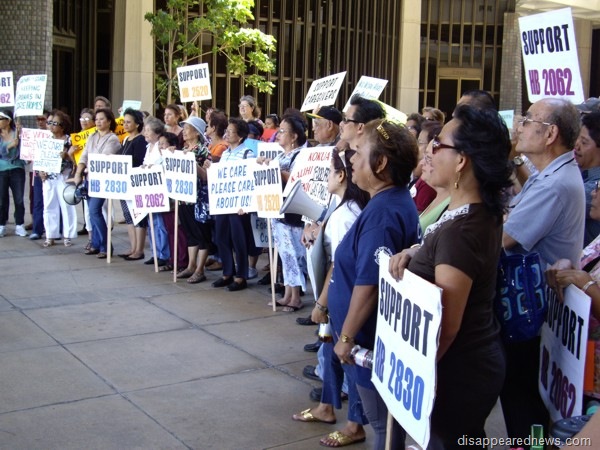
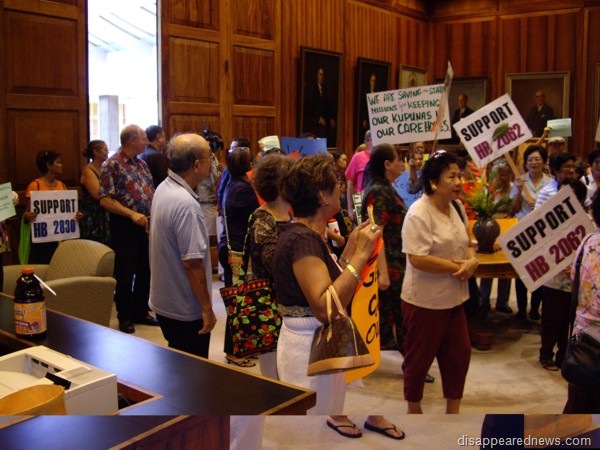
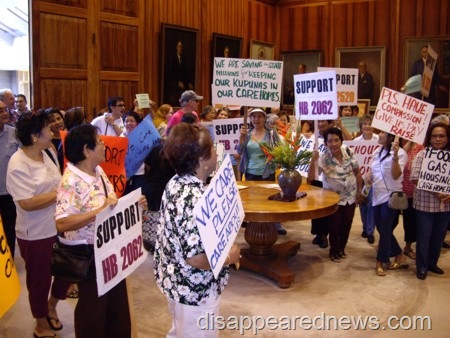
On Monday the groups assembled at the Capitol to support passage of caregiver bills carried their demands (and signs) into the Governor’s office itself. It was not a quiet group, in awe of the koa wood, giant portraits and official seal on the walls. It was a group that expected more from this governor. Maybe bringing the demand right into her office was a bit bold, but maybe it worked.
That day she signed the two bills bills into law that were the subject of the demonstration, though she took out the money with line-item vetos.
On TV Monday evening she said she had no idea who was outside in her office area and asked if that was the best way to achieve their goals. She could have just asked, of course (I find it hard to believe she didn’t). And yes, the goals were achieved.
Yesterday the Legislature put back the $500,000 for Kupuna Care. Activists and supporters of the bills had written to and visited legislators throughout the session. Here was the vote:

Note that the vote was unanimous in both houses. The governor was completely isolated on this, even by members of her own dwindling party. I hope they will have a word or two with her.
The above is from the Capitol website with information on the special session. There was also a handy list of bills in today’s Star-Bulletin story. Strangely, neither the Advertiser print edition nor its website lists the bills, and their story mentions the line item veto override thusly:
The House voted to override 13 vetoes and one line-item veto not considered by the Senate.
It’s not stated what that was, but if it’s the $500,000 for Kupuna Care, the Senate did consider it, and passed the override unanimously.
As usual, the Advertiser sought out Sen. Fred Hemmings for comment (among several other legislators). This time he was uncharacteristically subdued:
State Senate Minority Leader Fred Hemmings, R-25th (Kailua, Waimanalo, Hawai'i Kai), called the override session in the Senate "a healthy exercise in democracy with the exception of the partisanship."
Seems to me the session worked fine. On this issue, both sides of the isle joined together to make sure that vulnerable seniors will get the meals and services that they need. (see letter here for background)
It will be interesting, of course, to see if the Governor decides to spite the Legislature and the senior citizens waiting for those meals by withholding or delaying the money. In 2006 it took a community outcry to get the money released:
Lingle withheld more than $500,000 that was to go to Kupuna Care in 2006. As a result, reports circulated of seniors leaving the hospital who had to be re-admitted because they could not get services needed to get better at home. Several organizations had written letters asking that the money be released to no effect. I also wrote, the Friday before election day, and sent out a flock of press releases on the issue. Lo, the money was released just before the election. No, said the Governor, the letters had nothing to do with it. Ok.
I’ve held that the phrase “popular governor Linda Lingle” is a PR invention, a frame, if you will, like “free market” and others that don’t correctly describe reality. This $500,000 may be a test of her unpopularity. I will go by the evidence and continue to use “unpopular governor Linda Lingle” where appropriate.
Monday, July 07, 2008
Governor Lingle strikes back at seniors, women inmates
by Larry Geller
 Coincidence or not, Gov. Lingle struck out $500,000 from the Kupuna Care appropriation made by the Legislature today. The bill will become law, (but who knows when she will release the rest of the money??).
I am not sure I know the implications of this; more when I hear from advocates.
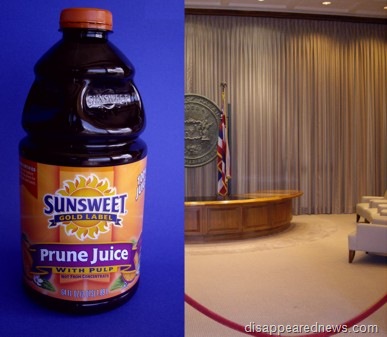
I guess she hasn’t had a chance to try the prune juice yet.
Also today, the Governor struck out the $100,000 in funding that the Department of Public Safety was to use to develop a plan to ensure that female inmates returning to Hawaii from the mainland have adequate housing, community supervision, medical care, drug treatment, reintegration programs, employment training, and transitional services. You can see what that bill looks like with the strike-out (on page 3, initialed “LL”) here.
Finally, she did sign into law the reduced ignition cigarette law. That should help cut down on house and brush fires.
Urge the House to schedule override session
by Larry Geller
It appears that the Governor will veto many if not all of the 52 bills she put on her list. Those bills include many that were hard fought by proponents who hoped they would become law.
If a bill that you support is on the list, your phone call can help convince the Legislature that an override session should be held. The Senate is probably on board for a special session, but the House is being resistant. So you can help by calling Speaker Calvin Say’s office and asking him to support holding a veto override session. The decision will be made tomorrow (Tuesday) at about 10 a.m., so please call today. Speaker Say’s phone number is 586-6100. Don’t worry, he doesn’t answer his phone personally, all you have to do is leave a message.
Call your own representative also if you can. Phone numbers are here.
Today a rally for two caregiving bills attracted 30-50 people or so to the Capitol rotunda, but it wouldn’t matter to our governor if there were 1,000 protesters calling to her. She’ll probably veto whatever bills she likes anyway. Just like George Bush ignores hundreds of thousands of peace marchers, this governor can shrug off any group of citizens nonchalantly.
What to do? It’s really frustrating. All session long people take time off from work to go down to the Legislature and give testimony.
Committees digest the testimony and move the bills along. Many of the bills, such as the caregiver bills that were the subject of today’s rally, are important contributions to the safety net as Hawaii’s economy fluctuates amid the country’s fuel and food shortages.
And then they go to the governor’s office… and nothing comes out.
I’m from New York, and our parents taught us what to do in such a situation.
So I brought the Governor a bottle of prune juice as an official gift.
Chanting “Prune Juice for the Governor” and other chants, the group invaded her space. Can’t tell if she was in, but if she was, she got the message. A flock of sheriffs came rapidly, someone must have pushed the panic button. After a few quiet minutes while waiting to see if the group could meet with the governor, the word came out that she was not available, and everyone left.
 All this to try and get a couple of very worthwhile bills passed, and maybe encourage her to release some of the money she’s holding back for other programs. And maybe she’ll start enforcing the Rx Plus law that should have been implemented starting in 2004 to negotiate for rebates on prescription drugs from the fat pharmaceutical companies.
 Will she sign or veto? I suppose it depends on whether she actually drinks the prune juice or not, so who knows what will happen.
Again, if you find a bill you’ve been supporting on the veto list, please do call Calvin Say and ask for a veto override session. Call today, they decide tomorrow.
And thanks!
Friday, July 04, 2008
Superferry rock smugglers face justice
by Larry Geller
Do you remember how last year, when the Superferry started up, right away some river rock smugglers were nabbed taking advantage? According to this Maui News story, they will now have to pay up.
WAILUKU - Three Oahu men next week face a total of $9,150 in fines and penalties for allegedly removing three pickup loads of rocks from the Paukukalo shoreline last summer for imu, or fire pits, back home to benefit their church and local charities.
Based on a complaint from the Maui Sierra Club, state Division of Conservation and Resources Enforcement officers discovered 934 river rocks under tarps loaded on three trucks waiting for the Hawaii Superferry on Aug. 28.
The Kaneohe men's trucks had been left stranded in the Hawaii Superferry parking lot a day after a 2nd Circuit Court judge issued an injunction that prevented the new ferry service from traveling to Kahului from Honolulu Harbor, the day after service began.
The case of the unpermitted rocks received additional attention last year when Superferry opponents used it as an example of how the access to the islands provided by the ferry service could lead travelers to deplete natural resources.
…
I wonder if they will be made to put the rocks back where they found them, one by one?
Wednesday, July 02, 2008
Rail EIS must weigh alternatives too
by Larry Geller
For a breath of sanity, please check out this article by environmental activist Henry Curtis on his Transforming Hawai`i blog:
Honolulu's Light Rail Draft EIS
There are rumors that the Honolulu Mass transit proposal has eliminated all alternatives except the preferred solution. This can't be so, as it would invalidate the EIS.
At a minimum, the Draft EIS must cover at grade and elevated rail, elevated toll road, expanded bus service, alternative technology and alternative routes and spurs.
Henry details the process. Along the way, we learn that decisionmakers must consider all the alternatives discussed in an EIS.
Will Mufi take his medicine if the EIS favors an alternative to rail? Not likely. So I’m grateful that Henry is being vigilant on this. Check out his blog.
Caveat emptor: check your warranty if you live in Hawaii
by Larry Geller
It’s not new that certain Internet vendors won’t ship to Hawaii. With the price of oil on the rise, that problem won’t be solved any time soon.
I ran into something that I think may be relatively new.
This weekend we went shopping for a 22” LCD monitor. We found a BestBuy ad in the paper that looked promising, and ended up buying a Velocity Micro monitor. They make gaming machines, and this looked like one fast monitor, and at a good price.
While I was setting it up, Nanette read through the manual and warrantee card. Oops… guess what… the warrantee is only good in the 48 contiguous states and DC. That’s right, no warranty in Hawaii.
So back it went. We took a look at another monitor, a Hannspree, which appears to be a BestBuy private brand. Cheap, good color, resolution, etc. Opening it at the store, guess what… the warranty says that if you need repairs, you have to pay shipping to them (pretty standard). But they will only ship it back to an address in the continental US. Forget that.
So over to Costco. We now have a more expensive but higher quality Samsung monitor with a three-year warranty. They will pay shipping both ways if it should break. It’s not as fancy as the Velocity Micro first choice, but we’ll enjoy it more. It has a great non-glare coating and other quality features.
So just to warn you, if something should go wrong with your bargain purchase, these days you could end up paying a good hunk of the purchase price all over again just to get it fixed! Read that fine print in the store if you can, or be sure you can return the thing if you find an unsatisfactory warranty in the box when you open it.
Also check on the length of the warranty. Is it three years or one year? If it’s only one year, there may be a reason for the manufacturer’s reluctance to be responsible longer. That Velocity Micro monitor was warranted only for one year.
Good thing we returned it.
Caveat emptor.
New blog blasts Prevedouros run for mayor
by Larry Geller
Update: I learned after I posted this that Doug is being paid to blog on this subject. He did not disclose that in his email to me, I assumed this latest website was just another interest of his. In fact, there is a disclosure on his blog, but I challenge you to find it.
Like much of the rest of the PR on the subject of rail for Honolulu, on both sides, the sources of funding and the special interests pushing one side or the other are shadowy subjects. We, the taxpayers, are being used. It’s not the right way to plan our communities.
They are paying newspapers and bloggers to propagandize us the same way they convince us to buy pizza, bottled water, SUVs, or bad insurance plans.
Prolific blogger Doug Carlson has weighed in on the Honolulu transit with a new blog, Say Yes to the Honolulu Rail System. His most recent post raises valid questions about Panos D. Prevedouros’s qualifications for mayor.
Prevedouros is a highway expert. Should he succeed against rail-crazed Mufi Hannemann, we can be assured that he would push with similar zeal for his pet HOT lanes, and Honolulu would find itself in the grip of a different bunch of special, predatory, interests. Over and beyond that, it would be an entree for the Grassroot (sic) Institute and Reason Foundation to take up residence in Honolulu Hale.
Doug and I will have to differ on a number of aspects of this debate. For one thing, I fail to see how a train that doesn’t go where people want it (e.g., UH Manoa, Waikiki) and which adds to the number of cars on the road by encouraging development in presently blank spaces on the map can ever reduce traffic. Even rail proponents have admitted that traffic will not decrease. Sure, those lucky (?) enough to have their neighborhoods blighted by overhead tracks might get into town without cars, but others will take their place in the traffic jam.
Rail won’t removed any cars from the roads
Doug, consider this: parking in town is at a premium. When one commuter decides to switch to rail and gives up a parking space, another driver will quickly take it. Parking spaces in town will always be full, they are in demand. And that car will, of course, have to occupy space on the highways and streets. Spaces in front of your car perhaps.
Coming behind you will be the cars owned by residents of the new homes and condos along and beyond the transit route that developers are salivating over. Transit increases the value of their property and makes it more desirable to build housing. Or shopping, either way, it encourages more cars.
So the net change in cars on the road should rail befall us will be zero at best, an increase at worst.
Can you imagine how bad traffic will become if Prevedouros should be elected and succeed in building his replacement blight: noisy, filthy, and likely privatized, elevated toll roads?
Our city government can’t say no to development
Without citizen participation in community planning, you can bet that those developments will be approved. A few thousand new homes here, a few thousand there. Each with about the same number of new cars added to the roads.
So the traffic reduction argument for rail has itself been reduced to absurdity, IMHO.
We, the people, can plan our living spaces. It’s not just a battle between developer-funded, rail-crazed Mufi on one side and highway-happy Prevedouros and his privatization-prone Libertarian supporters on the other. We should be given the chance.
It’s more like the grassroots against Grassroot (sic) and Mufi together. Neither of those groups, investing large sums for their own political gain, trust or care about what the average Honolulu family cares about. Neither of them.
Tuesday, July 01, 2008
Let’s plan Honolulu—or is that too radical an idea?
by Larry Geller
Someone asked me on the phone the other day why I am supporting HOT lanes for Honolulu over rail by linking to the Stop Rail Now petition. No, no, NO! What I support is planning our community before we ruin it with an expensive developer-driven transit plan. Or, for that matter, with HOT lanes that benefit the rich.
I think Oahu taxpayers have been cheated of the chance to plan our own community. Instead, the “planning” process consists of rubber stamping whatever a developer brings through the door of our city government. 3,000 new homes? You got ‘em. Height exemptions? How high would you like? Rail station? Our pleasure!
But at City Council hearings I witnessed repeated testimony that the voices of ordinary people were not taken into consideration. That’s been my experience as well. Should we just let them do this to us without a fight?
Letting developers pave over us is not great city planning. It’s the same old “Land and Power in Hawaii” mentality which guarantees that we will continue to be surfs to big money interests. Where we live and how much we pay are not under our control if we let developers run the fiefs. Of course, we’ll also pay through losing Oahu as we know it today. Before long it will be paved over, built over, and ruined for us.
And of course, our loss will be a big win for the ambitions of our mayor and his supporters:
Contractors on Honolulu's $3.7 billion transit system and their employees have contributed $163,000 to Mayor Mufi Hannemann's re-election campaign.
…
Between November 2004, when Hannemann was elected, to December 2007, he has raised $2.26 million for his campaign, and $163,000, or 7.2 percent, has come from contractors involved in the planning of the project, their employees and families, according to an Advertiser search of Hawai'i Campaign Spending Commission records.The $163,000 donation figure includes companies already receiving money from the city but does not include contributions from land owners and developers, labor unions, other future beneficiaries of the transit project. [Honolulu Advertiser, 5/4/2008]
There are plenty of examples of communities planning their own living environment. I’ve urged readers to explore Peter Calthorpe’s website as one resource. Here is a snippet from his work on the Metro Vision 2040 project for Portland, Oregon. The people pictured around the table are not, I repeat not, developers, they are community people like you or me. When they need developers, I’m sure they can ask for them:
The Calthorpe team led visioning workshops with community members to determine land use and circulation alternatives for each of the Metro 2040 study areas.
Community members worked in small teams to develop rough concept plans for each study area, providing a forum for exchanging ideas among stakeholders with divergent interests. Using this community input, Calthorpe Associates developed masterplans for each site.
Again from the Calthorpe website, a snippet from one of his planning guidelines:
Why not take some of the money accumulated by the transit tax and spend it on a planning effort? In other words, what’s wrong with starting from the beginning, from step 1? In the end, the developers, architects, engineers and trade unions get theirs anyway.
How about this, from an article I posted in 2006, a diagram from Calthorpe’s 1988 article on “Pedestrian Pockets:”
So that’s what I would prefer. Let’s first stop this rail fiasco. Then let’s plan our own communities, including transit, and only then tell our mayor and City Council what we want. If the mayor continues to side with the big money interests and ignores what the people want, guess what, there are other choices for mayor.
Straight talk from Gov. Cayetano
by Larry Geller
Today’s op-ed by former governor Ben Cayetano is refreshing. He starts by going straight to the hundreds of thousands of dollars of city and campaign funds that Mayor Mufi Hannemann is using to undercut the opposition.
I weigh in at this time because I am very concerned about the mayor's personal attacks on those who oppose the rail transit project. At the mayor's direction, the city — as well as his campaign organization — has spent hundreds of thousands of dollars demeaning the opposition. This is unfortunate as there is a significant and legitimate case to be made against rail transit that the public should hear on its merits.
He then digs into the conflicts of interest surrounding the city and Parsons Brinckerhoff. Here he points out that these consultants are happy to serve whatever the goals of their masters might be:
It is the height of hypocrisy for the mayor to cast aspersions on the reputations of opponents of the rail system. Whatever the conflicts of interests of rail opponents, they pale when compared to the inherent and financially juicy conflicts of the city's rail consultants who are doing the rail project's planning, design, alternative analysis and environmental impact studies.
Only a blind man would not recognize that the city's consultants, Parsons Brinckerhoff, which has already been paid $10 million in consultant fees, can be relied upon to do the mayor's bidding. In its August 2000, draft EIS report, Parsons Brinckerhoff concluded: "The light rail transit alternative was dropped because subsequent analyses revealed that bus/rapid transit using electric-powered vehicles could accomplish virtually all of the objectives of light-rail transit at substantially less cost."
By quoting snippets, I may discourage you from reading the whole article. So I’ll stop here and recommend that you click through and check out Cayetano’s op-ed. Here’s the link again: Attacks on opponents of rail are troubling.
And do consider signing the petition or helping to get signatures. You don’t have to favor HOT lanes to want to stop rail in its tracks. We deserve the chance to design Honolulu the way we, the people, want it (not to support an ambitious mayor and his self-serving supporters).