Wednesday, April 30, 2008
Hawaiian sovereignty discussed at UN forum
3300 participants attended the seventh UN Permanent Forum on Indigenous Issues taking place in New York at the United Nations.
Hawaii was on the agenda today:
Mr. FYFE, Kaoni Foundation, who spoke on behalf of the Hawaii Caucus, said that Hawaii rightfully belonged on the list of Non-Self-Governing Territories. Indeed, a public law had been signed by United States President Clinton in 1993 -- the so-called “apology bill” –- that seemed to signify an acknowledgement that the indigenous peoples of Hawaii had never relinquished their sovereignty, and that the statehood plebiscite of 1959 had been fraudulent. He noted that, in 2008, the Supreme Court of Hawaii had barred the State from obtaining lands from the public land trust until the question had been resolved. Also, in 2008, the representative of the Russian Federation had asked the Committee on the Elimination of Racial Discrimination why Alaska and Hawaii had been excluded from the decolonization list. The representative of Romania had asked what steps were being taken to facilitate the self-determination of the Hawaiian people. [Media Newswire]
Update: Scott Crawford posted a comment linking to his extensive discussion of the UN session above. It's very worth reading. Find it here. Can Hawaii move forward with this approach, or are there better or more appropriate alternatives? And Romania??? Click and read more.


CNN educates world on Overthrow
(Thanks to attorney Lanny Sinkin for the pointer)
Today, Iolani Palace reoccupied
While writing the "Today in Hawaiian history" article below, I hadn't noticed that history is being made right now, not 108 years ago: Iolani Palace has been re-occupied. There seems to be information on the Honolulu Advertiser website, but other media are there as well.
Today in Hawaiian history: April 30, 1900 President McKinley signs the Organic Act
Two laws for consideration today. The second depends on the first:
1) "Joint Resolution of Annexation of July 7, 1898, 30 Stat 750 (2 Supp. R.S. 895)."
2) "An Act to Provide a Government for the Territory of Hawaii (Act of April 30, 1900, c 339, 31 Stat 141), created the Territory of Hawaii, and took effect June 14, 1900."
Sounds so official. The first refers to a resolution used to annex Hawaii to the United States. The second is the Organic Act, that provided for governing the territory and for all the laws our Legislature is busy passing right now.
Sounds so official, but is so illegal.
Three separate Treaties of Annexation failed to pass in Congress. That should have been the end of it. Congress did not have the authority to annex by passing a resolution. But they did pass it, President McKinley signed it, and the next step was to set up a government, which was done via the Organic Act, passed on April 30, 1900.
Whereas, on April 30, 1900, President McKinley signed the Organic Act that provided a government for the territory of Hawaii and defined the political structure and powers of the newly established Territorial Government and its relationship to the United States;
What's this "Wheras?" The paragraph above is taken from US Public Law 103-150, in which the United States apologized to the Hawaiian people for the 1893 overthrow.
Although the Organic Act itself was illegal under the US Constitution, it wasn't the subject of the apology. However, Professor Francis Anthony Boyle, famed constitutional and international law scholar, said in 1993, linking it all together:
Treaties were the "supreme law of the land," and the invasion and annexation of Hawai'i in violation of those treaties not only violated international law, but the United States Constitution itself....
"From 1826 to 1893, the United States recognized the independence of the Kingdom of Hawai'i, extended full and complete diplomatic recognition to the Hawaiian Government, entered into treaties and conventions to govern commerce and navigation"
- and friendship. Now they didn't put the word "friendship" in there, they wanted to delete it, but the treaty was friendship, commerce, and navigation. So here they're admitting that the invasion, overthrow, occupation, annexation, starting in 1893, on up, violated all these treaties, violated basic norms of international law, even in existence at that time...
One has to assume that President McKinley was aware that the Organic act he signed was illegal. He just didn't care, any more than our current president cares much about the law.
Today's anniversary of the signing of the Organic Act can be a reminder to us that we have much more work to do on achieving Democracy. It's also an important milestone in Hawaiian history that the mainstream media would rather we forget.
(Many thanks to Scott Crawford over in Hana, Maui, and his Hawaiian Independence Blog, for starting a cultural and historical calendar on which this is based.)
Food or fuel for Hawaii?
My brief comment:
The message below is courtesy Henry Curtis. If you'd like to stay in touch with bioenergy in Hawaii, or if you're concerned, as I am, that we should have much more ag land in use for growing real food for our own people (perhaps we can do both...?), you can find out what DBEDT's plot plan is at this all-day meeting.
Tip: They're not offering lunch. You can get great food next door at Downtown, in the Hawaii Arts Museum, the old Hemmeter Building, to eat there, take out, or to eat quickly at their long counter. Food grown locally and organic where possible.
DBEDT's Hawaii's Bioenergy Master Plan Kickoff Meeting (May 21, 2008)
State Capitol Auditorium • 415 South Beretania Street • Honolulu, Hawaii
8:30 AM WELCOME; INTRODUCTION
8:40 AM TRENDS, STATUS, AND PROJECTIONS: International Energy Supply and Demand, State Energy Trends, Hawaii's Agricultural Lands - Trends, Status, and Projections, Water Resources - Trends, Status, and Projections, County Perspective (Panel)
10:15 AM Break
10:25 AM BIOENERGY UPDATE: Biofuels Assessment Project, What Can Grow in Hawaii (Panel), Conversion Technologies & By-products (Panel), Bioenergy Master Plan
12:10 PM LUNCH:
on your own
1:30 PM BIOENERGY MASTER PLAN: Issues to be considered, Federal Bioenergy Program, Research, and Resources, Land, Water, Crops, Conversion Technologies
3:05 PM Break
3:20 PM BIOENERGY MASTER PLAN: Next Steps, Tasks, Timelines, Partnerships, Funding
4:30 PM SUMMARY & CLOSE
This event is free and open to the public. No RSVP required. If special accommodations are required, please contact us in advance. Questions or comments may be directed to: mtome@dbedt.hawaii.gov, 808-587-3809.
--
Henry Curtis, Executive Director, Life of the Land, 76 N. King Street, Suite 203, Honolulu, HI 96817. phone: 808-533-3454. cell: 808-927-0709. Web Site: http://www.lifeofthelandhawaii.org/ email:henry.lifeoftheland@gmail.com
Tuesday, April 29, 2008
Locavore's dilemma: bread ships from Honolulu to Kauai via Los Angeles

It can. I have some personal experience of weird shipping arrangements.
It was mid-October 1988 and our household goods were all packed up and almost ready to leave Tokyo. We had been there more than 16 years, so we had lots of stuff. One whole container, exactly.
And we were on our way to Honolulu. After so long in Japan we felt it would be hard to return to the East Coast, so we told GE to save some money, drop us off in Hawaii, and that I planned to quit the company. Hey—I was convinced (or I convinced myself) that Hawaii was on the cusp of a high-tech revolution.
It would be cheaper for GE to just let me get off in Honolulu instead of hauling the stuff all the way to Washington DC. So that was the agreed plan. I hoped to learn the Hawaiian word for "sayonara" when we arrived at our hotel and email the folks back at HQ what I planned to do with the rest of my life.
Wrong.
A couple of days before we were scheduled to leave on Halloween Eve, a call came that it was much more expensive to ship a container to Hawaii than to the East Coast. Sorry, but getting my stuff here would be my responsibility. Yikes!
Well, the solution was discovered and our anguish relieved with an ingenious plan cooked up by our shipper, whom I knew from years of doing business with them when we needed to move delicate computer equipment. They suggested shipping to Long Beach, CA, and then back across a huge hunk of the Pacific to Hawaii. That was cheaper than shipping direct. GE agreed to the idea.
So these things can happen. Ordinary mortals can't understand why it might work to ship to a Neighbor Island by way of the Mainland. It's not logical.
As the Halloween parties wound down in Roppongi and we were gathering our luggage, we got one last call from our Tokyo travel agent to say, "Have a nice fright!"
Watch out Manoa--if HB 2863 becomes law, you could see that 132 KV line strung up before long
Here's the latest from Henry Curtis.
 For those who don't remember, the Kamoku-Pukele transmission line that he mentions below would have defaced the beautiful Manoa Valley with huge towers and unsightly transmission wires. There's no way to hide a monstrosity like that by painting it green.
Well, guess what everyone, it could happen again, if this bill becomes law. Listen to Henry and help stop it now! Last chance!
You can reach all state senators at sens@capitol.hawaii.gov
You can reach all state representatives at: reps@capitol.hawaii.gov
Plus, call your own senator/representative and tell them that HB2863 should not be passed, it's bad for the environment, bad for everyone (except utility companies, of course).
Aloha,
The Kamoku-Pukele 138-kV Transmission Line could return and be rammed through if HB 2863 becomes law.
What if HECO proposed a 200 MW wind farm in Waahila Ridge Park on Conservation Land and insisted that the wind farm needed the Kamoku-Pukele 138-kV Transmission Line for proper reliability.
After receiving approval, HECO builds the transmission line but not the wind farm. Sound far fetched. No. It's not.
HB 2863 (www.capitol.hawaii.gov/session2008/Bills/HB2863_CD1_.htm) allows this to happen. Although the public may comment along the way, DBEDT, the business advocate, meets privately with the applicant, accepts the environmental impact statement, processes the permit, and cajoles other agencies to get in line.
(No area of the state would be safe !!)
HB 2863 HD2 SD2 CD1 Conference Committee Report (Filed on April 26, 2008) ( www.capitol.hawaii.gov/session2008/CommReports/HB2863_CD1_CCR146-08_.htm)
''The purpose of this bill is to establish a renewable energy facility siting process for state and county permits required for the siting, development, construction, and operation of a renewable energy facility.''
''Specifically, the measure provides the Energy Resources Coordinator [The DBEDT Director] with the authority to establish and implement a consolidated application process to facilitate streamlined permitting of a renewable energy facility.''
HB 2863 CD1 (Excerpts)
''Renewable energy facility' or "facility" means a new facility located in the State with the capacity to produce from renewable energy at least two hundred megawatts of electricity. The term includes any of the following associated with the initial permitting and construction of the facility: ... (3) Any energy transmission line from the facility to a public utility's electricity transmission or distribution system''
'''Permit' means any approval, no matter the nomenclature, necessary for the siting, development, construction, or operation of a renewable energy facility ... Includes: (A) A state land use reclassification; B) A county development, community, or community development plan amendment; (C) A county zoning map amendment; (D) A state conservation district use permit; ... (H) A grant of an easement on state or county real property.''
'''Energy resources coordinator or "coordinator" means the energy resources coordinator as designated in section 196-3 [The Director of DBEDT].''
''The coordinator shall: (1) Consult with appropriate state and county agencies to develop and establish a permit plan application format and procedure designed to ensure a timely review to obtain required permits and approvals for renewable energy facilities;
Before accepting a permit plan application, the coordinator may hold a pre-application conference ... with the prospective applicant to discuss all the state and county permits necessary for the facility and notify the prospective applicant of the information that must be submitted for the necessary permits under the permit plan.''
''If a permit is not approved or denied within twelve months after approval of a completed permit plan application, the permitting agency shall provide the coordinator with a report identifying diligent measures that are being taken by the agency to complete processing and action as soon as practicable. If a permitting agency fails to provide this report and if the permit has not been approved or denied within eighteen months following the approval of a completed permit plan application by the coordinator, the permit shall be deemed approved.''
''Chapter 343 shall apply to any permit plan application for a renewable energy facility. ... Notwithstanding any provision of chapter 343 to the contrary, the department of business, economic development, and tourism shall be the accepting authority for any final environmental impact statement that is prepared by an applicant for any renewable energy facility under this chapter.''
''The applicable county shall establish an expedited process for review and issuance of all required building or grading permits. Under the process, the county may contract with a third party to conduct the review of the permit application and require the applicant for the permit to pay the cost incurred for the third party review.''
''The coordinator may adopt interim rules to implement this chapter without regard to the notice and public hearing requirements of section 91-3 or the small business impact review requirements of chapter 201M''
Henry
--
Henry Curtis, Executive Director, Life of the Land, 76 N. King Street, Suite 203, Honolulu, HI 96817. phone: 808-533-3454. cell: 808-927-0709. Web Site: http://www.lifeofthelandhawaii.org/ email:henry.lifeoftheland@gmail.com
The non-disclosure game revealed
Thank goodness we still have fine investigative reporting in Hawaii.
Ian Lind has just posted an article that deserves to win an award, Superferry disclosed less than 6% of 2007 lobbying costs. Please read it.
Bottom line, they reported only $21,791.56 but spent $379,431.52 in 2007, according to the corrected report filed today that Ian mentions. And look what a reward they got for their investment! But wouldn't we think differently about this if we knew how much they were "investing" in lawmaker's decisions?
The company filed the lower report then amended it only today.
I'll have to admit that this really made me seasick. I'm a citizen and I would like there to be an investigation (I'd like all the speeders and tailgaters to be ticketed, too! What are laws for??). Ian pointed out in his article that hearings are rarely held. So I wrote an email to the Ethics Commission and dashed it off just now. Here it is, an open letter:
Ian Lind has just posted an article, Superferry disclosed less than 6% of 2007 lobbying costs , which ends with this conclusion (boldface emphasis is mine):
The state lobbyist law (Section 97-7 HRS) provides for administrative fines for any person who "Willfully files a statement or report containing false information or material omission of any fact." However, it further provides that no fines can be assessed unless the Ethic Commission convenes a formal hearing and issues a final decision. Such formal hearings are rarely held, and the commission instead concentrates on obtaining voluntary compliance, even if after the fact. This means that there will likely be no consequences, apart from being mentioned here and on other blogs, even as a result of this glaring example of failing to report. They got their special legislation and six months later got caught for failing to make the legally required disclosure. The risk/reward ration is certainly quite favorable and no deterrent to future transgressions.
I would find it disturbing if the Ethics Commission is determined to prove Ian right on this point.
Ian has performed a great service in bringing this matter to your attention with his April 10 letter, but I hope that won't be the end of it. If it is, then the law is neutered. There's no point in the public bringing apparent violations to the Commission's attention.
It would seem that in this instance an investigation would not be complicated, since the crucial facts are filed on your website. It's like having a confession in your hand.
The result of the company's activity in Hawaii has been the expenditure of vast amounts of state money, not only in preparation of a barge, but in daily costs (for example) to operate a tugboat when the ferry is in port (something around $1,000 an hour). There are plans to put in massive harbor projects basically to accommodate this commercial operation. The company is reaping its reward. Had taxpayers or legislators themselves been aware of a large and expensive lobbying investment, the outcome might well have been different.
The risk part is up to the Ethics Commission. If you do nothing, then the risk multiplies as other businesses choose to emulate this example. A wrist slap would also encourage future lawbreaking by demonstrating the economy of breaking the law that Ian remarked upon.
Public education is useful as well, which might be provided by aggressively pursuing this violation. This is not a little company that just goofed, it is a high-profile company with experienced and aggressive management. Your action in this case would be highly educational to others. Inaction would be educational as well.
Ian is correct that this incident will be mentioned on other blogs, but the Ethics Commission's decision to follow up with what I believe is a slam-dunk case (or not) is sure to be a concern as well.
If there is good reason to let them off the hook on this, please advise.
Best regards,
--Larry Geller
Ok, I got the risk part mixed up. Ian was referring to the risk/reward ratio, I meant the risk to the public, should other companies decide they could just file amended reports later and get off the hook. Before you know it, everyone will be doing it. It could become the latest fad at the Chamber of Commerce, faking out the Ethics Commission in this way.
I don't mean to try to embarrass the Commission into a report by reproducing my letter here, that wouldn't work. I am hoping that others will feel similarly and that perhaps my example might lead to more letters, faxes or emails to the Commission. I won't give their contact numbers here, if you feel strongly enough about it, Google reveals all.
Plan now or pay later
 Look how big this guy's tank is. Guess how much he paid to fill it.
Maybe he's willing to keep driving it for awhile, but with the price of oil and oil company profits setting new records each day, sooner or later giant SUV owners will be thinking of trading their monsters in so that they can buy food or pay the rent.
And guess what: if they wait a bit longer they may have to pay to have them towed to the junk yard.
Now owners of SUVs and other gas guzzlers who've seen the price of a fill-up climb sharply are getting a second shock when they try to trade ins their behemoths. Used car dealers don't want the big vehicles on their lots any more because hardly anyone is buying them. Some won't take them at any price. [globalinvestor.com]
Worse, these big SUVs are usually loaded with luxury items that drove up the purchase price. Sound systems, special seating, even television for the kiddies in the back seats. But no matter, these extra-luxury monsters will have to be disposed of sooner or later just the same. It just means a bigger loss for the owners as their value plummets.
And, of course, hybrids and fuel-efficient smaller cars will sell at a premium. It's predictable.
So wait for that scenario or plan ahead. It's up to you. Be the first on your block to trade in the monster, or be the last to have it towed.
Hey, we're the consumers. We sacrifice for our country. We keep GM afloat by buying giant, fuel-inefficient vehicles because they want us to. We give up our homes while the mortgage firms and Wall Street banks that funded them are saved (see below, "Nearly three percent of all owner-occupied homes in the country are now empty"). Or we pay high prices for food to keep Monsanto and big agribusiness afloat. That's our job. We're the suckers they depend upon to keep CEOs' yachts afloat. We love and protect our CEOs and so we reward them. I say this because I believe in the rationality of the free market, and the free market says we will be poor so that the CEOs will prosper. They are always telling us about the free market and I believe them.
So if we have free choice, let's exercise it, as individuals, as a state, and as a country: Plan now or pay later.
Here are four articles that appeared in this sequence in today's Democracy Now!:
OPEC: Oil Prices Could Hit $200 a Barrel
On Monday, oil prices hit a new record of nearly $120 dollars a barrel, but OPEC’s president Chakib Khelil of Algeria warns oil prices could eventually hit $200 a barrel. Khelil blamed record oil prices on the weak dollar and global political insecurity.Shell & BP Report Record Profits
The oil giants Shell and BP reported making record profits in the first three months of the year. Shell earned $9 billion in the first quarter. BP’s income rose 63 percent to $7.6 billion.Economists Question McCain and Clinton’s Gas Tax Proposal
On the campaign trail, Senator Hillary Clinton has joined Senator John McCain in calling for the temporary elimination of the roughly eighteen-cent-a-gallon gas tax over the summer. Senator Obama has opposed the elimination of the tax. While Clinton and McCain have framed the tax cut as a way to help working class families, many economists question who would benefit from the tax cut. According to economist Dean Baker, the tax cut would result in higher profits for the oil industry but would not change the price of gas paid by consumers.Number of Vacant Homes in US Reach 18.6 Million
In other economic news, the number of vacant US homes has hit a record of 18.6 million. This is because more homes are in foreclosure and many homeowners are finding it increasingly difficult to find buyers. Nearly three percent of all owner-occupied homes in the country are now empty.
There are many things we can do as a state if we get together and plan ahead. One thing we can do right now: immediately quit requiring that ethanol be added to gasoline. Here's another article from today's Democracy Now!:
UN Officals: Biofuels Are a “Crime Against Humanity”
The United Nations special rapporteur on the right to food, Jean Ziegler, has called for the suspension of biofuels production. He said it is a major cause for the food crisis that has thrown millions into poverty.Jean Ziegler: “Biofuels, with today’s current production methods, are a crime against a great part of humanity. They’re an intolerable crime, and I requested the United Nations General Assembly in New York in my last report to the Human Rights Council that a moratorium be imposed as a five-year ban against this transformation.”
According to Jean Ziegler, the United States burned 138 million tons of corn last year and transformed it into bioethanol and biodiesel. In an interview with Al Jazeera, Ziegler said, “Burning food today so as to serve the mobility of the rich countries is a crime against humanity.” Ziegler’s comments came while the UN held an emergency summit in Switzerland to tackle the global food crisis.
The governor can turn off the ethanol spigot on a dime.
Why should you call or write her and ask her to do that?
Because you believe in planning ahead. Part of that is wanting to have rice, wheat and other grains on your table in the future. Think. Call. Write. Fax.
Phone: 808 586-0034
Fax: 808 586-0006
email: governor.lingle@hawaii.gov
Sunday, April 27, 2008
After Fidel, will Cuba become the new Hawaii?
You read it here first.
Suppose a newly emergent Cuba earns the lifting of travel restrictions by the next US president. Suppose oil (and aviation fuel) prices continue to climb. Suppose Oahu continues to pave itself over and build until it resembles Los Angeles more than Paradise. Suppose food prices here go through the roof.
Guess what: Cuba is ready for an influx of tourists.
Guess what: Hawaii isn't ready for what it will lose.
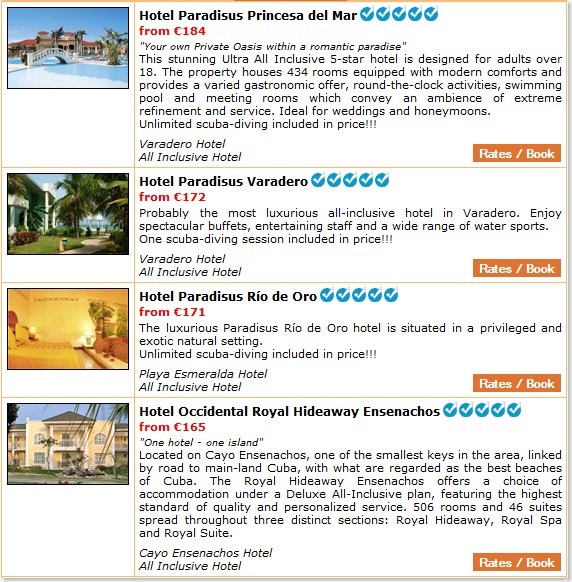
That's just the high end from one particular reservation site on the Internet. That's right, you can reserve your luxury vacation spot in Cuba already. Beautiful, clean beaches and a reputation for fine service already await Europeans in the know.
At the low end there's competition also. So much so that Hawaii residents may be tempted to skip that trip to the Big Island in favor of exploring a reasonably priced exotic stay in Cuba.
Short travel distances, low cost, a growing reputation for service, world-class cuisine (not to mention after-dinner cigars) will surely attract the discerning Mainland vacationer. Curiosity could mean that even Japanese visitors might be tempted, which could quickly start a fad in that most faddish of countries.
Americans might want to visit Cuba for medical care. No joke.
Ian Lind cited this NPR snippet in his article yesterday:
From National Public Radio, April 24:
”If you’re dreaming of a spring vacation on the sandy beaches of Hawaii, think again. Rising fuel costs are making that sort of vacation a lot more expensive. And travel agents are seeing a slowdown in vacation bookings. Madeleine Brand speaks with Bruce Fisher, owner of the Hawaii Aloha Travel Company in Honolulu.”
That's only the beginning. Soon there will be similar articles in Japan and Europe.
We must either plan or be caught by surprise. Will we? We better. Or our kids may be looking for tourism jobs in Havana.
Update: Commenter Walter Lipmann mentioned the CubaNews list. Since not everyone may see comments, the list he mentioned (he's the moderator) can be found here. A free Yahoo Groups membership (which many people already have) is necessary to join or to view the database. Walter's personal blog is here.
Feline Sunday
Blogging about cats is supposed to get people to visit your blog. Well, it seems to work for Ian Lind.
We have no cats in residence at the moment, but why should that matter? I can "borrow" some cats off the Internet someplace. Same thing, less investment in cat food, vet fees, etc.
My background is in engineering, so I thought I'd bring you this "engineer's guide to cats" and see if it somehow makes this blog more popular. At least among other engineers, possibly.
Friday, April 25, 2008
Today in Hawaiian history: April 25, 1885 Queen Emma dies at age 49
Almost everyone living on Oahu knows  something related to Queen Emma. For most, it is Queens Hospital, founded in 1859 by Queen Emma and King Kamehameha IV. Tourists may have visited Queen Emma Summer Palace. I sit here writing this from Queen Emma Gardens.
Emma Kalanikaumakaamano Kaleleonalani Naea Rooke was known in her own time as a great humanitarian. The hospital she founded continues to be supported by a trust consisting of 13,000 acres of land on the Big Island and in Waikiki. If you need to be in a hospital, the one to choose is Queens.
There's a biography of Queen Emma on the Queens Medical Center website.
How did the hospital get started?
In his first speech as king, Kamehameha IV stated the need for a hospital to treat the native population. Due to introduced diseases, the Hawaiian population had plummeted from 350,000 at the time of Captain Cook's arrival, to 70,000, with extinction a very real possibility. The treasury was empty, so the king and his queen undertook the mission of soliciting enough funds to establish a proper hospital in Honolulu. Within a month, their personal campaign had raised $13,530, almost twice their original goal.
To recognize and honor Emma's efforts, it was decided to call the new hospital "Queen's." The original building, housing just 18 patient beds, opened its doors on August 1, 1859. Within a year, a much larger building with room for 124 beds was built on the same site where The Queen's Medical Center stands today.
She did much more. Again from the hospital website:
She also helped found two schools, St. Andrews Priory in Honolulu and St. Cross on Maui. Her work included the development of St. Andrews Cathedral. She journeyed to England where she and her friend, Queen Victoria, raised $30,000 for the construction or the cathedral.
I strongly recommend reading the biography linked above, and the additional material Google will find for you all over the web.
(Many thanks to Scott Crawford over in Hana, Maui, and his Hawaiian Independence Blog, for starting a cultural and historical calendar, on which this is based.)
Will New York remain calm now that cops are acquitted of Sean Bell killing?
 For those who have been following the shooting of Sean Bell in Jamaica, N.Y., you probably know that a judge acquitted the cops today.
Bell was shot on his wedding day in November 2006 by three cops who fired more than 50 bullets into the unarmed man. Some of the bullets even landed on a nearby train station. From the article cited below:
Two of Bell's companions gave eyewitness testimony that the officers acted like Wild West cowboys and opened up without warning. And most importantly Bell was unarmed and seemingly posed no threat to the officers.
I hope things stay quiet in New York.
For those who wonder if police are ever convicted, check out this article, Verdict in Bell Shooting Is No Big Surprise.
From an AP story:
The U.S. attorney's office said after the verdict that it had been monitoring the state's prosecution and would conduct an independent review of the case. The Rev. Al Sharpton, who represents Bell's family, called for a federal investigation.
"This verdict is one round down, but the fight is far from over," Sharpton said on his radio show. "What we saw in court today was not a miscarriage of justice. Justice didn't miscarry. This was an abortion of justice."
A friend and I were in New York when Los Angeles police were acquitted in the Rodney King beating case in 1992. Everyone was afraid that rioting would spread from LA to other cities. We did an intervention in a high school in Manhattan.
How can you explain these things to kids? You can't. No one can explain to me either how come the cops always get off scot free when an innocent black man is shot for no reason.
A dangerous mixture of rice and oil
Viviane Lerner has researched the current rice hoarding/food crisis situation and sent some articles to me, for which I am very appreciative. The video and article cited below are via Viviane.
First the video:
I don't know what to make of it. Is there a rice shortage or 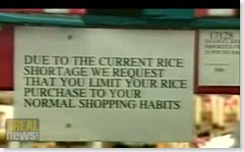 not? Seems not, but how to reconcile the Costco statement in the video that they are able to replenish their supplies with this posted sign?
Viviane circulated this "absolute Must-Read!" article, The Politics of Food is Politics:
In recent days, we have seen the rising price of oil and the devaluation of the dollar create two quantum shifts in the economy: the beginning of the collapse of the air travel industry and a global crisis of food-price inflation. These are related in ways that are crucial to understand...
There's much more. Another snippet:
The airline industry has been very forthright about their problems. They are saying, "We were neither tooled nor organized for $120-a-barrel oil." Most of us get this, because we associate transport technology with fossil hydrocarbons. We drive cars; and we buy the gas to put in those cars. Planes run on No. 1 Jet Fuel and if oil prices go up, so does the cost of jet fuel. Most of us are less likely to associate is oil prices with food prices.
We buy food at the supermarket; so we don't generally experience -- directly -- the association between fuel and food. The connection, however, is every bit as central in the current food production regime as the link between aircraft engines and their fuel. Industrial monocropping for global distribution is "neither tooled nor organized for oil at $120-a-barrel." It is not just the far-flung food transport network (much of it refrigerated and fuel-hungry) that creates the intimate dependency on oil; it is the whole scheme called industrial (or corporate, or "modern") agriculture.
This oil/food link -- during the onset of what some call the Peak Oil event -- has resulted almost overnight in steep food-price inflation, hitting peripheral economies like a tsunami.
Half the world's population survives on less than $2 per person per day. Even an increase of a few pennies for a kilo of rice can threaten survival on such a slender margin. That -- on the surface -- is why we are witnessing an outbreak of food riots around the globe.The unexamined assumption, however, is that it's somehow natural for human beings to be in the position of abject dependence on cash money to obtain food.
What to make of this? I don't know. Andy Parx commented on an earlier article I posted:
Last night Steven Colbert showed about a dozen clips from CNN, Fox, MSNBC etc. of talking heads, each saying “there is no rice shortage” to which he responded “Oh my god- there IS a rice shortage”... kind of like when authorities announce “this is not the time to panic” you know it’s time to panic.
Then there is the macro view in Step Aside Dollar, Is Rice the New Global Currency? in the Asia Times.
China is exchanging its depreciating reserves of the greenback for things of value, notably rice, with deadly consequences for U.S. foreign policy.
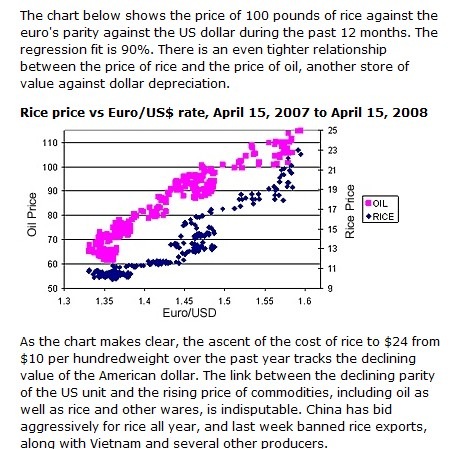
It's hard to summarize this article. With apologies, because it's inadequate, here is a snippet from the middle. I've always felt that anyone who can draw graphs like this must have something right:

Superferry fleet-of-one now has an admiral
I can't help it. The image that came into my mind was of an old cartoon (Dennis the Menace?) of a kid playing with a plastic boat in a bathtub.
This news isn't "disappeared," it's a big breaking news item right now. John Garibaldi has been replaced by retired Admiral Thomas Fargo as president and CEO of Hawaii Superferry, according to a press release today.
Fargo, of course was the head of the U.S. Pacific Command from 2002 until 2005. Now he's admiral, well, president, of a fleet of one ship, next year to expand to two.
This appointment is sure to be cited as indicative of the ferry's potential military role, and why not. Appointments are made for a purpose, even if outsiders may not be able to discern it immediately. A fleet of one boat intended for passenger service now has the former head of the country's largest military command in charge. Your speculation is as good as mine.
John Garibaldi will remain as vice president, according to the announcement. So now the ferry has to carry enough passengers to pay Adm. Fargo's presumably significant salary, in addition to buying fuel and all its other expenses.
Let's see how he does that, if there's no military future for the ship in the business plan. This is no cartoon kid in a bathtub, this ship has some real-world purpose which sooner or later has to involve making money.
The Advertiser breaking news story is here. The Star-Bulletin used a strangely deceptive Associate Press story which includes this:
The Superferry linked Honolulu with Maui and Kauai for a brief time in August before legal troubles and protests shut down the operation.
The Honolulu-Maui service resumed in December with the 350-foot Alakai making daily roundtrips. The company has announced a second Maui roundtrip will be run four days a week commencing May 9.
The whole first paragraph cited above is a crock, and the second paragraph is false. The ferry was supposed to start service December 1 but didn't start until December 13 and then there was the long outage in drydock. "Daily roundtrips" is just plain wrong, and let's see if the Star-Bulletin runs this in its paper edition tomorrow.
Some things never change
I think they must be confusing me with bb 840F1757-0C22-400C-9AE6-89409EFD03B3. I'm in a different select group, according to another funny promo that came in the mail yesterday (Duke Aiona for governor supporters).

Thursday, April 24, 2008
Shakeup in Iwilei begins
The building owned by the Weinberg Foundation at 418 Kuwili St., right between the two IHS homeless shelters, is home to several non-profit organizations. A couple of them receive their funding primarily from the federal government. The millions trickle in, something like the rain that has occasionally dripped through the ceiling of this former warehouse converted to offices.
The money has been flowing for years and years. It comes to the state as provided by different federal laws, and for more than a decade (actually 15 or more years) has simply been doled out to the same agencies. Kind of a pass-through by the Department of Human Services.
The ceiling of the Hawaii Center for Independent Living (HCIL) has more than some old water spots. The last time I was in there it sported so many CCTV cameras that it would be the envy of any FBI agent. Imagine knowing everything each employee was doing all day long, which clients they saw, what they said, how many times a day they put their fingers in their noses. All on recording, presumably.
How can anyone work under those conditions? Guess what—maybe they can't.
Following testimony at the Legislature (see this KGMB story), investigations are underway. There will be an audit. What's going on?
The testimony indicated that little in the way of customer service may be happening, but there's this (from the KGMB story):
Theft, Fraud and mismanagement - those are some of the allegations against a Hawaii non-profit organization. Now the state is getting involved in the investigation.
The Hawaii Center for Independent Living helps people with disabilities have equal pportunities in life and helps people live on their own but dozens of people say it's not living up to its mission.
An investigation appears long overdue, and I'm surprised it has taken this long. That so many people living with disabilities may have missed out on services that the federal and state money was supposed to provide is a true misfortune, should it be proven.
There's more to this than just the allegations against HCIL's executive director. Ultimately, a board of directors is responsibility for oversight of the entire operation of a non-profit. In too many organizations, however, the board is lax in its duties, or perhaps simply attends meetings and rubberstamps the actions of the ED. Often the ED exerts effective control over the board. This does not relieve the board of its responsibilities, but it happens all too frequently in the non-profit world. Sometimes board members simply enjoy the status of being on a non-profit board and having their names on the letterhead.
The investigation is not be limited to the audit that the Legislature is expected to request. According to State Senator Les Ihara, whose committee heard testimony from the public, HCIL's attorney and others, the state Attorney General is involved. After receiving the testimony, Sen. Ihara said that he has also been in contact with federal authorities, Senator Daniel Inouye and Congresswoman Mazie Hirono. Maybe the FBI will get to have a look through those cameras after all.
The shakeup will likely start with the HCIL board, which should have had knowledge of everything taking place in the organization.
An ounce of prevention would have helped, in this case, since reading the testimony indicates that problems may have been long-standing. The agencies receiving the federal money could have used some monitoring. They do file reports with the feds, but those are self-reports and you can imagine that they paint only the most glowing of pictures.
Prevention can start now. DHS has a responsibility to everyone served by the agencies whose money it distributes (and to those unable to get services they were entitled to receive) to review each and every one of the agencies, looking at their self-reports for accuracy and performing both fiscal and management audits.
Just because an agency has been receiving millions of dollars in federal funds year after year does not mean that the money is well-spent, as the audit of HCIL may demonstrate. Why wait for more trouble? DHS should step up to its responsibility in order to prevent future situations such as this.
Should they do so, I think we'll find that this shakeup, starting at the old warehouse in Iwilei, will be only the first step in a series of corrective actions, better late than never.
Rice rationing/hoarding spreads at big (but rice-short?) box stores
Front page news in today's Advertiser is Sam's Club limiting rice sales/Warehouse chain's Hawaii stores restrict purchases to 4 bags:
Sam's Club stores in Hawai'i have signs informing members of new limits on jasmine, long grain and basmati rice.
As of Tuesday, Sam's Club members in Hawai'i are restricted to four "units" of each type of rice, according to a Sam's Club official, who asked not to be identified because he is not authorized to speak to the media. Long-grain white rice comes in 25- and 50-pound bags and jasmine and basmati are each sold in 20-pound bags, the employee said.
Sam's Club followed Seattle-based Costco, which put limits in some of its stores on bulk rice purchases. Costco president and CEO Jim Sinegal declined to discuss the issue yesterday.
But Robert Loomis, manager of the Costco on Alakawa Street, said the company's Hawai'i stores have not imposed restrictions on how much rice customers can purchase.
That there is no rationing at Costcos in Hawaii seems to be contrary to the experience of commenter ku ching, who wrote in response to my article Could there be rice shortages and food rationing in Hawaii?
On Monday, April 21, at Costco in Kona - 20 pound bags of rice - white and brown - were limited to "one" per family - due to a "temporary" situation.
I thank ku ching for the report, and for this followup:
ku ching said...
In today's news - on CNN - Costco is rationing rice not because there is a shortage of rice, but because it intends to maintain current prices.
As for other retailers - because they can raise prices due to supply/demand mechanics - this isn't the game that Costco wants to play.
Costco makes its money of the sale of memberships - and very little on its markups. And - it wants to maintain its markup policy.
The report said that american farmers produce twice as much as domestic demand - and the rest goes to exports. Therefore - there is really no shortage of rice, but only the prospect of higher prices - except for sellers such as Costco.
ku
It happens before a storm with toilet paper, and perhaps the run on rice when there is no shortage is an indication of some perceived storm coming in the food supply.
The message for us might simply be, "be prepared."
And I don't mean by running out and buying rice.
Let's look at our vulnerabilities as islands in middle of the Pacific and make reasonable plans.
Wednesday, April 23, 2008
One win for Hawaii's Sunshine Law
It's somewhat unusual that anyone takes a government body to court because of violations of the Sunshine Law. In other words, to get a court to declare that a decision is illegal because the meeting was held in secret, or because secret (and hence illegal) communications took place, etc.
Maui attorney Lance Collins emailed today that he has achieved a win for his clients in just such a situation. Details follow.
Will this teach the errant Maui County Council a lesson? Will they resolve to follow the law in the future? Ha, ha, ha, that would be the best joke I've heard today, except they haven't said they would.
No, there's often a kind of almost childish rebellion that sets in when boards or councils are caught evading the law. You see, mostly they know they are doing it, but they think they can get away with thumbing their nose at the law because no one will take them to court, and who cares about OIP (Office of Information Practices) opinions anyway. Our Board of Education is a great example of this. They know and understand the Sunshine Law (open meetings, open records) but don't care if the violate it. But I digress.
Well, according to Collins' email, five residents of South Maui filed suit against the Maui County Council for a series of violations of Hawaii's sunshine law and won. This morning Judge Joseph Cardoza granted a motion for an injunction against the County of Maui. It seems that Council members exchanged all sorts of written memos among themselves instead of holding open meetings.
An injunction against what? I think the injunction stops the Wailea 670 Project. There seem to be details on that here, because on April 8 Maui's mayor signed two Council bills into law on the project, which is a master-planned, water-guzzling, golf/residential community. A whole section of Maui County code is revamped specifically to make the project possible, according to this short Pacific Business News article.
Probably this is a hot topic on Maui and I apologize for not being better informed about it.
But it feels good to have a judge take action against sunshine law violators. There's no jail time for it, though, so count on more and better-planned subterfuge in the future.
Good job, Lance.
Counter pundits
Tune in tomorrow to a Town Square program hosted by Beth-Ann Kozlovich and featuring journalist/bloggers David Schapiro and Jerry Burris.
When the three of them are in a small room equipped with microphones, anything goes. Transit, the Legislature, Super(?) ferries, anything is fair game.
That's 5-6 p.m. Thursday April 24 on KIPO, 89.3 FM or streaming from hawaiipublicradio.org.
It's a call-in program so you can have your own say on politics or whatever. Listen for the phone number and best to call early since the phone lines could be jammed.
David Shapiro, aside from writing a column in the Advertiser, blogs at Volcanic Ash.
Jerry Burris, long-time political editor and commentator, is now blogging at Akamai Politics. Both are on the Advertiser's web site.
(sob) All that work on the public access TV bill and then this...
Lots and lots of testimony in support of SB1789 just went down the drain, as reported by the Maui News in New rules governing public-access TV die at Legislature:
HONOLULU — Despite widespread statewide support, including from those associated with Akaku: Maui Community Television, legislation to clarify rules for public-access television stations has died this legislative session. ...
Senate Bill 1789 — drafted by Maui Sens. Roz Baker, Shan Tsutsui and J. Kalani English — would have required the Department of Commerce and Consumer Affairs to create rules for how it awards contracts to “public-access, education and government” (PEG) cable television organizations.
...
The bill was passed from the Senate to the House, and passed out of the Finance Committee in March. But the committee report apparently was never filed, and that inaction prevented the bill from being sent back to the full House for a vote.In an e-mail to The Maui News, Baker said, “The net effect is that the bill is dead.”
(Thanks to Doug White for his article about this over at Poinongraphy.com).
It's not just the hours spent testifying (and those coming in from other islands over and over had it worse than I did). There were also hours testifying before the Procurement Policy Board and on and on and on. This bill would have fixed everything.
And it just fell into a crack someplace? Gone, just like that? What can I say?
Kona Costco reported to be limiting sales of rice
Commenter ku ching left this report as a comment on my article, Could there be rice shortages and food rationing in Hawaii? Since comments are not so visible, I'll repeat it here, and thanks, ku ching, for your report:
On Monday, April 21, at Costco in Kona - 20 pound bags of rice - white and brown - were limited to "one" per family - due to a "temporary" situation.
I don't know how "temporary" the situation is - but I have a hunch that this "shortage" will be here for awhile.
However, in Waimea - at Foodland - there were no 20 pound bags of brown rice, but the 5 pound bags were on sale at $2.99. And there was a skip full of 20 pound Hinodes on sale at $8 something (with the usual "on sale" 5 bag limit). Had a variety of little bags.
At KTA - in Waimea - only 20 pound bags of expensive white rice (around $20) were available and only 3 bags of 20 pound bags of brown rice at $10.99 were on the shelf. Don't know about little bags.
On CNN this morning (Wednesday) - it was reported that Sam's Club - "nationwide" - had started rice rationing.
Tuesday, April 22, 2008
Advertiser editors on the hot seat for a change
Today's Advertiser editorial is Rail initiative offers no solution to voters. The main thrust, if I may summarize, is that the proposed ballot initiative on rail is inappropriate, we should instead wait and vote out the elected leaders we don't like. Please read it if you have not yet had a chance.
Hmmm... suppose I generally like a city council person or even the mayor, just not their position on "rail" as a technology, or instead of an alternative? Then voting them out on this single issue might not be what I want to do. Actually, that's exactly where I'm at with several city council members.
Let me revert to the ancient Internet convention of commenting paragraph by paragraph. I don't like it very much, but in this case, it's expedient. Also, I haven't included the whole editorial, just the parts I want to say something about.
Don't worry, very few people will read this (only the important ones!) in comparison to your editorial. My rant won't hurt you too much. But I hope you'll read it.
The left side is snipped from the editorial. The right side is my commentary.
| There is a way for voters to weigh in on the mass transit system, but the just-launched "Stop Rail Now" petition drive is not the route to take. Rather, we should hold accountable our elected leaders entrusted to make these decisions. | We have a participatory democracy. One can "weigh in" by giving testimony, making petitions, demonstrating, visiting/speaking with lawmakers, sending them emails. To say that our only appropriate recourse is to exercise the vote is a distortion of democracy. Besides, by November, it's clearly too late. Money will have been expended, commitments made. | |
| That's it. No alternatives proposed. Just a simple rejection of the $3.7 billion commuter train that studies show offers the best alternative to deal with O'ahu's worsening traffic. | It can be wrong to put in rail. Simply wrong, no alternative is necessary. In fact, alternatives (e.g., HOT lanes) have been suggested. The Phileas system (no rail required) has been suggested. And shame on you, do you still think this proposal will alleviate traffic? My understanding is that even the city administration is no longer making this claim. | |
| Imagine if every controversial public works project were pushed to the voters. If that were the case, would voters outside of East Honolulu have approved the widening of Kalaniana'ole Highway? What about H-3? Would voters outside the Windward district agree to pay for the $1.3 billion project that raised a number of environmental concerns? The city administration has the duty to responsibly address the transportation needs of the entire island — as it should. | Many rail opponents are arguing just that: that the city administration has the duty to responsibly address the transportation needs of the entire island. And the current plan doesn't do that. "Imagine that all the other projects were pushed to the voters" is a straw man. The proposal is that this one should be. It is so expensive that some believe it could bankrupt the city. And maybe, in the face of Mufi's arrogance, this one does need to go to the voters. | |
| In the case of the fixed-guideway project, the city administration has moved ahead after extensive study of various transit alternatives, which were also presented to the public in community meetings. | Yup, presented to the public. Reports are that no one listened to the public. So why not take a vote? Maybe next time they'll listen. | |
| The final selection of the system was handled as it should have been: by elected representatives who were informed by that research. | Obviously our elected officials (city council) have not yet selected the system. | |
| If the public is displeased by how their elected officials acted on the basis of those facts, the response at this point should be to show that displeasure at the polls. In November, both the mayor and several of the council members are up for re-election. | See first response above on leaving democracy to the vote only. Certainly we can vote out whomever we please as well. | |
| The question is: If not rail, what? And that question neither will be asked on the ballot, nor answered by the vote. | Instead of railroading us with this rail plan, how about proper city planning first, with choice of technology falling later, as appropriate? Why leave city planning to developers? Why is ad hoc better than the urban planning that has served municipalities like Portland, OR so well? And what makes us think that this city can run a railroad successfully, a criticism I hear often but that seldom makes it into print? And why rail to nowhere, clearly a development decision rather than a planning decision? The residents of this island (and their elected representatives) are clearly not unified or close to agreement on a transit system. I'm guessing (and who knows) that the 40,000+ signatures will be obtained in time. Piece of cake. |
End of rant.
Alakai defect allegations break into mainstream, kind of
Well, it's not in the paper yet, it's not even in breaking news, but reporter Derrick DePledge has posted an article, Guerrilla Radio on his widely read Capitol Notebook Advertiser blog.
It's a good article and brings the issue to the attention of his many readers, including other members of the mainstream press.
So although the article didn't detail the allegations of concrete poured in cracks and suspect welds, etc., perhaps more people will listen to the original interview and learn about the alleged defects (find it here).
If a paper or TV program does pick this up, perhaps the ferry company will respond so that passengers may be assured that the ship is safe (if not always pleasant) to ride.
I couldn't resist that last jab. My taxes are filed and I need even small pleasures like that.
DePledge observed at the end of his article:
The interview has caused a stir among several bloggers and activists who have picked over the Superferry project.
Yup, we're picking over what perhaps the mainstream press might pick over as well. After all, these allegations are of safety issues. Shouldn't we all be concerned?
Austal fires the welder who spoke to KKCR about the Superferry
Austal USA has apparently fired Wayne Jenkins, the welder who was interviewed on KKCR two weeks ago.
Jenkins was the only one of the three interviewees still working for Austal at the time. The three alleged that there were cracks and other defects in the ferry. Go to the above article to hear the interview if you haven't had a chance yet. Jenkins stated that he worked on the Superferry's sister ship but related what he knew about the Superferry as well.
The first blogger to post on this was Andy Parx, who writes from Kauai at Got Windmills?
The allegations made in the interview would appear to have great public interest. Perhaps the mainstream media will pick it up so that a wider audience could be aware of the allegations, and so that the ferry company might decide to reply.
Take two aspirins, because that's all the affordable health care there seems to be here
From French Health Care: C'est Magnifique, a report from ABC News:
As presidential candidates hammer out proposals to deal with the increasing millions of uninsured Americans, I know which health plan I'll choose: the French one.
The World Health Organization has named the French health care system the best in the world. (The U.S. ranked 37th). It's physician-rich, boasting one doctor for approximately every 430 people, compared with a doctor for every1,230 residents in the U.S. (and French docs tend to charge significantly less). The average life expectancy is two years longer than the U.S. And while the system is one of the most expensive in the world, costing $3,500 per person, it's far less than the $6,100 spend per capita in the U.S.
I've had a unique opportunity to see both systems up close and personal: I had breast cancer in California nine years ago and a recurrence in Paris this year. I received excellent care in both places, though looking back now my California oncologist's office was a bit of a meat market always packed with patients, from the seemingly not-so-sick to some a step from the grave a time-consuming disadvantage of living in a much larger country with a lower doctor-to-patient ratio.
My French doctors and nurses have been sensitive, skillful, caring and not so harried.
But the biggest difference has been money.
My top-level health insurance paid for most of my U.S. care, but it was often a struggle to shake loose the money. I was frequently stuck in the middle of disputes between the company and my hospital and doctors over "agreed to fees."
Continually dunned by the hospital for fees and facing multiple complaining phone calls to my insurance company, I sometimes simply caved in and wrote checks to cover bills that I knew were the insurance company's responsibility part of a wearing-down strategy I was convinced was deliberate.
Here in France I have a green carte vitale, literally a "life card" or social security card that provides entree to the system. It's funded by worker contributions and other taxes. My husband (and our family) is covered through his work with a French subsidiary of a U.S. company, and so is everyone else; coverage is universal. The French are responsible for co-pays, but some 80% of them have supplemental private insurance to cover the co-pay. People least able to pay and those with chronic or serious illnesses often have the best coverage. Because I'm being treated for cancer, I'm cent pour cent 100%covered.
The effect of a system where hospitals and doctors don't worry about getting stiffed by a patient or an insurance company seems to be a far more relaxed, generous system. When my surgeon discussed breast surgery here, he suggested that I stay in the hospital five days. "Of course I can do it the American way, kind of an outpatient situation," he told me, apparently not wanting to sound unsophisticated. "But I don't like pain."
Maternity stays for a normal delivery are a minimum of five days, not the 48 hours mandated by U.S. federal legislation in 1998 after many insurance companies insisted stays be even shorter.
The US is ranked 37th in the world (yikes!)... now take those two aspirins and read any of the current articles Google will find for you on the decrease in life expectancy in this country.
Yet neither Obama, Clinton nor McCain is proposing single-payer health care. Their plans ensure the health of insurers, not patients.
Want to take action? Choose your methodology. Write letters to the editors, or ask newspapers and TV why their reporters are not pressing the candidates on real health care reform. Take it up with your superdelegates. Do something.
Could there be rice shortages and food rationing in Hawaii?
Can you imagine walking in to a Costco warehouse in Hawaii and discovering that there is no rice? From a New York Sun article:
At a Costco Warehouse in Mountain View, Calif., yesterday, shoppers grew frustrated and occasionally uttered expletives as they searched in vain for the large sacks of rice they usually buy.
Right here on Oahu, Bale raised the price of bread at the KCC Saturday Farmers' market by $1, from $4 to $5, citing an increase in the cost of ingredients. That's a 25% price jump all at once.
The NY Sun article cited above is headlined, Food Rationing Confronts Breadbasket of the World, and begins:
MOUNTAIN VIEW, Calif. — Many parts of America, long considered the breadbasket of the world, are now confronting a once unthinkable phenomenon: food rationing.
Even given the often alarmist nature of Sun articles, this is one scary read.
Is it really "rationing?" For Costco customers, yes:
“You can’t eat this every day. It’s too heavy,” a health care executive from Palo Alto, Sharad Patel, grumbled as his son loaded two sacks of the Basmati into a shopping cart. “We only need one bag but I’m getting two in case a neighbor or a friend needs it,” the elder man said.
The Patels seemed headed for disappointment, as most Costco members were being allowed to buy only one bag. Moments earlier, a clerk dropped two sacks back on the stack after taking them from another customer who tried to exceed the one-bag cap.
“Due to the limited availability of rice, we are limiting rice purchases based on your prior purchasing history,” a sign above the dwindling supply said.
It's not just rice. The article reports other food is being restricted. In New York City:
An employee at the Costco store in Queens said there were no restrictions on rice buying, but limits were being imposed on purchases of oil and flour. Internet postings attributed some of the shortage at the retail level to bakery owners who flocked to warehouse stores when the price of flour from commercial suppliers doubled.
The article notes that shortages can also result from rumors resulting in temporary hoarding. Time will tell if this is a factor.
Time to prepare
Most of us were taken by surprise with the sudden failure of two airlines serving the state in quick succession. It's probably a characteristic of the current economic downturn that damaging surprises will happen. To some extent we can try to be prepared.
This seems like a good time to take a deep breath and evaluate Hawaii's economic vulnerabilities to see if steps need to be taken to protect us, as much as possible, from food shortages and other contingencies. I hope someone in our state government will step forward and take the lead on this [hint].
Monday, April 21, 2008
Does Superferry churn up vile crud from harbor bottom?
Brad Parsons continues to count passengers and vehicles when he has a chance. His counts show no significant increase in ridership so far. See HI Superferry: Count, pics, etc. for 4/21/08 for the numbers, a link to some new pictures, and this interesting observation:
"Maka'ala" John wanted to say he has noticed something that opponents on Maui have not mentioned in the media. John said that, "when the vessel is departing and backing up that its jet propulsion churns up the matter on the bottom of the harbor as the vessel turns and accelerates its engines to leave the harbor." John further stated he, "has been noticing what he thinks is the diminishing quality of the water in the harbor as a result." This is interesting because Jonathan Jay noticed and mentioned at the Belt Collins "EIS" Kauai hearing a similar thing at, "Nawiliwili Harbor from the two days there with the jets churning up the bottom and a septic smell came from the harbor afterward." Jonathan Jay asked that that be looked at in the "EIS".
Saturday, April 19, 2008
Speaker Calvin Say reportedly plans to screw the environment with corporate-written amendment
Henry Curtis sends this important notice( "CD1" is "Conference Draft 1", which means that this new text will replace what was in the bill previously ):
House Speaker Calvin Say is pushing HB 2863 Proposed CD1 which would kill all public participation, all utility reviews, all interagency approvals, all county reviews, and give one person, the DBEDT Director, power to approve renewable energy projects BEFORE the Final EIS has been written.
Imagine Waahila Ridge, Kalihiwai, Incinerators, Coal Plants, BlueEarth Maui any energy project in which the developer claimed was part of a large renewable energy project, would be extremely fast tracked an exempted from everything as long as the developer claimed that part of the project was a massive renewable energy project, regardless of what gets built.
Imagine imposing on all energy development proposals an override of the PUC, the Utility IRP Plans, the utility itself, in order to ram thru one project because the developer gave a donation or other considerations.
All checks and balances would be killed.
This proposed draft was written by Castle and Cooke.
Isn't that awful? Castle and Cooke writing our laws and the environment be damned? What happened to democracy in Hawaii???
Ok, Henry has alerted us to the problem. Here is what you can do. Call, fax or email House and Senate conferees and ask them to reject a CD1 that gives the DBEDT Director, power to approve renewable energy projects before the Final EIS has been written.
Senate conferees are:
Menor, Chair; Hee, Inouye, Kokubun, Baker, Co-Chair(s); Trimble.
Their contact information is here.
House conferees are:
Morita, Ito, Herkes, M. Oshiro Co-Chairs; Meyer.
Their contact information is here.
Just for fun, you can email also to Speaker Calvin Say, but as I said, for fun, because will he listen to us ordinary people? Ha, ha, ha, ha, ha.
Info on the bill is here, including testimony you can look at if you like.
Please take the time to send emails to conferees right away. Many of the House conferees may be reluctant to buck the speaker, but you can convince the Senators not to go along with this bad idea.
Please don't leave it to someone else, do your part for the environment by sending some emails. If you like to write letters to the editor, how about one on this subject?
Thank you!
Thursday, April 17, 2008
Trial of 26 CIA agents underway in Italy
Twenty-six Americans are on trial in absentia in Italy for a kidnapping. The news is big in Europe. Here's International Herald Tribune coverage of today's events: Lawyer: Defense in Italy CIA case requests Berlusconi, Prodi as witnesses.
Background:
[A terror suspect,] Abu Omar, was abducted from a Milan street in February 2003.
The alleged kidnapping was part of the CIA's so-called extraordinary renditions program — moving terror suspects from country to country without public legal proceedings.
You can follow this if you wish via Google News. Don't look for much blow-by-blow coverage in American newspapers, though the AP is covering the story.
Superferry under the microscope
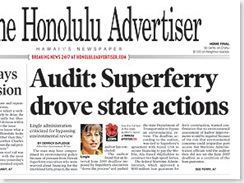 Top news in the Advertiser today is the story, Audit: Superferry drove state actions:
The state may have compromised its environmental policy because of pressure from Hawaii Superferry executives who were worried about financing for the interisland ferry project, the state auditor has concluded.
The Advertiser web article helpfully includes this link to the auditor's report stored also on their website. At this writing, the report is not yet available online from the Auditor. Update: the Auditor's report is now available here.
Update: The Star-Bulletin also ran an Associated Press report, Superferry exemption was forced, audit finds.
Ian Lind posted this note today about letters he has sent looking into potential unreported lobbying violations. The links are given below:
I submitted letters to the State Ethics Commission this week urging the commission to look at what appear to be unreported lobbying expenditures by Hawaii Superferry and the organization National Popular Vote.
Ian writes, in part (please see his complete letter):
I am writing to call the Commission’s attention to the apparent failure of Hawaii Superferry Inc. to comply with the public disclosure requirements of Chapter 97-3(c) HRS during the period covering calendar year 2007, and potentially during 2006 as well.
Hawaii Superferry Inc. has reported amounts paid to its registered lobbyists during 2007. No other expenditures were reported during the calendar year.
However, via published reports and by personal experience, it is clear that Hawaii Superferry Inc. and its agents have engaged in substantial additional activities that meet the definition of lobbying and should have been reported to the commission and disclosed to the public.
Wednesday, April 16, 2008
Honolulu City Council deadlocked on transit vote, but that's a gain for Phileas
I thought I would drop in and give my one minute testimony in support of rubber-on-concrete technology for the Honolulu transit system today. I figured I'd be out by noon. Wrong. It was 6:45 p.m. before I left, after a day of high drama and intrigue.
In the end, the Council was deadlocked on every vote 4-4 (Council Chairperson Barbara Marshall was absent).
While many present in the peanut gallery rolled their eyes and mocked the situation, actually, I think I can say that it is a gain for the Phileas system, the bus-like train (they don't like me using the word "bus" but it has those qualities I think). Months ago I was convinced that the "fix" was in for rail. Actually, at the Mayor's office, it is, but the Council has insisted that it has the right to choose the technology. And rubber-on-concrete has moved up so well that it was able to deadlock the decision, overcoming overwhelming odds in favor of steel wheels on steel rails.
There will be all kinds of slants in the news reports. An early Star-Bulletin article, for example, fails to mention the tie votes on the rubber wheels amendment, indicating how far it has come.
This is a $5 billion decision (at least) that the Council has to make, and it is a difficult one. Perhaps whatever happens is necessary to sort things out.
Councilman Djou proved a master at parliamentary procedure and basically controlled the outcome. I don't agree with his transit thinking, but he demonstrated real skill this evening. If you have a chance to watch the `Olelo coverage, check out the last two hours or so to see him in action. It was better than most TV dramas. There were several recesses called while the acting chair consulted with their parliamentarian on what to do.
The Council seemed to both attend to and object to the testimony early in the day of former U.S. Transportation Secretary Norman Mineta. I mean, why was this guy here except to shill for steel wheels on rail as a choice? The Administration's radio ads run at taxpayer expense also drew criticism.
I did get my one minute and did my best. A few other ordinary citizens testified for the Phileas system as well. Developers, union spokespersons, real estate people, they all want steel wheels. Some people objected to steel because of the potential for noise.
I learned also why the westernmost stations will come into service first and not the stations near the city. It's because there is no space in town for the maintenance yard, which will be at the Ewa end of the line. So service has to start there and work its way east, even if not too many people ride the train as a result. Makes sense, I guess.
I was at the edge of my seat several times during the day. Very exciting.
Now the spotlight will be on Barbara Marshall. She will be able to determine the technology next session, assuming the others hold their ground.
So if you want to urge her to vote one way or the other on this (steel, rubber or maglev), you have until April 23, the next full Council meeting, to convince her of your thinking.
Tuesday, April 15, 2008
Saving newspapers requires "vitality"
I found myself staring vacantly at the funny sideways business section in today's Advertiser while chomping on some celery and carrot sticks and other veggies left over from a dinner.
You probably don't care what I was chomping on. I mention this for a reason.
It's pretty boring to read, right?
So was the large headline, Flurry of returns as tax deadline looms. Yeah, it's tax day and really, it would be news if somehow there were not a flurry of returns. Maybe if lots of people decided to stop paying for the war or something, now that would be news.
I actually read the article to see if there was anything interesting, or why things might be so dull in the newsroom. Nothing at all interesting except that the writer got the due date for state taxes wrong (it's Monday, April 21, not Sunday, April 20). The best line in the story for me was this quote: "It's very hectic; it's normal. This is just like every other year." Yeah, so thanks for the headline story on sameness, right?
Investigative reporting brings "vitality"
On the other hand, I'm excited when I see a front-page article by Jim Dooley or Rob Perez. Perez wrote several award-winning stories. These guys bring what I'm calling "vitality" to the page. They make it worth reading and subscribing. If I see their byline, I go right to the story, and my attention is usually well rewarded.
On the web, it seems that newspapers are trying for "engagement." Things like comments on news articles, reader reporting, blogs, and so forth.
The trouble is, readers have many choices about where they can "engage," and most of the comments, with some few exceptions, don't add anything to the stories they're attached to. Few people will read the comments anyway outside of the community of commenters. They also add nothing to the printed newspaper.
The printed newspaper tries to "engage" by giving links to videos or on-line discussions. In other words, by driving readers to the web page. With the split between paper readers and web readers growing (as some paper readers give up and go to the web, and as young people skip paper altogether), those links on paper are kind of useless for many readers. For the non-web browser (often older readers) they only add to the feeling that the newspaper is not intended for them. Maybe they only print on paper because they have to, but their hearts are on the web.
Let's grant that "engagement" works on the web. What should the print purveyors look to? I think it might be something like this: (1) accurate, insightful, relevant, deep, entertaining stories, and (2) this quality I'm calling "vitality."
Dependence on questionable wire stories instead of seeking out deeper, more complete alternative sources detracts. Why cheerlead for the war when readers are interested in how to stop it? Bring us stories and ideas about that. An AP story about how US troops go out at night failed to mention that they couldn't go out during the day. But we knew that, we expected better than we were given. Wire stories that refer to insurgents always as "anti-American" consistently obscure what we know: they may hate us simply because we occupy their country, not because we are Americans. Guess what: there are other wire services, and a couple do a better job (IMHO) than the AP.
People turn to the web for alternatives to the print press and TV wasteland. If the print press, anyway, wants to save itself, it might look at becoming more alternative.
That leads to this quality "vitality." A story about how Bush expects that the war will turn a corner soon (usually in six months) may be good reporting, but it's dead reporting. A story about the same speech but criticizing it fairly or at least analyzing it should have more vitality. See what I mean?
We need less stenography and more critical discussion. It's great when it happens.
Oh, I guess high-profile murder stories and the like also can have that vitality. It goes with the territory. Those stories are often highly entertaining. Seeking out murders, though, might not be good policy in general. \
Some news is just dull, or it can be presented in a dull way, but some of it ought to be exciting. Depending on how it is written, I mean.
Now, since we have a "conservative" national administration, it may appear that to bring on criticism, critical thinking, or analysis would be viewed as "liberal." Well, so be it. The alternative is shrinkage, irrelevancy, and poor business prospects for daily newspapers.
Polls have shown that the American people are against the war. So criticism of the war is ok. Really. And we do see some. As a reader, I want the vitality that comes from debate, from analysis. Oh, please forget about presidential candidates' haircuts. Analyzing $400 haircuts is not what I have in mind here. Analyze their policies, their voting records. Try it.
On the local scene, if papers cut investigative reporters and other critical staff, the results are predictable.
Engaging "citizen journalists" is an interesting experiment, and it's enabled by the Internet. Let's see how it goes. The trouble is, we can get that already on the Web big time. Newspaper sites, popular as they may be or become, are in competition with local and national blogs and alternative media sites. Where newspapers shine is in the vitality of their local reporting.
I can read the New York Times on-line if I wish, though their local news may not be what draws me. Local newspaper websites are in competition with other newspapers' websites too. Local reporting in print is different. But it's gotta be better than that flurry of tax return thing.
It's all a grand experiment. The buggy whip is gone, carbon paper is hard to find along with typewriters. Few people write with fountain pens. Just try to find a decent cassette recorder. One day newspapers could disappear too, though I don't think so. But they could.
There's nothing guaranteed to be around forever. I hope the newspaper biz will figure out what we readers really want (whatever that is) before computers become cheaper than a year's subscription.
Anyway, end of rant.
Today in Hawaiian history: April 15, 1899, Father Damien dies

While visiting our congressional delegation last year we walked from the House office building to the Senate office building through the corridors of the Capitol, brushing up against tourists, congresspeople, high- and low-powered lobbyists and seemingly half the population of Washington DC. Everyone was there. The crowd resembled rush hour in the Ginza in Tokyo.
Along one corridor wall we were surprised to see this bronze statue of Father Damien, a work of sculptor Marison Escobar. Father Damien is currently a candidate for sainthood.
According to the WIkipedia, Father Damien (Joseph de Veuster) was a Roman Catholic priest from Belgium and member of the Congregation of the Sacred Hearts of Jesus and Mary, a missionary religious order.
Damien is known for love and ministering to people with what was then widely known as leprosy, forced by government-sanctioned medical segregation, living on the island of Molokai in the Kingdom of Hawaii. In the Roman Catholic and Anglican traditions, as well as other denominations of Christianity, Damien is considered the spiritual patron for Hansen's Disease, HIV and AIDS patients as well as outcasts. As the patron saint of the Roman Catholic Diocese of Honolulu and of Hawaii, Father Damien Day is celebrated statewide on April 15. Upon his beatification towards canonization and sainthood by Pope John Paul II in 1995, Damien was given a memorial feast day, celebrated on May 10 on the church calendar and was conferred the official title of Blessed Damien of Molokai.
In going to serve at the quarantined settlement of Kalaupapa on Molokai, Father Damien knew he would die there.
On May 10, 1873, Damien arrived at the secluded settlement at Kalaupapa. Bishop Maigret presented Damien to the colonists as "one who will be a father to you, and who loves you so much that he does not hesitate to become one of you; to live and die with you." The settlement was surrounded by an impregnable mountain ridge. There were 816 lepers living at Kalaupapa.
Conditions at Kalaupapa were disgraceful. Although the colony was supplied with food, there were no medical services.
Sociologists argued before the Roman Curia in proceedings for sainthood that Damien was sent to a morally deprived, lawless "colony of death" where people were forced to fight each other to survive. The kingdom didn't plan the settlement to be in such disarray but the government's neglect in providing much needed resources and medical help created the chaos. Damien's arrival is seen as a turning point for the community. Under his leadership, basic laws were enforced, shacks became painted houses, working farms were organized and schools were erected.
Father Damien died on April 15, 1889, of the disease.
(Many thanks to Scott Crawford over in Hana, Maui, and his Hawaiian Independence Blog, for starting a cultural and historical calendar, on which this is based.)
Second program on alleged Superferry defects to air today on KKCR
Today (Tuesday) KKCR's Kauai Soapbox program will analyze last Thursday's discussion on the Superferry.
If you can't pick up the wave (91.9, 90.9 or 92.7 FM), visit kkcr.org for streaming audio. The program, hosted by Scott Mijares and Keone Kealoha, will air at 4:00 p.m.
In case you haven't heard Thursday's program yet, just  click here. It should play without too much waiting.
On Thursday's program, hosts Katy Rose and Jimmy Trujillo interviewed employees/former employees of Austal, the manufacturer of the Hawaii Superferry.
You'll want to hear allegations of cracks during manufacture and more.
Last Thursday's interview is sure to be controversial. Some sparks have flown already on the web. Now that the audio is available on several websites perhaps it will break into the mainstream press. It goes without saying that the claims ought to be substantiated or corroborated (or disproved). But here they are, out in the open.
(Check also this article on the Island Breath website for pics and more.)
Monday, April 14, 2008
Advertiser prints tainted AP article on Hadley
This is what President Bush's national security advisor Stephen Hadley actually said during his appearance in an interview with George Stephanopolous on ABC television:
This whole issue of opening ceremonies is a nonissue. I think it is a way of dodging what really needs to happen if you're concerned about Nepal.
But in Hadley: Skipping Olympics opening a 'cop-out', "Nepal" was replaced with "Tibet." The AP did not report that Hadley repeated said Nepal instead of Tibet.
The New York Times reported that Hadley "referred at least a half-dozen times to Nepal when he seemed clearly to be speaking of Tibet." It's not exactly disappeared news, Keith Olbermann also covered this amazing gaff.
A minor quibble? He's the national security advisor.
That the AP covered this up raises issues with the accuracy of their reporting.
Curiouser still, Hadley was not corrected during the interview.
Hawaii and Indonesian military in news again
It was refreshing to read in William Cole's story in the Advertiser, Isle Guard trains in Indonesia:
U.S. military ties with Indonesia were cut by the Clinton administration in 1999 over human-rights violations. The Bush administration restored full military relations in 2005.
This extra background could alert readers that there is more to the story than just a report of Hawaii National Guard participation in joint military exercises held in Jakarta.
Now, getting you the link above was a bit of work. I cannot find military news linked from the Advertiser's new website at all. I looked and looked. If it's there, I was not successful. I tried Google, but that didn't find it either. Nor was military news on the site map. Only knowing the story title and searching with the site's search engine turned it up.
I continue to question why Hawaii should have anything to do with the murderous Indonesian military. Any assistance we give them (for example, the helicopter repairs noted in earlier articles) only works against the people they oppress and kill.
Perhaps the next governor will rethink this.
Saturday, April 12, 2008
Today in Hawaiian History: April 12, 1945, Princess David Kawananakoa (Abigail Campbell Kawananakoa) dies at the age of 63
Daughter of James Campbell [1826-1900], a wealthy industrialist, and Abigail Kuaihelani Maipinepine Parker [1859-1908] and married to HH Prince David Laamea Kahalepouli Kawananakoa. heir to the throne of the Kingdom of Hawaii.
From the Wikipedia (there may be better references, I'll look for next time):
Upon the death of her brother-in-law, Prince Jonah Kuhio Kalanianaole in 1922, Princess Abigail assumed the role of heir to the throne.
In 1924 she became the Republican national committeewoman for Hawaii and served in that capacity for twelve years. Her prominence on the national stage made Princess Abigail a role model for women in Hawaii.
Again from the Wikipedia:
The House of Kawananakoa survives today and is the only recognized royal family of the United States. Members of the family retain the titles of prince and princess, honorifics that have been bestowed upon them by the residents of Hawaii as a matter of tradition and respect of their status as alii or chiefs of the native Hawaiians, being lines of ancient ancestry.
...
Should the Hawaiian sovereignty movement succeed in the reinstitution of the Hawaiian monarchy, the heir presumptive would be declared monarch with the mandate of a plebiscite and constitution.
(Many thanks to Scott Crawford over in Hana, Maui, and his Hawaiian Independence Blog, for starting a cultural and historical calendar, on which this is based.)
Thursday, April 10, 2008
Barf-o-Meter current forecast
I don't plan to keep posting this, since few Disappeared News readers will be ferry riders. But I'd just like to show how well this is going, thanks to Brad Parsons' continued research and diligence:
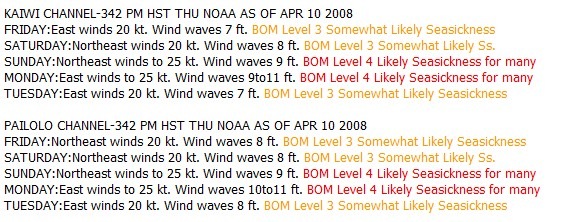
It's still experimental, of course. But when the Maui News reported widespread seasickness the other day, it was Level 3, so the index was accurate. But standby, world, for Sunday/Monday when the Barf Index kicks up another notch.
Whistleblower confirms spying on all communications
In a Feb. 15 article I wrote that the government needs to read all your emails if they want to know if they are going to overseas terrorists or not. (Or, let me add now, if they are just curious, or, say, if you write a blog they don't like):
A note on warrantless spying
It's easy to say that the issue of whether or not phone companies should be held accountable for illegally granting access to their customer's communications doesn't affect most of us. After all, it's not our emails that the government is looking at. Just the terrorists' emails, right?
Not so.
I'm not sure that many people realize that in order to spy on all those terrorists dumb enough to send emails from the USA to their overseas counterparts, it's necessary that the phone companies make all emails available to be read. Why? Well, how do you know where an email is going unless you read it? The information in the header of the email determines the destination. As each server passes on the message, that information is read to determine how to handle it. The NSA has to read the email to see where it's going. So they need access to everything.
Same for phone calls and everything you did on the Internet. Check out the video above. There's a sequence about the whistleblower who set up the intercept on the AT&T circuits.
So the NSA knows what sites you have been visiting and may have read everything you said to granny in Hoboken.
A whistleblower has come forward to report that indeed this is true. On today's Democracy Now!" Telecom Whistleblower Discovers Circuit that Allows Access to All Systems on Wireless Carrier—Phone Calls, Text Messages, Emails and More.
Babak Pasdar is a computer security expert who was hired in 2003 to help restructure the tech infrastructure at a major wireless telecommunications company. What he found shocked him. The company had set up a system that gave a third party, presumably a governmental entity, access to every communication coming through that company’s infrastructure. This means every email, internet use, document transmission, video, text message, as well as the ability to listen to and record any phone call.
Check out the story at the above link or watch or listen to the program today. You can just click on the video on their website to watch any time you like.
Superferry: if the cracks widened sufficiently, they could allow in enough water “to sink the ship”
Joan Conrow reports in Superferry Damage: Da Inside Scoop on interviews broadcast on KKCR this afternoon by Katy Rose and Jimmy Trujillo. They spoke with three guests who brought not-previously-available inside information to Hawaii on Superferry repairs and related subjects.
If the audio is available, I'll link to it in a future post. Meanwhile, thanks to Joan for the story, and of course to Katy and Jimmy for going where our commercial media fear to tread.
Quite possibly we could hear something from ferry management in response, if they have been paying attention.
Anyway, be the first on your block to learn about cracks and welds and more. Go read Joan's article now.
Today in Hawaiian History: Nona Beamer, Leleiohoku II
Her Music and WIsdom now in Heaven
When I started to write early this morning, I thought I was writing about events in the past, things we might want to take note of, especially since the commercial media show no interest in covering the history of these islands.
I didn't know that as I wrote, the news was breaking of the death of Nona Beamer on Maui at age 84.
There is a story in the Honolulu Advertiser, including a picture album, and a link to a short article on tonight's encore interview with her by Leslie Wilcox. The PBS special will air at 8:30 p.m.
A short Star-Bulletin article is here. Others, via Google, here.
Prince William Pitt Leleiohoku Kalahoolewa
 On April 10, 1877, at only 23 years of age, Prince Leleiohoku II, heir to the House of Kalakaua, died of rheumatic fever. He had not yet married, so his brother King Kalakaua named their sister Liliuokalani as Crown Princess.
Leleiohoku II is known as the composer of the Hawaiian War Chant, which remains popular today, and which the Wikipedia advises is used by the Hawaiian sovereignty movement.
The song is not a chant and was not written about war. The original title was Kaua i ka Huahua'i or "We Two in the Spray," and begins:
Kâua i ka huahua
You and I in the sprayE `uhene lâ i pili ko`olua
Such joy, the two of us togetherPukuku`i lua i ke ko`eko`e
Breathing deep of the palai fern
As you can see, it's a love story. Check the link above for more about it. Also see Adios Ke Aloha for another of his compositions.
A Wikipedia article on Queen Liliuokalani is here. There are certainly better sources of information which I'll try and locate for the future.
(Many thanks to Scott Crawford over in Hana, Maui, and his Hawaiian Independence Blog, for starting a cultural and historical calendar, on which this is based).
Wednesday, April 09, 2008
KKCR program Thursday on Superferry shipbuilder labor disputes... and more
From a program note emailed today by Katy Rose. I'm curious to hear more on why the Superferry spent so much time last month in drydock:
As you may be aware, Hawai’i Superferry shipbuilder Austal is embroiled in two ugly labor disputes at their Mobile, Alabama shipyard.
The workers at Austal are engaged in a bitter fight to gain union recognition and collective bargaining rights. At the same time, 22 former and current Austal employees have filed a racial discrimination suit against Austal for deplorable treatment of African American workers.
Tomorrow, April 10, 2008, at 4 PM HST on KKCR, Jimmy Trujillo and I will be joined by phone from Mobile, Alabama by Swan Cleveland, union organizer for the Sheetmetal workers’ union engaged in the union drive at Austal, and Wayne Jenkins, a welder employed by Austal who knows EXACTLY what when wrong with the Superferry and WHY it was in drydock!
Please tune in to get the scoop on Hawai’i Superferry and Austal, and to get ideas about how we can forge a strong solidarity campaign to support workers in Alabama who are facing discrimination and put pressure on Hawai’i Superferry to stand up for workers’ rights!
KKCR can be heard at 90.9, 91.9, 92.7, or on the web at kkcr.org. (If you have a question you would like to submit for our interview, please email me at klrose@earthlink.net, or in the studio at dj@kkcr.org.)
Dirty tricks: Senate arranges a corporate windfall for itself and endangers clean election bill
For crying out loud. Who would think that our legislators would stoop to tricks like this?
HB661 was a hard-fought bill that would allow the Hawaii County Council to hold publicly funded elections if a candidate wished. It was a giant step forward along the path to removing corporate influence from Hawaii politics. The County Council voted for it and supported it. The bill made steady progress through the House and Senate. Until yesterday.
Yesterday Senate President Colleen Hanabusa installed a big ATM machine outside her office. Yup. On a voice vote on the Senate floor, the senate voted to adopt floor amendment 6, which added most of the contents of SB2204 but instead of a ban on contributions, which is what advocates had been fighting for, they raised to $25,000 the corporate cap on campaign contributions. Right now, the corporate limit is $1,000, pending the outcome of a court case challenging the law.
Yes, thanks to Sen. Hanabusa, the money machine will be open at our state legislature. Unless this dirty trick is reversed.

Senate leadership wants to let contractors, developers, or any large corporation wanting to buy influence know that they are open for business (the guy in the pic above is supposed to be a contractor making a deposit, it's the best I can do...).
$25,000 buys a lot of influence, it's no small change. When a corporation gives that much, it expects plenty in return. Corporations are not philanthropic organizations, you know. They invest in legislation, given the chance.
So now the Senate is saying, "Shower us with money! We're here to do your bidding! Give, give give us your big bucks!"
With this amendment, corporations can give up to $25,000 but there is no limit on what legislators can receive! Yup, it's like having an unlimited charge card.
The dirty trick is that this evil amendment has been stuck onto a really good bill. What to do now? Should we fight to defeat the bill, killing any chance of Clean Elections this year? Should we fight to pass it, thereby opening the floodgates of corporate money into legislators' pockets?
Given all the testimony throughout the session, what should happen is that the amendment should be withdrawn. HB661 should be passed to simply allow the Hawaii County Council to choose publicly funded elections as an option.
Sen. Hanabusa has long had a tight relationship with corporate money. Maybe you noticed the article in yesterday's Advertiser on how her close buddy (?) Jeff Stone used some of his aquarium tax credits but isn't delivering the aquarium, Credits got used, but no aquarium.
Stone's claiming of credits re-ignites some controversy that has swirled around the aquarium development plan proposed through legislation in 2002 by Hanabusa and Sen. Sam Slom, R-8th (Kahala, Hawai'i Kai).
The Legislature in 2002 approved the initiative, but then-Gov. Ben Cayetano vetoed it on grounds that the tax credit would mainly benefit one interest group and could be spent on projects defined too broadly. Cayetano also argued at the time that hotel, condo and time-share developers would build at Ko Olina without the promise of a taxpayer-financed aquarium.
Hanabusa, an attorney, sued Cayetano over the veto and re-introduced the bill in January 2003. The Legislature approved it that year, and it was signed by Lingle.
If you believe that a cozy relationship between corporate interests and state government is not the best way to govern Hawaii, please take a moment and call, fax or email Sen. Hanabusa. You can also email all senators at sens@capitol.hawaii.gov. Yup, it's easy, and it's important. Ask that the floor amendment to HB661 be taken out. Here's how you can reach Sen. Hanabusa:
Tuesday, April 08, 2008
Barf-o-Meter extended forecast
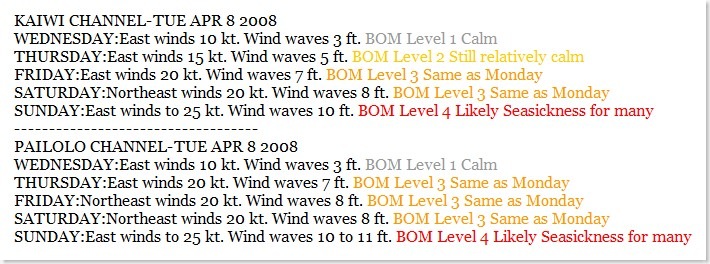
Disappeared News: food riots break out, the US is also affected
Stuffed and Starved: As Food Riots Break Out Across the Globe, Raj Patel Details “The Hidden Battle for the World Food System”
Global food prices have risen dramatically, adding a new level of danger to the crisis of world hunger. In Africa, food riots have swept across the continent, with recent protests in Burkina Faso, Cameroon, Ivory Coast, Mauritania and Senegal. In most of West Africa, the price of food has risen by 50 percent—in Sierra Leone, 300 percent. In the United States there has been a 41 percent surge in prices for wheat, corn, rice and other cereals over the past six months. [Democracy Now, 4/8/08]
With oil at $110 a barrel, it's not just the cost of transporting food that has skyrocketed. Petroleum is also used in fertilizer and pesticide manufacture.
For some crazy reason the US is determined to use corn, which is needed as a foodstuff, to create fuel to keep its gas-guzzling SUVs moving. Nevermind that the CO2 needed to make ethanol is greater than it saves. Nevermind that the demand for fuel ethanol is resulting in food shortages.
Not only do we use up much of the world's oil, but we eat an amazing amount of food:
...the US is the most obese country on the planet. There are only three in ten Americans are now at a normal body weight. And at the same time last year, about thirty-five million Americans went hungry at some point last year. So this contradiction between hunger and obesity is worldwide.
This can't go on. We in Hawaii are more vulnerable to any break in the food supply than is the rest of the country. We should be very concerned to hear:
AMY GOODMAN: Raj Patel, in the last thirty seconds—and then we will bring our listeners and viewers part two of this conversation—but in our last thirty seconds, how devastating are the hike in food prices for those living on the edge?
RAJ PATEL: I mean, they’re absolutely devastating. It’s important to remember, of course, that living on the edge is also devastating, but what we have now is a situation where the food prices are really just toppling people into straightforward hunger and famine. I mean, in Haiti, people are eating mud cakes in order to keep hunger pangs at bay. Things are pretty dire.
We were totally surprised by Aloha and ATA suddenly going out of business. The next surprises will be even less pleasant. Unless we plan, and begin to take action, to reduce our vulnerability.
 | Stuffed and Starved: The Hidden Battle for the World Food System by Raj Patel Read more about this title... |
Safety first, who can argue with that
It seems that the FDA has jurisdiction over sanitary conditions aboard ships. Barf is a bodily fluid, right? Might it transmit hepatitis and who knows what else? Do you want to visit a puke-covered bathroom without taking protective measures, or be the unlucky innocent passenger next to someone who suddenly can't control the urge? Or happen to be in the restroom when the multitudes bust the door down to get in?
Until we learn more, I leave you with this photo, plucked from the Santa Clara County fire department 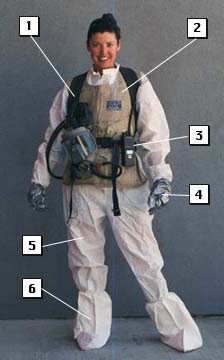 website. They have plenty of other styles to choose from, including some that might provide sunburn protection as well. They also have explanations of the different labeled parts.
Who knows, this could set a fashion trend for seagoing tourists to Hawaii.
Reports of yesterday's ferry ride indicated that there were maybe a couple dozen passengers on board. Imagine the same sea conditions (which are not unusual for Hawaii) and 400 or so passengers, which is apparently the target. If the bathrooms are sloppy now, just imagine... and be prepared.
This model looks like it might fold up into carry-on luggage.
Barf, New York Times excuse for not covering "Winter Soldier"
So Honolulu media choose to omit mention of seasick passengers on a ferry ride. Not a world-class concern perhaps (except that it makes me wonder what else I'm not being told when a big business advertiser is involved).
When the New York Times, however, deliberately chooses to skip coverage of a significant event such as the Winter Soldier hearings held last month near Washington DC, you know that manipulation is afoot.
FAIR (Fairness and Accuracy in Reporting) took them to task. At least, the Times editors responded to their concerns. We didn't know about it, they claimed. Barf!
You can decide for yourself if this great newspaper really didn't know about the hearing. Check out FAIR's article, New York Times Explains Winter Soldier Blackout, which begins:
New York Times public editor Clark Hoyt has offered a response to media activists who wrote to the paper about its non-coverage of last month's Winter Soldier hearings. Hoyt's explanation is that reporters at the Times had "not been aware of the group or its meeting," but likely wouldn't have covered it if they had been aware of the event.
The idea that the Times was unaware of Winter Soldier is remarkable; the paper's D.C. reporters were repeatedly sent press releases about the events, the same ones that other media outlets received that did manage to cover the event, ranging from Pacifica Radio's Democracy Now! to the New York Times' corporate sibling the Boston Globe.
Our local papers are, well, local. The New York Times is probably the most cited newspaper in the world. What they write is influential. With great power comes great responsibility.
Omitting coverage of the four-day Winter Soldier testimony was deliberate and revealing.
Check out also The Lies of our Times, by Amy Goodman and David Goodman.
Maui News breaks press silence on seasickness during ferry ride
I can understand why a TV reporter would not want to admit on camera that she herself might have felt seasick.
I can't understand why the unsanitary and uncomfortable conditions reported today in the Maui News article, Ride ‘really, really rough’, were omitted by other accounts of yesterday's resumption of Superferry services to Maui.
Passengers arriving in Kahului said many of them were puking during the ride.
“The crew was really trying to keep things clean, but there were vomit bags all over the place,” said passenger Monica Bishop in describing her ferry ride.
“You open the bathroom door and there’s puke on the sink,” said Brian Driscoll, a ferry rider from Fargo, N.D., who said he was among those who avoided illness.
“There were sick people all over the place,” he said.
Maybe some of the other reporters couldn't make it to the bathroom (that's why barf bags were invented).
Maybe this information is omitted for another reason. I leave it as a question for the reader.
Kudos to the Maui News for reporting what their readers need to know and for going where other media apparently fear to tread.
The Star-Bulletin devoted a few words on the problem in the middle of their story, Few passengers set sail with Superferry’s return, so I'll include their tiny mention in the middle of mine:
"It was a great trip, great crew, great service," said Larry Jellen, 64, of Waikiki, who sailed round trip with his brother, Tom, 68, of Cleveland. Jellen said a third of the passengers got sick, according to an employee on board. "Going over was a little bumpy, but coming back was smooth."
The Advertiser said nothing. After reading the Maui News and the Star-Bulletin stories, you'd think the "paper of record" would report that many ("a third"?) of the passengers were sick. I'll forgive them if their reporter couldn't make it to the bathroom to see that sink, assuming they had a reporter on board.
Oh, my understanding is that the Barf Index for today is about the same as yesterday, I am still learning how to compute it. At the same time, the Advertiser has posted East shores under high surf advisory. So let's see how today goes, and if the papers will get around to reporting on conditions inside the ship now that they've read the Maui News' superior coverage of this issue.
Instead of silence, Honolulu media might consider learning about and posting the Barf Index as a public service to their readers. Ha!
Interestingly enough, the Barf-O-Meter or Barf Index is so far proving to be accurate. "Barf Threat Level 3 (Orange)", somewhat likely seasickness, seems to describe what happened yesterday.
Perhaps it will come to be applied to similar ferry voyages in other parts of the world. Imagine being able to check a seasickness forecast a couple of days before a planned trip and choosing to fly if things looked like they might be rough.
Monday, April 07, 2008
Report from Maui on Superferry
Will we just wait for the inevitable? Hawaii is so dependent on oil it's gonna hurt one day
I like straight talk. So another plug for Doug Carlson's new blog, Hawaii Energy Options: Time for Straight Talk. What can be more direct than this:
Thank you for your interest in our energy health, which isn't healthy at all. Due to our overwhelming reliance on imported oil for our energy, the Aloha State is on life support. Cut that flow of oil and we'd be in economic arrest. Call it Code Red or simply critical, our condition is alarming and demands action to dramatically increase renewable energy's contribution here.
Slow and maybe queasy re-start for Superferry today
KHON's website article speculates:
Some travelers feeling the crunch from Aloha’s departure are looking for other options to get to the neighbor islands.
Well, maybe some, but not many so far. Today's first Superferry trip after a long stay in drydock saw few passengers, many of them reporters or camera crew. And some reporters were a bit seasick. In fact, the KHON reporter was observed to be a bit under the weather. Let's see how they cover the story tonight.
Brad Parsons was on hand for the arrival of the ship today on Maui. He will no doubt provide more details later, but his phoned-in report is that there were only 12 cars arriving on Maui today, and approximately 45 people, including reporters. Forty got off, and about five were visible still on the ship.
Heading the other way were 15 cars and 1 motorcycle. Brad could not get a people count.
Let's see how the news reports the count. The Honolulu Advertiser story, already on their website, indicates more passengers:
About 100 passengers and just a few vehicles were on board this morning's initial voyage, which was just fine with Garibaldi.
I don't know if Brad counted people in cars or not, but that could account for the difference.
With all those reporters on board there will be more coverage this evening.
It appears also that the experimental barf index (3 for today) was accurate.
Saturday, April 05, 2008
Iranians brought peace to al-Maliki's short war
George Bush had just praised Iraqi Prime Minister Nuri al-Maliki for waging a "historic and decisive" battle against the Mahdi Army, which he said achieved "a defining moment" in the history of a "free Iraq".
Nope.
Remember that it was al-Maliki's idea to start this battle in the first place. And it wasn't going well. How did it end?
According to the article Iran torpedoes US plans for Iraqi oil in the Asia Times:
By all accounts, Iran played a decisive role in hammering out the peace deal among the Shi'ite factions in Iraq. A bloody week of human killing on the Tigris River ended on Sunday.
...
General Qassem Suleimani, commander of the Quds Force of Iranian Revolutionary Guards Corps personally mediated in the intra-Iraqi Shi'ite negotiations. Suleimani is in charge of the IRGC's operations abroad.US military commanders routinely blame the Quds for all their woes in Iraq. The fact that the representatives of Da'wa and [the Supreme Islamic Iraqi Council] SIIC secretly traveled to Qom under the very nose of American and British intelligence and sought Quds mediation to broker a deal conveys a huge political message.
...
Anyone who knows today's anarchic Iraq would realize that triggering a new spiral of violence in that country may not require much ingenuity, muscle power or political clout.
But to be able to summarily cry halt to cascading violence, and to achieve that precisely in about 48 hours, well, that's an altogether impressive capability in political terms. In this case, the Iranians have managed it with felicitous ease, as if they were just turning off a well-lubricated tap. That requires great command over the killing fields of Iraq, the native warriors, and the sheer ability to calibrate the flow of events and micromanage attitudes.
Now, what has this to do with oil? Better to read the details in the article cited above, but one more snippet will give a hint:
Out of the dramatic developments of the past week, several questions arise, the principal being that the Bush administration's triumphalism over the so-called Iraq "surge" strategy has become irredeemably farcical, and, two, US doublespeak has become badly exposed. What stands out is that Washington promoted the latest round of violence in Basra, whereas Iran cried halt to it. The awesome influence of Tehran has become all too apparent. How does Bush come to terms with it?
What has happened is essentially that Iran has frustrated the joint US-British objective of gaining control of Basra, without which the strategy of establishing control over the fabulous oil fields of southern Iraq will not work. Control of Basra is a pre-requisite before American oil majors make their multi-billion investments to kick start large-scale oil production in Iraq. Iraq's Southern Oil Company is headquartered in Basra. Highly strategic installations are concentrated in the region, such as pipeline networks, pumping stations, refineries and loading terminals. The American oil majors will insist on fastening these installations.
The game plan for control of Basra now needs to be reworked.
Bush, if he has any sense at all of what is going on in Iraq, must be muttering something like, "Curses, foiled again."
Fat chance there will be much discussion of this in the American corporate media. For them, it will be Bush's defining moment.
The rest of the world knows better whose moment it was.
Follow the Blue Planet Summit
Doug Carlson has been blogging the Blue Planet Summit over at Hawaii Energy Options.
It's good to see a blogger with expertise in this area and passion for his subject covering the conference.
Check it out. I've added a link to his website over on the left side of this page.
Discover, for example, that "Bin Laden's target point for oil is $200 per barrel," according to James Woolsey, one of the speakers. There's more. You may or may not like the future, but you'll be part of it, so pay attention.
The feds have intervened so badly in our economy, we need something different
The Star-Bulletin editorializes today that Federal action is needed to stabilize airline industry, but they stopped short of suggesting what that action might be.
I have a couple of suggestions:
1) Stop the war in Iraq
2) End the subsidies to hugely profitable oil and energy companies, tax their windfall profits while prices remain high
3) Quit antagonizing Venezuela and instead "make nice"
4) End harassing passengers with overbearing search tactics at airports
You might have a few ideas of your own in mind.
As to federal intervention, the feds intervened already, ending whatever "free market" existed in Hawaii and giving us abnormally high air fares that negatively affected the economy. Here's a snippet from a Maui News article containing comments by economist Paul Brewbaker, Aloha’s departure leaves interisland market muddled:
Aloha and Hawaiian were “near perfect substitutes” for each other, Brewbaker said.
They flew similar planes, on similar routes from similar terminals.
State decisions reinforced their special status. The Department of Transportation, which owns the airports, provided them with adjacent terminals with (in Honolulu) parking nearby and elevators providing direct access to the ticket counters and baggage claim areas. Competitors got less attractive digs.
They were such twins that, back in the days when interisland customers could buy coupons, the two would sometimes accept each other’s coupons and settle the accounts in the back office later.
In that environment, which Brewbaker calls a “noncollusive duopoly,” they reached a pricing “kernel” at $60 as an average price for a passenger’s flight segment.
Because they were not collusive, they cooperated not by fixing prices but by arranging schedules that did not unduly aggravate each other.
But after Sept. 11, 2001, Sen. Dan Inouye arranged an antitrust exemption for Aloha and Hawaiian, and that allowed them to reach a new equilibrium, because it made it less likely that a new third, outside threat would arise.
The new equilibrium settled at $90 a trip.
In comes go!, entering a shrinking market:
Leroy Laney, professor of business and finance at Hawaii Pacific University, said Tuesday that it was obvious that Hawaii could not support three interisland airlines and that it might not even support two. The market is so small (and has been shrinking) that fixed overhead costs made it difficult for either of two airlines to get enough business to get into profitable territory.
So back to the Star-Bulletin editorial.
Working on the factors that produce high fuel costs (to the extent that's possible, should oil supplies be peaking) might be helpful. Artificially propping up a business fated to fail might not, unless the state determines that having two or more airlines is so very much in the public interest (in which case maybe we need a state-run airline?).
The anti-trust exemption didn't help, in the end it may have hurt. $90 wasn't the worst of it, one airline followed the other upwards, tit for tat.
It's not just airlines. The actions of our federal government work against a variety of business interests (excluding oil, pharmaceuticals, tobacco, etc.). You'd think, if corporations really ran this country, they'd be getting together about now and pushing for change. Or even for regime change.
Small and large businesses in Hawaii might think similarly. Imagine having leaders in the Chamber of Commerce or Small Business Hawaii who were willing to work at the root causes of business failure here?
Testing whether barf can be predicted
The Superferry pushed up its schedule to Monday for its first trip after leaving drydock.
What might passengers expect with regard to sea sickness? It depends on the individual, of course. The ocean isn't flat just because winter is over.
Here's the current Barf-O-Meter forecast. This is an experimental calculation which would apply to any "large capacity interisland ferry" on this route (Kaiwi and Pailolo channels). Tomorrow there will be one more chance to test the index.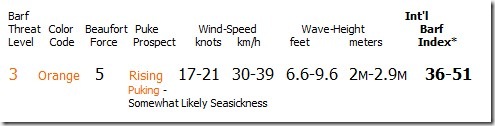
So "Barf Threat Level 3 (Orange)" means something like that anyone who is queasy might have a more interesting ride than most. We'll have to see how accurate this is.
For information on the Barf-O-Meter development, see Seastate Barf-O-Meter Index v.2.2.
While you're visiting Brad's blog, also check out his discussion on the cost of fuel, It's about the fuel, guys, also posted at his new Aloha Analytics Blog.
Friday, April 04, 2008
Who knew what when on Aloha demise?
I also pondered Richard Borecca's story, Shutdown has allies and rivals winging it, the one that Ian Lind wrote about this morning. The sub-head is: Officials considered issues such as hotel space, airport security and adding flights.
A couple of things went through my mind.
First, did anyone consider that Hawaii residents and visitors alike were still buying tickets even as the airline was about to shut down? Suddenly the word "passenger" is replaced with "unsecured creditor." Sounds like some sort of identity theft.
Hey, everyone, lots of residents and tourists are out a lot of money!! And lots of people knew they would lose money it seems!!
The article talked about contingency plans, like making sure there would be places to park airplanes, and that security guards would be in the right places. One can't argue with that, it's much better to have had plans than to let things fall apart (and get blamed for not having plans, of course).
Obviously, the public knew nothing. We don't know what the press might have known, and we can't find that our state government did anything to protect passengers who held tickets already or who, unknowingly, were in the process of paying out for tickets that would be useless the next day.
I'm not saying that the state has any responsibility to protect anyone against a business going bankrupt.
I'm just, for the moment, pondering the unfairness of the little person getting stuck with the short end of the stick all the time, whether it is losing a home while the banks are bailed out, or being allowed to pay for worthless airplane reservations, or losing your pension and medical insurance as a now-former employee. Are we just pawns in a corporate shell game? Are we just sheep to be fleeced? Grrr.
And speaking of fleecing, of course we will now have to pay much more for airfare. I'm not talking about a "fair" fare. There was no move to establish such a fare when Hawaiian, Aloha and go! were engaged in their fare wars. No one said, "Hey, these fares need to be regulated!" In fact, we all (myself included) enjoyed the ability to fly to a Neighbor Island at reasonable cost. No, I mean that now fares can be jacked up until the gauge hits "gouge" just because they can do it.
And as they get away with it, watch the salary and bonuses that Hawaiian Airlines execs will walk away with.
We need a new addition to the bill of rights. Why not set it in law that customers move to the front of the line in bankruptcy court? Why not? When the feds bailed out Bear Stearns, how come the CEO will get paid but those who lost their homes get nothing? When Aloha declared bankruptcy, why were not the ticketholders paid off first, and employees pensions etc. taken care of?
Why not, exactly?
Thursday, April 03, 2008
New record set for blindsiding public?
As you may know, there's supposed to be 48 hours notice given for a hearing at the Legislature.
As you may know, lawmakers often don't follow the rules.
Today a new record may have been set for rulebreaking. Check it out:
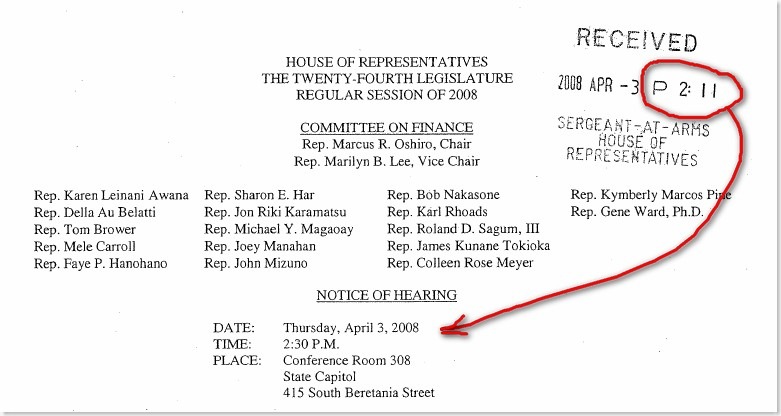
Yup, the public had all of 19 minutes notice, assuming the Sergeant-at-Arms did his work real fast. I hope you didn't intend to give testimony on any of the affected bills... tough luck.
Click the above for the complete hearing notice, as posted on the Capitol website, complete with the date stamp as pictured.
You may also wonder what's going on here. There are a few important bills on the agenda, shouldn't they re-hear the whole lot?
This sort of thing might push me to think we really should have a ConCon, in order to bring an end to the constant abuses at our state legislature.
Kauai's fires a shot across the Superferry's bow
Attached (with thanks to attorney Daniel Hempey) is a copy of the brief just filed on behalf of 1000 Friends of Kauai.
It's very nicely organized and argued. I'm sure that it will serve as a reference for Superferry students, journalists and scholars of the future. I find it interesting to observe first-hand the development of what I think will come to be referred to as a "textbook case" in the usual negative sense.
The narrative is quite dramatic at points. For example:
On August 26, 2007 the Alakai bore down upon Nawiliwili Harbor; turtles and an endangered monk seal were seen in the harbor when the Alakai arrived. The DOT, however, permitted the Alakai to dock at the State owned harbor – without first completing the environmental assessment ordered by the Supreme Court only days earlier.
This is beautiful prose, IMHO. After reading this, I feel the need to defend the helpless sea creatures against this powerful evil and an uncaring DOT. I hope the judge will feel the same way.
Let's see how this goes.
Airlines dropping like flies, is the Hawaii economy next?
It can cost $600 to $1,000 to get out of Hawaii right now. That's probably temporary, but who knows where airlines (and the Superferry) will ultimately peg their rates?
Aloha and ATA have suddenly quit. Gone. No longer flying. Then United Airlines Tuesday canceled some flights out of Hawaii due to FAA orders grounding Boeing 777s.
The papers have stories of stranded visitors who have to pay again to return home, if they can find flights at all. This was unexpected and devastating for both visitors and of course for airline employees and their families.
This leads to fear, uncertainty and doubt for tourists planning their vacations here. It also raises questions about the viability of Hawaii's travel-dependent economy.
The failure of the airlines was disorderly, and it's not clear whether government action could have avoided the sudden shutdowns. One thing that state governments should be doing in the aftermath might be to take a deep breath and look at the current risks to the economy and how that might affect key infrastructure and business health.
Band-Aids may not help as the recession deepens. Nor will amateur efforts to fix it likely succeed. It might be time to round up the economists and other usual suspects, lock them in a room with sufficient beer and snacks, and then pay attention to what will no doubt be bad news but possibly also some good advice.
The alternative is a little waterboarding, which the feds insist is not only legal but effective. (Can you tell what I think of mainstream economists?)
Retired General William Odom counsels rapid withdrawal
See complete article and link to audio files here.
From his testimony before Senate Committee on Foreign Relations:
...we face a deteriorating political situation with an over extended army. When the administration’s witnesses appear before you, you should make them clarify how long the army and marines can sustain this band-aid strategy.The only sensible strategy is to withdraw rapidly but in good order. Only that step can break the paralysis now gripping US strategy in the region. The next step is to choose a new aim, regional stability, not a meaningless victory in Iraq. And progress toward that goal requires revising our policy toward Iran. If the president merely renounced his threat of regime change by force, that could prompt Iran to lessen its support to Taliban groups in Afghanistan. Iran detests the Taliban and supports them only because they will kill more Americans in Afghanistan as retaliation in event of a US attack on Iran. Iran’s policy toward Iraq would also have to change radically as we withdraw. It cannot want instability there. Iraqi Shiites are Arabs, and they know that Persians look down on them. Cooperation between them has its limits.
No quick reconciliation between the US and Iran is likely, but US steps to make Iran feel more secure make it far more conceivable than a policy calculated to increase its insecurity. The president’s policy has reinforced Iran’s determination to acquire nuclear weapons, the very thing he purports to be trying to prevent.
Withdrawal from Iraq does not mean withdrawal from the region. It must include a realignment and reassertion of US forces and diplomacy that give us a better chance to achieve our aim.
A number of reasons are given for not withdrawing soon and completely. I have refuted them repeatedly before but they have more lives than a cat. Let try again me explain why they don’t make sense.
First, it is insisted that we must leave behind military training element with no combat forces to secure them. This makes no sense at all. The idea that US military trainers left alone in Iraq can be safe and effective is flatly rejected by several NCOs and junior officers I have heard describe their personal experiences. Moreover, training foreign forces before they have a consolidated political authority to command their loyalty is a windmill tilt. Finally, Iraq is not short on military skills.
Second, it is insisted that chaos will follow our withdrawal. We heard that argument as the “domino theory” in Vietnam. Even so, the path to political stability will be bloody regardless of whether we withdraw or not. The idea that the United States has a moral responsibility to prevent this ignores that reality. We are certainly to blame for it, but we do not have the physical means to prevent it. American leaders who insist that it is in our power to do so are misleading both the public and themselves if they believe it. The real moral question is whether to risk the lives of more Americans. Unlike preventing chaos, we have the physical means to stop sending more troops where many will be killed or wounded. That is the moral responsibility to our country which no American leaders seems willing to assume.
Third, nay sayers insist that our withdrawal will create regional instability. This confuses cause with effect. Our forces in Iraq and our threat to change Iran’s regime are making the region unstable. Those who link instability with a US withdrawal have it exactly backwards. Our ostrich strategy of keeping our heads buried in the sands of Iraq has done nothing but advance our enemies’ interest.
Wednesday, April 02, 2008
1,000 Friends of Kaua‘i appeal Superferry decision
From an article in yesterday's Garden Island, Kaua‘i group appeals Superferry rulings:
Claiming that Hawaii Superferry profits do not trump federally mandated environmental requirements, attorneys filed an opening brief in the Intermediate Court of Appeals this week.
Attorneys argued in the brief that Kaua’i should enjoy the same constitutional protections afforded to everyone else in the state.
The article details the group's arguments. It also raises anew the extent to which the governor's office was cooperating with the ferry company in avoiding completion of environmental assessments:
Though the Lingle administration has claimed it was surprised by the Hawaii Supreme Court ruling for an EA in the Maui case, Hempey said, “the fact the DOT wrote four separate letters to exempt four harbors back in 2005 suggests that they were trying to circumvent environmental law all along.”
Tuesday, April 01, 2008
Wal-Mart drops suit against Shank family
Keith Olbermann said he would pound Wal-Mart every night until they caved. He pounded, every night, and today they caved (see video below).
Every day more newspapers across the country picked up the story of what he is doing and, of course, the plight of the family.
In a nutshell, Debbie Shank, a 52-year-old mother of three, suffered severe brain damage in a traffic accident. She won a $417,000 settlement, which the family set aside in a trust for her future medical expenses. Wal-Mart sued the family for $470,000 to reimburse the company for every cent it had paid for Debbie's medical bills because of a clause in her medical insurance contract, and they won.
Wal-Mart, with billions in profits, did not need to sue the Shank family, but they did. To top it off, Debbie's son was killed in Iraq. Although she attended his funeral, she asks about him every day, and weeps when she hears the news.
Tonight Olbermann asks how Wal-Mart will compensate the family for all of the legal torture. Jim Shank will appear on tomorrow's Countdown. Don't miss it.
Here are some emails to try if you would like to express thanks to Olbermann after viewing the videos below:
viewerservices@msnbc.com
letters@msnbc.com
countdown@msnbc.com
KOlbermann@msnbc.com
Today's Countdown:
Yesterday's
This is such a wonderful example of media activism. I hope Olbermann gets awards for this.
Do-it-yourself disaster planning
I have to agree with Hunter Bishop, for the reasons he gave in Volcano hazards now color-coded, that the Big Island's disaster planning, including the new brochure, is unhelpful. It does say some useful things about ash and sulfur dioxide, but not a lot about civil defense.
Basically, the brochure says "you're on your own."
There's even a bit about making your own evacuation plans, but nothing about where to go.
So I suppose, in the absence of any official guidance whatsoever, Big Island Civil Defense might turn themselves into traffic cops, guiding families in cars through intersections as they scurry here or there, like ants, trying to go somewhere other than where they are.
Think of it: while some families will be leaving their neighborhood, others may be moving in.
Why not have a plan, and let people know about it?
One of the most helpful suggestions is to wear a mask, but if you find it too difficult to breathe, take it off.
The brochure says nothing at all about how residents will be warned or what they are supposed to do or where to go. There's a nifty color code system on the back of the brochure, but no indication of where/how it will be used. There's nothing about sirens or radio warnings, emergency stations, where the shelters are located (are there shelters?) or the conditions for using them (pets? no pets?). Nothing. Zilch.
I hope there's another brochure with all the missing stuff.
In a comment to another post on Hunter's blog, the writer says "...CD has NO staff! Hard to write a plan when there is no one to write them! " Farther down, someone else states that plans are being developed. Better late than never, I suppose. Maybe they should hurry some more. The volcano won't wait.
Oahu has no volcano but we'll have our own disasters one day. We could sure learn from this what not to do.
Flash! Hawaii Superferry Corp. buys Aloha Airlines
Yes, and they plan to put their new headquarters at Turtle Bay.
Now it all makes sense.
On the national scene, results of 2008 election announced
It's McCain. You knew that, of course.
The Onion reported today that Diebold Accidentally Leaks Results Of 2008 Election Early.
Check out the earliest election returns in US history in their video report.