Monday, March 31, 2008
Can it be that only bloggers push for better disaster planning?
--Hunter Bishop
Hunter Bishop writes in What disaster planning? about this and more. Or less, maybe I should say. The Big Island may be as unprepared as we are here in Oahu. Which is odd, given that there's a live volcano right in the middle of the place and they have recently had a damaging earthquake. You'd think they'd wake up.
Hunter is concerned about ash in catchment tanks and the effects of acid rain. He complains that even in Harry Kim land, there seems to be a lack of disaster preparedness and planning (this is a short snippet, please read the whole article):
Holy Katrina! Now they are planning?
Evacuation notification plans could have been written already, the protocols shared with communities and perhaps even tested. But no, somebody will be going "door-to-door, if necessary." Why are we still figuring this out?
And about that evacuation. Would it be mandatory? Where would people go? How would they get there? How long would they stay? At what cost? Who pays? What about the infirm? People's pets? Livestock?
What about the security of people’s homes from the threat of looting in an evacuated area? Are there plans to call in the National Guard? Is the guard in fact available? Or is it too busy with Iraq?
Maybe you think I’m being alarmist but shouldn’t someone start thinking aloud about the answers to these questions before they are raised in the heat of a dire emergency? Or will everybody be on their own?
It’s time Mayor Kim leveled with residents about disaster emergency plans, whether we have them or not. And it’s time to stop the paternalistic patter and to partner with communities in developing these plans and making them public before they are needed in order to avoid unnecessary panic, anxiety and confusion in the event of a real disaster.
I've written about the lack of disaster planning including the troubling weakness in our system of medical care. With doctors in short supply in many specialties in rural areas, a disaster could be, well, a disaster. Doug Carlson holds forth on disaster planning and related topics at Citizens Helping Officials Respond to Emergencies.
I'll close by asking if you know where your designated shelter is, and who has the keys to let you in? Does your condo have a plan for elderly residents and others with mobility problems? Have you ever been handed an evacuation plan?
Why is it that mostly bloggers are asking these questions? And of course, when do we get answers? Nah, they don't care about us.
But more important, they don't care about you either.


No save, it's the end for Aloha it seems
This just posted on the Advertiser's website:
Governor tries to intervene in Aloha bankruptcy case
However, in case the petition fails, the governor said the state has also activated a rapid response team to help the 3,500 Aloha employees and their families, who will face the most immediate effects of the airline closure
Bankruptcy judge will not stop Aloha shutdown
and that "gut and replace" corporate welfare bill has passed the Senate:
State Senate passes tax relief for interisland airlines
Over at the Star-Bulletin, an AP story:
State leaders scramble in attempt to save Aloha
About 1,900 employees may be affected by a shutdown, Lingle said. A government labor team has been formed to evaluate their job skills and determine what type of job placement assistance might be needed.
And by Star-Bulletin staff:
Court rejects state bid to save Aloha Airlines
Maybe we'll learn soon how many employees Aloha actually has (had).
Just a closing thought: the same number of passengers need to fly without Aloha as when it was flying. Surely there will be jobs for some Aloha employees. It still takes pilots, mechanics, etc., to get all of those people back and forth.
No aloha on line, anyway
Sorry, no news here. Check the commercial media. I tried. I really wanted to know if the judge would even give Lingle's representative standing to make any kind of motion or even speak. We'll find out later.
I went down to Bankruptcy Court hoping to get in. I figured the courtroom might be small, so I got there early, about 1:20. There was a huge crowd outside—Aloha Airlines employees and their families as well as folks from related unions, and of course, the TV cameras. There were signs and plastic megaphones and some good t-shirts. Some t-shirts blasted Mesa, but most were pro-Aloha.
So I went into the building and got on line. Surprisingly, there were only about a dozen people altogether waiting, so I was feeling like I would get a seat, the courtroom couldn't be too tiny.
Then WHAM! In piled Aloha employees mostly in their work uniforms, and they pushed ahead of all of us line-waiters right to the front, where they stayed laughing and chatting. In fact, there wasn't a long face anywhere. The only serious looks were owned by the many attorneys in their strange black outfits who of course went in freely ahead of us.
Now, I know I would never get away with pushing ahead like that at the airport! No way! But what to do? I was probably the only one there not an employee or mechanic. Actually, I began to feel guilty, thinking I might take up a seat instead of an Aloha employee. After all, they are about to lose their jobs and I'm just there, well, to write something in a blog.
The bailiff then went to the back of the line, now probably 60-80 people long, and told them that they wouldn't get in, better to go upstairs to room 606, where there is a TV set up.
So I was third in line, still waiting, still hoping. But the bailiff got a radio message, no more room. The judge was not allowing anyone standing in the courtroom. And up to 606 we all went. It was like rush hour in Tokyo. Everyone was still strangely in good spirits, making jokes about squeezing into elevators and not weighing too much.
Up on the sixth floor the room with the TV was already packed full.
Oh, well.
Downstairs again I thought I'd grab a late lunch at Govindaji. Oops, they closed at 2 p.m. But with the only good luck I've had today (I'm not even going to tell you what Windows Vista did to me before I left), they let some of us in, and I had a great vegetarian Thai red curry.
So I've wasted your time reading this, I have nothing to tell you except how good the curry was and that usually, if you want to eat at Govindaji (1118 Fort St. Mall, 585-0960), it's best to get there between 10 a.m. and 2 p.m.
Sunday, March 30, 2008
Aloha
In quick succession today came the news that Aloha airlines will be shutting down passenger service Monday and that the governor will ask the judge to delay the shutdown at a scheduled hearing Monday afternoon:
Lingle questions Aloha shutdown, will ask bankruptcy court for delay
Gov. Linda Lingle said she will ask a bankruptcy judge not to allow Aloha Airlines to shut down until she is satisfied the airline "exhausted all possible avenues for continuing its operations."
If you would like to attend the hearing, here is the posted calendar for the case. Monday, 2 p.m., 3rd Floor of the Federal Courthouse.
Correct location of Bankruptcy Court (thanks, anonymous commenter!) from their website:
The court is located in downtown Honolulu, on Bishop Street between Beretania and Hotel Streets, with entrances at both Union and Fort Street Malls. We are on the Lobby Level of 1132 Bishop, towards the glass doors in the north corner. You will be required to show a picture I.D. and pass through a metal detector. No electronic devices (cell phones, pagers, PDA's, etc.) are allowed on the premises. You may leave these items at the security desk and reclaim them when you leave.
Mailing Address
United States Bankruptcy Court
District of Hawaii
1132 Bishop Street, Suite 250-L
Honolulu, HI 96813
You'll have to leave cellphones in their little filing cabinet before going in (or better, leave it in your car since no one supervises the file cabinet). The calendar below will be at this link only for a few days.
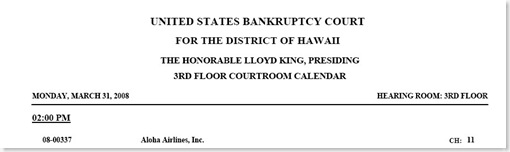
The court maintains a web page for the case here. Aloha Airlines has a press release and FAQ here.
I am wondering if even a governor can compel an airline that has run out of money to continue operating. It should be an interesting, and very sad, hearing tomorrow. The articles note that over 1,900 employees and their families will be affected. They would normally be due 60 days notice if their jobs are to end. Update: this evening's news articles mention 3,500-3,550 full- and part-time employees.
In addition to the direct job loss, the ripple effect of this shutdown through Hawaii's economy will probably be hard to predict.
Pure corporate welfare for Aloha Airlines planned
HB509, the poor bill that has been gutted to save Aloha Airlines, is pretty explicit about its intent:
The purpose of this Act is to assist Hawaii inter-island air carriers whose operations and revenues have been adversely affected by the recent inter-island travel fare wars by authorizing the department of business, economic development, and tourism, through its director, to guarantee loans from private lending institutions.
In other words, three businesses (Hawaiian, Aloha, and Mesa) have freely chosen, as a business practice, to engage in a perpetual fare war, and now one is paying the consequences. So we, the people, are supposed to bail them out? And does this bill do that? Won't the fare war continue? Won't it destroy Aloha in the end even with a loan?
There is a legitimate argument for maintaining availability of interisland air travel. The economy of the state would be in a shambles if all we had were the Superferry. The Legislature should look at all the available options, including (if it's possible) fare regulation.
The bill provides that the loan may be used for working capital. What's to prevent Aloha from simply spending it down to nothing?
Loan guarantees are also a gift to companies that might extend them. They are eligible to keep the profits, but protected against the loss. This is the same thinking that saves Bear Stearns but lets homeowners swing in the wind.
What about a small business that makes a bad decision? Will the State of Hawaii be there with legislation to keep them afloat? No way. The state would have plenty of reasons why bad choices shouldn't be rewarded at public expense. Those same reasons should apply to Aloha.
Advertiser strengthens rail bias
I was curious about the headline All sides of rail debate presented that editor Mark Platte chose for his commentary in the Focus section of today's paper. I'm guessing that the editor, unlike most writers, gets to choose his own headline.
Why, thought I, would an article defending the paper against bias on the choice of a transit technology use the word "rail," instead of "transit?" It reinforces a "frame" for discussion which excludes other transit modalities.
In this commentary, the word "rail" appears exactly 20 times. The word "transit" appears twice, as headlines of other stories referenced. But in the on-line version, there were no jumps to those stories, which would have been nice had readers wanted to check out the other points of view.
Elsewhere in the paper, the report Council to revisit type of transit demonstrates that the choice of technology for Honolulu's proposed transit system is still being debated. There is a chance, however large or small, that there may be no rails ("rail: one of a pair of steel bars that provide the running surfaces for the wheels of locomotives and railroad cars" or "the railroad as a means of transportation: to travel by rail.").
Saturday, March 29, 2008
Is it time to bid Aloha to Aloha?
In New York, the rich folks who run Bear Stearns and JP Morgan are being bailed out. They need the help of our federal government, or they might lose their yachts and country club memberships.
Nevermind all the homeowners who lost their homes, the rich folks are being taken care of. The sale took place and then the Fed put extra gravy on their potatoes.
In Hawaii, we are, or maybe we are not, bailing out Aloha Airlines. It's hard to tell what is going on here. Isn't Aloha doomed already, whether or not the Legislature gives them a loan guarantee?
Do you remember when Interisland fares started from $144 for the lowest-priced round-trip tickets, if you could get them? Without planning ahead, you could get stuck paying $208 for that same trip.
Then the airlines took away the price advantage for early reservations and charged according to the flight, so the convenient morning flights, for example, cost more. In 2003, weekly rates for commuters jumped to $599 and monthly passes to $1999 (note the dumb supermarket prices). As a last straw, the airlines cut discounts to tour operators and others.
Ok, so fast-forward to the recent fare wars. $19, $9, even free, for a one-way ticket. $39 not unusual. Were we being gouged when the airlines charged peak fares, or was there some fare needed to keep them profitable? Probably, both are true.
And so Aloha goes bankrupt (again) and the Legislature panics and rapes a perfectly innocent bill moving through the Senate (HB509) to "save" Aloha. We'll get back to this at the very end of this article.
I'm skeptical that it can work. Why? Aloha has started selling off bits of itself. Guess what will happen. The profitable parts might find a buyer, the unprofitable parts may not. Without the profitable parts, there is no gold in the goose. In other words, no profit, no airline.
A Seattle cargo company, Saltchuk Resources Inc., has bid for Aloha's profitable cargo assets, equipment and service lines. If the bankruptcy court permits the sale, then what's left of Aloha will be less viable than before. Keep in mind that Hawaiian has profitable Mainland routes and Mesa seems determined to keep go! going at any cost. This does not bode well for Aloha even with loan guarantees and tax breaks. Why does anyone think that loan guarantees will provide a long-term solution for what's left of Aloha?
Aloha may be just the first of many bankruptcies now on the horizon. As the recession deepens we may see more businesses fail. It comes with the territory. Which should they be bailed out? Shouldn't a failing business just fail, speaking generally?
It used to be that businesses took a risk in order to make a profit. If they lost, so be it. Now, our government eliminates the risk but lets them keep the profit. Note that Bear Stearns/JP Morgan is still keeping their fees. Socialism has arrived in the USA for corporations.
The Fed bailout was extra-legal according to some analysts:
In effect, the Federal Reserve decided last week to overstep its legal boundaries – going beyond providing liquidity to the banking system and attempting to ensure the solvency of a non-bank entity. Specifically, the Fed agreed to provide a $30 billion “non-recourse loan” to J.P. Morgan, secured only by the worst tranche of Bear Stearns' mortgage debt. But the bank – J.P. Morgan – was in no financial trouble. Instead, it was effectively offered a subsidy by the Fed at public expense. Rick Santelli of CNBC is exactly right. If this is how the U.S. government is going to operate in a democratic, free-market society, “we might as well put a hammer and sickle on the flag.” [Hussman Funds Weekly Market Comment, March 24, 2008]
Back in Hawaii, the Legislature's loan guarantee appears to be a Band-Aid measure. It does nothing to resolve the fare wars. If Aloha is losing $5 million a month, the Legislature needs to have a business plan in hand from the airline showing that these guarantees will make a difference.
If Aloha is losing money today and sheds its profitable cargo business, why would anyone expect it to be more profitable tomorrow?
Just to wrap up, let's look at what happened to that poor bill. It suffered what is called a "gut and replace" operation.
"Gut and replace" is by its nature antidemocratic. The bill that was passed was not the bill that was heard earlier by each committee.
Chairs get away with it because the public generally doesn't know what has happened. Also, no one in the Legislature seems to bear any consequences if rules are broken. The rule in this case is Senate Rule 54. Bills: Amendments:
Rule 54, line 2:
(2) The fundamental purpose of any amendment to a bill shall be germane to the fundamental purpose of the bill.
But the important thing, one might say, is to preserve competition in interisland air services. If so, then the status quo is unsatisfactory. Aloha can't survive cutthroat, routine fare wars.
It would be better for the Legislature to contemplate sensible regulation of the industry.
Friday, March 28, 2008
Isn't it great when it happens?
 I love when the opposition gives me a line I can pick up and run with. A deputy Attorney General did that today.
I went to the Legislature to testify on HB7, a bill that would join Hawaii with five other states (Illinois, Kansas, Wisconsin, Missouri and Vermont) in a purchasing program that imports prescription medications from overseas. Snippet from the Illinois web page:

This would be an option, not a mandate. It would be one way that seniors, persons with disabilities, or those on fixed or low incomes could lower their costs for medicine. Many insurance plans don't include a drug benefit. Costs for these medicines are soaring, along, of course, with drug company profits.
Testimony has been overwhelmingly in support of this bill, which has passed both houses of the Legislature without a single No vote.
The only testimony against has come from the pharmaceutical industry (predictably), from the Attorney General's office and also from a representative of Lillian Koller, Department of Human Services, saying it would interfere with their priorities (pity that saving seniors money has not been their priority).
The deputy AG has testified that it is illegal, but under questioning, admitted that no one has been arrested for participating.
Millions of Americans are purchasing drugs from Canada or other countries. It turns out that these are the same drugs purchased here at grossly inflated prices. Our drugs, like almost everything else, it seems, are made in factories overseas.
Well, today there was a different deputy AG. He did say that the program was illegal under federal law, but indicated that the AG's office did not oppose the bill.
After extensive questioning, he said, and you gotta love this: "Nobody in their right mind would oppose lower drug costs." I wrote this down as fast as I could scrawl on the screen of my tablet PC. And I'm going to send it to Lillian Koller.
You may recall that the Administration is refusing to implement Rx Plus, the program that would negotiate discounts for prescription drugs. Yes, it's the law, and last session the Legislature changed "may" to "shall" so that there would be no excuse. There is no excuse, but DHS continues to ignore the law. Seniors should have had the benefit of lower prices since 2004.
Of course, the governor wants to remain friends with her rich buddies in the drug industry. Campaigns depend on these folks with deep pockets, and they do get returns on their investments, it seems.
Let's see if the governor vetoes this bill (See: cheating seniors out of their prescription benefits).
If she does, we can remind her that "Nobody in their right mind would oppose lower drug costs."
I hope the deputy AG doesn't get fired for this.
Wal-Mart's ugly face
 This isn't "disappeared news," it's spreading like wildfire all over the web, thanks to the efforts of Keith Olbermann on MSNBC and bloggers who are carrying stories and videos. It was the most emailed story on CNN.com.
In a nutshell, Debbie Shank, a 52-year-old mother of three, suffered severe brain damage in a traffic accident. She won a $417,000 settlement, which the family set aside in a trust for her future medical expenses. Wal-Mart sued the family for $470,000 to reimburse the company for every cent it had paid for Debbie's medical bills because of a clause in her medical insurance contract, and they won.
Wal-Mart, with billions in profits, did not need to sue the Shank family, but they did. The family doesn't know how they can ever pay Wal-Mart and provide for Debbie's needs. To top it off, Debbie's son was killed in Iraq. Although she attended his funeral, she asks about him every day, weeps when she hears the news.
There must be a special place in hell for company executives who would do this.

For the complete, ugly story, check out this article on Huffington Post by David Nassar, Will Wal-Mart Do the Right Thing for Brain-Damaged Ex-Employee Debbie Shank's Family?
More is at Wal-Mart Watch. If you click the top image in this article it will take you to a Wal-Mart Watch article which has information on a petition, a Shank family donation page, and other articles (including Big Box, Small Heart, a great title).
Keith Olbermann takes on Wal-Mart
Keith Olbermann says he going to feature Wal-Mart's CEO on his World's Worst segment every night until Wal-Mart caves.
It's a new kind of activism. In addition to supporting Deborah Shank, we should also express our thanks to Olbermann for his unique approach to pounding some humanity through the thick, greedy skulls of Wal-Mart's management. Here are some emails that may work (if they haven't been turned off by the time you try them):
viewerservices@msnbc.com
letters@msnbc.com
countdown@msnbc.com
KOlbermann@msnbc.com
And the first two Worst segments:
If you have a blog, please consider posting something to keep the pressure on Wal-Mart.
And of course, if you still shop there, why not consider whether you still want to support a company that would do this.
Thursday, March 27, 2008
Turtle Bay tonight on Town Square
What's really happening up North with the Turtle Bay buyout?
Listen tonight, Thursday, to Town square on Hawaii Public Radio 5-6 p.m., KIPO, 89.3 FM to learn from members of the Keep the North Shore Country Coalition what's happening with this project.
Host Beth-Ann Kozlovich will be taking phone calls at 941-3689.
Sunday, March 23, 2008
Honolulu transit noise: barriers work only if they build them
An op-ed in today's Advertiser, Modern steel wheel not your father's technology, proposes that the noise of an overhead transit system can be abated by use of short sound walls, and features an illustration of San Francisco's BART system.
Trouble is, this solution requires that the sound walls be built, and in a town which has done nothing to install sound abatement measures on its noisy highway system, what is the likelihood that Honolulu will have a sudden change of heart? I can hear Mufi saying "we can't afford it" and poof! no sound walls.
It's going to be bad enough for anyone who lives or operates a business near the Honolulu transit elevated right of way. Sound barriers wont help if your condo is above the tracks or if you are very close or underneath. Sound barriers also do not reduce the vibration of rail transit passing by. More discussion is clearly needed.
At base, Honolulu has not developed the standards necessary to reduce noise. Contrast this with Tokyo, which decades ago realized that the most effective method of reducing its pollution problem (including noise) was by regulation of the pollutant source. That is, Tokyo set standards for emissions, noise, and other urban pollutants and then enforced them.
Since Honolulu has not set standards to reduce transit noise (from cars or trains) there is nothing saying that noise will ever be reduced here. Reducing noise has not even been on our radar screen. The police seem never to enforce laws that would quiet motorcycle or other noise pollution. Maybe we care about noise, but our city government clearly doesn't.
One thing the Honolulu City Council could do, if it is concerned about noise, is get busy setting some standards. This could influence a decision on mass transit. That is, the choice of technology.
Japan regulates noise levels with monitoring stations located around the country. Standards are of little use unless they are enforced. Japan does that, Honolulu does not. As a result of enforced standards, transit in Japan has become quieter.
 Tokyo's elevated highway system (a blight, but at least a mitigated one) uses sound walls combined with high sound-absorbent barriers extensively. Special low-noise paving (porous asphalt) is used (and unrelated to noise, white paint for pavement marking that reflects headlights back to the driver).
Honolulu uses none of this. In fact, the design of sloping embankments reflects sound and makes living near the H-1 a constant ordeal of noise.
Where the Shuto Expressway passes through certain areas of suburban Tokyo, barriers rise higher than the picture, and even arch over the roadway for further absorption. It's like driving in a sound-absorbing tunnel on some sections west of Tokyo.
Given the standards, transit in Japan has had to reduce noise through the extensive use of noise barriers, construction of underground rail and road sections in built-up areas, and the use of low-noise pavement for vehicular traffic.
Transit noise not just from wheels
It's not just an issue of steel wheels, by the way. Stations are noisy places by design—they are places where passengers are given information and warnings.When a train pulls into a station, there will typically be announcements and warning bells, tones, or buzzers. Then there is a voice announcement of the station, and finally warnings (possibly multi-lingual for tourists) or bells about the doors closing.
I've written previously on how happy we were when the old Myrtle Avenue El was torn down in Brooklyn. A good part of our joy was the silence that replaced the cacophony of constant loudspeaker announcements and clanging bells. At last, no more interference with lessons in our classroom nearby the station.
With regard to trains and subways in Japan, I understand that some changes have been made to reduce the noise level around stations, but they are starting with a huge established system they have to tame. Here's Tokyo's transit system map (click for a larger image):

Honolulu is struggling to avoid becoming like Tokyo (I hope). We have an advantage: we can make choices on what we would like for ourselves, including choosing to maintain a high quality of life.
Finally, one thought about the rubber-wheel solution: if emergency vehicles are also allowed to use the elevated roadway, then there is no need for them to use sirens, for example. That current source of noise pollution can actually be reduced if a Phileas-type system, with on- and off-ramps to connect to UH and Waikiki, is selected, and if emergency vehicles can share the roadway with transit.
For train or urban design freaks, here's a book that treats the design of transit facilities seriously.
 | Building Type Basics for Transit Facilities (Building Type Basics) by Kenneth W. Griffin Read more about this title... |
Bottom line on transit noise in Honolulu: it hasn't been a priority until now, so why do we think, when the $billions in construction costs come up for approval, that anyone will spend money to reduce noise?
Saturday, March 22, 2008
Read any good newspapers lately?
Maybe people are reading newspapers less because of the increasingly obvious bias in the commercial media.
Maybe people are reading newspapers less because there's too much disappeared news. Things we actually know a little about that don't get printed, like who is responsible for atrocities in Palestine, what happened to the Superferry in drydock, what the Winter Soldiers said last weekend that we all need to hear. What is the civilian death toll in Iraq, why no presidential candidate is asking for single payer national health care, what have their voting records been?
Maybe people are reading newspapers less because all they talk about is how much money politicians rake in for campaigns without discussing the paybacks that are expected for those bribes.
Maybe we don't want so many "info-mercials," maybe we don't look upon ourselves as commodities to be served up to advertisers. Maybe the pizza ads are making us fat.
Maybe, as per the comment (thank you) added to a previous article, we now have alternatives:
circulation could be dropping because no one wants to buy that stuff anymore. it's not convenient (folding a paper the right way is an art generation Xers never learned) and it's just crap anyway. it always was crap, but now we've got an alternative.
Maybe newspapers that use a single typeface for almost everything are just plain boring. I just discovered that there are several typographical videos on YouTube. What a gas for typography freaks like me.
Funny, kind of:
Artistic:
(if you go to any of these on YouTube, the "related videos" have some powerful works including some that don't fit on a family blog like this....)
There's still a lot to be said for the static page—for books that last for years, for comics that teach kids to read, and even for newsprint destined for the landfill next week. But on the Internet, words can inform, challenge, and yes, even dance. To compete, newspapers might think about how they can do their important job better (hint).
'Cause the Internet not only informs us, but it listens to us and it's often a lot more fun.
Friday, March 21, 2008
Religion, politics, and presidential candidates
I read the September 2007 Mother Jones article, Hillary's Prayer: Hillary Clinton's Religion and Politics, and became very concerned. It wasn't just the terrible caricature of her which headed the article:

What I found scary is the thought that if she should become president, and if the story is accurate, we could find our country led by another strong religious conservative who cannot isolate her beliefs from from her political actions. And I don't think it would be a good thing to do that again.
Now that the press is working Obama's religious beliefs and affiliations over the coals, I thought I would discuss the above article a bit here. And I could, but I would be doing you a disservice. A far better discussion appeared Thursday in the Progressive Review Undernews:
WHY IS THE MEDIA PAYING SO MUCH ATTENTION TO OBAMA'S PREACHER?
AND NONE AT ALL TO MCCAIN'S RIGHTWING MINISTER PAL AND CLINTON'S MEMBERSHIP IN A GROUP OF RELIGIOUS EXTREMISTS?
THE CORPORATE media is doing a major hit job on Barack Obama's ties to a minister given to hyperbole, but is nearly completely ignoring John McCain's extremist religious backer, Rev John Hagee, or Hillary Clinton's involvement with a group of religious fanatics known as the Fellowship. Both these stories have been reported here before, but to make it easier for the corporate media to introduce a touch of fairness into its coverage, here's a reprise plus a clip from a new Nation article. [Undernews, 3/20/08]
Please check this out if you are curious about the candidate's religious affiliations and how they might influence decisionmaking in the White House. If only we could ignore a person's private beliefs. Ideally we should, but if our leaders keep injecting their beliefs into their leadership then their beliefs become fair game. In fact, with the clash of religious extremists currently driving world politics, an understanding of the interaction of religion and politics is essential.
I'm indebted to peace researcher and visiting UH professor Johan Galtung for his emphasis on cosmology (broader than just religion) as a driving force of world history. In other words, to ignore how a person's background influences them as a leader would be foolish.
Sunrise over Halemaumau Crater in Hawaii Volcanoes National Park
What a thrill to watch the sun rise over Kilauea Volcano on the Big Island on the wide computer screen.
There's a webcam, actually three side-by-side to form a panorama very suited to computer widescreen displays, here. Pictures are beginning to turn up around the web, for example, here, but Google for more.
From the webcam a few minutes ago:
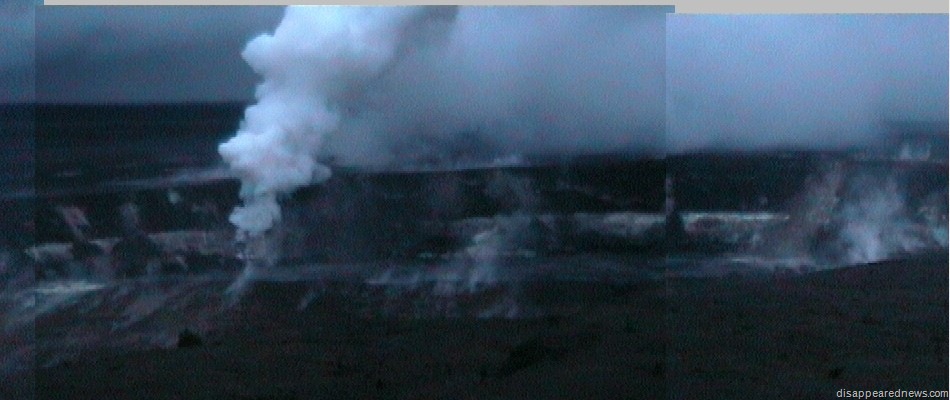
No point watching all day to see if the volcano explodes again, but the view is still breathtaking, particularly if you have visited the scene and have the real picture, the full expanse of the crater, in your mind's eye.
Scientists do not know whether — or when — a similar explosion will occur, Brantley said. There were no reported injuries, but falling rocks — including a boulder about 3½ feet in diameter — damaged the popular Halemaumau lookout and its parking lot. Rubble was scattered along Crater Rim Drive, the road that visitors use to drive through the park, Brantley said.
The explosion at Halemaumau crater was the first since 1924. [USA Today 3/20/2008]
Also check out the Hawaiian Volcano Observatory web page. For general Hawaii volcano images scattered all over the web, Google finds them, and Flickr has an overwhelming 42,149 posted by individuals, including 424 of Halemaumau crater.
Wednesday, March 19, 2008
Disappeared News: Winter Soldiers are shunned by the commercial media
Thank goodness for Democracy Now! and other alternative media which have been covering the Winter Soldier hearings held this past weekend near Washington, DC. If not for the alternative media, there would be no notice in this country of the moving testimony given by our veterans who chose to speak publicly about their experiences in the Iraq war.
The rest of the world, of course, is tuned in. But our commercial media (including PBS) are doing their best to keep this news away from the American people. Make no mistake, the decision to keep Winter Soldier off the air and out of the newspapers was deliberate. They are suppressing the news they don't want you to have.
Here is a snippet from an article posted today by Fairness and Accuracy In Reporting:
Why Are Winter Soldiers Not News?
3/19/08
Dozens of veterans of the Iraq and Afghanistan wars gathered in Silver Spring, Maryland last weekend for the Winter Soldier: Iraq and Afghanistan hearings (3/13/08-3/16/08), where they offered harrowing testimony about atrocities they had witnessed or participated in directly. The BBC predicted that the event, organized by Iraq Veterans Against the War, "could be dominating the headlines around the world this week" (3/7/08). The hearings were covered as far afield as the U.K. (Guardian, 3/17/08), Australia (Australian Broadcasting Corporation, 3/14/08), Croatia (Javno, 3/16/08), and Iran (Press TV, 3/14/08). Yet there has been an almost complete media blackout on this historic news event in the U.S. corporate media.
Despite being noted in the New York Times' Paris-based International Herald Tribune (3/13/08), Winter Soldier has yet to be mentioned in the New York Times itself. No major U.S. newspaper has covered the hearings except as a story of local interest; the few stories major U.S. newspapers have published on the event have focused on the participation of local vets (Boston Globe, 3/16/08; Boston Herald, 3/16/08; Newsday, 3/16/08, Buffalo News, 3/16/08).
The Washington Post, too, published their account in the metro section (3/15/08). In contrast, the paper published an article about pro-war demonstrators protesting the Winter Soldier hearings in the A section (3/16/08), despite the fact that they were, according to the Post, "small in number."
None of the major broadcast TV networks (ABC, NBC, CBS) have mentioned the hearings in their newscasts. PBS has been silent as well. [FAIR: Why Are Winter Soldiers Not News? ]
On the other hand, pro-war coverage continues, as the same FAIR article mentions:
While the testimony of soldiers who had served multiple tours of duty was broadcast on Pacifica Radio's Democracy Now!, Free Speech TV, and the Real News network, the major broadcast networks and PBS instead devoted airtime to the pro-war assessments of Vice President Dick Cheney and Sen. John McCain, both of whom have only made brief visits to Iraq (NBC Nightly News, ABC World News, CBS Evening News, PBS NewsHour, all 3/17/08).
Tune in to Democracy Now on radio, TV or via the web to catch up with the testimony, or go to one of the websites linked above. Don't be left out. Go for the information if the commercial media won't bring it to you.
The full FAIR article includes email addresses and phone numbers you can use to chastise the major networks for not carrying this crucial story. [I wonder why newspaper circulation is decreasing? Could it be that they don't bring us the news we need? Could it be that we're tired of the war and the war drums that they are still beating?]
Also see Joan Conrow's article today for her own reaction to listening to the Winter Soldier testimony.
Sunday, March 16, 2008
Ok, I missed a simple truth about the $100 breakfast during session
 Several people have pointed out to me that in my article on fundraisers during session I left out a very simple truth.
Most $25 fundraisers are in the community the lawmaker represents. There is often lots of food, entertainment and fun for the entire family. The example I gave was not in the representative's community, this $100 affair was held in the heart of corporate Honolulu and was priced out of the reach of many individuals.
 I didn't mention that Bob Herkes represents part of the Big Island, yet this fundraiser was held in downtown Honolulu. So no fun for families, in fact, very little chance that many of his constituents could make the trip to be there.
Let's keep pushing for a ban on corporate contributions this session. We can also take note of these out-of-district fundraisers held during session. It's all part of the same fabric.
If you see any ads like the above, please let me know.
Thursday, March 13, 2008
Call in tonight with your favorite good/bad bills
Bills crossed over last week at the Hawaii State Legislature. What didn't cross over is (usually, but not necessarily) dead. What did cross over, for better or for worse, is still alive.
Maybe you know of a bill that should pass, or one that should die. Why not spread the word? Are you concerned with the environment or some other topic? You can ask about it.
Town Square, hosted by Beth-Ann Kozlovich, will be live tonight (Thursday) 5-6 p.m. on Hawaii Public Radio, 89.3 FM on Oahu, or streaming from hawaiipublicradio.org if you're elsewhere.
Guests will be Sen. Norman Sakamoto, Rep. Lynn Finnegan, and Prof. Ira Rohter.
The call-in number is 941-3689 or 1 877 941-3689 toll-free. If you plan to call, try early so you get your chance.
Push your bills, give a stab at the one's you don't like. Ask questions of the guests.
Wednesday, March 12, 2008
Winter Soldier testimony starts Thursday
Admiral William Fallon's resignation as head of the US Central Command overseeing Middle East operations is a powerful statement by a military leader. Not that he had a choice, after opposing US policy with regard to Iran. He also was the messenger who said that Afghanistan is not doing well and that the soldiers necessary to bring that operation under control are tied down in Iraq.
Of course, we always shoot the messenger, but Fallon's message has been heard. Shinseki was heard before him, and so on.
When the military itself begins to object to a war, the light goes on at the end of the tunnel.
In 1971, at an event called Winter Soldier, a group of Vietnam War veterans exposed the corruption, the abuses, and the human rights violations of that war.
Starting tomorrow, Thursday, another group of courageous soldiers will do the same for the Iraq war. On Maui, the event will be recorded and broadcast by Akaku, but so far the best bet for everyone else will be to use your computer to catch the streaming program or to view the on-demand video afterwards. In either case, a good starting point is here, How to watch and listen to Winter Soldier.
According to their web page:
Winter Soldier: Iraq and Afghanistan will give veterans and service members the chance to speak out and share their experiences about what is really happening, day in and day out in Iraq and Afghanistan.
The four-day event in Washington, D.C. will bring together veterans and service members from across the country to testify about their experiences in Iraq and Afghanistan - and present video and photographic evidence. There also will be panels of scholars, veterans, journalists, and others to give context to the testimony.
As the event is taking place in Washington, groups all over the country will be gathering to watch the testimony live via audio and video feed.
The event runs from Thursday March 13 to Sunday March 16.
Here's a "trailer" snipped from their web page:
Winter Soldier: Iraq & Afghanistan
And 5 minutes of Pete Seeger on Winter Soldier:
Honolulu as a brushfire zone?
I just came back from an errand. Entering the H-1 Westbound at the University onramp, I was amazed to see all the grass straw piled up alongside the roadway. Brown and drying, I was afraid that the first cigarette butt tossed out of a car window could set the entire area on fire.
A couple of months ago the grass was so high at this already short and hazardous onramp that drivers wanting to merge into traffic could not see the traffic lanes through their left-side or rear-view mirrors. I and no doubt others complained about this, and there was at least one letter to the editor published, I recall. After a while, the grass was cut. It seems that the contract to cut maintain the roadway had expired and was not replaced.
Now there are piles of straw, probably killing the grass that had been planted there. It looks like a fire hazard, although I admit that I can't tell if it is wet brown or dry brown. No one has taken it away, and that can't be good.
It seems we can't even do simple, routine maintenance on our infrastructure (don't forget neglected dams that burst, etc., etc.).
So we're going to build and operate a train?
Help save public access TV with a phone call
If you believe that free speech on public access TV (`Olelo, Akaku, etc.) is important, please take the time for one quick phone call.
SB1789 is being held up. This is the bill that would clarify the law and exempt public access television from going out to bid.
Please call Rep. Kyle Yamashita at 586-6330 or email him at repyamashita@capitol.hawaii.gov and ask him to pass SB1789 out of his EDB committee today so it can move forward and become law.
Remember, if public access television goes out to bid, it could end up run by a subsidiary of Fox News or even a religious broadcasting group. Anything could happen if an organization wants to put enough money into creating a bid that wins them access to Hawaii's public access channels. That would not be good.
Please call right away. It's quick. Thanks for your help.
Tuesday, March 11, 2008
Superferry damage: "guys are suing each other"
In an article today, Musings: Comedy of Errors, Joan Conrow observes that no report on yesterday's task force meeting has appeared in the daily papers, perhaps the meetings weren't covered.
According to a report Joan was able to obtain, the Superferry damages did come up ("Oh, what a comedy of errors"). Also, there may be litigation around the problems.
For details on this and Superferry fuel usage estimates, plus speculation on the viability of this venture, click on over to Joan's article above.
Monday, March 10, 2008
Fired Big Island reporters win labor dispute against paper
There's nothing on his blog yet but Hunter Bishop and another Hawaii Tribune-Herald reporter have won their jobs back in court. The order also prevents the newspaper from interfering with protected union activities.
The Advertiser has a breaking news item, Hilo reporters fired illegally, judge rules, with details of the decision. It looks like complete vindication for the reporters, who will also be given their back pay.
HILO, Hawai'i — A judge for the National Labor Relations Board has found the Hawaii Tribune-Herald newspaper guilty of violations of federal labor law in the firing of a longtime reporter in 2005, and another in 2006.
The 41-page ruling by administrative Judge John J. McCarrick found the Tribune-Herald management illegally suspended and fired reporters Dave Smith and Hunter Bishop, and illegally suspended reporter Peter Sur for engaging in union activism protected under federal law.
Until there's something on the blog, check out the story above for details.
We deserve the rest of the story on Hawaii's dams
Today's story in the Honolulu Advertiser, Kaloko breach brought action, omits some critical facts that readers would need to put what was written in context.
"Since Kaloko, all of us in the business of providing for public safety are certainly more acutely aware," said Maj. Gen. Robert Lee, the state's adjutant general and head of Hawai'i's Civil Defense program.
Since the Kaloko tragedy, the state government has spent more than $7 million inspecting and reinspecting its 136 largest dams for signs of similar trouble.
Sounds good, but it took the deaths of seven people to get the state to be "more acutely aware." The lesson learned was very costly, but it's omitted in the story.
Dam inspections had been neglected at least for 11 years. According to a report on the Kaloko dam failure, despite clear law and knowledge that inspections were required, this dam was never inspected:
The State of Hawai‘i failed to conduct required dam safety inspections of Ka Loko Dam. The State is required by its own statutes to inspect all dams at least every five years. Ka Loko Dam was never inspected. [Report of the Independent Civil Investigation of the March 14, 2006, Breach of Ka Loko Dam]
The state knew that dam inspections were being neglected. Here's an alarming story from the October 23, 2005 issue of the Advertiser, 22 structures in dire need of repairs. Note that this was before the March 14, 2006 disaster. Yet there was no "catch up" on inspections.
So before readers get that warm fuzzy feeling about the current state of inspections, they need to know that, like traffic lights installed only after several pedestrians are killed, the inspection program is in place because a deadly disaster resulted in part from the state's inaction.
The state put money and personnel into the Dam Safety Program that had been understaffed and hadn't inspected a dam in more than a year when the Kaloko Dam broke.
You might think that "hadn't inspected a dam in more than a year" was the problem. No, that sentence should be entered into the newspaper understatement of the year contest, if there is one. It's true, but why not say that the dam had never been inspected, then it broke?
The writer goes on to omit:
The odd thing about Kaloko that became apparent soon after its dam broke was that it didn't appear to have a spillway — the safety overflow system that takes away excess water in case of overfilling, and keeps the dam from breaking.
"Odd thing?" It's been well documented since the disaster that the spillway was likely filled in, and how this happened is the subject of legal action involving the owner of the property, James Pflueger. According to the report,
One member of the community sent Mr. Pflueger a facsimile in June 1998 expressing his concern:
It looks to me as if the Kaloko spillway is covered with 8 to 10 feet of new fill.
The reservoir is about 1 to 2 feet above the old fill level. It would probably take at
least several months for Kaloko to fill to the new level. Then I think water will
flow over a broad area in the middle of your earth dam . . . just an eye ball guess.
I suggest you consider digging back down to the old concrete spillway, setting a
small culvert on the spillway and then backfilling it to your current level. You
would probably also need to cut a new overflow ditch to the valley below your
dam. Your building sites are beautiful. Thanks for letting [my wife] and me hike
up there.
Mr. Pflueger did not respond to the facsimile.
This question also raised issues of the County's responsibility. Again, snipping from the report:
The Role and Possible Culpability of the County of Kaua‘i
The 1997 Notice of Violation at Ka Loko Reservoir was not enforced. The County sent a notice to stop all work at Ka Loko Dam when it found unlawful grading occurring. This was before the spillway had been filled in. Had this notice to stop work been enforced, the spillway might never have been filled in. But the engineer involved was called into the office of the Mayor, questioned, and told to “stop all actions involving Mr. Pflueger.” This should not have happened. No further enforcement action was taken for the next five years.
This cannot be dismissed as an "odd thing." It may turn out to be a crime.
This assurance in today's article may give false comfort, it sounds so warm and fuzzy:
But the larger dams, with thousands of people in potential harm's way, have traditionally gotten a good look by civil defense folks.
Don't get too comfortable, though, if you live below any of these larger dams. We are located below the Nuuanu Dam. From that 2005 article:
The Army Corps of Engineers, in the Nu'uanu Dam's first formal inspection report in 1978, directed the owners to remove the vegetation.
"Until the downstream area is clear ... the seepage or leakage deficiency will remain a real safety concern," civil engineer Robert J. Yunker wrote in April of that year.
But the dam was even more overgrown when Nicholson inspected it in 1993. In 1999, another inspector estimated it would cost about $400,000 to clear the crest and upstream and downstream slopes.
So from 1978 to 1999, 21 years, the vegetation problem grew worse, not better. I wonder if the dam is still leaking now, and if the vegetation issue has been adequately addressed.
From the story, it sounds like a lot of money, attention and work are being put into dam inspection and maintenance at present. But I don't know if the writer has done enough research to give us that assurance. The significant omissions from her story make me want a second opinion.
Sunday, March 09, 2008
Lava pics by Hunter Bishop
Some bloggers get up early. Ian Lind posts while I'm still eating breakfast. It looks like Hunter Bishop, the Big Island journalist-blogger who holds forth at hunterbishop.com may be another early riser.
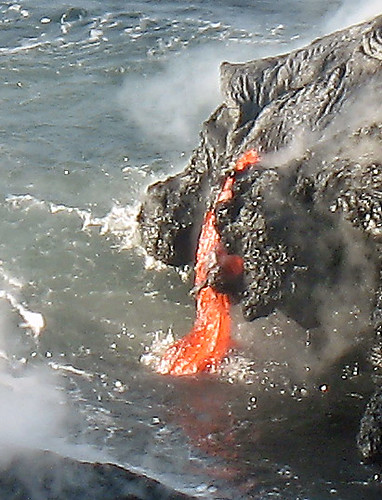 He recently posted pictures of the new lava flow into the ocean taken at dawn. Some of his pictures are here, or click the image. Push the "all sizes" button after choosing an image to enlarge them for a front-row view.
The ghost of Mayor Harris still wanders the earth
Quote without comment from a Ft. Wayne, Indiana, website, Former Honolulu mayor to speak on cities of the future:
During his three terms as Mayor, Honolulu was recognized as one of the best managed cities in the United States. In addition to the hundreds of awards the City received during his tenure, Mayor Harris also earned national and international acclaim...
The article is a long one, check it out.
Superferry protestor's case dismissed
A snippet from a short Garden Island newspaper story:
Superferry protest case dismissed
Charges against one of the last defendants to be arrested during the Aug. 26 and 27 protests of the Superferry at Nawiliwili Harbor has been dismissed, his attorney yesterday said.
Glad to hear that. I haven't followed this, and wonder if the other cases were similarly dismissed.
The Superferry drydock damage remains mysterious
Maybe it isn't very important. I can't help wondering, though, why newspaper readers must be the last to know about this.
Finally, in today's Advertiser, is a hint that something happened in the drydock (it's possible I missed something earlier, but I don't think so) (I'm sure someone will correct me if I have).
The hint comes in the front-page story, Superferry in drydock till April 22, by Christie Wilson:
Hawaii Superferry originally announced it would be in drydock until March 3 to strengthen the metal surrounding the auxiliary rudders after cracks were found. When the aluminum hull sustained damage during the drydocking process, the company delayed the restart of service until March 25.
Later in the same story:
The company announced yesterday the Alakai would be spending additional time in drydock. [Superferry director of business development Terry] O'Halloran said extra time is needed to finish repairs and the extension is not because of any new problems discovered while the ferry has been in drydock. He did not have an estimate of the cost of repairs.
Since there isn't any detail, readers who have not seen the coverage on KGMB or read about it on the blogs will not have much background on what the article is talking about here.
Again, this is in contrast to the article on Hawaii Reporter yesterday, credited to Lori Abe, "a spokesperson for the Hawaii Superferry."
HONOLULU - Hawaii Superferry announced today that it is extending the amount of time the Alakai will be in drydock because work to repair damage to the ship that occurred during the drydocking process is going to take longer than was previously projected.
Over at the Star-Bulletin, a short breaking news article yesterday put it this way:
The company is working to repair damage to the 350-foot catamaran that occurred during the routine dry-dock process.
The KGMB/blog reports, if they were accurate, might make suggest that the word "routine" is not quite right to describe what befell the ship.
I don't take the Sunday Star-Bulletin, but didn't find anything at all on their website other than yesterday's breaking news.
So again, this is not the most important concern as far as ferry operations go. What's busted should be fixed. Still, it's strange that there hasn't been more detail in the papers on this. Why? Because the clock is ticking on reports, and passengers are probably curious about anything that could affect safety.
Superferry info shortage distorts measurements
Last year Maui Judge Joel August required that traffic impacts from the Hawaii Superferry be assessed. This Maui News story, Assessment finds little traffic — or ferry service, illustrates a larger problem: With service so sporadic, how can the public (or the court) know the true impact that the operation of the Superferry is having?
It's not ok to say that the impact is minimal when there has been little opportunity to measure the true impact.
We don't know if passenger loads would be higher if prospective users could be sure that they could return their vehicles from their planned trip. Would more businesses take their trucks and tools to the other side if they weren't so afraid of being stranded?
The ferry has been out of service so much that it isn't possible to properly assess either how well it is doing or what the effects of its operation might be.
Yet the clock is ticking on various reports.
The article above notes that there is the opportunity for public comment.
Saturday, March 08, 2008
Protestors win: Blackwater backs off on Potrero, CA training site
If you've been following the news on Blackwater, protestors in this California community have been fighting the plans of private military contractor Blackwater to establish a training camp in their backyard.
I just have to assume that most Disappeared News readers will be familiar with the controversies surrounding this private militia, which is unaccountable to anyone for its actions in Iraq and elsewhere overseas. If not, Google will reveal all, or check out information on the Democracy Now! website.
An email from the Hawaii AFSC alerted me to the news that Blackwater has backed out of its plan.
See this article, Blackwater pulls application for Potrero training center.
Of course, one can wonder if they're simply planning to open up a secret training center elsewhere. In other words, a covert rather than an overt operation. We'll never know. Watch out for strange groups of armed men gathering on Molokai, for example.
So congrats to the protestors in California and elsewhere for making a difference.
 | Blackwater: The Rise of the World's Most Powerful Mercenary Army by Jeremy Scahill Read more about this title... |
Superferry: needs more time for repairs, and audit report gets delayed
See breaking news in today's Advertiser. It appears that the Superferry will not resume operating until after April 22.
Well, this and other blogs offered reports on the possibility of extensive damage to the Superferry over a week ago, as did KGMB. Of course, a Superferry announcement formed the basis of today's Advertiser's story, I assume.
Just as followup, I did speak to the Coast Guard last week. In an email, their spokesman assured me that
The Coast Guard takes safety very seriously, and we require vessels such as Hawaii Superferry to meet a comprehensive set of Coast Guard safety regulations; moreover, the Coast Guard has the authority to require correction of any deficiencies before allowing a ship to take on passengers at U.S. ports.
So essentially, it will be the Coast Guard that gives the green light for the Superferry to operate a passenger service again.
While the cost of repairs may be covered by insurance, the downtime still amounts to a huge loss of operating revenue for the ferry. I wonder about the part-time employees, and if they are earning salary during this long outage.
On the sidelines, the task force monitoring the ferry's operation doesn't have anything to monitor, but the clock still ticks on their reports.
And finally, speaking of reports, in today's Advertiser is this story, Report on ferry history delayed. Here's a snippet, but I encourage you to read the entire story:
[State auditor Marion] Higa warned lawmakers in January that she would likely miss the March deadline because she had not been given all the documents she requested from the Lingle administration. Higa also questioned the administration's use of attorney-client privilege and executive privilege in relation to some of the documents.
Update: The statement on the additional delay from Hawaii Superferry is apparently this one:
HONOLULU - Hawaii Superferry announced today that it is extending the amount of time the Alakai will be in drydock because work to repair damage to the ship that occurred during the drydocking process is going to take longer than was previously projected.
Based on the latest repair schedule, reservations for sailings after April 22 are now being accepted. Updates on the sailing schedule will be issued as they become available.
Passengers holding reservations for affected voyages are being notified, re-accommodated on a future voyage or refunded.
Customers are encouraged to visit www.HawaiiSuperferry.com for the latest travel information or they may call Hawaii Superferry’s reservations at 1-877-HI-FERRY (1-877-443-3779) open daily from 6 a.m. to 7 p.m. (HST).
The Advertiser story is a fair copy of the press release, notably omitting the part of the first paragraph that confirms damage that occurred during the drydocking process as reported to you by the blogosphere over a week ago. It's not like there's any shortage of space in Breaking News on the web... so I wonder why that portion of the press statement was not as faithfully transcribed as the rest?
Here's the first part of the Advertiser story. Compare:
Superferry extends drydock repair time
Advertiser Staff
Hawaii Superferry announced today that it is extending the amount of time the Alakai will be in drydock because repair work is going to take longer than expected.
The press release by Superferry spokesperson Lori Abe appeared, with her name (not anyone's "staff") in its entirety on the Hawaii Reporter blog. Yes, including the part about the damage in drydock.
Corporate contributions bill fast-tracked--act now to stop the tsunami
The bill to increase corporate campaign money has been fast-tracked for a hearing in the House Judiciary committee on Tuesday at 2:00pm in Room 325.
So if you'd like to help stop the flood of corporate contributions that SB2204 would allow, your testimony needs to be sent in soon! Ask the Judiciary Committee to amend this bad bill to ban corporate donations to campaigns.
Please don't count on someone else to do this, your testimony is important. And it's easy to do!
According to the hearing notice, you may submit testimony in one of the following ways:
PAPER: 5 copies (including an original) to Room 302 in the State Capitol;
FAX: For comments less than 5 pages in length, transmit to 586-9456 (Oahu) or 1-800-535-3859 (Neighbor Islands); or
EMAIL: For comments less than 5 pages in length, transmit to JUDtestimony@Capitol.hawaii.gov.
It says:
Persons wishing to offer comments should submit testimony at least 24 hours prior to the hearing with a transmittal cover indicating:
· Testifier's name with position/title and organization;
· The Committee the comments are directed to;
· The date and time of the hearing;
· Measure number; and
· The number of copies the Committee is requesting.
Hey-- nothing could be easier. Send off your email by Monday. What you want them to do is amend SB2204 to ban corporate contributions. Tell them in your own words why, if you like, but tell 'em. Send something, even if it is late.
And thanks!
Friday, March 07, 2008
Theater critic fails to do justice to famed poet's work
I was disappointed to read Joseph T. Rozmiarek's put down of the fine effort by students in their production Rumi at the Earle Ernst Lab Theatre at the University of Hawaii, which I enjoyed last week.
Rozmiarek is clearly out of his depth on this. He seems to want to be entertained according to some sort of stereotype:
A shoestring budget keeps the actors in drab sweat suits with only minimal props and set pieces. Recorded music makes an ethnic nod and the entrance and exit dancing is perfunctory — with, sadly, no whirling dervishes in sight.
...
Plainly, we need more help from the director and actors to sort things out. We need things to watch that are interesting without being blatantly literal, dialogue that lets the words sing like poetry, integrated music and dance, and an exotic wrapping.
Otherwise, if this is your first introduction to Rumi, you might well wonder why Madonna ever sang his love poems.
Madonna might have been tuned in to Rumi, but this critic wants whirling dervishes, music and dance, and an exotic wrapping. Those who have studied or enjoyed Sufi teaching stories and in particular the many translated works of Rumi know better.
Sufi stories don't start "once upon a time" because they are timeless, and they don't end with "the moral of this story is" either. This critic seems to want the comfort of being handed the moral:
... So, somewhere among the thrashing and the slashing and the tussling and thrusting, a moral emerges. But we're never quite sure whether it's meant to be straightforward, funny, or both at the same time.
He misses the point. The interpretation is up to him.
Sufi teaching stories do not require dancing or exotic costumes. They may simply be read or performed. The reader does some of the work, but most of it is for the listener to complete. Victor Olsufiev wrote (snipped from an article very worth reading on its own):
There are many stories and parables which do allow application of more or less simple decoding methods: these are allegorical stories. By taking them in an appropriate context, or layer, it is possible to uncover the meaning of their content, and to interpret it accordingly. However, Sufi teaching stories are not allegories. And if they are, they are not only allegories.
Yes, it's a complicated thing, not to be handed the answer but to have to figure it out yourself. Maybe understanding will come on the spot, maybe later, perhaps never. It depends not only on the stories but on the listener. Maybe understanding will manifest in how the listener reacts to some future event in her own life.
Moreover, this is a lab theater. It's very appropriate to select, interpret and present the works of Rumi to an appreciative and understanding audience. It didn't matter that Rumi was presented in ordinary clothing ("drab sweat suits"!). Richard Burton starred in a famous John Gielgud production of Hamlet acted in street clothes. Burton himself is said to have disliked period costumes. Following Giegud's lead is no mistake, despite this critic's preference for "exotic wrappings."
Check out also the works of the late Idries Shah on Sufi thought and writing.
Shah maintained that spiritual teachings should be presented in forms and terms that are familiar in the community where they are to take root. He believed that students should be given work based on their individual capacities, and rejected systems that apply the same exercises to all. In his own work he used teaching stories and humour to great effect.
I'm sorry that many readers of today's paper may skip this weekend's productions based on the printed review. The few reading this article who may attend won't make up for the loss.
Bravo to the students and the director for choosing to work with Rumi and for bringing it to the late-night audience. Let's have more, with or without dancing and fancy costumes. I'd rather have Rumi tried and presented in different ways. More Rumi, please, UH, and don't let this guy drag you down.
Help reduce the landfill fill--with one phone call
We recycle our newspapers. But I noticed that next to the mail boxes at our condo, the garbage can is full of Advertiser "People" sections. These are now mailed to us instead of being included with the rest of the paper. Those in the garbage can will all go into the landfill and won't be recycled.
Maybe the scene is repeated around the city—people throwing out junk mail envelopes and this ad section too. Just look at the current issue. The lead story is "BMW's Short honored as 'Dealer of the Year." Who needs that??
There's a rebellion in progress. People are reacting to the quantity of junk mail that they simply throw away. I was glad to see this in yesterday's Advertiser Breaking News on-line (snippet):
Hawaii among states pushing 'do not mail' effort
Washington Post
WASHINGTON — One more challenge for the Postal Service: people who just say no. Unlike the national "do not call" registry, the "do not mail" effort is developing state by state, including in Hawai'i.
And this, from today's paper: U.S. Postal Service fighting efforts to block junk mail.
Well, we received our first and last "People." Like bringing our own tote bags when shopping, one family stopping "People" makes only a small difference. But if more people started doing it, we'd make a contribution to the environment for everyone.
All you need to do is call 538-6397 and ask them to stop delivering "People." And they are very ready for your call. After waiting on hold a short while, a friendly voice came on. I said that I'm calling about the People section that came in the mail the other day. She asked if I'd like to stop it, and I said that I would.
They probably get a bunch of calls. Why else would someone call about this section except to stop it?
So I did my tiny bit for the environment today. 538-6397 is the magic number. Call before 10 a.m., I think, or they close.
Thursday, March 06, 2008
What do students think about conditions at UH?
Tune in to Town Square tonight, Thursday, 5-6 p.m. on KIPO, 89.3 FM, to learn what UH students think about conditions on their campus. After all, they're paying the tuition, right? Should they have to study in a library with a leaky roof?
Beth-Ann Kozlovich will have as guests Kumari Sherreitt, Editor of the campus newspaper Ka Leo, and Christina Stidman, President of Associated Students of the University of Hawaii.
There will also be information on how federal funding might be used to assist both UH and its community colleges.
So tune in, call in with your own questions or experiences. The program streams on-line from hawaiipublicradio.org.
Wednesday, March 05, 2008
Following the numbers in the presidential race
While you're visiting the Progressive Review website, hidden among all the articles is some excellent mathematical analysis of poll results.
Sam Smith uses a rolling average method that he has tested out over time.
His web page, Smackdown 2008, is located here. It may be confusing at first, but enlightenment comes if you study the color codes.
Sam describes the method in this article. Snippet:
Once again, the Progressive Review's Morning Line Rolling Average - exclusive until a number of the bigger outfits copied it - has proved its worth. Based on 31 polls this season, the Morning Line had an average error of 6 matched only by Survey USA.
Typically, our rolling average involves the last three polls in a race, although sometimes we adjust it when there are only a few, or if there are many, polls in the final days. By smoothing out the poll results, we limit the flaws in any individual polls.
Clinton? Obama? How to choose???
I thought this was so well done I better bring it to you here, instead of just linking to Sam Smith's article in the Progressive Review Undernews.
HOW CLINTON AND OBAMA ARE ALIKE
Their positions are often barely indistinguishable from that of the
RepublicansThey have built their campaigns around genetic identity rather than on political principles and issues.
They take multiple positions on individual issues such as NAFTA
They have produced no interesting new ideas nor promised to fight for any important new programs
They have offered no good idea about how to handle the current economic crisis
They have gone about their campaigns as though they were leading a cult rather than a political movement
Clinton hangs out with a covert group of right wing GOP Christians;
Obama would name some of them to his cabinet.They have similar voting records with Progressive Punch ranking Obama 19th and Clinton 24th in Senate
They both dissed Nader for daring to run for president again
Obama wrote that conservatives and Bill Clinton were right to destroy social welfare, Clinton supported her husband's program
Hillary Clinton comes in at 38th and Obama at 48th in the ranking of the League of Conservation Voters
Both have hawkish foreign policy advisors involved in past US misdeeds and failures
Both support Israeli aggression and apartheid. Obama has deserted
previous support for two-state solution to Mid East situationBoth have voted numerous times to continue funding the war
Both support or won't oppose nuclear power
Both support war on drugs
Both support Real ID
Both support No Child Left Behind
Both supported crack-cocaine sentence disparity
Both oppose single payer healthcare
Both support PATRIOT Act
Both support the death penalty
Both have no clear plan to leave Iraq and Afghanistan
Both support charter schools
Both support federally funded ethanol
HOW CLINTON AND OBAMA ARE DIFFERENT
Clinton would continue the 28 year old Reagan - Bush - Clinton - Bush
era; Obama would probably end it.While both have misled voters, Clinton has by far the worst record, witness the cattle futures, Whitewater, travel office and similar scandals as well as the fact that five of her fundraisers have been convicted of, or pleaded no contest to, crimes and one fled the country after being indicted on charges related to raising money.
While they both have had seamy friends, so far only one has surfaced for Obama - Rezko - as opposed to a lengthy list for Clinton that begins with three close business partners who ended up in prison.
Obama, unlike Clinton, has never been almost indicted.
Obama, unlike Clinton, has never been mentioned 35 times in a criminal indictment.
Obama, unlike Clinton, has been involved in a resort land scam with in which about half the purchases, many of them seniors, lost their
property.Obama, unlike Clinton, is not currently being sued in a case involving an allegedly massive misreporting of campaign contributions.
Obama, unlike Clinton, did not support the appointment of the now indicted Bernie Kerick to be head of Homeland Security
Obama would be good at international negotiations; foreign leaders wouldn't know whether to trust Clinton.
Obama is not married to Bill Clinton
Obama has revealed his tax returns; Clinton hasn't
Clinton thinks McCain would be better qualified for the White House than Obama; Obama would rather have Clinton than McCain
The Clinton administration, according to an HRC ad, wouldn't answer an emergency White House call until the sixth ring; the Obama administration, it is implied, would wait for the seventh.
Obama voted against immunity for telecoms' illegal spying on Americans; Clinton didn't show up for the vote.
Obama has inspired a lot of young and minority voters to get involved in politics; Clinton has relied upon a traditional and aging constituency.
Obama favored cluster bomb ban in civilian areas; Clinton opposed the
banObama says "everything is on the table" with Social Security. Clinton
seems slightly more supportive of the classic Democratic programObama opposed putting heating fuel assistance for low income in stimulus bill; Clinton supported it
OBAMA ALSO. . .
Promises not to sign a trade bill without environmental and labor
protections.Helped fight for restoration of habeas corpus at Gitmo.
Aggressively opposed impeachment action against Bush.
Wouldn't have photo taken with San Francisco mayor because he was afraid it would seem that he supported gay marriage
Supported restricting damage awards in medical malpractices suits
Supported making it harder to file class action suits in state courts
Misled on extent on lobbyist support
Called the late Paul Wellstone "something of a gadfly"
Voted for a business-friendly "tort reform" bill
Voted for a nuclear energy bill that included money for bunker buster
bombs and full funding for Yucca Mountain.Won't rule out first strike nuclear attack on Iran
Received $708,000 from medical and insurance interests between 2001 and 2006
Went to Connecticut to support Joe Lieberman in the primary against Ned Lamont
Refuses to take a position on the anti-constitutional Homegrown
Terrorism Prevention ActCalled Pakistan "the right battlefield ... in the war on terrorism." Threatened to invade Pakistan
Sounds sort of like Tony Robbins
Uses various evangelical cons to win supporters
Has not revealed his proposed policies in many areas and where he has they primarily consist of minor alterations in the status quo
Voted against a 30% interest rate cap on credit cards
Opposed the war as a state senator, is less certain as a federal one and has voted for full funding of it
Wrote critically in his books of the New Deal and the New Left while
praising Bill Clinton,CLINTON ALSO . . .
Favors healthcare individual mandates that would help insurance companies and banks but not citizens
Has the most number of foreign lobbyist contributors
Is even more popular with Pentagon contractors than McCain
Is most popular with K Street lobbyists
Is only First Lady to come under criminal investigation
Has received the most funds from oil industry
Has received the most funds from health industry
Gave most number of evasive answers (250) to congressional inquiries
Submitted the largest false campaign finance report
Tuesday, March 04, 2008
Senators vote to enrich themselves with corporate money
 SB2204, which opens the tsunami of corporate contributions to our lawmakers, passed in the Senate this morning.
Only seven senators did the right thing and voted against the bill. They are:
Senator(s) Gabbard, Hee, Hemmings, Ihara, Inouye, Slom, and Trimble.
The bill now crosses over to the House.
Although the companion bill died over there, this is a new ballgame. Expect the temptation of corporate money to cloud the minds of those who rejected the earlier House bill.
If this is to be stopped, it will take a lot more work to do that.
No auditor's report yet on administration's actions re Superferry
As followup to Auditor's report on state administration's actions re Superferry due tomorrow, I looked on the auditor's website and couldn't find a report. So I called this morning.
No, the report is not completed, and they said there is no estimate on when it might be completed.
Monday, March 03, 2008
Massacre under way in Gaza
The killing of Palestinians in Gaza that I mentioned as part of the previous post has regrettably continued. Before the reading of My Name Is Rachel Corrie began at Harris Church, we heard that in the prior 24 hours 45 Palestinians had been killed in Gaza by Israeli military forces.
The killing has continued, and with our country's blessing:
Democracy Now reports 112 killed in the past five days, one third of whom are children:
112 Palestinians Killed in Five-Day Israel Attack
Israel has reportedly pulled most of its ground troops out of Gaza following a five-day attack that left at least 112 Palestinians dead. But Israeli aircraft continue to carry out bombing raids and Israeli Prime Minister Ehud Olmert has warned that Israel’s military operation in Gaza is not over. On Saturday 60 Palestinians died in what officials said was the deadliest day in Gaza since the first intifada of the 1980s. Al Jazeera reports at least a third of the Palestinians killed over the past five days have been children. Since last week three Israelis have died—one civilian and two soldiers. Sami Abu Zuhri of Hamas accused Israel of carrying out a war of elimination.
Sami Abu Zuhri: “What happens in Gaza is not an aggression of bombardments by planes but it is a war of elimination by its full meaning. Babies are being killed, civilians are being killed and buildings are being destroyed.”
It's important to understand that these are civilian deaths. Israel is not killing soldiers, they are targeting and killing civilians.
The clashes reached a peak on Saturday, after Israel sent in a regiment of ground troops in an operation dubbed “Hot Winter” that killed 77 Palestinians in two days. According to Gaza health ministry statistics, 22 children were killed. More than 350 people were wounded. Since last week three Israelis have died—one civilian and two soldiers. [Democracy Now, 3/3/08]
Where is the outrage?
Listen or watch Democracy Now today for coverage you're not likely to see elsewhere.

Kahului, Maui
AKAKU Ch. 54
7 p.m. M-F

Kaua'i,Hanalei
KKCR 90.9, 91.9 FM
11 a.m., M-F
Oahu
Olelo TV, Channel's 53 & 56
8am on Ch 53, 10pm on Ch 56
Sunday, March 02, 2008
My Name is Rachel Corrie at Harris
 I was glad to see an abundance of introductory material on the table at Harris Methodist Church last night. My Name Is Rachel Corrie cannot be fully understood, I think, in isolation. It's not just the story of the brave, articulate young lady who was murdered by the driver of an Israeli bulldozer while trying to protect the home of a Palestinian family from being destroyed.
Rachel Corrie: Andrea Devon Bertoli
Craig Corrie: Jonathan Larson
Cindy Corrie: Rev. Barbara Grace Ripple
Tom Dale: Danny Prince
Playing next on March 14, 2008 (Friday)
7:00 p.m. at Church of the Crossroads,
Weaver Hall, 1212 University Avenue
Honolulu, Hawaii 96826, 949-2220
This also created, at least in my mind, a nascent awareness that Rachel Corrie gave her life while trying to stop the violence, but what about us, in the audience? What have I done lately? And why were there still some empty seats? Every American should see this play. There should be crowds pushing to get in.
Well, the occasional empty seat illustrated the problem. Americans were doing something else last night, something other than concerning themselves with the wholesale slaughter that is befalling others. And it's not just that the bulldozer was made in the USA for the specific purpose of leveling homes. Our support for the killings and the division of the occupied territories into Swiss cheese makes it all possible.
Andrea Devon Bertoli was a moving Rachel Corrie. Her reading made me realize that Rachel was more than the snapshot of her confrontation with the Israeli bulldozer. She had already written extensively and passionately about her convictions and her experiences. She had been writing since her early school years.
Let me leave you with some links from the literature that was available on the table at Harris:
hawaiiandpalestine.googlepages.com
IfAmericansKnew.org
bds-palestine.net
FMEP.org
BTSELEM.org
MIFTAH.org
also
en.wikipedia.org/wiki/Israeli_settlement
http://disappearednews.com/2008/02/name-is-rachel-corrie-to-be-read-in.html
Finally, if you couldn't be at Harris, please consider attending the March 14 reading at Church of the Crossroads. In New York, after the censorship fight, tickets were $65. Here you can attend for free (or for a donation). It's a rare chance to be exposed to Rachel, her life and her writing, as well as learn more about an important world conflict that is happening today.
Saturday, March 01, 2008
Action Alert: stop tsunami of corporate money in Hawaii
The campaign to prevent limits from being taken  off of corporate contributions is gaining lots of momentum (no, Obama doesn't have the word patented). There was a great editorial in this morning's Star-Bulletin, Corporate lid on contributions should be maintained. It reminds us
Corporations are not protected by the First Amendment in amounts they can contribute to campaigns. Congress has banned corporate contributions in federal elections since 1907 and included labor unions in its prohibition in the 1940s. Corporate contributions are against the law in 22 states.
It's a mystery to me why Senate president Colleen Hanabusa would introduce a bill like this one. Holding out the tin cup for corporate contributions so visibly isn't the best thing to do in an election year. Isn't it a bad thing for Democrats to admit they need even more corporate lucre? Won't people notice who is voting to increase their corporate take?
Why should we let corporate influence in Hawaii grow even larger than it already is?? Instead, let's ban corporate contributions as 22 other states do.
There's a website to help coordinate the wave of opposition that's growing and growing. Please go there and check it out. With your help, this evil bill can be turned around.
The House bill appears dead already, so efforts are focusing on the Senate bill.
Here's what you can do--please act now!
This Tuesday March 4, the Senate will vote on SB2204, which includes a number of campaign finance issues including lifting the corporate cap. Please contact your senator and ask them to amend SB2204 and BAN corporate donations to candidates!
You can send one email to all senators if you prefer. Just send to sens@capitol.hawaii.gov.
It's better if you email or contact your own senator, and be sure to say you're a constituent. In an email or fax, give your address. It seems to make a difference. It makes your voice louder.
You can write anything you like. Mention the bill, and say something in your own words about banning corporate donations to candidates. Tell them what you think. A few words is ok.
This is really important, please do it.
Ok, (and thank you!), now you can do some other things if you like.
There's an on-line petition at: http://ga3.org/campaign/stopthetsunami .
You can take the same email you sent to your senator and turn it into a letter to the editor! Those can be sent to letters@starbulletin.com and to letters@honoluluadvertiser.com .
There are more resources for you here.
It's because lots of people helped that the House bill was stopped. Your emails, phone calls or faxes can help ban corporate contributions entirely in Hawaii. Now's the time. Tuesday's the vote. Today's the day you can send your email.
Thanks very much!!
Superferry EIS informational meetings
The state will hold public meetings on the Superferry EIS. Here's the schedule, according to KGMB:
March 11 - Molokai
Kaunakakai Elementary School
6:00 - 9:00 p.m.
March 14 - Oahu
Wallace Rider Farrington High School Auditorium
2:00 - 5:00 p.m. and 6:00 - 9:00 p.m.
March 17 - Maui
Henry Perrine Baldwin High School Auditorium
2:00 - 5:00 p.m. and 6:00 - 9:00 p.m.
March 19 - Kauai
Kaua'i Community College Performing Arts Center
2:00 - 5:00 p.m. and 6:00 - 9:00 p.m.
March 24 - Big Island
Hilo High School Auditorium
2:00 - 5:00 p.m. and 6:00 - 9:00 p.m.
March 27 - Big Island
Kealakehe High School
2:00 - 5:00 p.m. and 6:00 - 9:00 p.m.
March 31 - Lanai
Lana'i High School
6:00 - 9:00 p.m.
Superferry update
I'm gonna cop out. Joan Conrow has written a story that's better than anything I could anyway. Click here to go there.
KGMB was the only mainstream outlet to pick up on the circulating damage reports (thanks, KGMB!). A lawsuit has been filed, and more on the damage. All there. Go read.
It would be strange if the Star-Bulletin would send you over to the Advertiser to read a story, but this seems perfectly natural in the blogosphere. So go, already.