Thursday, January 31, 2008
More technical analysis of the Superferry troubles
Maybe we're getting a little self-referential here. In his post tonight, Superferry taking a beating in rough seas?, Doug White refers through my link to Juan Wilson's analysis of the Superferry's rudder troubles and adds expert analysis of his own.
This is a must read. Doug is a guy who knows his way around a ship. He differs from Juan on the rudder problem, but between the two of them, I have learned quite a bit.
Meanwhile, the Superferry's website advises that it will leave port tomorrow, but on a revised schedule, leaving Oahu at 9:30 a.m. Presumably it will do so with all rudders operating. Juan said it should take longer to fix the problem. Who's right?
This Just In: As I am typing this article at around 9:45 p.m., the Superferry website has changed its Travel Alert. It's not going out tomorrow.

By leaving Oahu late, the predicted swell for Friday should have decreased. I'm not sure I understand how to interpret the NOAA forecasts, but for Friday for Maui they predict:
East winds to 25 kt. Wind waves 9 ft. Northwest swell 4 ft decreasing to 3 ft
I think that translates into a Level 3 - Orange - puke alert on the Barf-o-Meter. This means that it is probable that some passengers will be very uncomfortable (Brad, if I've got this wrong, please correct me). Coming back from Maui might be smoother as the seas calm down later in the day. They'll have time in port at Maui to swab and disinfect the decks if necessary.
And the rudder should stay stuck on if they've repaired it properly.


Superferry: structural failure?
Thanks to Brad Parsons for pointing to this excellent article by Juan Wilson.
Juan has some great pics of the computerized "Seastate" steering system used by the Superferry and a lot of information on the rudder problem that this large capacity passenger ferry is experiencing.
Juan describes the problem as a serious structural failure, and a disaster for the ferry corporation. Not just a PR nightmare (if the dailies ever cover it), but something serious enough to doom its military future (awww...).
It's a long article and I don't want to quote snippets. Check it out.
In contrast to the dire prediction that Juan is making, the Superferry website insists, as of a couple of minutes ago, that it will be sailing on Friday:

So I guess we just wait and see. Too bad though about those 30 or so vehicles stuck on the dock on Maui (and maybe some on Oahu too). They might be home again tomorrow, as this Travel Alert says, or if Juan is right, maybe not yet.
Equal time for the Advertiser's typos
Line of flight commented on my earlier copy editing post:
Having worked in the newsprint medium for several years and then reading The Elements of Typographic Style, my life both in words and in their setting will never be the same. If only I could turn a blind eye to the small errors and word processors generic kerning. But for the dailies, there is hardly any justification.
I'm relieved that I am not the only reader of The Elements of Typographic Style in the state. I wonder if line of flight has noticed the Advertiser's selection of typeface since their makeover in 2004. Since nobody cares about this at all (even over at the Advertiser?) but perhaps the two of us, let me skip that until the end of this post.
I just thought I should give equal time to the Advertiser's copy editors as long as I was having a little fun at the Star-Bulletin's expense.
Mostly, I think they do very well. Keep in mind that a good deal of copyediting these days is done by the reporters and writers themselves. Unlike the days of yore when manual typewriters ruled, everyone now has spell checkers and access to an AP program that is supposed to standardize usage. Or I assume they do. Anyway, check out Jerry Burris' column, Hawaii caucuses will matter, in yesterday's paper. I'm not picking on Jerry, just his copy editors.
But in presidential years, interest soars dramatically. That's certainly the case this time around. Democrats meet Feb. 19 to begin their delegate selection process, and the party reports a surge of new interest in attending the caucuses.
I thought they were meeting Feb. 29. Maybe they are also meeting Feb. 19, or this could be a typo.
[Update: Rachel corrects me in comments, below. The caucus is Feb. 19. She directs us to the website of the Progressive Democrats of Hawaii for information.]
Just a paragraph down:
There is less activity on the Republican side, largely because the GOP handles most of the delegate selection process within the state convention itself. But for the Democrats, the candidate preference of the bulk of Hawai'i's 29 delegates to the national convention will be decided by those Feb. 29 caucuses.
In the same article:
Other slots, such as at-large and unfledged party leaders, will be allocated according to the preferences of those elected at the caucuses.
I like that about the Democratic party, the young and inexperienced party leaders thing. Thanks, Jerry, for this Freudian(?) typo. Or thanks to the copy editor, if there is one.
Ok, the typeface thing. You can leave now, I know no one at all is interested in this.
In the middle of 2004 the paper settled on Poynter Old Style for body type. This is a modern design created by or for the Poynter Institute, and has also been used effectively by the St. Petersburg Times, for example. But the Advertiser overuses the same typeface for headlines. There are better choices. The St. Petersburg Times uses a variety of typefaces for headlines. If one reads the Advertiser every day, one gets used to an unusually bland use of typefaces.
Why should you care? You shouldn't. I'm talking about a lost art, something children are no longer taught at school, and something newspapers may no longer care about.
Just something else gone extinct in Hawaii.
Superferry: count of stranded vehicles
Many thanks to Dick Mayer for sending a count of vehicles stranded on Maui by the Superferry's five-day (so far) cancellation:
With regard to the number of cars stranded:
I went to the Kahului Harbor piers on Wednesday noon, and counted 4 rows of 7-8 cars probably waiting to be shipped back to Honolulu. Several were large pick-ups.
I wonder if the SF folks will be reimbursing drivers who may have flown back home to Honolulu, so they can now fly back to get their vehicles, or will HSF require drivers to take the SF back to Maui (and charge them for the trip)?
Mahalo for keeping the issue alive (more alive than the SF).--Dick Mayer (Maui)
Several points I'd like to make on this, if I may:
- Shouldn't we be reading about this in the big daily papers?
- About 30+ individuals or families have been inconvenienced. Shouldn't legislators and the public be informed about this, especially given the large number of cancellations?
- What does this say about low ferry utilization? There are only about 30 or so vehicles stranded. Maybe some owners shipped them back via Young Bros. barge, or maybe it means that very few people are using the ferry in the first place. Enquiring minds want to know.
From the frying pan into the fire
Biodiesel magazine posted what to me is a confusing article yesterday:
Hawaiian environmental advocates oppose palm oil
By Bryan Sims
Web exclusive posted Jan. 30, 2008, at 4:32 p.m. CST
Major environmental and cultural organizations in Hawaii have reaffirmed their stances on opposing a “palm oil pipeline” intended for large-scale biodiesel production on the islands.
Hawaii is the most petroleum-dependent state in terms of electrical production, with more than 90 percent of the state’s energy needs coming from imported oil. Despite abundant renewable energy sources from solar, wind and hydroelectric power, Hawaiian Electric Co. Inc. has spent the past year supporting proposals to construct two large biodiesel plants—one by Imperium Renewables Inc. on Oahu and one by BlueEarth Biofuels LLC on Maui. Both intend to use imported palm oil from Indonesia and/or Maylasia as a feedstock.
In October , HECO and the Natural Resources Defense Council finalized a policy to ensure that HECO’s two electric companies—Maui Electric and Hawaii Electric Light Co.—would only purchase biodiesel fuel produced from locally grown, sustainable feedstocks and palm oil. These feedstocks would comply with international standards established by the Roundtable on Sustainable Palm Oil, an international organization made up of more than 200 members who represent all facets of the palm oil industry.
I'm just a little confused about where they stand on this. "Despite abundant renewable energy sources from solar, wind and hydroelectric power, Hawaiian Electric Co. Inc. has spent the past year supporting proposals to construct two large biodiesel plants" implies opposition?? I mean, I think we're missing out big time by ignoring sun, wind and wave sources of power. Human too, if you count the replacement value of encouraging bicycle transportation, which we totally ignore. But this is Biodiesel Magazine, after all, shouldn't they be pushing their product?
I've always been confused with the state's policy on both ethanol and now biodiesel. As above, it looks like HECO will only buy biodiesel grown locally. That's cool, unless there isn't any, in which case the above implies that they'll continue to burn imported oil.
Same with the ethanol fiasco. You may know that it seems to require more energy to produce alcohol from corn than the stuff gives back, and of course we're shipping it here from outside, and using expensive petroleum to get it here. Plus, using ethanol for fuel has disrupted much of the world's corn supply as farmers divert production from food to fuel.
This article doesn't compute for me. In fact, the whole thing doesn't compute. Are we planning our alternative energy project the same way we're planning Mufi's train? If so, it's doomed.
Copyediting--a lost art, and Britney Spears
I was copy editor and then managing editor of our college newspaper, so my brain was thoroughly conditioned to pounce on tiny little typos that really don't matter much. In fact, I appreciated the little bloopers because most of the articles student reporters turned in were so bad that it would be cause for celebration if there were only a small typo or two.
Some typos are funny. LIke the principal the DOE allowed to remain at Laupahoehoe High and Elementary School for 112 years in today's Star-Bulletin.
Probably thinking enough is enough, the DOE put him on administrative leave. The article gives no hint whatsoever about why they waited this long or what motivated the decision. It's probably with pay, so he might well continue to earn a salary for the next couple of decades while they figure out how to oust him permanently.
[Update: I see that the S-B has fixed the 112 year typo. Good news for me, I have at least one reader over there. Or maybe an anonymous source tipped them off.]
I was checking this morning's Star-Bulletin to try and find out about the two people who ended up on the H-1 Freeway yesterday (am I supposed to capitalize "freeway?" Gotta be careful if I'm going to write about copy editing...). There wasn't much in the print Advertiser this morning. They ran the breaking news from last night that I linked to in the previous article.
The news was hidden 'way down on page B2, tucked into the left corner under the obituaries. And under the tiny story about the Superferry cancellation for today. (If you're looking for the Advertiser's coverage on the Superferry problems, please continue to check the obituary page. It's close to dead).
One paper or the other has the story backwards. The Advertiser reported:
Earlier today, a 32-year-old woman injured in a 3:45 a.m. fall onto the H-1 Freeway's westbound lanes near Halona Street in Kalihi died at Queen's at 4:29 a.m.
While the Star-Bulletin reports:
Shortly afterward, police received a call about a woman lying in the middle of Halona Street. Police said the woman apparently fell from the freeway onto Halona Street. Preliminary investigation revealed no signs that the woman was hit by a vehicle, police said.
Even though this is on the same page as the 112 year reign of the Laupahoehoe principal, it has that air of truthiness about it, don't you think?
I'll leave the editors to duke it out on this one, who fell from where onto what, when (those Ws journalists are supposed to worry about first thing).
While checking today's breaking news to see if anyone else had ended up on the freeway (lower case is ok this time I think), I also learned that according to "a police officer who requested anonymity because he was not authorized to speak on the matter" that Britney Spears had just escaped from her home again in an ambulance.
Have you noticed how many news stories now depend on someone "who requested anonymity because they were not authorized to speak on the matter?" I imagine newspapers would be much thinner if stories based on all these unauthorized anonymous people were suddenly banned. Papers would be thicker, on the other hand, if they would stop firing reporters who research stories by interviewing real people.
And of course, with the rash of stories based entirely on these dubious sources, I'm wondering how I can get to be one myself. I'm not authorized to speak on much at all, and I am quite happy not to give my name. So any young reporter wanting to make that big front-page splash (is front-page hyphenated?), just give me a call and I'll tell you anything you want to know.
By the way, Britney's escape was very cleverly planned to get her past the huge crowd of paparazzi:
The crowd of photographers and news trucks outside her gated home was larger than normal Wednesday night.
At least, I think it was clever. If a reporter wants to ask me anything about Britney Spears, bring on the questions. I'm happy to answer any and all of them anonymously, and I'm totally unauthorized to say anything about Ms Spears. And I'm ready to spill all. Just call me.
I'm your perfect source on anything Britney.
Why are people suddenly falling onto the H-1 freeway?
Two in one day: H-1 westbound near Liliha overpass reopened.
What's going on here? Suddenly we have people dropping onto the freeway.
I was wondering if there would be copycat events after the child was thrown from the Miller Street pedestrian bridge. I hope these adult incidents were not like that.
These incidents reminded me that every time I cross the Nuuanu Avenue bridge over the H-1, I wonder if the side rails are too low.
Wednesday, January 30, 2008
Day 5 and counting...
 I thought I was losing count, but Sunday, Monday, Tuesday, Wednesday and Thursday comes to five days canceled....
My sympathies if your car is still on the wrong island.

The Advertiser ran what looks like a Superferry announcement in its breaking news this morning: Hawaii Superferry voyages canceled again today. Wouldn't it be nice if they reported on the forest, not just the one tree? And the line about "special rental car rates are available for impacted passengers" should be tested. The 5% discount doesn't seem very "special" to me, and I wonder if it could be beat by checking one of the on-line discount travel sites. C'mon, Superferry, give 50% off at least.
Puhleez don't just tell me about the special rental car rates every day. Give me some real news. Remember when there were special sessions of the Legislature? This is a big deal!
Part of the big picture is that passengers have been inconvenienced for five days so far. Are there cars stranded? Is produce intended for Oahu markets rotting or thrown out? Is anyone unhappy?
The other part of the big picture I'd like to see (and I know I could do this myself, but this is only a blog) is a calendar with canceled days Xd off in red, or something like that. The days canceled for barge repair count also, you know. That would be an interesting graphic to print.
I know that the ferry company has not taken up my suggestion to turn the ship into a floating restaurant anchored in port. Pity. It's been tied up on Oahu all this time. We could have partied! A special few government officials might be invited to dine at the Captain's Table.
At least, they could have offered discount day parking or shown movies or something. Why not Sunset on the Ferry instead of on the beach, when it's just sitting there doing nothing anyway?
Unreliability was obviously not part of the ferry plan, but now what?
Yes, the Governor and most legislators were all gung-ho to support the hype around this new service. And indeed, an interisland ferry service may make sense, but so far, this one is disappointing.
It's not just the loss of service days. Real, individual lives are negatively impacted by cancellations and no doubt some businesses too.
The best summary I've seen appeared in this insightful observation by Maui resident Karen Anderson:
I really want to hear the passenger stories on this one. Sail over for the weekend and get stranded for five days! What to do? Spend big bucks on accommodations and just wait it out? Or book a last-minute flight for big bucks and leave your car behind, then rent a car when you get home so you can get around? Then wait for your car to arrive on the next non-canceled voyage, but be sure to bring someone with you because you'll have to drop off your rental car on the way. Jeeze... thank god Superferry really goes out of its way to help, what with the 5% rental car discount!!
Many of us have experienced airplane flight cancellations. But at least your car isn't in limbo also. After reading Karen's email, I had a greater appreciation for the major hassle faced by anyone taking their vehicle on the ferry and not being able to get it back. And what if it's a business truck loaded with tools?
The newspapers wrote about all the happy passengers, but who is checking into the inconvenience caused by the numerous cancellations? :) ---> :(
There's been little payback so far for the Governor's efforts. Too many cancellations, low passenger counts when it runs. As we look toward this weekend, the ferry has not run for three days and tomorrow may not be a good day for them either (if they do sail in rough seas, it won't be too good for the passengers).
Had an EIS been completed, the expectations might have been lower. People would know that the service is really an "as available" add-on to existing air service. Perhaps a different ship configuration might have worked better.
Maybe an expedited way to get vehicles across the water would be a better deal. In other words, people fly, meet their car on the other side. I'm just thinking out loud, but we actually did that returning from Sapporo to Tokyo when we lived there. The car was on the ferry, and although the seas were rough, we didn't hear any complaints from it when we met it at the dock in Tokyo the next day. We had a great flight, with fine views of snow-capped mountains, and even a decent lunch included. No sea sickness cruising along at 10,000 meters. I was able to take the subway to pick up my car, no rental necessary. The ferry company offloaded cars into a parking lot where they could be conveniently claimed. It was included in the fare.
Existing services on Maui have to make way for the ferry barge, which is probably very disruptive to commerce. To remedy that, the state is planning a huge investment in proposed harbor improvements. It's an investment which at present only benefits a single company.
Shouldn't we learn from this experience and make a better plan? Why not start now?
Tuesday, January 29, 2008
4th cancellation in a row for Superferry
… and airlines have reduced fares in a February promotion: $29 tickets renew airfare battle. They're more reliable too, though there's still the inconvenience of that TSA inspection and harassment.
Drug sniffing dogs fail to reduce usage at a Maui public high school
Reading the Star-Bulletin report, I was wondering how come it seems sometimes that our educators can't learn.
At Board of Education testimony yesterday, according to the article, Ron Okamura, superintendent of the Hana-Lahaina-Lanai-Molokai complex, testified that after the dogs left his campus, drug finds increased. He said that students are not afraid to bring drugs to the campus now.
But he doesn't realize that this indicates the program is a failure. Students have learned nothing, according to his very own report.
This point was not missed by those who understand that there are effective educational programs proven to reduce drug use. Maui could have used one of those instead:
But Jeanne Ohta, executive director of the Drug Policy Forum of Hawaii, said the program did not prevent students from using or bringing drugs to campus once the dog was gone.
"An effective program is supposed to reduce drug use in the long term," she said.
Ohta and other critics of the searches, including the American Civil Liberties Union -- which contends they violate students' privacy -- have testified against the initiative. They have been urging the board to instead consider programs that scientific studies have shown reduce substance abuse by students.
I understand that the Maui principal countered that they do use DARE in addition to the dog program. Trouble is, DARE has been shown to be ineffective, and the Board of Education understands that. It doesn't affect the drug use statistics if students participate in a DARE program or if they do not.
Before they can educate students about drug abuse prevention, it seems that Maui educators need to educate themselves.
Danny Schechter's quotes of the day
Quotes worth passing on, I thought, from today's News Dissector:
"Why shouldn't truth be stranger than fiction? Fiction, after all, has to make sense." -Mark Twain
AN IRONY FROM A READER: "This year, both Groundhog Day and the State of the Union Address fall on the same day. It is an ironic juxtaposition: one involves a meaningless ritual in which we look to a creature of little intelligence for prognostication. The other involves a groundhog.""Every question, if it's a truthful question,can be answered by askin' it." Bob Dylan
"He who can lead you to believe an absurdity, can lead you to commit an atrocity." Voltaire
The rest of Danny's posts today, dissecting the State of the Union address and the "tepid" Democratic response, and more, is a must-read.
Worth repeating here also, from Danny's post today, a quote from Greg Palast:
In his State of the Union, the President asked Congress for $300 million for poor kids in the inner city. As there are, officially, 15 million children in America living in poverty, how much is that per child? Correct! $20.
Here’s your second question. The President also demanded that Congress extend his tax cuts. The cost: $4.3 trillion over ten years. The big recipients are millionaires. And the number of millionaires happens, not coincidentally, to equal the number of poor kids, roughly 15 million of them. OK class: what is the cost of the tax cut per millionaire? That’s right, Richie, $287,000 apiece.
Mr. Bush said, “In neighborhoods across our country, there are boys and girls with dreams. And a decent education is their only hope of achieving them.”
So how much educational dreaming will $20 buy?
Check out the News Dissector, his blogs and his documentaries. Subscribing to his email list brings you dissections in your mailbox, an effortless way to keep in touch with Danny and the news.
Monday, January 28, 2008
A glimpse at Hawaii's new friends, the Indonesian military killers
If you would like to see the kind of atrocity that the Indonesian military is capable of, check out the Democracy Now! program that aired this evening. It's still on the web here. You can get video, audio or read the transcript.
This is the very same Indonesian military that Gov. Linda Lingle is cozying up to and providing assistance to.
An excerpt from Amy Goodman and Allan Nairn’s award-winning documentary on the Santa Cruz massacre, in which the Indonesian military gunned down more than 270 Timorese, and the history of Indonesian and US involvement in East Timor.
JAMES BAKER: Big countries with powerful military machines should not be permitted to invade, occupy and brutalize their peaceful neighbors.
AMY GOODMAN: With these words, former Secretary of State James Baker explained why the United States was going to war against Iraq. Yet, 16 years earlier, another big country, Indonesia, invaded a much smaller one, East Timor, with the support of the United States. What followed was one of the greatest genocides of the 20th century. It is estimated that up to one-third of the Timorese population has been killed through a policy of army massacre and enforced starvation. Many of those who are left have been imprisoned and tortured by a military armed and trained by the United States.
Why should peace loving Hawaii assist the Indonesian military with helicopter repairs or anything else? We should unequivocally condemn what they have done and what they stand for and have absolutely nothing to do with them.
Where is the outrage?
Microsoft admits that Something went wrong...
Honest, I got this error message today while checking websites for readability index. I had just plugged in poinography.com when Internet Explorer popped up this dialogue box:

Well, duhh, can't Bill Gates with all his billions and the entire crew of Microsoft tell me something more specific?
For those who are interested in these things, a better set of readability tests can be found here.
Barf happens--now we can measure it
Hey—if you're planning to go hiking or camping, you'd check the weather, right? No sense going out on the trail if it's going to be mud.
Surfers have their surf reports. Those who live in cold places can check the ski forecast. Temperature, wind, clouds and precipitation are routinely translated for us into conditions on the slope.
The idea is to know before you go.
Shouldn't we have the same ability to check before embarking on an interisland ferry trip in often choppy Hawaiian waters? In this case, it's the comfort of the ride that we might be interested in.
If the sea is calm, the trip is likely to be enjoyable. Clear weather, flat ocean, no camera shake, great views. If, on the other hand, the wind is high and the waves spectacular, you'd best leave the lens cap on to protect the camera from projectile barfing. Or take an airplane instead.
One day perhaps, we'll be able to turn on the radio and check the barf index before planning a trip. The Honolulu Advertiser has documented what can happen to ferry passengers who depart in innocent ignorance of roller coaster conditions along the route.
 Looking towards that day, a barf index is under development and has already received national notice on the website of Improbable Research.
Who knows, the Barf-o-Meter may be on its way to winning an Ig Noble Prize.
Superferry cancels three days in a row...
 The summer will be better. But the frequent cancellations further cast doubt on whether the ferry can be used for commercial purposes. I'm also wondering if they really waited until 4:30 p.m., as this alert from their website indicates, before making the decision to cancel.
It's one thing to go on vacation with the kids, spouse, dogs, cats, gerbils, etc., and find you're stranded, and quite another if your business  depends on getting the truck back for appointments already made.
Ridership may pick up steadily once the winter weather is past, if the ferry can sustain operating continually at a loss. In other words, will they still be around?
Sunday, January 27, 2008
Working folks are gonna miss Kucinich
One of things that most debate moderators found so frustrating about Kucinich was his determination to talk about the bread-and-butter issues that matter most to working Americans, rather than to play their games.
Kucinich forced the anchormen and the reporters, as well as the other candidates, to pay a little attention to the problems of factory workers, shop clerks and farmers. There is no question that the Ohioan's determination to do this influenced more prominent and well-funded contenders, especially former North Carolina Senator John Edwards. [The Nation: With Kucinich's Exit, Democratic Discourse is Diminished]
Don't get burned by alternative energy schemes
I posted a comment yesterday to Ian Lind's article, Check this! Huge energy plan to be announced? that I'd like to elaborate here.
Ian posted links to two articles on the Lingle administration's proposed alternative energy plans in cooperation with the federal government. I wrote:
It’s about time.
But it has been predicted that alternative energy is the upcoming bubble, so investors should be cautious. I don’t have the source with me right now, but the theory is that a new bubble forms as the old one collapses. The housing bubble is collapsing, so I guess the gods of the economy would welcome this new one.
Not that dot coms, housing or alternative energy are bad things. It’s just that to have winners in the investment world you need losers. Bubbles generate large numbers of losers among foolish investors so that others may prosper. Especially, for example, Wall Street folks who reaped huge year-end bonuses even as housing and mortgage bubbles burst around the less elite.
Of course, Hawaii could gain in the process. On the personal level, though, “Don’t take any wooden nickels” or invest in any wooden windfarms.
I have that source for you. Check out Alternative Energy, Alternative Media, & Asset Bubbles, and the article that it, in turn, references: The next bubble: Priming the markets for tomorrow's big crash.
We have learned that the industry in any given bubble must support hundreds or thousands of separate firms financed by not billions but trillions of dollars in new securities that Wall Street will create and sell. Like housing in the late 1990s, this sector of the economy must already be formed and growing even as the previous bubble deflates. For those investing in that sector, legislation guaranteeing favorable tax treatment, along with other protections and advantages for investors, should already be in place or under review. Finally, the industry must be popular, its name on the lips of government policymakers and journalists. It should be familiar to those who watch television news or read newspapers.
Perhaps, before this bubble's time is up, we might derive some lasting benefit from it. But watch out, and don't get burned by alternative energy schemes.
See also this article for a discussion of rational and irrational bubbles. A snippet:
"A rational bubble," explains Richard Dale in his excellent history of 1720's South Sea Bubble - The First Crash - "is characterised by the continuing rise in the price of an asset, generated by the belief that this price rise will persist...Investors understand that the bubble will eventually burst...[but] they expect to be compensated for the risk of a price collapse."
And an irrational bubble? It arises, says Professor Dale, "where the relationship between asset prices and fundamental values breaks down...Investors have totally unrealistic expectations about a company's future profitability and therefore dividend-paying capacity."
In other words, irrational bubbles display the most rational behaviour according to the academics. Investors keep buying because they believe - wrongly, as it turns out - that they're making a rational investment in rock-solid investments. Rational bubbles, on the other hand, mean everyone knows that things have got out of hand. But they keep holding anyway, hoping to exit before the last fool catches on.
Conservation counts too, maybe as much, maybe more. Cut down your consumption and save! It's a no-brainer on a personal level and it should be embraced also by our government at all levels.
Honolulu Advertiser dumbs down its comics in overnight coup
Hey... they've messed with my comics page. It's the one thing that convinces me to renew my subscription when the bill comes every year [actually, see this before you pay your bill]. The one thing that makes me pay instead of just surfing the web for news is always the comics.
I know I can get the comics on-line also, but it's just not the same somehow. The comics section is my comfort food. It's my escape into a simpler, more fun world. I wish they wouldn't mess with it.
And the section is significantly "dumbed down" now. I don't blame the editors for not understanding the literary references in Frazz, maybe literature wasn't their best subject in school. I'm sure many readers love this comic. By eliminating Frazz, the Fog Index of the comic section has already dropped significantly.
And Cathy is back. Aaargh! She has not appeared since her marriage and banishment from the page in 2005. She was getting boring (though I'm sure there is an army of Cathy followers who would disagree with me and are happy to see her back).
B.C. is back too. Some papers have been pulled this strip from their comics pages due to its religious proselytizing. I haven't seen a Los Angeles Times recently but if I remember correctly, they put B.C. in their religious section. The Advertiser might do the same.
And Shortcuts, that educational panel at the bottom of the last page, is gone too, contributing to the dumbing down big time. I learned a thing or two from that feature, and I'm sure many kids' interests in science and the natural world were sparked by something they saw in Shortcuts.
I didn't see anything in the paper explaining the change. In the past they even sought public input. What's the story here, editors?
And while I'm on the subject, has anyone noticed that placing the flooring ad on the left side instead of the right has broken up the section and made it hard to hold together? Better for the ad, maybe, but worse for the reader. At least they're not printing the comic section sideways, we should be thankful for that. Grrr.
At last-a tax refund to stimulate the economy
What a great idea! Bring it on.
I can hardly wait to buy that new Sony HDTV. and it's about time we bought a new Honda Civic.
Let's celebrate with a bottle of Champagne!
Saturday, January 26, 2008
Gov. Lingle threatens public education in Hawaii
The latest skirmish in Gov. Linda Lingle's own statewide war on drugs could cost Hawaii's children dearly. She has threatened to withhold pay raises for teachers if the Department of Education does not implement a teacher drug testing provision of the current contract. Should she do that, teachers might resume their strike, setting back education throughout the state.
That provision was stuck into the contract as a non-negotiable demand at the last minute. Lingle has refused to pay for the expensive testing and argues that money should come out of school funds. So what if the children don't have textbooks.
The state Board of Education voted last night not to fund a plan to drug test public school teachers, casting doubts as to whether the program will be able to start by a June 30 deadline required in a new contract.
Board members voted 7-0 to reject a motion calling for some $400,000 to pay for the random and reasonable-suspicion drug tests each year of as many as 3,250 teachers, or one in four employees.
Several board members called the testing "an unfunded mandate" and criticized Gov. Linda Lingle's administration for failing to include money to pay for the testing in her request to the Legislature.
"Let her fund it," said board member Breene Harimoto, who said the program was "offensive."[Star-Bulletin 1/25/08]
Lingle failed to break up the state-wide Board of Education during her first term, and candidates for the BOE that she backed in order to gain control of the Board did not win seats. The refusal to fund the unpopular drug testing provision of the teacher's contract fits into the sequence neatly.
This issue combines her push for enforcement and incarceration over education and treatment in her own war on drugs with an easy assault on the educational system. If teachers should strike, wouldn't she blame the school closure on the teachers or the Board of Education? And would she care how long the strike continues?
It's not likely that she will back down and agree to fund the teacher drug testing program.
President Bush will be gone later this year, but Hawaii's problem continues until 2010.
Friday, January 25, 2008
Strong opposition voiced to the Kahului Harbor 2030 master plan
Check out this long, detailed article in the Maui News. It may be a fair enough summary of community objections to the state's plan to completely change the character of the harbor for the benefit of the Superferry and other commercial interests, riding roughshod over community uses of the harbor.
The strength of Neighbor Island solidarity against state and commercial encroachment is quite impressive. I have no way of knowing if the Maui News article is accurate or complete, but reading it makes it clear that Maui intends to have its say on this.
As the article makes clear, there are alternatives. The very first testifier, Foster Ampong, had a suggestion:
Ampong and others said that expanding the harbor does not promote long-term sustainability, it just aids unabated growth. A common solution offered by plan opponents was to move all the cruise ships to Lahaina or Maalaea Harbor, where they said that the tourists really want to be anyway.
The end of the article includes ways for the public to present its comments on the draft EIS. The deadline is February 28. See the article for details.
Giuliani column misleads
The Advertiser's op-ed today, Giuliani putting all his chips on Florida describes Rudy Giuliani's race for the Republican presidential nomination as "struggling" and repeats the inaccuracy that Giuliani didn't pay attention to Iowa, New Hampshire and South Carolina because he planned to focus on Florida. Carl Leubsdorf writes:
In essence, Giuliani decided to challenge historical precedent by bypassing Iowa, New Hampshire and South Carolina. He calculated that a former big-city mayor who failed to share his party's opposition to abortion rights and gun control was unlikely to do well there, despite a split among his conservative rivals.
Actually, Giuliani tried hard in those three states but lost anyway. Flat out lost. As Fairness and Accuracy in Reporting, among others, has pointed out:
Giuliani spent a lot of money in Iowa, campaigned very hard in New Hampshire, and for months we were reading long articles about him cultivating a serious base in South Carolina—but he bailed on those states once he started slipping.
In the same column Leubsdorf admits:
But Giuliani reached his decision [to skip those states] only after spending a lot of time and money in all three states, especially New Hampshire.
It's hard to see how this writer can hold both points of view simultaneously, or why the Advertiser would choose this particular op-ed. It does fit, though, with the shallowness of their election coverage so far. Instead of hard-hitting analysis of issues, positions and voting records we've had rather superficial reviews that didn't fail to mention Edward's hair, as an example.
Maybe the editors receive their marching orders from above. Who knows. It was a Gannett newspaper that kicked Kucinich out of the debate they sponsored, after all, and thus was making news itself instead of reporting on it.
Newspapers (and other media) selectively influence public opinion in many ways, including, of course, their choice of op-eds to print.
What happened at the Akaku hearing yesterday
I wrote Wednesday that Akaku's motion would be heard on Thursday in its ongoing challenge to the state's plan to put the public access television contracts on each island out to competitive bidding.
This should concern us all, because (among other problems) the state isn't requiring a potential contract winner to have any public access experience, only TV experience. So a subsidiary of Fox News, for example, could win a contract in Hawaii.
There was a Maui News story, but what happened, if I understand it correctly, is that Judge Joel August continued the motion until the state comes up with some rules on the bidding process. He did not rule on whether the state's decision to put the current contracts out to bid was lawful or unlawful, and in fact, they don't have to make rules that adopt procurement, they just need to get some rules.
Now, if the state comes up with rules, which they are working on, then as I understand it, part of the motion becomes moot and probably that's the end of it. I'm not sure about this, though no doubt the attorneys are clear on it. I'll find out more if I can.
For those who (like me) are concerned but confused about different actions to preserve public access television, I would like to recap that the process seems to have been rigged from the get go. A vote was taken after a secret meeting held without public notice. After 2 hours 12 minutes of some kind of secret discussion, a vote was taken that flew in the face of the testimony of hundreds of people. Why take public testimony when the plan is to ignore it?
A lot more can be said. I'm not sure what the public can do at this point—what can be done when open meetings laws are ignored, the OIP has taken no action on it, and public testimony is cast aside in favor of a clearly political decision?
It feels to me like we're getting screwed by the state on this.
Lee Cataluna, meet Ian Lind
Ok, my paper arrived. I really appreciate many things about the Honolulu Advertiser. For example, it's occasional coverage of the situation in Burma. And always, Lee Cataluna's columns. I don't appreciate their selection of national commentators, but that's another article.
In today's column, Beware of Lingle 'legacy', Lee questions Lingle's announcement during her State of the State address that she'd like to pick up ownership of the Turtle Bay resort for the state. Cataluna's closing paragraph:
It's hard to believe that Lingle would throw in such a huge, flapping red herring in a time when there are so many other pressing issues to be dealt with. It hardly seems a capricious move. She has no history of being a capricious leader. Quite the contrary. She's very plotting. Like a chessmaster, she plays the whole match in her head before the first move. She must be up to something.
Lee Cataluna has questions. Ian Lind is working on answers.
Troubling Hawaii ties to Indonesian military intensify
My copy of the Advertiser hasn't even been delivered yet, but the on-line article, Isle ties with Indonesia growing, rang alarm bells even at this early hour.
Hawai'i National Guard soldiers will participate in a military exercise in Indonesia in April, the Southeast Asian nation will take part in a hurricane exercise here in March, and Indonesian noncommissioned and junior officers may train at Hawai'i National Guard facilities.
The military-to-military engagement is part of Hawai'i's emerging relationship with the world's largest Muslim country, and stems from the National Guard Bureau's efforts to link U.S. states with foreign countries.
As the article lays out, the military relationship goes beyond disaster preparedness. It will be of significant benefit to the corrupt and murderous Indonesian military organization, and Hawaii will therefore be complicit in their future human rights abuses.
The article only touches on the problem in a single paragraph:
U.S. military ties with Indonesia were cut by the Clinton administration in 1999 over human rights concerns. The Bush administration restored full military relations with Indonesia in 2005.
See also these earlier Disappeared News articles related to Governor Linda Lingle's trip to Indonesia.
Ian Lind discovers some background to Lingle's proposed purchase of Turtle Bay
Just moments ago I sleepily tuned my browser to Ian Lind's blog and discovered his post revealing that the registered agent for Turtle Bay developer Kuilima Development Co is listed as Joe Pickard, identified by Ian as a significant contributor to Lingle's campaigns. There's much more in the article, you need to read it.
My eyes are now wide open. It worked better than strong coffee. Check out Ian's article here.
[Update: Ian has posted a couple of caveats on his earlier post with questions about the relationship between Kuilima Development Co. and Kuilimia Resort Company. So perhaps this is still a work in progress. Stay tuned for any new information.]
Thursday, January 24, 2008
City Council lets experts choose train, but will cars be the future?
Yesterday's paper added playground equipment to the list of things the City doesn't maintain. Why do we think Mufi's train will still be running a few years after they build it?
If passengers don't enjoy switching from car to bus to train to bus to walking, will the City continue to run it at all, should ridership fail to materialize?
An alternative to the train is on the horizon
We better have a backup plan in case it rusts solid to its tracks.
Fortunately, there is a hot new transportation alternative catching fire around the world: the car! Small, cheap cars. The price of oil surely has something to do with it. So here they come, ready or not!
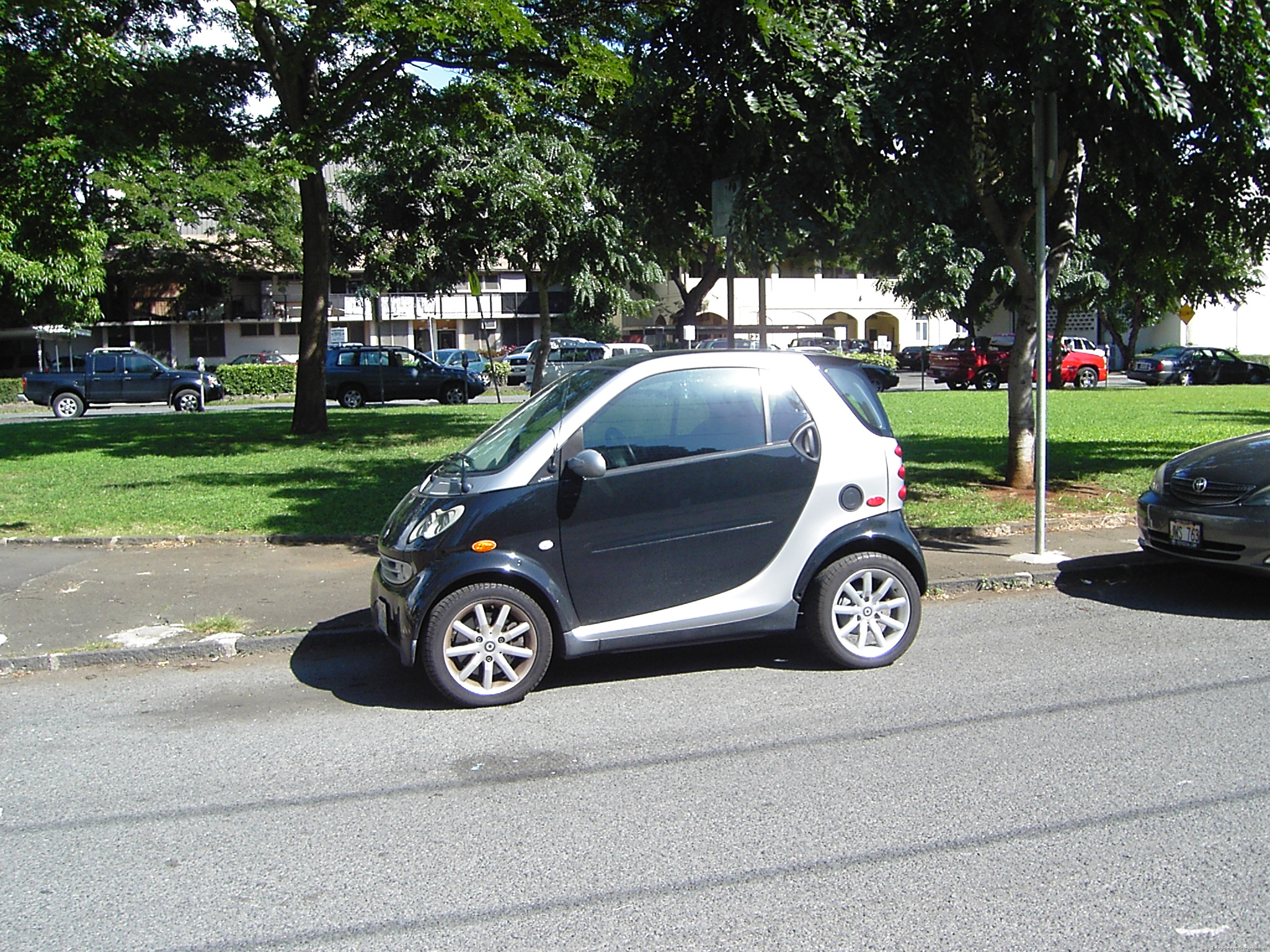 There is the Smartcar. I'm not sure how this translates to highway utilization, though. Will more cars be able to use the H-1 if they are smaller? At least there will be more parking available if we let them double up in one space. Here's a pic I snapped near St. Andrews.
Regardless of whether they help relieve traffic congestion, smaller, cheaper, more maneuverable cars appearing on the scene would be an incentive for people not to use Mufi's train. Environmentalists are already afraid of what that might mean in India, due to the recent announcement of the Tata Nano, an affordable small car that could drastically boost car ownership there and elsewhere. I don't know what it would mean for the environment if small cars like this become more popular here.
These are the cars
Watch out for the Nano to spread from India to other countries and eventually even to the USA.
Other automakers are poised to bring out small, competitive, affordable cars. Many will never make it past the concept stage, but others will be out on the streets before long. And they will be competing with mass transit systems everywhere.
I don't expect to ever see this next one hit the streets, but it's cute!
When we figure out that the train won't relieve highway congestion on Oahu we'll be in the same fix as other cities. We'll have to make better use of our roads or innovate ways to avoid using cars altogether when possible. Honolulu could have taken measures such as staggered work hours already, but hasn't. It looks very much like we'll have to figure out how to get to work on our own.
So if smaller, cheaper cars become available, people may take matters into their own hands, and avoid the inconvenience of the train. Of course, for most of us, the train won't go anywhere we need it to go anyway. But the small car will take us everywhere.
Bush is coming, but for what?
As a country, we're setting new records for environmental noncompliance. So Bush is coming here for his meeting. Should we celebrate? Why?
U.S. Places Low in Global Environmental Ranking
The United States has placed at the bottom of industrialized countries in a new ranking of global environmental compliance. Researchers at Yale and Columbia listed the U.S. as the worst among the Group of Eight nations and thirty-ninth out of a total one-hundred forty-nine countries on the list.[Democracy Now! headlines, 1/24/08]
Wednesday, January 23, 2008
$350,000 for tugs for the Superferry--where did that money come from?
I wrote about the state subsidy of this commercial operation in a post on Monday. It's kind of corporate welfare, don't you think? Today there is a front-page story in the Advertiser.
 Just for fun, I went back to the list of grants-in-aid that have been withheld by Governor Lingle that Ian Lind discovered in the legal notices.
I just picked a few that added up to $350,000. There's no particular reason why I chose these except that they add up to the same $350,000 she is not withholding from the Superferry.
| Aloha Medical Mission | $75,000 | |
| Alzheimer's Disease and Related Disorders Association | $50,000 | |
| Assisted Living Options Hawaii | $25,000 | |
| Hawaii Cord Blood Bank | $100,000 | |
| Hawaii Primary Care Association | $50,000 | |
| National Kidney Foundation of Hawaii, Inc. | $50,000 |
Of course, there is no real connection between these organizations not getting their money and the Superferry getting this service from the State. I just think it's illustrative of what's been going on throughout this governor's tenure in office.
And for what is this $350,000 being spent?
Today's passenger count
Thanks again to the Maui volunteer counting corps:
37 cars got off the boat.
2 motorcycles got off the boat.
1 truck with crane on back got off the boat.
3 delivery trucks got off the boat.
10-15 people walked off the boat.
31 cars got on the boat.
1 motorcycle got on the boat.
2 Roberts Hawaii buses got on the boat.
2 flat bed trucks got on the boat.
1 truck with bobcat on trailer got on the boat.
10 people got on the boat.
It's continuing to look as though the State is subsidizing a sinking venture.
Akaku goes to court tomorrow over bidding process
The Maui News report that Akaku Maui Community Television will go before Judge Joel August tomorrow in its quest to have the public bidding process for Hawaii's public access television services set aside.
Read the article here.
I was one of hundreds of people who turned out to testify against putting the contracts out to bid. After a two hour 12 minute secret session held without required notice, the Procurement Policy Board voted that the contracts should go out to bid. My request for minutes of that 2006 meeting is still pending at the Office of Information Practices. It's now more than a year old, and they haven't responded to my recent email asking for the status of the request.
Fighting to reclaim Makua Valley: on this week's Making Contact
This week's program on the Radio Project's Making Contact:
Paradise Lost: Military Training in Makua Valley
January 23, 2008Native Hawaiian and Making Contact intern Samson Reiny reports on what happens when the military takes over historically sacred land and on how people are fighting back to reclaim this once pristine area.
Featuring:
Momi Kamahele, Makua Makahiki cultural advisor; David Henkin, Earth Justice attorney; Kyle Kajihiro, Makua Makahiki member; Fred Dodge, Malama Makua spokesman; Summer Nemeth, English teacher and demilitarization activist.
The program is available as a podcast from their website. I'm going to listen on my walk to the State Capitol this morning.
Tuesday, January 22, 2008
Will anyone get Lei'd? (ouch)
Ah, January in Hawaii. Who can resist? Yes, Bush is coming at the end of the month for his big climate change meeting. Of course, he doesn't want anything to happen that will hurt his oil buddies, so the best outcome for him is if it fails, of course. Or if it looks like a success but does nothing. You get my point. I would like to hope that something might be accomplished here, but I'm not expecting Bush to have an epiphany during his stay .
When people speak of the 1997 Kyoto meeting, it's generally with praise. The US is now isolated, everyone else has signed on to the Kyoto Protocol who matters (174 parties). Kyoto is associated with this highly regarded landmark in the effort to avert the effects of global warming. Kyoto shines all the more because we (the bad guys) won't go along with it.
So will Hawaii be associated with a failure? Will people remember the meeting held here? At best, maybe they'll forget it quickly.
Oh, that meeting.
Hawaii has nothing to do with it, except that some caterers will probably make a buck, there will be plenty of pomp, and maybe DBEDT will claim that Hawaii is now the center of something or other. The meeting will be closed to the public. You and I cannot attend. They're just using Hawaii as a convenient meeting place.
Oh, we taxpayers will probably be footing the bill for the extra security needed to hold the meeting here.
In fact, much of the world is already laughing. Here's an article deriving from an Agence France-Presse wire story:
Will Anyone Get Lei'd?
White House talks up its Hawaii climate-change meeting16 Jan 2008
The White House has released a statement regarding its very own climate-change meeting for the world's biggest economies, to be held Jan. 30-31 in Hawaii. "The two-day meeting will further the shared objectives of reducing greenhouse-gas emissions, increasing energy security and efficiency, and sustaining economic growth, and will help to advance the negotiations under the U.N. Framework Convention on Climate Change," the White House Council on Environmental Quality announced, fooling no one. Australia, Brazil, Britain, Canada, China, the European Union, France, Germany, India, Indonesia, Italy, Japan, Mexico, Russia, South Africa, South Korea and the United Nations are invited to send delegates. The gathering will be a follow-up to a rendezvous held back in September, at which nothing happened. The same is to be expected in Hawaii.
So that's Europe's take on this secret meeting. In Australia, there have been a few articles. My favorite was one about Prime Minister Kevin Rudd's wife, Theresa, insisting he cut off his sideburns so he wouldn't look like Elvis in Hawaii.
After attending to his hair the Prime Minister yesterday called on the US to join his government and ratify the Kyoto Protocol, ahead of a second round of climate change talks between major world economies.
That was from an article today. Any chance that Bush will ratify Kyoto? Australia is clearly laughing also. The Prime Minister, by taking preemptive action, is clearly trying to avoid any Elvis in Hawaii jokes that might result from his trip here.
The best thing Hawaii might do is distance itself from the meeting. Of course we won't do that. Look for Lingle-Bush photo ops, Ted Liu-Bush photo ops, etc.
Hawaii could end up the center of derision if we claim we were somehow part of something that the world might be laughing at.
Superferry not in much demand
This just in from Maui via email—the vehicle count for January 21, 2008 (I'm not sure if the counter wants to be recognized, so for the moment, here is just the report):
Vehicles exiting the Superferry
Semi trucks (without the trailer) 2
Cars 13
Pick-up trucks (more then half were FULL of gear) 15
10 passenger vans 6
Suvs or Mini-vans 9
Motorcycles 2
Small buses 2Of the 49 leaving the Superferry, 31 DID NOT have the letter "M" on their license plate.
Vehicles entering the Superferry
Cars 17
Trucks and all others 6
Yesterday was a holiday, perhaps that is related to the low numbers.
Monday, January 21, 2008
Large capacity passenger vessel on welfare?
I seem to be in a letter-snatching mood this morning.
Here's a snippet of a letter written by W.D. Woodward in this morning's Star-Bulletin:
Harbor fixes for ferry would be a waste
The former director of the Hawaii state Department of Transportation, E. Alvey Wright, wrote a letter Jan. 14 that only a bureaucrat could.Wright's irresponsible call for millions of tax dollars to be spent building and maintaining ferry terminals in three counties reflects the thinking of someone who understands government power but not market economics. Even at heavily discounted rates, the ferry is sailing below break-even capacity. It will not be long before the ferry goes bust, leaving us stuck with $40 million worth of barges.
Wright's proposal would throw good money after bad. We should be thinking about an alternative use for the barges. Perhaps one could be a place of retirement for Linda Lingle.
My understanding is that the state has a third mortgage on the Superferry in the event that harbor fees and expenses aren't paid. But fat chance that a third mortgage would ever be paid (the prior mortgage holders have priority). So indeed, the state could end up in the hole if the ferry goes bust.
So should we put even more money into improvements designed for a venture that is running below expectations and might fail?
I don't know the answer to this. If a "large capacity passenger ferry," of which the Superferry is an example, were a municipal or state ferry that had passed all its environmental requirements, it might be different. But it's a private venture, making profit using public facilities. I hope the Legislature will take a look at expenditures in a critical way, as this letter writer does.
Is the state footing daily expenses for ferry operation?
Do you know that whenever the tug boat pushes the barge around or otherwise assists the ferry, we pay for it? That's my understanding. I think the taxpayer cost would surprise us all. Someone should ask for those numbers and make them public.
In an email, activist Greg Kaufman estimated that at $1,000-$2,000 an hour for tugboat service (a Dept. of Transportation number), the state might be spending up to $6,000 each ferry trip when there is a swell. The tug first stands by, then assists the ferry, then holds it against the dock, etc. State money, private profit.
In effect, we're subsidizing that private company. It's corporate welfare. [Yet you can bet the governor will withhold money from social services at the end of the session, claiming we can't afford to spend diminishing tax revenues.]
Perhaps some concerned legislator could ask for an accounting of public funds spent on the ferry so far. It's only fair to know the truth.
Hawaii's quest to remain a third-world country: "We don't do maintenance"
I seem to recall that Hawaii was supposed to be the high-tech center of the Pacific, or something like that. The Governor wants us to have an innovation economy, whatever that is. These are vague concepts that have not yet been defined. They just keep a small army of public and private people employed chasing a dream (at public expense, of course).
But first, don't you think we should learn to fix something? That's very concrete. It's a basic requirement for building anything on, whether it is better education or a better economy. Keep what you have in good working order.
John Pritchett's letter in today's Star-Bulletin says it:
In Hawaii, we build it, but we don't fix it
Dear Coach Jones: We are sad to see you go. We know you were not happy that your requests for improved facilities and maintenance were rejected. However, we could have told you from the beginning, we don't do facilities and maintenance. We don't maintain our roads. We don't maintain our sewers. We don't maintain the restrooms at our parks. We don't maintain our streams and storm drains. We just don't do maintenance. Sorry, Coach.
One could easily add to John's list. We don't inspect dams. We don't keep emergency sirens running. We don't have enough inspectors to enforce health laws. We don't enforce traffic laws. We let schools rot around our children. The stadium is still rusting. Hamilton Library's roof is still leaking.
I'm sure you have your favorite list also.
A high-tech economy is impossible in a place where we haven't even mastered low-tech. Like fixing pipes, leaky roofs, decaying facilities of all kinds.
Where's the outrage?
Sunday, January 20, 2008
Checking in at the CompUSA liquidation
I stopped by last week to see if there might be some bargains at CompUSA downtown. Perhaps there are, but as I wrote earlier, you need to know the street prices of anything you're interested in, or you could pay too much.
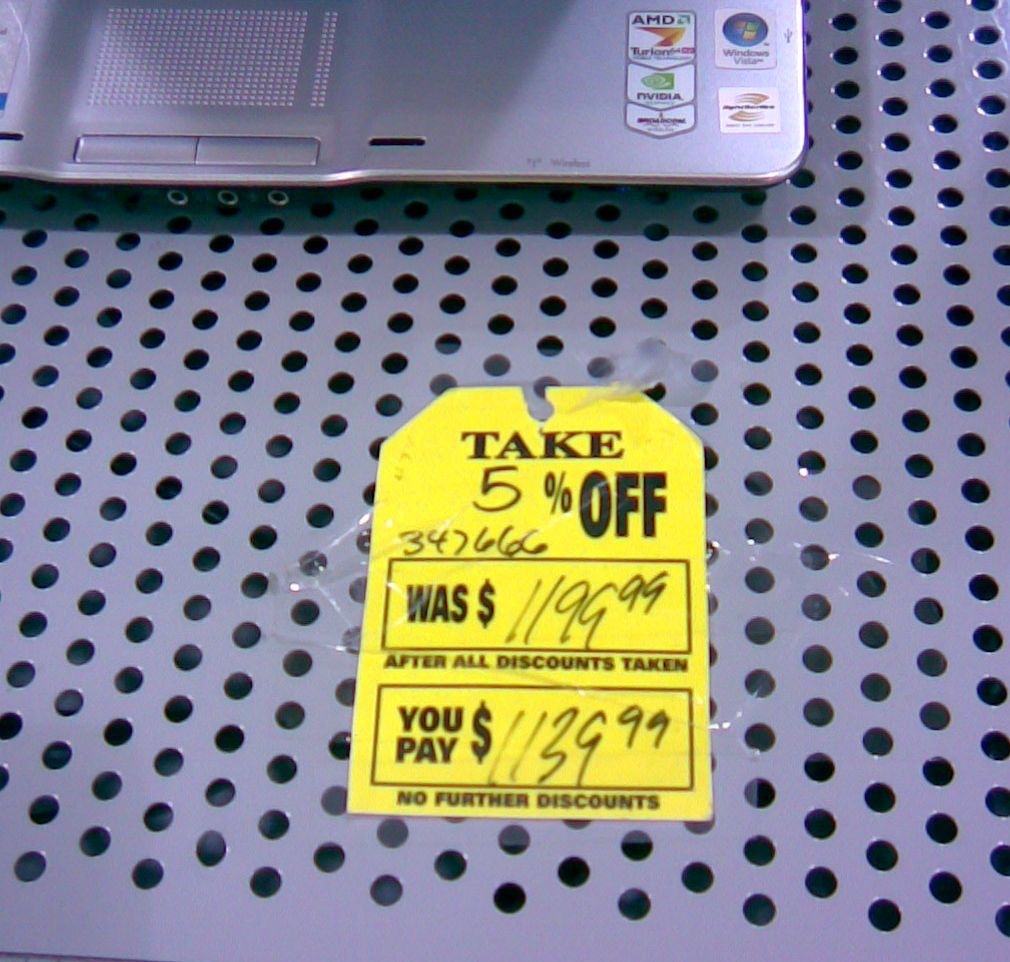 I've had my eye on the HP touchscreen laptop that CompUSA used to offer for $999.99. Last week the liquidators were still offering it for $1139.99, clearly no bargain.
But get this—the same computer is in this week's Office Depot ad for $699.99.
I don't know if it would qualify for any rebates if purchased at CompUSA. Nor did the CompUSA sales person nearby.
I just feel sorry for the folks I saw hauling away shopping carts of stuff that they probably didn't check on. Actually, very few shopping carts were in evidence. Most visitors to the store were wandering around, as I was, looking at stuff, but not carrying much.
The junk is surfacing, too. Memory cards that have small capacity by today's standards at prices not competitive with those advertised elsewhere. But oops... someone snatched away the card I was looking at. Sucker! Curiously, there was a sticker on it identifying it as a "store fixture."
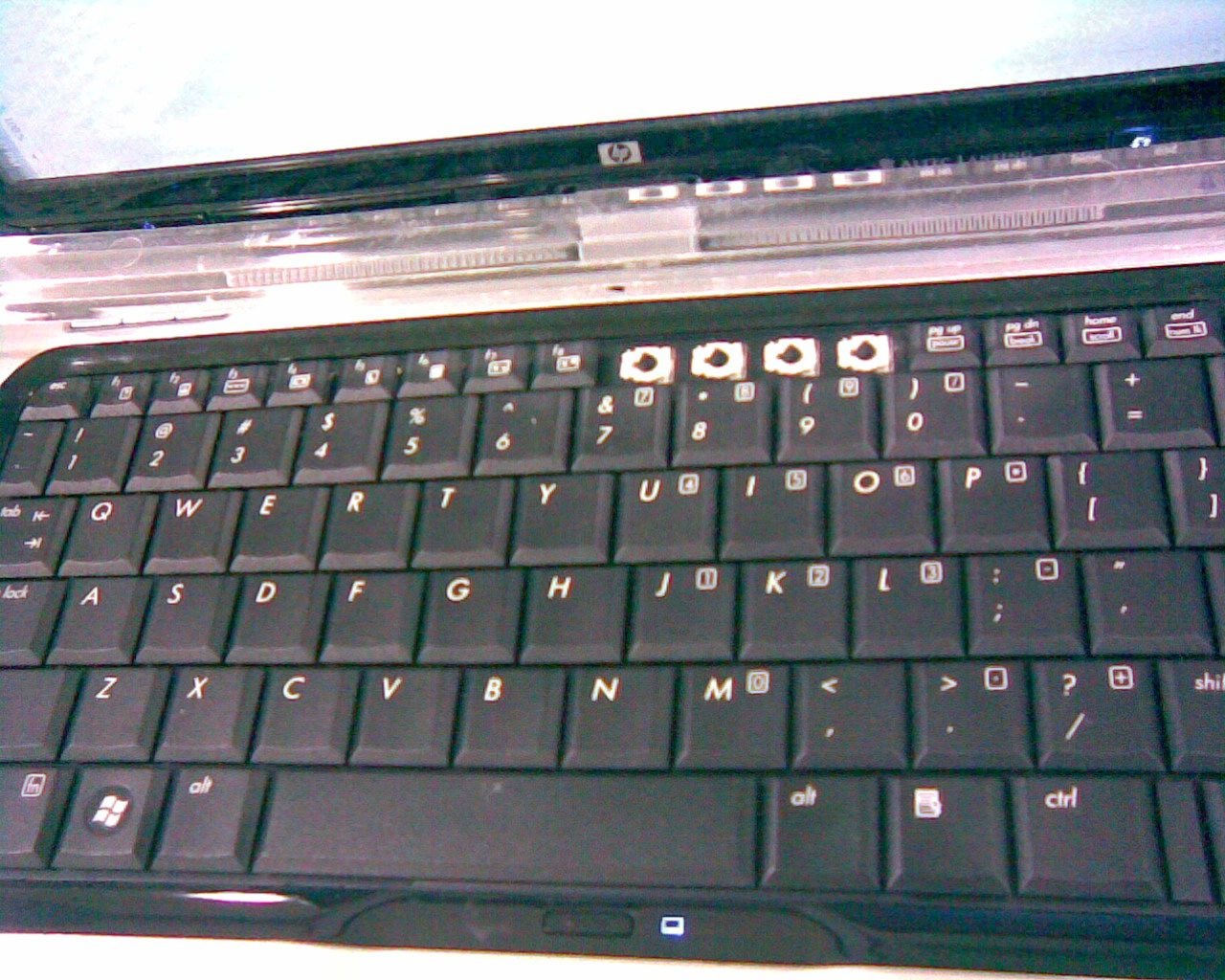 And that touch screen computer is falling apart. It's actually not a very sturdy machine, and not a real Tablet PC, so I won't be buying it. See how the keys are popping off? Some of the other stock, including single clearance items, was no longer pretty either, but no cheaper for the wear.
I guess that's how liquidation works. Like a spider in a web, just wait, and sooner or later the prey will come. But we know better than to become prey, don't we.
Smart Car spotted in Honolulu
 (Click for larger)
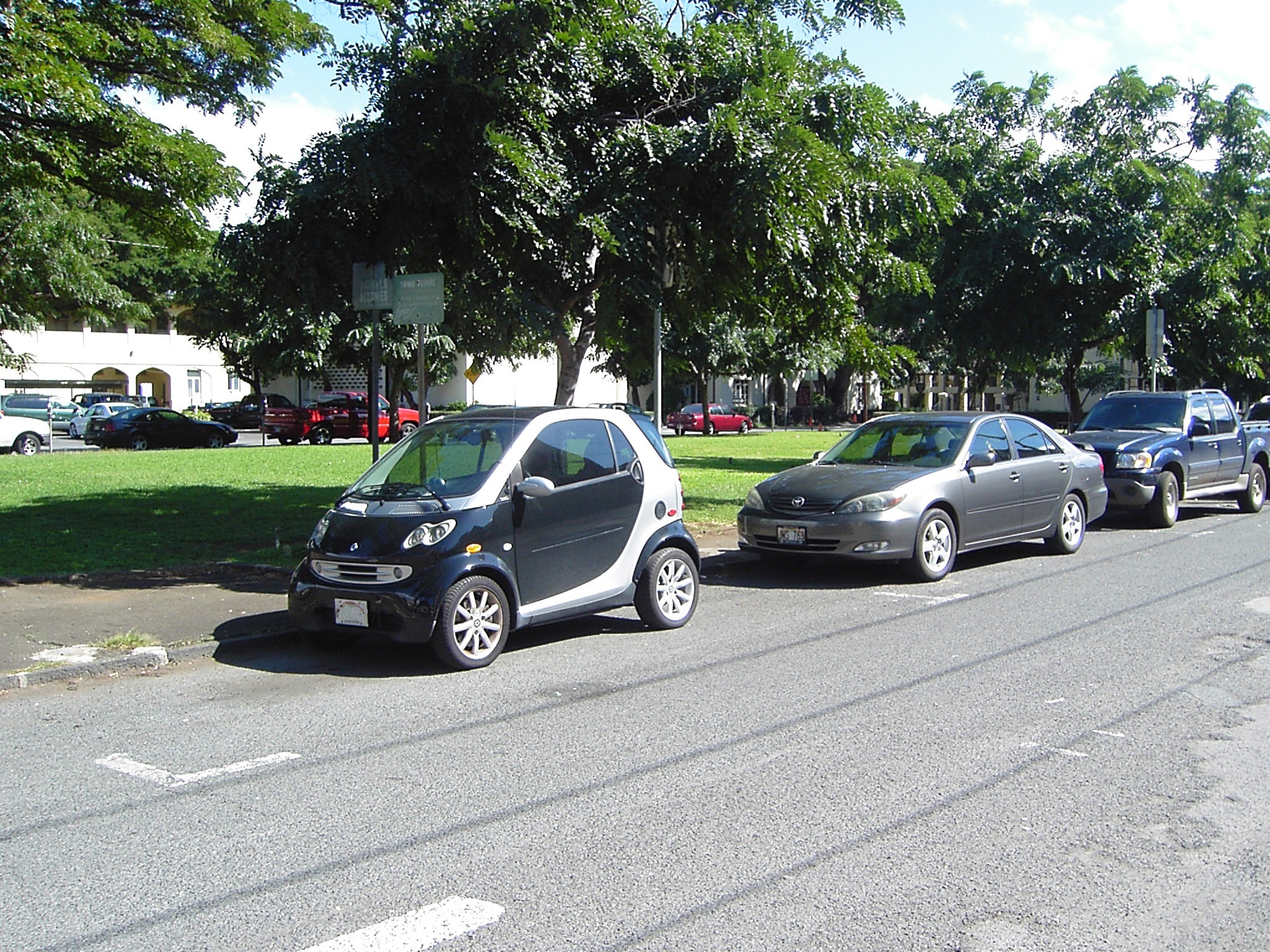
I spotted this Smart Car parked near St. Andrews last week while walking to the State Capitol. I didn't know there were any in Hawaii at all. The last I heard was that people were gaping at them in New York City whenever someone drove one down from Montreal. Obviously, my information is very out of date. It seems you can actually buy one, though there's no dealer in Hawaii right now.
As you see in the photo, two of these fit comfortably in a single parking space. Imagine if everyone owned a car this size—twice as many cars would fit on the H-1.
I've been very interested in the little car, which seats two, and has plenty of headroom and good visibility. So I left a note under the windshield wiper, hoping the owner would call.
He did. We talked about his car for some time. Sure enough, people are always asking him about it. He's actually had it for about nine months, he said.
Towards the end of the conversation he mentioned he is looking to sell the car—his family now has too many cars. I'll have to admit that for an infinitesimal fleeting moment, I kind of thought, if only my own car, recently stolen, had not been recovered, I could buy this Smart Car. It makes ecological sense, economic sense, and I'd probably love its ability to maneuver in traffic.
Anyway, I'm happy my car was recovered. It's almost completely repaired now, and I'm lucky to get it back. So no Smart Car for me, right now.
If you, Disappeared News reader, are interested in speaking with the owner about buying it, you can send your name/phone number to me and I'll pass it on. No, I don't get any kind of commission or anything. The owner was so kind in answering all my questions that I thought I'd just mention it on the blog. Send email to me at larry -# a t #- disappearednews.com and I'll pass on the information. Let's say, till the end of the week, I don't want to do this forever.
Withholding $7 million from charities, culture, arts, social services should help explode the myth of Lingle's popularity
I admire investigative reporters immensely. Ian Lind's Saturday blog post mentioned a new reporter headed to Hawaii to work at the Star-Bulletin. That's good news. Of course, Ian himself is a star investigative reporter. And he's just uncovered some important information.
I was amazed to learn that Ian reads the legal notices. Now, that takes dedication. Check out the article above for what he discovered—a comprehensive list of Grants-in-Aid that Governor Lingle has withheld. Yup, Disappeared Money.
Since these funds would have directly benefited the people of the state, it raised the question once again, in mind, whether Lingle's supposed popularity is real or whether it is a product of her PR team's expert spin. Check this out:
Reading the list (Ian helpfully links a copy from his site), I can tell you that Lingle is probably not popular with supporters of the Kidney Foundation. They're out $50,000. Kidney disease is a major problem in Hawaii. Those suffering with diabetes or kidney ailments might be thinking twice after this money was snatched from their advocacy organization.
I'm guessing that Lingle can't be too popular with the Hawaii Farm Bureau Federation. They're missing $500,000. No small change.
Or the Aloha Medical Mission, Family Promise of Hawaii, the Hawaii Cord Blood Bank, or the Coalition for a Drug Free Hawaii. And on and on.
The total snatched from the people's programs was $7,533,193. That's an astounding sum in a small state.
The Grant-in-Aid process is described by Senator Roz Baker in this article she posted on the Senate Majority Caucus blog. It's an essential source of funding that is not easy to get, and which benefits innumerable programs that government cannot provide on its own. Like the work of the Kidney Foundation, the others mentioned above, and many more. Jobs, health, culture, the arts. All people's programs.
I'm grateful that Ian posted the list. It would be nice if a print reporter would pick up this issue as well. Stop laughing. Meanwhile, good thing Ian Lind is on the beat.
Saturday, January 19, 2008
Lingle's Legacy (2): cheating seniors out of their prescription benefits
In an earlier article I listed up some of the laws that Lingle has refused to implement by withholding or delaying funds. I've also just written about her obstinate refusal to let go of the $3 million that the Legislature apportioned for pedestrian safety.
Let's look at the Rx Plus program next. As you may know this law should have been implemented years ago. Seniors, persons with disabilities, and those below a given income ceiling should have been able to save money by taking advantage of this program.
From 2004-2007, Rx Plus, by giving Hawaii residents the benefit of state negotiations with drug companies, should have saved them from having to choose between food, rent, and their medicines. I can't say it didn't save money. At a meeting attended by Department of Human Services head Lillian Koller, she let us know that it saved those who took advantage of it an average of nine cents. No typo, that's 9¢. Please don't laugh. This is pathetic. In a real world, someone who brought in only a nine cent discount would be summarily fired. But not here, because, of course, the law and intent of the Legislature is not what runs things.
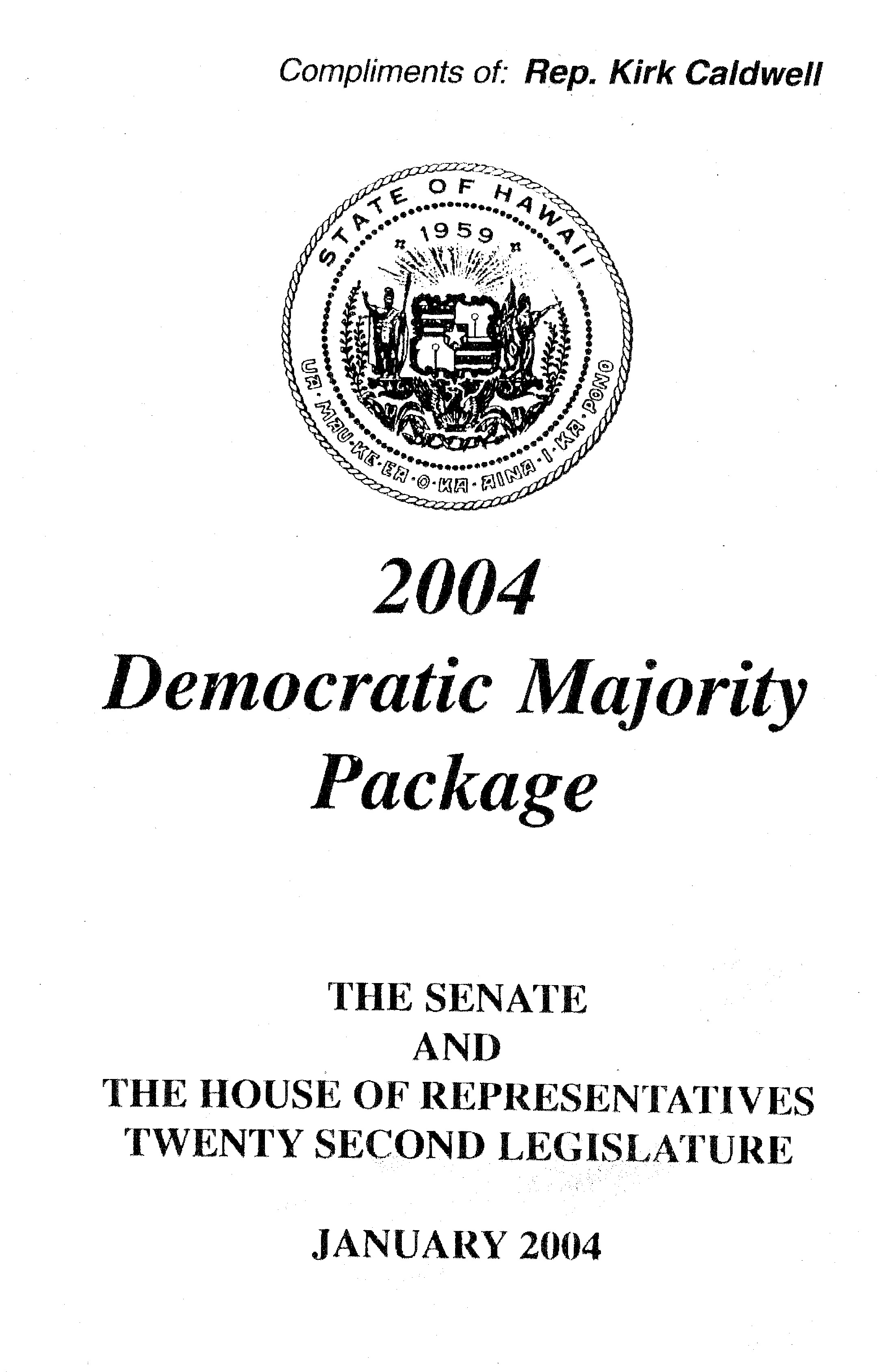 Since I'm an incurable packrat, I still have the 2004 Democratic Majority Package leaflet where I first saw this program mentioned. It's dated January 2004.
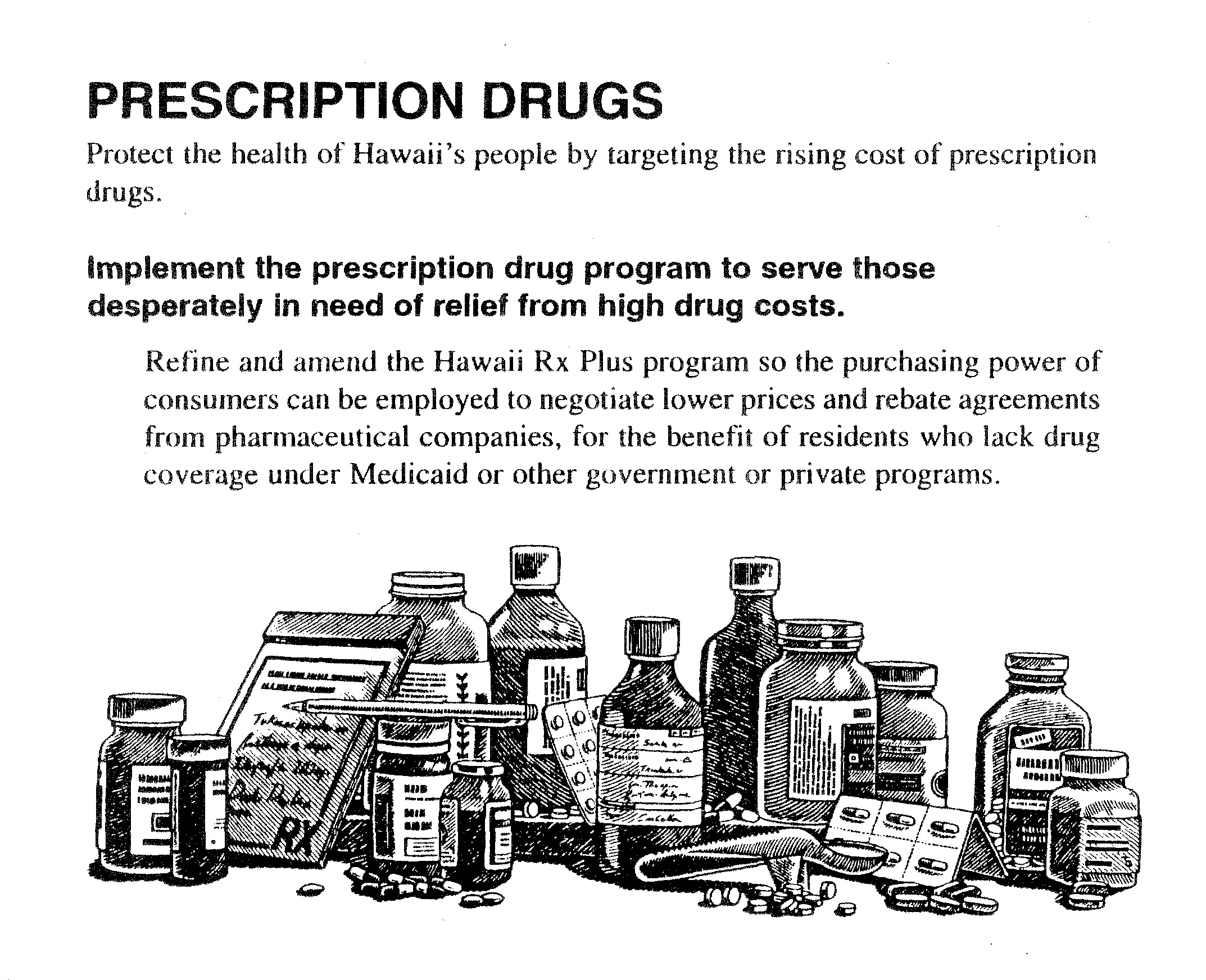 Inside, the Rx Plus program (click for larger) is featured.
Well, the law, as it came out, said that DHS "may" negotiation with the pharmaceutical companies for lower prices. Although the intent of the Legislature was clear, our governor did not implement the law. Shucks, it said "may," right? So no need. Nevermind all the seniors having to pay full price for drugs to her drug company buddies (Pharmaceutical companies (Pharma) are the second biggest lobby in Hawaii, according to a Pacific Business News list published just this Friday).
So in 2006, the Legislature amended the law, changing "may" to "shall." That's S-H-A-L-L. What is there not to understand?
It didn't help.
Here we are, the 2008 legislative session has just begun, the law was strengthened, and still, no benefits. As you may know, drug prices have steadily increased, and many seniors find themselves in President Bush's so-called "doughnut hole" where their Part-D insurance no longer pays for their drugs at all.
I was surprised. Yes, I was. Just after Lingle took office, that first session, she came down to the Legislature to testify on a mental health bill. I think it was the parity bill, I'm not sure. I was very moved. I thought, finally, we have a governor who cares. Well, I was fooled. Many psychopharmacological drugs are very expensive. Her refusal to negotiate with drug companies may help her should she seek higher office, but it doesn't help those with mental illness who are stuck paying for these medicines.
[I gave up my misimpression completely when, at the end of the session, she vetoed bills including one for a service for the blind.]
So now what? I am not sure what the Legislature can do. DHS' Lillian Koller would probably negotiate strongly for lower prices if she didn't have a leash around her neck. I find it hard to blame her for the plight of seniors and others. But she is the one who has to take the pounding, although direction for each of the department heads comes from above.
Stay tuned for more in this Legacy series.
Superferry numbers vs reality?
I couldn't say it better myself. (Thanks to Vivian Lerner for email pointing to this article):
Superferry Caught Lying Again
According to Pacific Business News:
When asked about the Dec. 21 letter, Terry O'Halloran, Superferry's director of business development, told PBN the Alakai was transporting about 160 passengers round trip on average, and 50 vehicles on average.That conflicts with other recent news reports in which O'Halloran said passenger counts were averaging 200.
And it also conflicts with the actual on-Maui vehicle counts done by Brad Parsons
O'Halloran is blaming EIS-first proponents for his business failure but it is rather a situation where the EIS-first advocates identified the weaknesses in the plan and Superferry execs ignored them.
There is more worth reading in the above article, please click the first link and check out the whole thing.
Exploding the myth of Lingle's popularity -- withholding money, attacking elderly pedestrians
Lenny Klompus, Governor Linda Lingle's senior advisor and publicity guy, should know better. In Friday's Star-Bulletin he wrote a letter attacking Rep. Kirk Caldwell, the House majority leader, for trying to reduce Hawaii's shameful pedestrian death toll. Let's get one thing clear—Rep. Caldwell, as well as other legislators with the exception of two Republicans, voted decisively in favor of a bill that would help protect pedestrians.
Governor Lingle vetoed SB1191, and her veto was overridden. She then withheld the money that was to fund the pedestrian safety bill, now a law of the state. Lenny, Rep. Caldwell stands in the light on this issue. His constituents will thank him for his efforts to protect them. Where does this leave Governor Lingle, and now you? You wrote, in part:
In a recent Associated Press article on funding for projects including pedestrian safety, Rep. Kirk Caldwell says, "Since (Gov. Lingle) has failed to release the money, we've had several other senior citizens die. There is an issue of blood on someone's hands."
This is a despicable statement on a couple of different levels. First, it politicizes an issue that shouldn't be politicized. Rep. Caldwell should be ashamed for twisting the unfortunate instance of pedestrian casualties to serve his own selfish purpose.
Dear Lenny, what's despicable is your letter.
Elected officials have the power of life and death over dozens or hundreds of people. It was Lingle who decided to spite the Legislature by withholding money apportioned for pedestrian safety. She had vetoed SB1191 and the Legislature overrode her veto. In fact, in her own Republican party, only Sen. Hemmings and Sen. Slom voted against the override. They were the only No votes. It's clear that the people and their elected representatives wanted this bill to pass and the $3 million it called for (a relatively small amount) to be spent to improve pedestrian safety and reduce the death toll.
2007 started off badly for elderly pedestrians, with a large number of deaths before the legislative session closed. And of course Hawaii is still Number One in the nation in elderly pedestrian deaths.
Sadly, the money has not been released, and indeed, the deaths continue. These are often avoidable deaths, and they were not avoided. The money, had Lingle released it, might have helped save one or more pedestrians. No one can say how many, but Caldwell is correct that the blood is on Lingle's hands. He can say that because of her politicized act. Right or wrong, is it worth endangering human lives to prove something?
A no-brainer, right? Lingle (with Hemmings and Slom) stand isolated. The rest of the Legislature did what they could.
So the politicization of this issue (that indeed should not have been politicized) was Lingle's gambit. And her decision may, inevitably, cause an indeterminate number of avoidable deaths.
Lenny, look into your heart and see if you really want to be on the wrong side of this issue.
Friday, January 18, 2008
On the two Honolulu newspapers, print and online
For all you Costco members or those not yet members, the Honolulu Advertiser is offering a free membership, kind of.
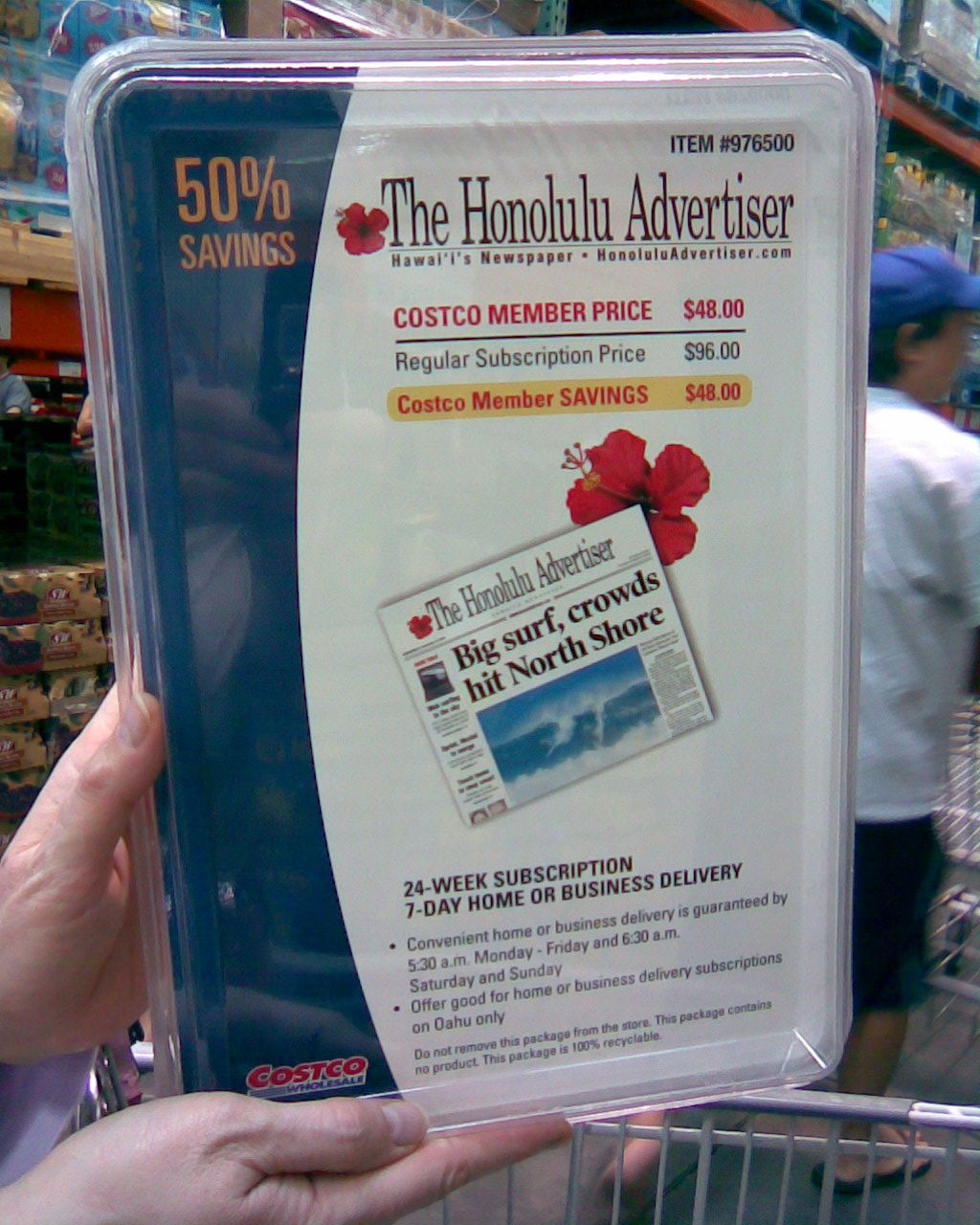 The other day I was shopping at Costco and noticed a big card with a 50% off Advertiser subscription. That's a mind blower. I recently renewed my sub for $209 for a year. Indeed, the Costco deal comes to only $100 for a year.
That's like putting $100 in your pocket. No small change!
I called the Advertiser to find out if I receive a refund for my unused paid subscription, and the answer is "yes." So I bought two Costco cards. And canceled my current sub, asking for a refund. Then I faxed in the new coupon. And my paper is still coming.
Several thoughts on this:
- I have subscribed to the Advertiser for years and years. I resent that they are charging me double the rate they are offering to others. Where's the deal for loyal subscribers?
- If someone is not a Costco member but thinking about it, and you're an Advertiser subscriber, here's your chance to get a couple of year's free Costco membership, if you'd like to think of it that way. You could join Costco and reduce your newspaper costs enough to pay for it, then enjoy the Costco membership for all the other good deals they offer.
- Idle thought on profits. Do ads pay for the paper? What proportion? Obviously they are willing to forgo half the ordinary subscription price pretty easily.
Switching now to the Star-Bulletin. I'm glad there are two papers in Honolulu. Often enough, despite its smaller operation, the Star-Bulletin beats out the Advertiser on quality of reporting. Check the difference in the coverage of yesterday's tragic killing of a 2-year-old. I very much appreciated the S-B's story over the Advertiser's. Just my opinion, of course. That's just an example that was readily at hand. I can do without the S-B's right-wing diatribes, though, and their trick of putting conservative comics on the funnies page. So I won't subscribe. They telemarketed me for a $40 annual subscription last week and I said "no thanks."
But who needs to subscribe to the Star-Bulletin? They're giving it away free on buses and in Subway stores. I heard that some people got a free sub offer included in their phone bills (unverified). The S-B press run is limited, and my understanding is that they run the max even if it means giving the paper away. Yet they go on. A mystery, but again, I'm glad they are still here.
Ok, shifting to on-line. Gannett (Advertiser) obviously has the resources to move into a strong web presence, and they have done so. Blogs, reader comments, even steadily improving video coverage can be found on their Internet pages. It seems to be still a work in progress but I think they will do a good job of it. And supposedly, the on-line ad revenue will pay for all that. Internet advertising is growing while print stagnates.
There's a dirty little secret though, that all on-line newspapers have to contend with. Users are adopting ad-blocking software. It's getting darn easy to eliminate most ads. I don't see many ads at all when I surf the web. Less geeky folk can still eliminate a large number with browser add-ins or ad blocking features of many firewall or antivirus programs, or with specific ad-blocking software.
No doubt there will be a software war, with websites working to produce ads that can't be blocked, and ad-block software vendors working to block them. The New York Times Reader is an excellent bit of software and its ads can't be blocked (to my knowledge), but they charge money to use it. Perhaps other papers will offer similar software. Sites running videos include "commercials" in the videos, and those get through.
For those of us using browsers, though, we have options. Newspapers hoping to substitute on-line ad revenue for print ad revenue will have to deal with it.
Advertisers know about ad-blocking software, of course, and they also know that relatively few users are using it. As the software becomes more popular, though, there may be a falling out.
Is it cheating to block ads? I say no. It's not much different from scooping out all the ads tucked into your Sunday paper and chucking them into the garbage bag. That's pretty much what I do. It's my Constitutional right to throw away the ads. And I'll do the same on the Web, thank you.
Meanwhile, enjoy your Costco/Advertiser savings.
Wednesday, January 16, 2008
Dennis Kucinich patched back into the debate
Well, Nevada kicked him off, then he was back, then he was off again. Democracy Now! put him back in.
Amy Goodman overruled the Nevada Supreme Court by putting Kucinich back in the debate. She broadcast clips from the debate on her program today and let Kucinich respond, as he might have, had he been there.
Well, it's not a huge TV audience, but Democracy Now! is broadcast on more than 650 stations. Folks that count, like you and me, can watch it.
Check it out tonight at 10 pm on channel 56 (Oahu), or stream it from democracynow.org anytime. They also have the broadcast schedule for other islands. There's also audio and video podcasts from their website.
A tsunami of garbage TV sets is headed for Hawaii
In February 17, 2009, just over a year from now, broadcasters will switch over to digital broadcasting. A veritable tsunami of old, heavy, analog TVs, most with picture tubes and filled with pollutants such as mercury and cadmium, will hit the garbage heaps in Hawaii as it will elsewhere in the country.
Are we ready? At least, we should ask the question, particularly at the start of the legislative session. Do we need to create a way to handle the coming tsunami of dangerous junk?
While it's possible to buy a converter box, most viewers are expected to toss their old sets and succumb to the escalating wave of advertising for new large-screen and high-definition sets.
Old TV sets are simply incompatible with the new broadcast standards. Those using antennas will have a choice, and it seems that most will choose to dump their TVs, often more than one per family, and upgrade. At least, that's been the pattern so far.
How shall we handle the coming tsunami of garbage? Let's figure out something before we end up stepping over them everywhere we go.
Tuesday, January 15, 2008
Are we being used by the Superferry?
Joan Conrow has researched and presented a series of articles on the Superferry and its military ambitions. The series appears on her blog, KauaiEclectic, and there will also be something in Wednesday's Honolulu Weekly, according to Joan's post today.
I hesitate to quote a snippet because it doesn't represent the breadth or depth of Joan's writing, but I'll dare to quote just two little paragraphs that are of interest to me:
A March 2005 Pacific Business News article that announced Lehman was joining the HSF board stated: “With Lehman's expertise, the Superferry plans to operate a Westpac Express, essentially to carry military equipment and ferry vehicles from Oahu to the Big Island on a daily basis.”
The article continues: “This logistical plan will make it easier for soldiers to train when the Stryker Brigade comes to Hawaii. The brigade will be stationed on Oahu and conduct training exercises on the Big Island, Lehman said. "The Superferry is strong enough to take Stryker vehicles," he said.
Not that this was a secret, except possibly to those who don't read many blogs. The mainstream press certainly hasn't kept on this issue (parenthetically: nor do they seem to be interested in doing independent ridership analysis, instead they just quote whatever numbers they are fed by the ferry company). Some questioning did take place during the special session that gave the Superferry its green light to go. Ouch! Is it permissible to use the words "green" and "Superferry" in the same sentence, considering how much oil it is burning?
Could it be that the ferry needed to get its EIS exemption to sail so that it will be available to the military, and that it doesn't care much about passengers at all? Look how easily they gave up the second Maui run. Oh, sorry, Mayor Tavares, we'll just cancel the plan, it's ok. We'll do more outreach. Shucks, we'll double the outreach we're already doing. Triple it, even.
Don't mind me, I'm getting a bit tired of all the Superferry shenanigans. If a business plan requires two trips, then how can half the business plan just be canceled?
In announcing the second trip to Maui on Jan. 4, John Garibaldi, president and CEO of Hawaii Superferry, said "our business model is dependent on running two trips per day." [Honolulu Advertiser, 1/15/2008]
So much for their business model. Or could they be looking to fail in the civilian business as part of a larger model?
I'm sure we'll find out eventually what's up here. In the meantime, the safety of whales, the environment, Maui agriculture (the bee thing and more), and Maui's quality of life for its residents remain valid and ongoing concerns.
Those on Oahu who say we are all one state should ask themselves, well then, if you feel that way, what about caring for and protecting our neighbors? Hmmm?
Sunday, January 13, 2008
Greenpeace's win is Shibuya's loss, but don't count Japan out quite yet
It's pretty well known that Japan's "scientific" whaling is primarily a commercial venture to keep this traditional food on restaurant menus. There is widespread international condemnation of this blatant deception and of the ongoing kill by the Japanese whale fleet. Greenpeace has recently achieved notable success (see below) in heading off the Japanese whale fleet near Antarctica.
What's not so well known is that Japan is in the forefront of a growing list of countries that want to return to "sustainable" commercial whaling. The list includes: Antigua and Barbuda, Benin, Cambodia, Cameroon, Cote d’Ivoire, Denmark, Dominica, Gabon, Gambia, Grenada, Guinea, Iceland, Japan, Korea, Kiribati, Mali, Marshall Islands, Mauritania, Mongolia, Morocco, Nauru, Nicaragua, Norway, Palau, Russian Federation, St Kitts and Nevis, St Lucia, St Vincent and the Grenadines, Senegal, Solomon Islands, Suriname, Togo, and Tuvalu.
It's important to understand the dynamics of this. Condemnation of Japan's whale hunt is not universal. And if the Japanese fleet should be stopped entirely, there may be alternative sources that they can tap. Especially if they are willing to pay the price. And they will pay, of course.
As the caption on this snippet from the Tokyo Food Page suggests, eating whale meat goes back "forever" in Japan. This restaurant is in the busy Shibuya area of Tokyo, right near the station. It's one of the most popular, affordable, and most accessible of several choices in Tokyo. Japan's "scientific" whaling is enough to sustain an affordable lunch at this restaurant of around $15-20, and a crowd of hungry "scientists" lines up daily for what is considered a delectable treat.
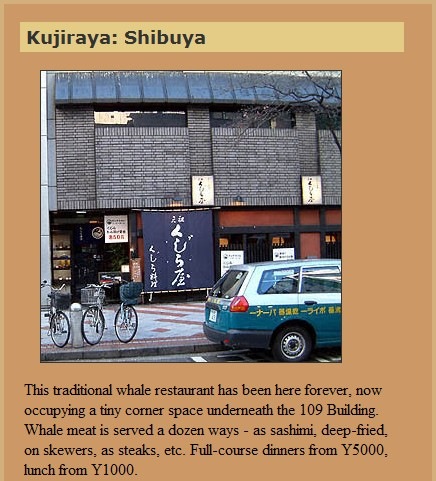
Should international protests continue, no doubt the price of whale sashimi will go up at Kujiraya. But don't doubt that this landmark restaurant will still be around 100 years from now. Greenpeace and other activist organizations are bucking a powerful tradition. The battle needs to be waged, and at the same time, it's helpful to know what they and other determined activists are up against.
Thanks to Viviane Lerner for the link to this article reporting on Greenpeace's success in separating the Japanese whaling fleet from its catch. Embedded in the article is a YouTube video. Since a picture is worth a thousand words (and a video how many?) I'll leave you with this for now.
Hawaii's quest to remain a third-world country
Under the leadership of King David Kalakaua, Iolani Palace had electricity and telephone several years before the White House. Yes, it's true. Well, it's 2008 now, and the King's initiative and foresight are sadly lacking in our state government. But maybe it's not entirely their fault.
It's not just the current administration, whose idea of improving schools is to break up the system, or which believes that it can get away with withholding money for social services, pedestrian safety, or culture and the arts. The neglect of Hawaii's infrastructure is long-standing. It takes time for things to rust this badly. It takes continued neglect for a university to decay as the University of Hawaii has. Dams were not inspected for 11 years. The conditions leading to the deaths of seven people were long in the making. There's much more I or you could add, of course.
The poor condition of our roads cannot be blamed on former mayor Jeremy Harris any longer. They're Mufi's potholes now. It's also his bus that can't run on schedule, that won't give riders basic information like maps and timetables posted at bus stops. Heck, the bus stops usually don't even say what buses stop there, at what hours, or where they are going.
King Kalakaua would not have run things this way. I'm sure of it.
We deserve more than we are getting. Or do we? I agree with Richard Borreca's column in today's Star-Bulletin.
In Hawaii, chronic disrepair of the infrastructure such as neglected roads, harbors, bridges and schools has translated into the way to balance bad budgets. With this year's budget already bleeding red ink, don't expect the state to visiting Home Depot anytime soon.
It's not like people don't know about the chronic backlog of school repairs. It's in the papers every year. We know. But fixing schools is not our priority. If we cared, they would be fixed, don't you think?
It's not like we don't know that the roads are in bad condition. We drive on them, accepting the potholes, lack of paint, dangerous crosswalks and intersections and the lack of enforcement of traffic laws. In fact, we accept the high death toll that results from this neglect. If we cared, the roads would be fixed, and our kupuna could cross the street without fearing for their lives each time. Don't you think?
 I just picked one intersection. You can choose any. Guess what: they are painted. Shiny white (if I recall correctly, they use reflective paint for added safety). (click photos for larger)
 This shot is along Pali Highway. It's nothing special, just one of many thousands of examples of paint gone and not renewed. There's a little paint, or I wouldn't have a picture to show you. Give it a month or so and this will be bare.
 a crosswalk ahead. This one has no zebra stripes. No doubt there are several like this near where you live. At night, in the rain, would a driver slow down for this?
Here's one across the street. Is this a crosswalk? It has about as  much paint as other intersections where the zebra stripes have been omitted. In fact, no, this one is not a crosswalk, but my point is that it looks exactly like others that are.
How about this one:
 Yes, this one is a crosswalk. It's about to vanish forever.
Or this one?
 If you click to get a larger view, you might find the crosswalk signal. It's hard to see, and harder to tell if it's red or white in the sunlight. This is assuming you figure out that this is a crosswalk in the first place.
Will cars know it is a crosswalk? Are pedestrians safe using it?
Should we accept this as normaL?
 Imagine that a blind person is looking for the pedestrian button to cross the street. Or that someone in a wheelchair or scooter is thinking of getting across this street.
 http://picasaweb.google.com/UH.ugly
if you have other photos documenting the shameful state email them to uh.ugly@gmail.com
This (with a little sorting out), given publicity, could help keep the spotlight on conditions at our flagship university and perhaps shame the state into making improvements. I urge anyone with a cellphone camera to snap away and perhaps help anonymous build up this collection. Or make your own, and present it to the world. Citizen journalism can do a service, in this case.
The hospital situation has been in the news repeatedly. Doctors are leaving the Neighbor Islands so that some specialists are hard to find. Hospital beds are in short supply even on Oahu. It's in the papers every year. If you've read this blog for awhile, you know that I've written about lack of medical and hospital capacity as a real danger should a hurricane or other calamity strike the islands. No beds now means we won't be able to handle an emergency in the future, when, not if, disaster comes. If we cared, it would be fixed, don't you think?
In fact, we seem not to care. We're letting our government proceed with UH West Oahu even though it will mean that Manoa will continue to crumble into the dust. We drive the roads, potholed and unpainted as they are, without complaint. We say nothing about the conditions in our schools or the poor education that results from that sort of management. We are accepting of the decay in our medical infrastructure.
It's also no secret, apparently, to the outside world.
Although the athletic department's financial plight was well enough known that national commentators on ESPN radio snickered that if the UH budget was improved "the football team would get double-ply toilet paper," the message never seemed to make it from Manoa to the state Capitol.
Borreca is right. But why isn't government taking care of these things?
Because we let them get away with it.
C'mon, folks, don't just pay a bottle deposit tax for a refund system that doesn't work. Don't just pay the 12.5% increase in sales tax for a train (yes, Mufi's rumored to have decided on everything, including the vendor) to nowhere important. Don't leave fixing the schools to future generations.
Why should we expect that repairs will be made now, when they've never been made before? Do we think the streets will become safer if we take no action?
Predictably, tomorrow will be very much the same as today.
Unless, that is, ordinary citizens do something different. Unless they get angry, get together, and get some action from our government.
Friday, January 11, 2008
Looney Tunes is in charge of my computer service today
It has been a bad RoadRunner day. If you are a RR customer, you may have had days like this, so you know what I'm writing about.
This morning my incoming email started bouncing back. It turns out that one of RR's mail servers is bouncing mail which it said is because of a blacklist they use. Except that the ip address it gave wasn't mine. Their server can't do simple math.
From experience, I know better than to call them on the phone. After a long wait, I'll just be asked to use the on-line chat. So I just went to their web page and did that. The analysts, in whichever country they were located, didn't have a clue and said they would transfer the chat to a network analyst. After one hour, that still was not done (it was a couple of hours ago, still nothing, but at least I'm not sitting around waiting for it anymore).
If you're still reading this you must be a geek too. So you'll appreciate this one. I next tried getting help by email. Here's what they sent back, after I typed the whole long story into their email form:
At least, it reminded me at the bottom, that I'm dealing with a Looney Tunes character. You remember the Looney Tunes tune? They should play it when displaying the above message.
So much for email help. Aha! I should email the Postmaster! I did. And here is what I got.

Yup. If I can't send a message to Postmaster, I should complain about that to Postmaster. To whom I cannot send a message, of course.
This whole thing has shortened my life by a couple of hours. Struggling with Consumer Reports' defective website and some others probably took another 30 minutes off my lifespan.
Probably lots more people are affected. I wish legislators would pass a law that when cable services are down they must automatically issue refunds to all affected.
They'd be humming a different tune if they could not profit from their mistakes.
Wednesday, January 09, 2008
Lingle endangers Hawaii's honey industry and Neighbor Island agriculture by withholding funds to protect bees
The headline of this Hawaii Tribune-Herald story tells it all: Lingle nixes more money to fight bee killer.
The bee killer is the Varroa destructor mite which is hitching a ride on the Superferry as described in the article.
For want of a small amount of money, not only the honey industry but Neighbor Island agriculture is put at risk:
Honey is a $1.5 million industry in Hawaii, with queen bee production in Kona worth another $3 million to $5 million per year. But even more essential is the state's $450 million agriculture industry, particularly fruit, macadamia nuts and coffee, which rely on bee pollination to survive.
We wrote about that over a month ago. It's good to see the issue in a mainstream news article.
But something needs to be done.
Just waiting for Varroa mites to invade the Neighbor Islands on the Superferry or in other ways is a clear recipe for disaster.
It's disaster that Lingle is cooking up.
KKCR--setting the record straight
Don't miss the graphic at the top of this article by Katy Rose on the Island Breath website:
Katy Rose gives her account of events Out of the Washing Machine, On To the Clothesline!
Superferry vehicle count for Wednesday Jan 9
Today's count by volunteers (thanks for doing this!):
29 vehicles got off the boat, nothing commercial.
33 vehicles got on the boat, nothing commercial.
Volunteers take up ferry passenger count chore
I'm glad to hear that volunteers from Maui Tomorrow have taken over the task of counting vehicles arriving/departing the Superferry. Here are the numbers for yesterday:
| Jan. 8th |
I'm not sure if they will be counting passengers also.
This is an important public service that could enable our legislators to deal with future issues arising from their passage of a law during last year's second special session designed to allow Large Capacity Passenger Ferries (of which the Superferry is an example) to run despite a court ruling to the contrary.
For example, legislators may want to know about the carbon footprint per passenger of the ferry compared with air travel. You don't think so? Well, then, they might want to calculate passengers carried per whale collision, should that unfortunate circumstance arise. In other words, how many passenger trips is one whale life worth.
Lawmakers may also be concerned that expensive harbor improvements which benefit ferry operators among others and destroy surf breaks may be superfluous if passengers continue to shun the service.
Some of us who blog on the Internet are interested in publicizing the numbers, anyway, simply because the mainstream press has not undertaken to do this. Should any Large Capacity Passenger Ferry slink away in the night for another assignment, it would be helpful to understand why.
Barf alert
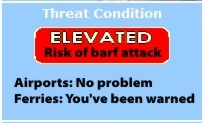 I note that as of 4:30 p.m., the Superferry has not altered or cancelled Thursday's schedule, according to their website. Yet there is a high-surf warning in effect. From this morning, via surf watcher Brad Parsons:
1. EVENTS: The National Weather Service in Honolulu has issued a HIGH SURF WARNING for the NORTH AND WEST FACING SHORES of MOLOKAI and NORTH FACING SHORES of MAUI effective from 6:00 p.m. this evening to 6:00 p.m. Thursday.
A High Surf Warning indicates that dangerous, battering waves will pound the shoreline. This will result in very dangerous swimming conditions an deadly rip currents.2. EFFECTS: A storm passing 1500 miles north of the state has generated a large northwest swell that will produce rapidly building surf along north and west facing shores of Kauai this afternoon.
Warning level surf will spread to Oahu, Molokai and Maui overnight, peaking late tonight and early
Thursday.
Surf heights along the north facing shores of Molokai and Maui will build rapidly to 25 to 30 feet tonight.
Surf heights along the west facing shores of Molokai will build rapidly to 15 to 20 feet tonight.
Forecast surf heights are estimates of the height of the face or front of waves.
So here is an experimental Barf Index warning. The index is still being developed by volunteers. Do you want to volunteer to help perfect this index? I didn't think so. But we'll do the best we can based on anecdotal reports and NOAA's surf predictions.
It's only fair that one day operators of Large Capacity Passenger Ferry Services (like the Superferry) should take on this task themselves. But I'm not holding my breath.
Uses for Barf Bags
 Aside from their intended function, barf bags have myriad uses. In fact, the number of things you can do with a barf bag is limited only by your imagination.
So I recommend asking for one (or more!) as soon as you board an interisland ferry, should the Barf Alert be Yellow or above.
Here are some of the things you can do with it, should you not need it for its design purpose:
- You can keep your Zune mp3 player in it so no one will know you didn't get a real iPod for Christmas.
- You can put your kid's lunch in it and no one will steal it at school.
- If the ferry bathroom is full, or too splattered with barf to use, well, there's always the handy barf bag (see this article for details of actual use).
- Take to restaurant as doggie bag.
- Use it to mail things. It's legal.
- Blow it up on an airplane and pop it, if you want to see if they'll actually arrest you.
And finally, my favorite use:
- You get on one of those interisland airplane flights where there is no reserved seating. It doesn't look too full, so you'd like to have room to stretch out. It would be nice if the next seat stayed empty. So take your purloined barf bag, open it, lean over slightly and stare at passengers coming down the isle. Look as apprehensive and uncomfortable as you can, while making eye contact with each one. Chances are good the seat next to you will stay empty.
Monday, January 07, 2008
Superferry discloses low booking numbers
From Henry Curtis:
Public Utilities Commission Order 23953 re Hawaii Superferry (dated January 3, 2008) approving the requested extension of discount rates from March 12, 2008 to June 5, 2008.
''By supplemental letter dated December 21, 2007, HSF, in support of its request, also asserts:
1. HSF is experiencing bookings at numbers that are much lower than expected. Bookings are averaging approximately 150 passengers per voyage, while the planned passenger load is about 410 passengers per voyage.'' (Order 23953, page 5)
Henry
Looking behind the June Jones headlines at a deteriorating UH
The headlines the past couple of days have been around whether UH can keep coach June Jones or whether he will fly the coop.
Ignored, except by Ian Lind, is the perhaps more important story that the coop is crumbling while we focus only on June Jones. Today he asks if we can (should?) afford a top tier football program. A snippet:
Take the beautiful renovation job that was done on Hawaii Hall, one of the original buildings on the Manoa campus. Now that the building’s like new, the academic programs were moved out and replaced by administrative offices, while across Varney Circle one building has been emptied after being allowed to totally deteriorate and the library seems to be in chronic crisis. Hawaii Hall now stands in the center of campus much like Baghdad’s Green Zone, a comfortable administrative enclave in the midst of widespread campus problems.
Ian mentions that the library is always in crisis. A university can be measured by the quality of its research libraries. UH is sliding academically and physically, even as we ignore everything but its football team.
Sunday, January 06, 2008
Must-read essay on KKCR, racism, privilege and more
Katy Rose has posted a remarkable essay on the Island Breath Kauai website. Please click on over and check it out. I won't dare to excerpt even a word of it. It's too good.
I describe it as "remarkable" because it's seldom that I see discussions relating a particular incident to larger issues of institutional racism (part of institutional violence) in Hawaii. Mostly there are attack letters when a person of color speaks out, or if there is an altercation of some kind that gets into the newspapers.
Katy includes a link to the classic Peggy McIntosh article, White Privilege: Unpacking the Invisible Knapsack, which ought to be basic reading in Hawaii schools. I won't give you a link to it because I'd rather you go via Katy's article.
We may feel that because people from so many backgrounds and ethnicities live here that we don't need to understand racism or discrimination. We surely do. Especially since the conditions around the illegal overthrow of the Hawaiian government are still with us today—the matter didn't end a hundred years ago. This means that oppression continues.
Back in North America, there is "diversity training" which often includes a handout of the Peggy McIntosh article, and of course, much more. There are books, workshops, trainings and plenty of community discussion. I attended a session run by leaders of the Oakland Men's Project one day in Oregon. It was an eye opener for me, and I thought I knew the subject. No, we don't instinctively know how other people feel. We are subject to the prejudices of the communities in which we each were brought up. The knapsack idea is a good one.
We can start by listening. It's actually a small start, not sufficient, but perhaps a beginning. It seems that KKCR needs to listen. As a radio station, perhaps they are more used to speaking, but here's a case where regardless of who is right or wrong, listening, getting together, holding discussions, working things out, would be a good thing to try.
It may be hard for them to understand, but the responsibility is on KKCR, regardless of the merits of the issues, to open their gates instead of locking them, to get some snacks on the table and start by just listening. In my humble opinion. Of course, it should go on from there.
Enough from me, please read the article. I do have more to say on institutional violence, but that's for another day.
What to do with one Superferry if passengers don't come
I suspect that if passenger counts continue to disappoint, the Superferry might shrug its shoulders and say it has to take on some military business to make ends meet. Now that special laws have been passed to overrule the Hawaii Supreme Court, it's free to sail, pending further legal action. So why not pick up a few Stryker gigs.
There may be alternatives, though. Let's explore some possibilities here.
1) Floating restaurant
We on Oahu have a great variety of restaurants to choose from. This morning, for example, we joined some friends for a dim sum breakfast in Chinatown. Neighbor Islanders can enjoy the same treats if the Superferry were converted into a floating restaurant.
This picture is of the Jumbo floating restaurant in Aberdeen 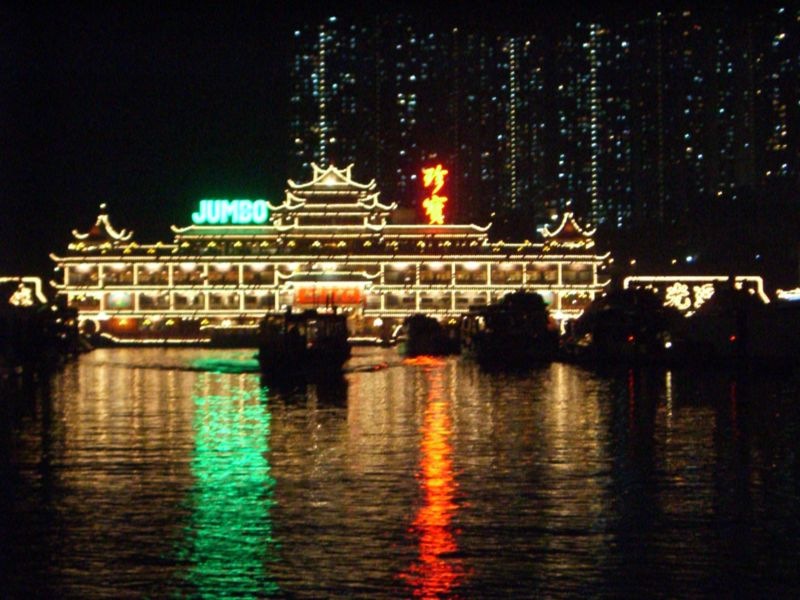 Harbor in Hong Kong. I've been there, the food is so-so, but the environment is stunning. Tourists love it.
They even have a "throne" and costumes so tourists can dress up as pseudo Chinese courtesans and have their picture snapped. I hate to admit that after downing some Wu Jia Pi jiu (五加皮酒), I joined my companions in getting dressed up and photographed. Watch out for that stuff. And you don't want to know what's in it. But I digress.
Wouldn't the Superferry look great, all fitted out in bright lights, and wouldn't people trek to the harbor for a great meal? Plus free parking, of course.
They could even do Chinese part of the year, Italian for a few months, and sushi for New Years.
2) Floating prison
Hawaii is short of prison space. Why waste a perfectly good Superferry. The idea isn't new. For example, it was tried in the  UK: [Home Secretary] Straw Visits Controversial Prison Ship. Floating the prison off-shore would certainly solve the "not in my backyard" problem we now have at the Legislature, wouldn't it?
Think for a moment. We could bring back a couple hundred prisoners from the private prisons in Arizona and avoid that expense. Unless someone challenges barfing all the time as "cruel and unusual punishment" or a form of torture. One ship wouldn't accommodate ll of them, but the Superferry company is planning a second one to be completed in 2009. That would take care of most.
The bottom area of the ship could be converted to an exercise yard or used for vocational training.
The British experience wasn't totally positive, though:
The vessel, bought by for £4 million from the New York prison authorities, was towed into Portland harbour, Dorset, in March to ease overcrowding in Britain's jails.
It became the first floating jail since the hulks of Victorian times. The same month, the then Environment Secretary John Gummer gave clearance for the development of shoreside facilities crucial to the jail's operation, despite strong local opposition.
Nevermind possible opposition. Our state government knows how to handle that. Draft a law, let opponents speak at "hearings." And of course, before converting the Superferry to a prison ship, I'm sure they could do some outreach to the community.
3) Floating observatory
When I look out my window, I see that the Missle Defense Agency's floating radar vessel is back for more repairs at Pearl Harbor. I'm sure that thing is sensitive enough to pick up a gnat on my window screen. So it's possible to use a ship for observation purposes. This could solve a long-standing problem—community opposition to defacing Hawaii's mountaintops with observatories.
The idea is to get these things away from city lights and pollution, right? Here's another option that might work.
 Why not cut a hole in the deck of the Superferry so it can be open to the sky, and move one or more of the controversial observatories off of Mauna Kea and into its reinforced vehicle area? I'm sure that this idea will not meet with any community opposition.
Then break a bottle of champagne over the bow and send it off someplace. Since it will have to stay very still, it won't be burning much diesel fuel. Maybe whales will come by to watch it.
4) Floating state capitol
Do this and there will be no problems with the algae-filled moat around the State Capitol. Build a replica on the deck of the Superferry (keep the free  parking downstairs) and float it from island to island.
This should have several benefits. For one thing, legislators and the Governor may gain a better appreciation of Neighbor Islander sensitivities, sensibilities and needs if they have to spend part of the time among them. And it's impossible now, ferry or no ferry, for anyone living outside of Oahu who is not on a corporate payroll to commute to the Capitol to give testimony on issues that affect them deeply—for example, but not limited to, the Superferry. Floating the State Capitol to Neighbor Islands will eliminate that glaring inequality between islands.
Of all of these possibilities, I don't know which one I'd prefer. Maybe the floating restaurant. But that's because it's lunchtime. Maybe during the upcoming legislative session I'll favor the possibility of floating the whole thing away somewhere.
I'm sure that there could be other (peaceful) uses for the Superferry.
I hope they find one.
Documents dig into underpinnings of ferry decisions
Kudos to Advertiser reporter Derrick DePledge for his first analysis of documents obtained from the state under the Uniform Information Practices Act, and to the Advertiser for requesting (and probably having to pay for) them. The article appeared in today's paper.
The Advertiser has also posted some documents on the Web, a trend I hope will continue. The link is at the top of the story on the web article, Hawaii, ferry at odds in ’04 over environment.
The article should be read in its entirety. I suggest also having a look back at the earlier Advertiser story, Hawaii Superferry spent $175,000 on lobbying and my short article, Honolulu Advertiser reveals extent of Superferry contributions to Lingle, pols.
There are good comments attached to today's Advertiser article and to my post, don't miss them.
Perhaps reading the articles together will hint at why (snippet from DePledge's article):
At the time, the [state Department of Transportation] and its consultants were conducting financial and operational reviews of Superferry. The department's harbors staff believed Superferry was considered a "go" project by the administration and was aware the governor's office was tracking progress.
In other words, if I may interpret, while the DOT was doing its reviews, which might have resulted in decisions protecting the public, whales and the environment, the administration was moving forward and presumably pushing on the DOT.
How can a mere whale compete with $175,000 in "lobbying" expenses?
Was the DOT really working on the need for an EIS? Again, snipping from the Advertiser article:
The documents, obtained by The Advertiser through the state's open-records law, show that the internal debate over an environmental review for Superferry was far more extensive than has been publicly disclosed by the Lingle administration and Superferry executives.
There are more documents to come to the Advertiser, and I hope that they will continue this project wherever it will take them.
I'm curious whether the documents will shed light on the strange position of Rod Haraga, who was director of the DOT but iced out approximately contemporaneous to the Superferry reviews. The story appears in this Maui News article, Gov. Lingle silent on Haraga ice-out. This article describes how DOT deputies, including harbors, reported directly to Bob Awana, Lingle's former chief of staff. It includes this statement by attorney Margery Bronster:
“The statute is pretty clearly formulated about how departments are run,” she said.
State law (HRS 26-19 ) states that “the Department of Transportation shall be headed by a single executive to be known as the director of transportation.” Also by statute, only the director is authorized to sign contracts.
Haraga said he continued to sign contracts during his last year and a half but had no other operational functions. He could not, he said, get information about his divisions’ activities from his deputies.
So what was going on between the DOT and Lingle, and was the Superferry project involved? The public deserves to know.
Please do check out the full articles, the snippets above merely scratch the surface. These kinds of articles are why we need to have a vigorous investigative press in Hawaii. Bloggers can't do it all.
Readers comments on Superferry
Check out the comments on my last Superferry article. They're more important than the article itself, so I hope you'll read them.
Saturday, January 05, 2008
Iowa by the numbers
An interesting analysis in RollingStone (snippet):
1/4/08, 2:30 am EST
Iowa By the Numbers
Four statistics blew me away tonight:
- Obama beat Hillary among women voters 35 to 30 percent.
- Amid record Democratic turnout, as many people under 30 showed up to caucus as those over 65.
- Sixty percent of the GOP electorate in Iowa were born-again Christians.
- Rudy Giuliani finished with a mere 4,013 votes, in sixth place, with less than half of the support of Ron Paul.
Taking them in order:
One:
Hillary lost tonight to Barack Obama by 8 points — a margin just as wide as Mitt Romney catastrophic shortfall against Mike Huckabee.And Obama beat her eight ways to Sunday. He edged her out among Democrats 32/31, and cleaned her clock among independents (44/17) and wayward Republicans (41/10). He beat her among people making less than $15,000 (37/30) and more than $100,000 (41/19). He beat her among health-care voters (34/30) and suburban voters (30/25).
Most astounding however, he beat her among her core supporters, women, by five points. What more can I say than — in a night of mind boggling statistics — that that’s the stat of the night.
A black man did this. In a state that’s 96 percent white. This is truly a historic night in America.
Superferry vehicle count low again
Brad Parsons and friends report fewer than 25 cars and two motorcycles getting off the Superferry on Maui today. There were about 35 cars and one large commercial vehicle getting on departing Maui, he reports.
I'm not sure if there was a passenger count done today.
For sure, the ferry management would not want low counts to become news, but I would love to see our daily papers make the minimal investment necessary to bring us information on how well this ferry thing is actually working.
And to speculate, if they must, on why there is now to be a second run to Maui if ridership is low.
Of course, it could increase over time, but that's what we want to know about.
Stuff to forget about Obama
Speaking (see previous post) about things we've forgotten, Sam Smith has a series of posts today on his Undernews about Iowa, the candidates, and lots that's forgetten about Obama. It's amazing to see all these article gathered in one place. Scroll down a bit.
Regardless of who or whom you support, check it out for some interesting reading. Hey, there's an election coming, we need to be prepared.
So much Disappeared News
So much to write about, if I had time to write and you to read. So news disappears even from Disappeared News.
What's have we forgotten?
Burma. Sudan. Congo, Palestine. Massacres, genocide, killing around the world. The killing goes on even if we never read about it.
How is East Timor doing these days, how is Aceh Province? How soon we forget.
Did you know that in 2005, NASA scientists studying the tsunami-inducing Indonesia earthquake of Dec. 26 discovered that it slightly changed Earth's shape and shifted the poles by about 1 inch? And I didn't report that. Sorry.
Kucinich. Gannett disappeared him from the Iowa debate. Are they trying to get us to forget him? Should newspapers work to influence opinion outside of their editorial pages?
Clinton. He was responsible for the "welfare reform" that drove single mothers into poverty and low-wage slavery. His sanctions killed probably a half-million Iraqi children. Hillary has chosen his advisors as her advisors. But we've forgotten.
Henry Kissinger. He's still around, giving his advice. How come he's not doing time yet? We've forgotten.
Last year the president of Sudan agreed to a cease-fire in the Darfur region, but I think he forgot to do it.
Women's rights in Afghanistan. Forget about it. The USA did.
Here in Hawaii, the Legislature passed a couple of laws to provide relief from the excessive costs of prescription drugs. DHS head Lillian Koller was supposed to negotiate lower drug prices for Hawaii's seniors, those with disabilities, and those below a certain income level. But I think she forgot about them. Or did the Governor put her foot down on Koller, to protect drug company interests so she can get elected to Congress? If that big boot were removed, would seniors have to choose between food and medicines?
Pedestrians were being killed in record numbers on our streets and crosswalks in early 2007. Hawaii still tops the entire country in pedestrian deaths in the older demographic, and injuries among school children are comparable or higher. But Governor Lingle hardened her heart and decided to forget about them, withholding $3 million that was to be spent on traffic safety. Never mind that there's a law saying it has to be spent.
I vaguely remember that we elected Democrats to Congress to end the war in Iraq. They did get elected, but someone forgot to end the war.
Check out also two remarkable Democracy Now programs featuring fast-paced reviews of 2007 with video and sounds. They are here and here.
Do you remember these names? They're all in the two programs:
Nancy Pelosi, Cindy Sheehan
President Bush, Sgt. Ronn Cantu, Leslie Cagan
Sen. Patrick Leahy, Zanku Armenian
Molly Ivins, Sami Al-Arian, Laila Al-Arian
Greg Palast, Rep. John Conyers, Salim Lone
Patrick Fitzgerald, Murray Waas
Dennis Kucinich, Jeremy Scahill, Don Imus
Rev. Al Sharpton, Bill McKibben, Louise Melling
Alberto Gonzales, Sen. Dianne Feinstein,
Seymour Hersh, Katrina Vanden Heuvel,
Ernesto Arce, Paul Rusesabegina, Don Cheadle
Sen. Daniel Akaka, General John Batiste
Majid and 9 yr old son Kevan
Ricardo Alarcon, Tony Blair, Joan Baez
Tariq Ali, Studs Terkel, Ted Shaw, Mona El-Farra
Rocky Anderson, Michael Moore, Ali Abinumah
Vanessa Redgrave, Dennis Brutus,
Joseph Wilson, Alan Johnston, Robert Bailey,
Caseptla Bailey, Marcus Jones, Helen Thomas,
President Bush, Rep. Dennis Kucinich,
Ward Churchill, Sen. Barack Obama,
Marjorie Cohn, Nydesha Foster, Angela Hegarty,
Amira Baraka, Nir Rosen, Camilo Mejia,
Grace Paley, Alberto Gonzales,
Sen. Larry Craig, Norman Finkelstein,
President Jimmy Carter, Sen. Robert Byrd,
Gen. David Petraeus, Rev. Al Sharpton,
Alan Greenspan, Naomi Klein, Mark Canning,
Rep, Danny Davis, Erik Prince,
Sen. Ted Kennedy, Jeremy Scahill,
Katie Redford, Yoko Ono, Bill McKibben,
Maher Arar, John Tanner, Jonathan Paul,
Sen. Sheldon Whitehouse, Michael Mukasey,
Desiree Anita Ali-Fairooz, Mark Klein,
Evo Morales, Asma Jahangir, Wayne Barrett,
John Edwards, Noam Chomsky. Desmond Tutu,
Mitt Romney, John McCain, Nelson Mandela,
Lou Dobbs, Mohamed ElBaradei, Michael Ratner,
Mark Benjamin, Rev. Jesse Jackson,
Rajendra Pachauri, Al Gore, Jon Corzine,
Benazir Bhutto
Whew!
KKCR update
First, a very polished and professionally produced video posted two days ago to YouTube:
And for those of us who don't get the Kauai newspapers, there's an article from today's Garden Island, on the web, KKCR station refutes racism claims. Instead of quoting snippets here, I'd rather that readers click and read the full story.
I noticed that the paper is happy to include a link to http://bebo.com/hmawae2004, even though it is off their site. This helps build a "web" of discussion that can help readers understand a complex issue. Our two big dailies might take note.
By the way, KKCR is no longer just a "Kauai" station, because it has an Oahu repeater. While reception is spotty, it can be picked up sometimes in the car while driving around, even if you can't snag the signal at home. It's at 104.7 FM. Not that you'll learn that from their website, I couldn't find it.
Also, no mention on their website of the current controversy. That's something I hope they'll remedy. If they truly are a community radio station, how can they omit talking about an issue that affects the station and the community? A blackout on their part will also leave the discussion to others. That should freak out any responsible management.
They might learn how to make YouTube videos themselves. If they don't engage the issues and the protestors, they'll just take a pounding from those who are coming from a place of passion, and possibly who are actually much better at media than they are.
Retreating behind locked gates and hiding somewhere while music plays won't make the problems go away.
Update: please check out comments to this and previous posts here about KKCR. The Blogger format doesn't highlight them very well, and they're very worth reading. Same for the other blogs writing about this.
Lingle stonewalls Auditor's investigation while ferry changes course
I thought Charles Memminger was in charge of jokes at the Star-Bulletin. But he didn't write this, appearing in the article, Superferry to have 2 Maui trips daily:
Hawaii Superferry President John Garibaldi said the company needs more time to work with the Kauai community before resuming service there.
This is so deep! First, it's not clear that Garibaldi has really even begun to work with the Kauai community. But the real laugh is that our newspapers continue to dutifully write down whatever Garibaldi says.
Company officials said they are still meeting with communities on Kauai to ensure a safe and successful resumption of operation.
Have I missed something (it's possible)? Where and when did these meetings take place, who conducted them ("company officials", maybe?), how many attended, why didn't the Star-Bulletin report on them? Were they successful? Do Kauai citizens now feel more comfortable with the prospect of Superferry service to their island? Why am I asking this instead of the reporter??
Journalism suffers when reporters don't even ask softball questions. From the same article:
Maui Mayor Charmaine Tavares said she is "disappointed" in the decision and that the company did not consult with the Maui community.
You'd think that this would be a "hint" to the reporter that claims of outreach and caring for the community could and should be questioned. Nevermind, probably the assignments are just to record what they say, and so what is a poor reporter to do.
The Tavares "disappointed" quote is not a result of reportorial digging, the Mayor sent out a press release yesterday. The traffic study concerns mentioned in the article were also in the press release.
The story does have some meat:
Meanwhile, state Auditor Marion Higa said the Lingle administration has not released many of the documents her office has requested for an audit on the decision to start the ferry service without an environmental study.
Higa said she will not be able to meet a March 2 deadline to complete the audit because the documents are still being reviewed by state attorneys.
In a separate article we learn that Lingle may be emulating George Bush again by claiming "executive privilege" and not releasing documents:
State Attorney General Mark Bennett said his office has released thousands of pages to the auditor, but all the information the auditor wants must be reviewed before it can be released.
Bennett said his attorneys have to go through each page and e-mail to determine if they include legal advice requested by a state official exercising attorney-client privilege.
"It's a huge request," Bennett said. "We have made it a large priority. We have not been treating them as unimportant."
Higa said disagreements have also arisen about whether Lingle and department officials can claim "executive privilege" in restricting access to documents.
"They can make those claims. It depends on how they apply those claims," Higa said yesterday.
Higa, speaking this week during a Senate Ways and Means briefing, said since November she has received only one of 30 boxes of documents requested from the Lingle administration.
The last laugh was reading that once again Sen. Fred Hemmings has jumped in to defend Lingle:
State Senate Republican Minority Leader Fred Hemmings said the Democrats have used the audit to thwart and harass the Lingle administration.
Hemmings accused Democrats of micromanaging the executive branch of government.
"Marion Higa is the legislative auditor and obviously doing the bidding of those who appointed her," Hemmings said yesterday.
For many of us, Marion Higa is as close to a saint as we have in state government. Hemmings also separates himself from the rest of the Legislature, you'll notice. Higa is also his auditor, after all. Could Hemmings' example of what it is to be a Republican in Hawaii be part of why there are now so few of them?
Ok, getting serious again, maybe the Superferry "company officials" are happy enough with the thought that they don't have to run to Kauai to pick up the small number of passengers who might sign up. It's a good excuse to make a second (more profitable?) run to Maui.
You'd think that they would at least have discussed this with Maui folks (government and community). Next time a paper reports on their "outreach" I'll be busting a rib laughing so much. Sorry, I was trying to be serious, really. See, bloggers have more fun.
We'll never know if avoiding Kauai is the company's secret strategy, of course. It would be helpful, in evaluating the future of interisland ferry transportation, if the papers would report the actual passenger count, not the numbers fed to them by the company. Independent observers (not working for the newspapers) have reported low ridership. With air fares going up a smidge, indeed, more people may ride the ferry. If they don't, we need to know that too.
The ongoing ferry saga is no laughing matter at all. We could use some serious examination of how the ferry business is going at present.
We also need to look out for the health of island agriculture, and the invasive species discussion has dropped from media radar. It shouldn't be ignored. The Varroa destructor bee mites may have already hopped a ride to Maui. Where's the story on that?
Thursday, January 03, 2008
First pedestrian fatality of 2008 underlines city/state's failure to protect pedestrians
Where's the enforcement? What wasn't done in this case?
A 93-year-old man became Oahu’s first traffic fatality of the new year this morning after he was hit by a car yesterday evening.
At 5:25 p.m., the victim was in a marked crosswalk just north of Dowsett Avenue. He tried to cross the Pali Highway toward Ewa, when he was struck by a vehicle traveling Kailua-bound. He was identified as Chung Rak Ha by the city Medical Examiner’s office.
Police said the driver, a 47-year-old Kailua man, apparently tried to slow down but was unable to dodge the victim. [Star-Bulletin, 1/3/2008]
Cars are supposed to stop, not "dodge the victim"s, so I don't understand this. Maybe more information will come out.
(click image for larger) Pali Highway has long been a problem area, along with several others where problems have gone on for years. When rumble strips were removed about four years ago, it was to be in exchange for HPD enforcement of speed limits. Has this happened? Was speed a factor in this avoidable death?
Organize your life... but what about mine??
I stopped making New Years resolutions some time ago.
The resolution I inevitably chose was always the thing I most needed to do, and of course, the most difficult challenge I had. Too often, the resolution was in vain. Changing myself has always been difficult, I'm both somewhat stubborn and somewhat lazy. Sure, I "could" do this, and I "should" do that, but...
If I were making a resolution this year, it would be to "get organized," because, naturally, I find that I really need to do that right now. All the available technology, programs, and guidebooks (see below) have not yet done the trick for me. Sounds like buying books, scanners and new computers isn't the magic I need (sigh).
At the same time, I'm amazed at the number of new web services designed to help me get organized (at someone else's profit, of course).
After fixing an incompatibility with my T-Mobile cellphone service, Jott now works for me. I can use my phone to remind myself of what I need to do. Jott also links with other strangely named and free services that will help me keep track of my expenses, serve as my personal assistant, organize my calendar, and do everything except eliminate the pile of stuff on my desk.
Thanks to Neat New Stuff I Found This Week http://marylaine.com/neatnew.html by Marylaine Block, an email list I've subscribed to for years, I can let you know about 100+ Ways to Organize Your Life. Looks useful. Where to begin?
My favorite potential way to get organized is Getting Things Done, a book by David Allen that has achieved cult status on the Web. There are programs that implement the concept, and websites devoted to learning the discipline. It's abbreviated GTD on the web, and Google will provide an overwhelming number of links to peruse (how to organize all of that??).
There's 43 folders, with a current headline "Sick of resolutions?" that I can identify with. The "43" refers to the folder system recommended for GTD, 31 days and 12 months. It works, try it, it's really easy. I'm not going to give you the exact link because reading the discussion is important, so I'll leave you to flounder around this site and use Google as a means of discovery.
I don't know if David Allen contributes to his own website any more, but it's here. A better starting place is actually the Wikipedia article here. There's an unfortunately mushrooming list of software that supports GTD or claims to here.
And, of course, the book, a good place to start, though the web has carried the discussion much farther and made it more accessible:
 | Getting Things Done: The Art of Stress-Free Productivity by David Allen Read more about this title... |
Stress-free is what I need and deserve. But how to cope with all this stuff that's supposed to help me get organized??
Anyway, good luck to you. I'll see what I can do, but no resolutions.
KKCR - crisis and opportunity
There's a great comment over at KauaiEclectic. Please read the whole thing, but I'll steal just the first part:
In the Chinese written language, the word for crisis is written with two kanji characters.....danger and opportunity. I believe we have an opportunity here.
You've seen that before, and I think there's a lot of wisdom in it. KKCR listeners may have an opportunity, if they feel strongly about it, as the writer of the above comment does (read it to see).
Visit Joan Conrow's blog above for the KKCR discussion and much more.
Let me use WBAI as an example, because it was my local radio station when we lived in New York. [I still listen, via the web. It's not like any station we have here. I can't find the reference, but I think they have around 32 local producers. It's more like our public access TV channels in that respect, but more structured. Programs are podcast automatically, so you can subscribe and listen to your favorites any time on an iPod, for example, without sitting glued to the loudspeaker.]
First, I need to say that there is no way that I can convey the turmoil that engulfed the Pacifica Foundation stations and involved their huge listener base back in North America. The struggles resulted in station governance by the present local boards. This short blurb from the WBAI website is vastly understated: 
It seems, from what I can read coming out of Kauai, that accusations of racism and bias are involved in the current dispute. Back over at WBAI, the local board has formed a Committee of Inclusion, described briefly here:

My point is that the Pacifica local boards are real. They take on real issues. At WBAI, their board actually meets, posts its activities on the web, and fully involves listeners:
Imagine how radio and television could be different in Hawaii if our non-commercial stations had listener participation on governing boards. Most will take your money, but of course you don't have any real say over what they do with it.
KKCR is a Kauai station, so I don't mean to push my own views (Haven't they had enough of Oahu folks interfering?). I did want to offer my own experience, though, since the entire Pacifica struggle took place far away and may not have been reported very much in Hawaii. Except perhaps on KKCR.
Wednesday, January 02, 2008
A ConCon is coming! A ConCon is coming? Tune in to Town Square tomorrow
Yeah, the Lt. Governor is putting it on the ballot, and for sure, there are folks willing to pay for enough PR to push voters to go for it.
I don't know if I'm in favor of holding a Constitutional Convention or not. While I think we could use the occasion to remove some of the corruption in government (for example), on the other hand, a lot of damage can be done as well.
If it is to happen, we, the people, want to be in charge, don't we?
That means getting educated. I wasn't in Hawaii for previous ConCons. So what do I know.
We can learn together. Tune in tomorrow, Thursday, 5-6 pm to Town Square, hosted by Beth-Ann Kozlovich, on Hawaii Public Radio. 89.3 FM or streaming from hawaiipublicradio.org.
Guests will be UH Prof. Jon Van Dyke, constitutional law expert, Poka Laenui, attorney and a delegate at the first ConCon (and lots more, if you know Poka), and UH political science professor Ira Rohter.
It's a call-in program, so you can join in. What do you think should happen if there is a ConCon? Be heard.
2008 is kinda like 2007
I love the year-end retrospectives in the newspapers, on radio, and everywhere. For me, looking back at the year's political cartoons, top news stories, or even hit recipes refreshes my mind. Oh, that. Yes, that was important. Or that, it was really stupid. Or that, we shouldn't forget that story, it's still happening.
Trouble is, having reviewed 2007, we may then tend to forget it for good. I mean, who looks back at 2006??
Although the year has changed, I notice many things are still the same.
This was brought home to me while trying to take the last backup of my shiny new HP system for 2007.
I have never been able to get this system to complete a backup. It's one of the many things it refuses to do. I have come to hate Microsoft Vista. With a passion.
I called HP, of course, when the problem first arose. They said the error message was from Windows. Microsoft says the error means that the data on my backup drive is corrupt. Hey, I know that. But I've tested the drive and it passes with flying colors. Western Digital (the drive manufacturer) says the problem is with the backup software. The backup software people say the problem is with the drive. Trapped. Finished. No one will help me.
So I bought another drive. Same problem. I changed backup software. It still happens. I know better than to call HP again, they'll just send me to Microsoft.
This is so 2007.
Please don't suggest I buy a Mac.
Don't rub it in.
Crisis at KKCR?
KKCR, the community radio station on Kauai, was the first to broadcast Democracy Now! in the entire state of Hawaii, if I understand correctly. It was the example many of us used in the (unsuccessful) effort to bring the program to Oahu on Hawaii Public Radio (it's now a TV program, carried on public access TV, e.g., Olelo on Oahu).
KKCR has recently started a repeater on Oahu at 104.7, although reception is spotty. It's given KTUH a bit of competition as Hawaii's "only" alternative station.
Now a controversy is brewing, starting with a popular producer being locked out, and another program "pre-empted." It appears the station was also closed during regular business hours while playing canned music, which would appear to be a major violation of FCC rules, as I understand them (I'm no expert). If I understand the rules correctly, there must be someone present to provide access to station logs at any time during normal business hours. That may sound technical, but stations are very familiar with the rules that govern their daily operations. It means that the public can't be locked out. Again, I'm no expert.
It would be a pity if a rift is created between KKCR and its loyal listener base. I saw this happen before when Pacifica Foundation went berserk and interfered with its fiercely independent local station producers, staff and management, and even threatened to sell off WBAI in New York because of the value of the station's license and frequency spot on the crowded New York FM dial. The result was a massive revolt and confrontation.
In the end, Pacifica stations have listener-controlled boards. That's right, listeners elect the management of the stations. Imagine, for a moment, that listeners elected the Hawaii Public Radio board. Would the programming be the same or different? Who knows, but you see what I mean. Some radio stations pollute your brain with endless commercials, others take your money but you have no say in the programming, and there are a few where, if you contribute as a member, you get to vote.
So KKCR is in the lockout stage. I hope they understand that their listeners, formidable enough to stave off even a Superferry, must persevere in the end. The best thing to do is to avoid a Pacifica-style confrontation, if it comes to that.
Sitting here on Oahu I have no idea how Kauai listeners feel. Who is right or wrong is not something I can or should say. I do know the value of non-commercial radio, and would hate to lose KKCR for that reason. We could use a KKCR of our own on Oahu.
To follow this ongoing situation, you need to dig into the comments on Joan Conrow's KauaiEclectic website. The article is here. Go down to the comments. Add your own if you feel strongly on this, one way or the other.
For sure, KKCR will be reading along. May they get the message.