Saturday, December 29, 2007
Passenger reaction will determine if ferry continues
According to the Star-Bulletin, today's schedule was canceled. Again.
One day the seas will relax enough for the Superferry to sail. At that point it will be interesting to see 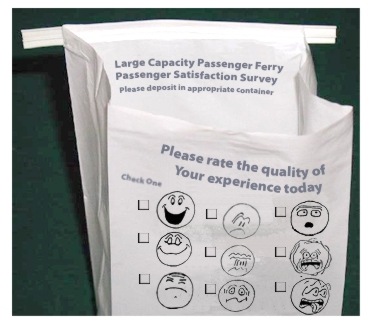 how passengers enjoy their ride.
While flying may not be comfortable for everyone, most people are used to it and there's no discomfort. Flights to Neighbor Islands are pretty short.
A ferry is another thing entirely. If sea conditions are bad, it could be a while before you get any relief. If conditions are good, of course, there's the possibility of taking in some great views and maybe spotting a whale or two.
How many trips will be marvelous, how many "ok," and how many will be bad enough to ruin the rest of your day?
Passengers deserve to know what they might experience. Perhaps the best way to inform them is through a comprehensive survey of passengers who have gone before. To assist the process, we offer the Superferry company a proposed survey instrument. No charge, it's free to use.
Friday, December 28, 2007
Superferry sails into the Twilight Zone
Today's cancellation notice for Friday indicates also that Saturday "will operate on an adjusted schedule:"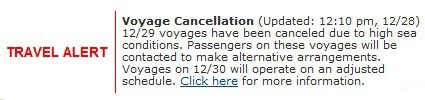
Might as well check, thought I, bored after a couple of hours of paperwork. How were they going to avoid high seas on Saturday?

That's how. Ride the Superferry Time Machine!
An obvious typo, but a little feeble comic relief. Let's see if they are reading my blog and fix it quickly.
Call your Congressperson to stop HR 1955
This is your Democrat-controlled Congress attempting to suppress dissent. Check it out, or google for further information and commentary.
From yesterday's Washington Times:
Congress is perched to enact the "Violent Radicalization and Homegrown Terrorism Prevention Act of 2007" Act, probably the greatest assault on free speech and association in the United States since the 1938 creation of the House Un-American Activities Committee. Sponsored by Rep. Jane Harman, California Democrat, the bill passed the House of Representatives on Oct. 23 by a 404-6 vote under a rule suspension that curtailed debate. To borrow from House Speaker Nancy Pelosi, California Democrat, the First Amendment should not distract Congress from doing important business. The Senate companion bill, sponsored by Susan Collins, Maine Republican, has encountered little opposition. Especially in an election year, senators crave every opportunity to appear tough on terrorism. Few if any care about or understand either freedom of expression or the Thought Police dangers of S. 1959. Former President John Quincy Adams presciently lamented: "Democracy has no forefathers, it looks to no posterity, it is swallowed up in the present and thinks of nothing but itself."
Denuded of euphemisms and code words, the act aims to identify and stigmatize persons and groups who hold thoughts the government decrees correlate with homegrown terrorism, for example, opposition to the Patriot Act or the suspension of the great writ of habeas corpus.
The act will inexorably culminate in a government listing of homegrown terrorists or terrorist organizations without due process; a complementary listing of books, videos, or ideas that ostensibly further "violent radicalization;" and a blacklisting of persons who have intersected with either list.
Political discourse will be chilled and needed challenges to conventional wisdom will flag. There are no better examples of sinister congressional folly.
The act inflates the danger of homegrown terrorism manifold to justify creating a marquee National Commission on the Prevention of Violent Radicalization and Ideologically Based Violence . . . Since September 11, 2001, no American has died from homegrown terrorism, while about 120,000 have been murdered. . .
The commission's Big Brother task is to discover ideas and political associations, including connections to non-U.S. persons and networks, that promote "violent radicalization, homegrown terrorism, and ideologically based violence in the United States." And "violent radicalization" is defined as "the process of adopting or promoting an extremist belief system for the purpose of ideologically based violence to advance political, religious, or social change."
Under the Act, William Lloyd Garrison would have been guilty of promoting "violent radicalization" for publishing the anti-slavery Liberator in 1831, which "facilitated" John Brown. Susan B. Anthony and Elizabeth Cady Stanton would have been condemned for assailing laws disenfranchising women and creating an intellectual atmosphere receptive to violence. And Martin Luther King, Jr. would have fallen under the Act's suspicion for denouncing Jim Crow and practicing civil disobedience, which "facilitated" H. Rap Brown. . .
Lengthy lists of persons, organizations and thoughts to be shunned will be compiled. Portions of the Holy Koran are likely to be taboo. The lives of countless innocent citizens will be shattered. That is the lesson of HUAC and every prior government enterprise to identify "dangerous" people or ideas - for example, the 120,000 innocent Japanese-Americans herded into concentration camps during World War II.
Bruce Fein is a constitutional lawyer with Bruce Fein & Associates and Chairman of the American Freedom Agenda.
(thanks to Undernews)
Call or fax Rep. Neil Abercrombie:
Phone: (808) 541-2570
Fax: (808) 533-0133
Call or fax Rep. Mazie Hirono:
Phone: (808) 541-1986
Fax: (808) 538-0233
And ask them to vote to defeat HR1955.
Questioning the figures on Superferry performance, and a "Linda Komon" proposal

I don't know if this works correctly, but if you click here it is supposed to show the previous article with comments. Anyway, please check it out if that link doesn't work.
In the anonymous comment signed as Karen Chun (hope this is you, Karen):
The AP wire story on this says, "The cancellations were the first since the Superferry restarted its Maui service on Dec. 13." but, in fact, service started Dec 1.
It was canceled Dec 1-6, then canceled again Dec 7-12. And now canceled Dec 26-28 and most likely the 29th also.
So we have it operating only 13 days out of 28.
Check out Karen's comment in full and the website she references, SaveKahuluiHarbor.com . Her comment included observations about the costs of the previous and contemplated harbor improvements.
A lot of money has been spent, or perhaps thrown out, depending on how you look at it. Can money just be created out of thin air? Not that I know of. Or maybe, only in Hawaii. If the Superferry proves unviable, who picks up the tab for past and proposed harbor improvements? Even if things work out for the ferry company, shouldn't they be paying for it?
Wouldn't it be wise to make future harbor improvements that benefit the ferry contingent on the ferry continuing in operation, since so far, it hasn't panned out?
I have been wondering also about the passenger counts. The numbers reported by the Advertiser, apparently passing on information obtained from the ferry company without further investigation, may be high. Brad Parsons has been doing a count, and his numbers are so sickeningly low they might make the Governor barf. [Gads, there's an image. I wonder if she'll ever try taking a ride on the Superferry? Hmmm... I'll pick up on this at the end of this article.]
Joan Conrow sums it up nicely in her post today. I'm quoting Joan quoting Brad because her article is very worth reading for Superferry content and much more, so go check it out:
“The approximate number of passengers and vehicles each way for yesterday's [Wednesday’s] trips was 250 passengers and 57 vehicles for the O'ahu-to-Maui trip, and 200 passengers and 50 vehicles for the Maui-to-O'ahu trip.” the [Honolulu Advertiser]article reports.
But even if there was an error, and they were really reporting Tuesday’s figures, there’s a huge disparity between those numbers and the count Brad reported for that day: “18 cars and 55 people got off the ferry at Maui, and 48 cars and two motorcycles boarded for the return trip to Oahu.” He also noted the article’s use of “approximate” figures. It seems if the ferry’s selling tickets, they ought to have an exact count, but since the article doesn’t attribute the numbers to any source, we don’t know where they came from.
We're not there yet, but at what point would it be fair to say that this ferry idea isn't working out?
Lingle in Paradise, the film
Ok, back to "what if" the Governor rode the ferry. This flashed into my mind, why not go with it.
We lived in Japan for many years. A staple of Japanese television is the program Mito Komon (水戸黄門), which just completed its 37th season, well over 1000 episodes.
The program is very formulaic, going like this, taken from the above-linked article:
The main character, Mito Mitsukuni, is based on Tokugawa Mitsukuni, one of Tokugawa Ieyasu's grandsons (son of Tokugawa Yorifusa) and lord of the province of Mito (now Ibaraki prefecture). Born in 1628, he was a scholarly recluse best known for researching the Dai-Nihonshi, a history of ancient Japan. Late in his life, he adopted the literary name "Komon" (Yellow Gate). The stories are based on popular legends about his incognito rovings around Ibaraki. Of course, in the series, he also puts right any wrongs wherever he finds them.

There he is in the center of the picture. Of course, the actor has changed over the years.
Basically, no one recognized Mito Komon, so as he traveled about the countryside, he learned what was happening in the lives of ordinary folk, and of course (because it's television) corrected the evils he discovered with the aid of his cast of accompanying retainers, and then moved on. Each week a different situation, but he always takes care of it. You can count on Mito Komon to stand up for his subjects.
Here's the official website to give you a flavor of the program. In a society like modern-day Japan where life can be tough, working hours are long and pay low, burdened by a complex and sometimes heartless bureaucracy, the program has obvious appeal. Hey—sounds like Hawaii, doesn't it?
"Lingle Komon" doesn't quite click. But imagine for the moment that our distant governor dresses up like an ordinary citizen, maybe puts on a wig, shades, and a big hat, and goes wandering with her bodyguards (maybe even with a discreet film crew) around her domain. This would be good for her to do, especially if she turns it into a TV program, if she is contemplating running for higher office. It worked for Reagan and Schwarzenegger, it could also be her path to success. Especially if she chooses the right wig.
She could certainly take a ride on the Superferry for a first-hand experience, whatever that would be. On the other end she could speak with protestors and perhaps gain an understanding of their position (she'd have to restrain herself on seeing the "Impeach Lingle" signs, but she's made of strong, impervious stuff) (good attributes also to survive her Superferry trip, according to reports).
But why stop there. Lingle could try crossing Vineyard Boulevard at Nuuanu Ave., deftly weaving between cars blocking the crosswalk or ducking those turning illegally in front of her, and visit the Safeway. She could buy a few containers of milk or orange juice, then experience carrying them back across one of the state's most dangerous intersections. Then, like Mito Komon, she would be sure to release the $3 million for pedestrian safety improvements that she is withholding.
If she survived the ordeal, of course. Some don't.
Imagine that she visited the working homeless on the beaches. Perhaps then we'd have an affordable housing plan, perhaps even real rent control, to keep Hawaii from continuing on this slide into poverty.
Maybe she could stop at the condo across the street and speak with some seniors who live on fixed incomes. She'd learn what it is like to try to pay rent, buy food and medicines on a fixed income. Perhaps then she'd direct Lillian Koller, head of the Department of Human Services, to negotiate with drug companies for the rebates that the law requires as part of the Rx Plus program, another law which she (Lingle) is defying.
Ok, the theme music has ended, she's back at her office, the wig comes off.
How different Hawaii would be if we had a governor curious about Hawaii's problems and in tune with its people.
Ok, I was dreaming.
Thursday, December 27, 2007
Does ongoing cancellation mean Superferry just isn't viable in Hawaii?
I believe this is the third day in a row. Clipped from the Superferry website:

If Saturday''s schedule is canceled too, it will probably kill many people's New Year vacation plans. And I wonder how many people/dogs/vehicles are stranded on Maui?
Only those going to/from Maui are affected because the Superferry has not resumed trips to Kauai. They're afraid of the reaction they'd get. Maybe Kauai folks can rest easy for a while. If Maui is a "test run" for full service, the ferry will have to deal with passengers stranded all over the place should they expand beyond the current schedule. Maybe they'll wait a bit longer before testing the Kauai waters.
Newspaper reporters get paid for their time, bloggers don't. A paper would be doing a great service if it would keep track of daily passenger loads, passenger (dis)comfort, and rate of cancellations.
After all, the papers gave the Superferry a big boost and were its biggest cheerleaders. The least they can do is keep track of their team's performance.
Wednesday, December 26, 2007
Col. Ann Wright on Town Square Thursday 12/27
Spend an hour with peace activist Ann Wright on Town Square, hosted by Beth-Ann Kozlovich, on Thursday, 12/27/2007 from 5-6 p.m. Listen on 89.3 FM or stream on the computer from hawaiipublicradio.org .
Col. Wright is a co-author of a new book:
 | Dissent: Voices of Conscience by Ann Wright, Susan Dixon, Daniel Ellsberg Read more about this title... |
Ann Wright resigned her post with the U.S. State Department in protest to the run-up of the Iraq war.
Col. Wright, a Hawaii resident, will discuss her book and review where we are now, what has been accomplished in 2007 and what must be done in 2008.
"Success" in Iraq and Afghanistan largely a matter of controlling the news
I wrote last year that the press (in that article, the Associated Press wire service) was covering up the fact that US troops were confined to base during the daytime in Iraq. It was just too dangerous for them to go out except at night. The coverup continues, in both Iraq and Afghanistan.
One way to minimize US troop losses, of course, is to reduce the number of missions and keep the troops from going out at all. The US typically compensates by escalating aerial bombardment, which leads to increased civilian casualties. But who's counting civilians, of course. With a cooperative press dutifully reporting only what it has been handed by those in charge, it can be made to appear that the "surge" is working.
Stories do get out, though. Information wants to be free. I was just listening to the podcast of last week's Counterspin and heard of a massacre in Afghanistan that didn't make it to the mainstream news.
The program segment also reported on the increased bombing and pointed out that every missed bomb might create ten new Taliban recruits. I did think it odd that we think we can win hearts and minds by bombing civilians and conducting nighttime massacres.
The story about the massacre is here.
at 2 A.M. on Sunday, November 17/18, 2007 in the hamlet of Lakari, 2 kms from the village of Toube (Tebbi?) in the Garmsir district of southern Helmand along the Helmand River. The Taliban have long had a strong presence in Garmsir. Foreign troops (probably U.S. or British Special Forces) with Afghan soldiers arrived by air in the village at 2 A.M. in the night (as is usual with such air borne attacks). What ensued was a gruesome massacre successfully kept out of sight of the world for almost a month by military “news management” and mainstream western media neglect. The story was broken by two Afghan journalists of the Institute for War & Peace Reporting (IWPR) in the Afghan Recovery Report dated December 10, 2007. The reporters interviewed dozens of local villagers who all confirmed what had transpired. Their story was picked by the Zurich-based Center for Security Studies’ ISN and brief mention was made in The Telegraph. No mention by the Associated Press, the Washington Post, etc.
For a story on the Associated Press by the Counterspin interviewee, see The AP speaks Newspeak. The author reveals how the AP labels massacres as mistakes and minimizes reports of civilian casualties.
Of course, our local dailies depend on the AP. There are alternatives. AFP (Agence France-Presse), for example. But don't hold your breath waiting for them to switch. It won't happen.
[Aside: when I lived in New York City in a previous life, radio station WBAI subscribed to the AFP wire service. Their studios were in an old church, and in a bathtub was the wire service teletype. The dispatches were in French at that time. The staff translated them. How else to get around the bias and manipulation of the US wire services?]
Since local dailies do not have reporters in the mid-East, they select stories. Those that our papers bring to Hawaii are chosen from a wide range of available sources. They select the commentaries similarly. The totality reflects the bias of local editors, and quite likely, the directives of their management on what they must print and what they may not.
No wonder the United States is ranked low in press freedom. It depends on who does the ranking, of course, but in an analysis by Reporters without Borders, we came in this year just under Botswana, Croatia and Tonga. You might disagree, but check it out. Our descent is accompanied by a reduction in the quality of news we see or read.
If you read the story on AP referenced above, you'll have a sharper eye for the excuses they make for civilian casualties. The high death rate is not the result of little mistakes in aiming the bombs, or of insurgents hiding in civilian areas, it's a predictable result of the way we wage war. Get used to it. Great armies no longer clash in fields of battle. They kill civilians, that's what they do. The mainstream media don't want to trouble you with that fact.
We must stop these wars. It's within our power as Americans to do the right thing, and we're not doing it. What is our excuse? After we do that, we should replace our corporate media, which bears responsibility for perpetuating wars by printing lies about war.
Another Superferry cancellation
I found this posted on the Superferry website:

How many cancellation days will there be each year? What will the reliability of the Superferry be as a passenger carrier? Suppose a return trip is canceled and your hotel on Maui doesn't have a room available... Suppose you need to be at work the next day?
Just asking.
Tuesday, December 25, 2007
Tased for using her own credit card in Best Buy
This shopper could have been killed by the Taser-happy cop.
(Thanks to Viviane Lerner for circulating the articles below)
http://www.msnbc.msn.com/id/22361567/
Officer uses Taser to tame Best Buy customer
Sides split on what happened; review begins
Fri., Dec. 21, 2007
DAYTONA BEACH, Fla. - A review is under way in the case of a Florida police officer who used a stun gun on a woman who had yelled at her.
Last month's incident began as Elizabeth Beeland, 35, tried to buy a CD player at an electronics store, and stepped outside to talk on her phone, leaving her credit card behind. A store clerk became suspicious, and suspected Beeland was using a stolen card. When police officer Claudia Wright approached, she said Beeland became "verbally profane" and "abusive."
Wright said she warned Beeland to calm down or face arrest. The officer hit Beeland in the stomach with the Taser darts and arrested her on charges of disorderly conduct and resisting arrest.
In a video, the customer is seen backing away, then crumpling to the ground after being tasered. Police later verified that Beeland was using her own credit card, but she was arrested for disorderly conduct and resisting a police officer without violence. She has since pleaded not guilty.
Two sides to story, video Daytona Beach Police Chief Mike Chitwood defended the officer's actions, which he said avoided use of other weapons.
"Even if you look at the video, when the officer stepped toward her after announcing she's under arrest, she's flailing her arms and retreating from the officer," Chitwood said. "Police work isn't pretty. It doesn't look pretty, but from where we sit, interviewing civilian witnesses and people may or may not agree, but she followed our policy, she followed FDLE (Florida Department of Law Enforcement) guidelines."
Cop Watch's George Crosley sees the incident in a different way. His group polices police actions. He said he is stunned by the store surveillance video.
"This is wrong, this shouldn't have happened that way," Crosley said. "When the officer starts toward her, you don't see her threatening the officer, you see her backing off with her hands up," he said. "If she couldn't figure out how to handle it, she should have called for back up. The truth of the matter is, people have died as a result of being tased."
State prosecutors are reviewing whether to pursue the case against Beeland. Beeland's attorney is also reviewing the incident.
Lingle's legacy: a long list of unpaid debts to Hawaii
George Bush has his signing statements, his weapon of mass disregard for laws passed by Congress. As governor of Hawaii, Linda Lingle has her own method of defying the law and so hurting the people of Hawaii. Strong words, I know, but how else to sum it up?
Laws don't just happen. They are often the product of hundreds of hours of testimony by ordinary citizens motivated to show up and express their views one way or the other. Lingle has used the veto as the first salvo, but of course the state legislature can (and frequently does) override her veto.
When the Legislature overrides a veto, a law is created, just as though the governor signed it. Enforcing the law then moves to the executive branch. Can the governor simply ignore or refuse to fund laws she doesn't like?
Ignoring the law or refusing to release funds is Linda Lingle's own weapon, and it usually hurts the most vulnerable people in Hawaii. I can't help but point out that corporate tax credits don't seem to suffer the same fate.
Let's look at a few of these. I know there are others and welcome comments on them.
- Lingle has not released $4 million authorized by the Legislature two years ago for the Honolulu Symphony Foundation. Result: musicians have not been paid since the end of November. I suspect that many musician's families are thinking of her during this payless Christmas holiday.
- Lingle has not released $3 million for pedestrian safety authorized when the Legislature overrode her veto of a pedestrian safety bill passed this year. I wonder if the families of loved ones killed in crosswalks in 2007 are thinking of her today.
- Lingle withheld more than $500,000 that was to go to Kupuna Care in 2006. As a result, reports circulated of seniors leaving the hospital who had to be re-admitted because they could not get services needed to get better at home. Several organizations had written letters asking that the money be released to no effect. I also wrote, the Friday before election day, and sent out a flock of press releases on the issue. Lo, the money was released just before the election. No, said the Governor, the letters had nothing to do with it. Ok.
- Linda Lingle became the first governor in history to veto a Baby Safe Haven or Baby Moses law. 47 other states, even those with Republican governors, have such laws. The Legislature overrode her veto, but her administration has refused to implement the law. (In those 47 other states, mothers are allowed to drop off their unwanted newborn infants at designated safe havens without fear of prosecution. The laws provide an alterative to abandonment or infanticide.)
- Linda Lingle vetoed HB10 this session. This was the bill that requires pharmaceutical companies participating in the Hawaii Rx Plus program to provide rebates for prescription drugs. It's the one where the Legislature, clearly expressing its intent yet again, changed the wording from "may" to "shall," taking away the last possible wiggle room that the Lingle administration could use to avoid implementing the law. Well, here we go into the 2008 legislative session, and negotiations have yet to take place, costing seniors and those with disabilities dearly.
- A little different tactic is Lingle's recent refusal to fund the high costs of drug testing teachers, which her negotiators fought for in contract talks, and suggesting that children should bear the burden by giving up funds that should be spent on education in order to pay for the testing.
Lingle as Grinch
Let's look at the Honolulu Symphony first today, just because it is Christmas and indeed, musicians have not been paid. An op-ed in this morning's Advertiser argues that support of the Symphony is a good thing, but doesn't dig into the causes of the present economic woes.
An earlier story did: Honolulu symphony can't pay musicians. This article, by Mike Liedemann, does analyze the economic challenges, and notes that:
Symphony officials also are hoping that Gov. Linda Lingle will release $4 million in state funds for the Honolulu Symphony Foundation authorized by the state Legislature two years ago.
"If we had had that money, we could have earned an extra $400,000 in interest by now, which would have helped a lot," [Jeff Minter, chairman of the symphony's board of directors] said.
Would this money have paid the salaries? Easily. The same article notes:
About 65 full-time musicians, as well as part-timers and other staff members, were told late last week that the Honolulu Symphony Society did not have enough money to meet its $60,000 biweekly payroll, officials said
Not only has Lingle established her Grinch  credentials by stealing Christmas from Symphony families, the withholding of funds threatens the Symphony itself. It would be hard to imagine Honolulu, or Hawaii for that matter, without the Honolulu Symphony.
I'm a believer. While in college in New York City and copy editor of the school paper, I received two tickets from the college president to a concert at the Brooklyn Academy of Music.  I think I was supposed to write a review or something, and can't remember if I did.
More important, I asked a certain member of my copy staff to the concert and to dinner at Manhattan's Kabuki Restaurant . That date was more than 40 years ago, and set the tone for our relationship ever since. We still love classical music and Japanese food, and we can enjoy both here in Hawaii.
It would be a pity if Hawaii's governor could end the chance that our young people might have similar experiences.
If you value culture and the arts, I urge you to email letters to the newspapers (letters@honoluluadvertiser.com and letters@starbulletin.com) or to call the Governor at 586-0034 and ask that she release the $4 million dollars for the Symphony. Let this be the last Christmas that she has ruined for our long-suffering musicians. C'mon, call, don't leave it to someone else to do.
Monday, December 24, 2007
Lawrence Ferlinghetti (88)of City Lights Books reads his poem, "Pity the Nation" on today's Democracy Now!
AMY GOODMAN: I’m sitting here, Lawrence Ferlinghetti, with many of your books, not nearly—not nearly all of them, but, for example, Coney Island of the Mind, what is it? The biggest-selling poetry book of all time?
LAWRENCE FERLINGHETTI: I think so.
AMY GOODMAN: Talk about when you wrote that.
LAWRENCE FERLINGHETTI: Well, it all came out at once. And another case that if I had died shortly thereafter—I wrote it when I was in my mid-thirties. That would probably be considered my best book, and it’s as I was saying before, the best poetry is written when one is fairly young. To me now, it seems that the mid-thirties as being—is very young. But—
AMY GOODMAN: Why is it, then? I mean, you’ve got the wisdom of a lifetime now.
LAWRENCE FERLINGHETTI: Well, you haven’t have time to be acclimated or acclimated in the worst ways by modern industrial corporate monoculture, for instance, or American consumer society, which the way American consumer society is worked out, it seems to me the suburbs of America are the great American death.
You know, I’d like to read one poem that I just wrote. I really want to get this out.
AMY GOODMAN: Read.
LAWRENCE FERLINGHETTI: Especially since Khalil Gibran has been in the news lately, including yesterday or the day before on your program. “Pity the Nation,” after Khalil Gibran.
Pity the nation whose people are sheep,
and whose shepherds mislead them.
Pity the nation whose leaders are liars, whose sages are silenced,
and whose bigots haunt the airwaves.
Pity the nation that raises not its voice,
except to praise conquerors and acclaim the bully as hero
and aims to rule the world with force and by torture.
Pity the nation that knows no other language but its own
and no other culture but its own.
Pity the nation whose breath is money
and sleeps the sleep of the too well fed.
Pity the nation—oh, pity the people who allow their rights to erode
and their freedoms to be washed away.
My country, tears of thee, sweet land of liberty.
Watch the entire interview on Democracy Now! tonight at 10 p.m. on `Olelo channel 56 or click on the above for audio, video, or a complete transcript.
Sunday, December 23, 2007
Disappeared streets--TomTom GPS not too useful in Hawaii
Or parts of New Jersey, either.
Hawaii has addresses that look like 94-nnn Kamehameha Highway. New Jersey has some also. In fact, there are so many of these addresses here that they might be in the majority.
So what's the problem? The problem is that one of the best-selling GPS navigation brands, TomTom, does not have a hyphen on their keyboard. That's right, no way to enter most Hawaii addresses.
The TomTom One is a best-seller and a top choice of Consumer Reports. It works fine if you want to go somewhere on King Street, or to an address in Hilo, for example. Heck, I don't need an expensive GPS unit to find those. If I want to visit an office in Kaneohe, though, I can't enter the address.
Believe it or not.
This brand is widely advertised in Sunday ads. It gets good reviews from on-line sites. I scored a TomTom GO920 at a reasonable price the day after Thanksgiving. It was the only one Office Depot had at that store, and I got it! Yay! Now I know why. It worked fine, except of course when it's needed most.
TomTom customer service is as useless as the unit was. After a phone call and an email, they advised us to fax the main office. So I did. Nothing. A second fax. Nothing.
After about a week I had an idea, I'll fax their headquarters in the Netherlands. I'll also tell them that faxing their USA office did not good. They should know about that. This did bring a reply in a couple of days. But no good news.
I'm supposed to subscribe to their newsletter to find out when the fix is in. They won't even drop me an email.
So back it went, reluctantly. I don't know if I'll find as good a bargain any time soon. The other brands (Garvin and Magellan, anyway) have no problem with Hawaii addresses, but their voice quality wasn't as good.
We just liked the TomTom and can't believe that it has this problem.
So be warned. They are still advertised everywhere. Try one before you buy it. If you just need to navigate on center-city streets, you'll be ok. If you want to get out of town, though, see if the TomTom will actually take you there.
Good thing I didn't buy one from CompUSA which has a no-return policy.
Friday, December 21, 2007
Car found! Yippee, mostly
Police located my car. Damaged, most all of my personal stuff gone, but all will be well in the end.
Of course, since they found it late today, I couldn't get a tow truck without a long wait. It's the Friday before Christmas and all the tow trucks were stuck in traffic on the highway. So I learned to hot-wire the thing myself. Now I have a new skill.
After it's all fixed I need to learn how to keep a car from being stolen, at least as much as is possible.
So today I feel I'm one lucky blogger.
Holiday barf forcast
This surf forecast just in via Brad Parsons:
From Pat Caldwell/NOAA: Outlook through Thursday Dec 27. A moderate northwest swell will arrive Saturday night. A larger northwest swell will roll in Sunday night with surf above the advisory level of 15 feet for north-facing shores and near the advisory level of 12 feet for the west facing shores. A small to moderate trade wind swell will continue through next week with surf along east-facing shores staying below advisory levels. Surf heights are forecast heights of the face or front of waves. The surf forecast is based on the significant wave height in the zone of maximum refraction. Some waves may be more than twice as high as the significant wave height. Expect to encounter rip currents in or near any surf zone.
I'm not familiar with surf forecasts. It would be nice if there were a way to translate the numbers into some kind of index, let's call it the Superferry Barf Index, which could give passengers an idea of just how sick they'll be going to or returning from their holiday. Something like, from 1-5, 1=moderate discomfort to 5=wretchedly ill.
Cartoonist John Pritchett caught the essence of the Superferry experience in his Honolulu Weekly cartoon in the current issue. Check it out here, on his website.
Maybe John would make up some postcards using that image for people who've experienced high seas on the Superferry to send back to their friends and relatives (hint).
On this day in history in Hawaii - December 21
Complicated stuff. On this day in 1850, the French warship La Serieuse was in Honolulu Harbor, and the question was whether there was a threat to the Hawaiian Kingdom. Or was the whole thing a plot to get Hawaii to seek the protection of the United States?
While the diplomatic wheels were grinding, Hawaii began its first postal service. The first letter was postmarked December 21, 1850, and dispatched to San Francisco. It would take a month to get there.
(More, much more, in The Hawaiian Kingdom By Ralph Simpson Kuykendall, 1938)
Hawaii: What they do wrong, they can't even do right
Drug testing teachers was a bad idea to start with. Now guess what: the Lingle administration won't pay for it, so if it is to start in June 2008, the money will have to come out of kids' educations. $500,000 would buy a lot of textbooks, don't you think?
So much for the "education governor".
Gov. Linda Lingle's administration is refusing to fund planned drug tests of public school teachers despite fighting to add the program in contract negotiations early this year, at the time arguing it would "help ensure schools are safe."
The administration denied the Education Department's request for more than $500,000 to cover annual, random and reasonable-suspicion drug tests of as many as 3,250 teachers, or one in four employees, starting June 30.
"In their base budget of $2 billion, the (education) department will have to cover it," state Budget Director Georgina Kawamura said yesterday.
The administration's decision shocked education officials who assumed they would get extra money but now fear they might need to pull funds from school programs to check whether teachers are high when they come to campus. [starbulletin.com | News | /2007/12/21/]
The cost of defending the state against an ACLU suit will come from... where?
Maybe the best thing to do, for the children, the teachers and the taxpayers, would be for the 2008 Legislature to set aside the drug testing provision and save us all a lot of trouble and expense.
Oh, I'll bet the governor's development programs aren't shortchanged a nickel. I just had to add that last comment. Big bucks for business, steal money from children.
24-hour video podcast in progress--join in, celebrate new citizen journalism breakthrough
Yup, you no longer need ugly sponsors and millions of bucks for transmitters to reach the multitudes.
Pioneer podcaster Todd Cochran (Geek News Central) started his podcast at 6 am today and will continue on until 6 am Saturday. You can watch it and participate yourself. It's a videocast, it's a call-in program. It's also a benefit for One Laptop per Child.
It may not be the end of Fox News, but the possibility is there.
You can tune in several ways. Try the Ustream feed:
http://www.ustream.tv/channel/geek-news-central-24hr-podcast-marathon
or participate at:
http://www.talkshoe.com/talkshoe/web/talkCast.jsp?masterId=10832&cmd=tc
Todd just finished Hour 3, 21 hours to go.
If you're a geek or interested in alternative media, check this out. Think of what you or your group could do with the technology that's being demonstrated today.
Stay in touch with this promising experiment either at Todd's site or at the website of the Hawaii Association of Podcasters. Learn about podcasting. Do it yourself.
Thursday, December 20, 2007
Superferry needs to be stopped until it watches for whales, checks for contraband, and prevents the spread of Varroa mites
Via Brad Parsons I learned that the Superferry/Hornblower may not be watching for whales and won't watch at all this month. Nor are they inspecting coolers for opihi or other contraband.
This needs to be verified and if true, someone should intervene. Who? I don't expect the Governor to act.
As I wrote yesterday, bees were discovered that may already have spread the deadly Varroa mite to Maui. If the ferry has not already spread the Varroa mites, continued inaction will guarantee that they get there in time.
How to get rid of stuff
Every holiday season it's Buy, Buy, Buy.
But what to do if you have too much stuff? Do you really need that brass plaque with bronze oak-leaf palms your uncle Jean gave you, or could the space it occupies be put to better use? Maybe some of the presents you'll be getting should be turned around and go the other way instead of piling up in the living room.
Tune in this evening, Thursday, to Town Square, on Hawaii Public Radio, 5-6 p.m. on KIPO, 89.3 FM, to find out how to get rid of stuff.
Guests include an organization consultant who can help decide what to part with and how to do it, someone who can help sell things on eBay if that process appears too daunting or mysterious, and a guest who can explain how to recycle your stuff through an agency that will make it available to people who can use it.
[Factoid: Did you know that there was actually a car called the "Opala" (the Hawaiian word for garbage)? "The Chevrolet Opala was produced between November 1968 (as the 1969 model) through April 1992.…It was the first passenger car built in Brazil by General Motors."]
All that and more tonight on Town Square.
Wednesday, December 19, 2007
Fire in the White House--what documents were destroyed?
There was a fire in the White House this morning that damaged Vice President Dick Cheney's office.
The story is here.
A list of documents and records destroyed is here.
Has the Superferry carried super bad bee mites to Maui?
I wrote just over two weeks ago that the Hawaii Department of Agriculture, with the cooperation of the Superferry, is endangering Neighbor Island bees and agriculture. I wrote in Varroa mites may already be on the Superferry due to Dept. of Agriculture neglect that feral bee colonies near the Superferry pier on Oahu had not been eradicated as they were supposed to have been:
If Varroa mites make it to Neighbor Islands, Hawaii's organic honey industry could be wiped out. The mite is also thought to be a contributing factor to Colony Collapse Disorder which is wiping out bee hives on the Mainland. Hawaii currently exports queen bees to the Mainland—those exports would be endangered as well if the infection spreads.
If the infection spreads and wipes out bee hives on the Neighbor Islands, any agriculture dependent on bees for pollination would also be adversely affected. In other words, it's not just a bunch of little insects we're talking about here. It's a whole economic ecosystem. Farmers would be hurt too.
Even before I posted that article, Dr. Michael Kliks had spread the same warning to legislators and to others.
The danger is clear, the solutions almost obvious. But was anything at all done?
Joan Conrow wrote today:
And finally, yesterday I was chatting with one of the guys who serves on the Superferry task force. He mentioned that at their first meeting, which coincided with the ferry’s first trip to Maui, Superferry CEO John Garibaldi told them that on the trip to Maui, they’d found some bees on car radiators, which they collected. The bees are a concern because they could spread the varroa mite, which is a serious problem.
The bees are attracted to car radiators because the antifreeze smells sweet to them, so they want to get some.
Were the bees hanging around the Superferry pier because of DOA neglect? Were they on the Superferry itself? Or did they come in with the cars from wherever? It doesn't matter, the consequences for Neighbor Island agriculture and the bee industry itself don't care where Varroa infested bees come from. It's the responsibility of the state and the Superferry corporation to keep invasive species off the ferry, and it doesn't look like they did that.
So the deadly mite may already be on Maui.
Prevention is better than blame. Someone should get on this right away, even though it may already be too late.
On this day in history in Hawaii
On December 19, 1842:
U.S. President John Tyler recognizes the Kingdom of Hawaii by invoking the Monroe Doctrine to discourage intervention by European powers; agrees to Hawaiian independence. [Maui and Hawaiian Chronology]
December is a significant month in the history of Hawaii. Yet you'll probably read nothing about it in the newspapers.
Certainly, the prior owners of the Honolulu Advertiser would not have been terribly interested in celebrating the complete history of the islands. I wonder if the current editors are willing to make up for the damage caused by their predecessors.
Sunday, December 16, 2007
Bummer
No post today; car stolen. It kind of ruins the weekend.


Saturday, December 15, 2007
More Superferry protest pics from Maui
Pics of the protests snapped by Brad Parsons. Check out the signs. Strong feelings!
Today:
http://www.flickr.com/photos/21400600@N03/sets/72157603469348875/
Yesterday:
http://www.flickr.com/photos/21400600@N03/sets/72157603463859123/
Two days ago:
http://www.flickr.com/photos/21400600@N03/sets/72157603454736835/
By posting his photos, Brad demonstrates the value of citizen journalism. Newspapers have limited space, of course, and editors have demonstrable biases. Not only is the blogosphere relatively unlimited, but the absence of self-censorship editing means that you, the reader, get to sort through the information yourself.
The blogs differ from recent newspaper accounts on the number of passengers, how many of those were reporters and how many might have been relatives of Superferry employees. Brad has been keeping a count of passengers and vehicles.
If the papers are interested in giving us useful facts, they might do their own occasional count and report on whether this ferry is really so important to Hawaii that people are actually using it. Will the editors actually allow an honest passenger count to be reported?
They might also be honest about the conditions on board. The first voyage last week seemed grim. People aren't supposed to get sick when they travel from one place to another.
Depend on the blogs
Not everyone who writes a blog is, well, just a blogger. We have several fine journalists out there, and they are following, among other topics, the ongoing Superferry saga.
Both Joan Conrow and Ian Lind have written about the appointment of Kauila Clark to the Superferry oversight task force, noting that he is closely tied to Superferry management although Say appointed him as a cultural practitioner. Remember where you learned about Say's own ties to the ferry: his son is/was an employee. Where is the editorial outrage? Not in the newspapers.
Joan wrote:
I was rubbed the wrong way by the revelation that Kauila Clark, appointed to serve on the Superferry oversight committee, actually blessed the vessel before it sailed. The connection was made in a comment on yesterday’s post, and followed up today by Ian Lind, who raises the question of whether Clark was paid by Hawaii Superferry for his various services.
...
It seems that of all the cultural practitioners in Hawaii, Rep. Calvin Say could have come up with one who wasn’t already so closely linked to Hawaii Superferry. That’s the sort of thing that further erodes the public’s confidence in what is already widely perceived as a bogus process that began when the state exempted Superferry from an environmental review.
Ian Lind's article is longer and has a picture, so I suggest clicking there and reading that.
And did any of the papers mention the machine guns toted by security personnel?
You just have to read the blogs to find out what is really going on with this ferry. But more than the ferry, you'll have to look at the pictures and read the blogs to learn about the seething resentment against our "popular" governor.
Protests or not, perhaps the ferry ridership will increase. Or maybe it won't. Predictably, protests will taper off. Nature, in the form of rough seas, will not, so let's see how this goes. Read the blogs and stay in touch with the pulse of the people.
Friday, December 14, 2007
Watch out for fake bargains at CompUSA liquidation
It's not CompUSA anymore. They won't even take CompUSA credit cards. The liquidators bought it, and they will do their thing to make the most money at customer expense. They are experts and have ways to part customers from their money, so buyer beware.
I went over there Thursday evening. Some shelves were already bare. I had my eye on a HP laptop which has been advertised each week for $999.99. The laptop was indeed on sale, but for $130 more, after discount ($1129). There were USB memory sticks on sale for more than you can get them elsewhere.
I was interested in a webcam I wouldn't have bought unless it was cheap, but it had no marked price. So I went over to one of the computers on display, visited the manufacturer's website, and looked it up. List price was $79. You can take items over to what used to be the business center desk and they will scan the barcode and tell you the price. So I did that, and it was, after discount, $79. So no deal, since it's easy to find it cheaper on the web.
Liquidators know that many people will go for the discounts they are offering without checking the street price. Some buyers see "20% off" and figure they are getting a deal. If the base price was kited up, then it isn't a deal, is it?
Liquidators also move stock around. It's reasonable to expect that crap they have on hand can be moved to the stores they are currently closing. Perhaps there will be less of that in Hawaii simply because of the higher shipping cost, but it's still something to watch out for.
Also, be sure you know what each item should cost and make sure that the register price is what you thought it should be. They make that difficult by ringing up the full price, then when all items have been checked in, they apply the discounts. It is all supposed to work out, and the receipt shows the reduced price. But it's confusing if you're standing there wondering if the discount is what you thought it would be.
If the manufacturer has any rebates, you'll have to find out about them elsewhere. I didn't see any rebate action at all.
Typically, the discount will increase as time goes on. Also typically, the good stuff will be gone.
So I suggest knowing what an item should cost before you buy, and make sure you get the discount you expect. You mean nothing to them as a future customer, they just want your money now, and as much of it as they can get.
Gannet "makes" news by banning Democratic candidates from their debate
If you watched or listened to Democracy Now this morning, you already know that Rep. Dennis Kucinich and Senator Mike Gravel were excluded from the latest debate:
Kucinich, Gravel Excluded from Democratic Debate
And in Iowa, Democratic presidential candidates held their final debate of the year Thursday, just weeks before the first primary vote. Congressmember Dennis Kucinich was excluded despite having the same polling numbers as three other candidates both nationally and locally in Iowa. Also excluded was former Alaska Senator Mike Gravel. In a campaign first, Gravel has released a rap video criticizing his exclusion. The song samples John Lennon and Yoko Ono’s “Give Peace a Chance.” [Democracy Now! | Headlines for December 14, 2007]
(you can catch the program on Oahu at 10 pm on channel 56)
The Advertiser failed to mention the exclusion in its article today, which was part of this longer piece in the Des Moines Register, the sponsor of the debate. The Advertiser included something like the first third or so of the article.
Of course, neither the Advertiser nor the Register mentioned the exclusion. They are both owned by Gannett.
Thanks to Jeff Garland for the pointer to this USA Today blog (USA Today is also owned by Gannett, read it before someone can drop the axe on it): Kucinich protests debate exclusion; columnist says his absence was beneficial. Don't miss the comments.
In this case, Gannett both made the news (through its exclusion) and then failed to properly report its action and hence its complete roll in the debate.
I believe your Advertiser subscription currently costs about $209 annually. Perhaps that should buy readers some right to complain. We are entitled to fair coverage (the Advertiser probably does well on "balanced", for example, in comparison to the Star-Bulletin/MidWeek). Here is a case where the least they might have done would be to disclose their exclusion of a candidate very popular in Hawaii.
Call to ban Tasers
Reproduced here with author's permission, originally from the Big Island Weekly:
Ban tasers
Wednesday, December 12, 2007
On Nov. 28 I attended a presentation on tasers given by Hawai`i County police officers. I was enraged; let me explain why. First off, this is not an attack on the officers who made the presentation for I believe they believe the taser is a proper tool for law enforcement. In my opinion they are incorrect; there is nothing proper about a device that has been labeled "less lethal" and yet has killed nearly 300 people. Almost every day we read about someone who has died from tasing.
We were told at the presentation that tasers are not to be used on the frail, on persons with heart conditions or diabetes, on the mentally ill and the obviously pregnant, to mention a few. With more than half the population fitting these descriptions, how do officers know beforehand who has what illness or condition? What about margin of error or the possibility of misuse if an officer has a bad day? The police say there is a tiny camera on each device that records each incident; if abuse is noted, the officer is removed from duty.
Isn't this just a little too late for those who may have lost a child or grandparent from the deadly incident?
The device shoots two darts into the skin, then imparts enough current to disempower the muscle system. Usually five seconds long, the blast gives officers time to handcuff subjects. Often additional blasts are needed. The police videos showed subjects screaming in fear and pain; they were hard to watch.
Two days before the presentation, the U.N. came out with a strong statement opposing tasers. Amnesty International has called for a full ban calling tasers an instrument of torture. There is a broad citizen effort in Canada in support of a complete ban. I gave copies of these three critiques to the presenting officer and reminded him that his original title was "Officer of the Peace," a title that carries a great responsibility to the public. He thanked me for my opinion.
I had thought it was only the old or weak who could die from tasering. Apparently I was very wrong. People in their 20s have also died, sometimes just for being too slow to cooperate. I, for one, strongly feel I would not survive a tasering.
I do not endorse criminal behavior, but this new leap forward into electric control seems to me a dark night for humanity. I'm sure I will take some heat for my stance. So be it. I must say I stand with the U.N. in wanting more studies/guidelines, but I stand more firmly with Amnesty International and our Canadian citizens in saying: "Ban tasers."
Galen Kelly
Pahoa
Brad's photos of yesterday's protest
Citizen journalism: click here. Thanks to Brad Parsons for posting this Flickr album.
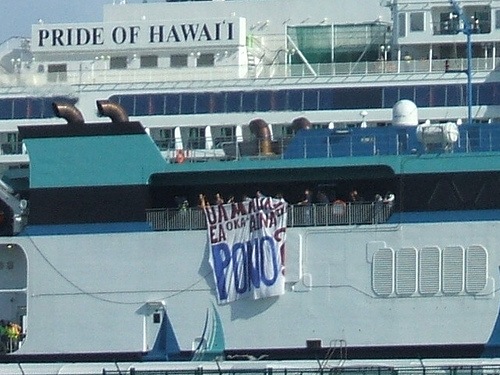
Spinning the Superferry story, and some possible new tourist souvenirs
The front page of a newspaper is seldom funnier than the comics page, but I'll have to admit I laughed more at the Nauseating but enjoyable trip for passengers headline than I did at any of the funnies.
 If you click on that link you'll see that the Advertiser changed the on-line headline to Some queasy, some easy in rough seas. Maybe someone noticed the print headline and thought twice about letting the whole world laugh at it.
After calming down, I read the story, which begins:
ABOARD THE HAWAII SUPERFERRY — Maccine Carter spent more than three hours vomiting aboard the Hawaii Superferry yesterday on the final day of her Hawai'i vacation and still enjoyed her trip from O'ahu to Maui.
"I was sick the whole time," Carter said after going through several motion sickness bags in the front, deluxe Hahalua Lounge cabin of the 350-foot ship Alakai. "There was a lot of choppy water. But it was my last day and I wanted to see Maui. It was beautiful — from what I saw."
How funny! As the rest of the story made clear, the article could, and probably should, have opened with mention of how sick passengers became, because it bodes ill (if you'll pardon the expression) for the future of the Superferry in Hawaiian waters, at least as far as passenger transport is concerned. The real story begins to unfold only on the continuation page:
At least 25 passengers all over the Alakai were openly vomiting, said Superferry cabinet attendant Leeann Toro, who passed out barf bags as if they were candy on Halloween.
One passenger in the Hahalua Lounge was in so much misery that he had to be carried and dragged off to a first-aid area to lie down, Toro said.
Reporter Dan Nakaso chose to interview and feature one passenger, the one who said she enjoyed the trip anyway. I wonder why he didn't interview some of the others? Likely they did not enjoy their voyage quite as much as the one he chose for his lead paragraph.
A much more realistic, I suspect, story appeared in the Garden Island News, Less than smooth sailing - Superferry arrives in Maui:
“It was torture,” said O‘ahu resident Nola Watasa, who was traveling to Maui with her son, Colby, and husband, Dave, for a varsity wrestling tournament. “I’m glad it’s over.”
She and others riding the $85 million jet-propelled vessel — such as Clayton Fernandez, an O‘ahu resident visiting Maui for the first time — filled up the “barf bags” that Hawaii Superferry staff handed out early on in the three-hour voyage.
Workers scrubbed the carpet and wiped down the faux leather seats for those passengers who were unable to find a paper sack or make it to the bathroom in time.
And the voyage did not take place in a storm, it took place in typical conditions (from the Advertiser story):
Veteran harbor pilot Ed Enos said the weather and wave heights are typical for Hawaiian waters this time of year.
The Advertiser story didn't hide the ugliness of the trip, but for sure, if you only read the beginning you would have no idea of the extent of the disaster that this voyage represented:
Hale Mawae of Anahola, Kaua'i, couldn't make his way to the bathroom in time and vomited all over the Superferry's wooden floor passageway. His cruisemates, Katy Rose and Andrea Brower, also of Kaua'i, vomited as well.
-- Incredible String Band
If conditions were typical, then perhaps the vomiting will also be typical. If so, don't count on too many people riding the ferry when they could have a quick, healthy, safer and cheaper airplane ride. I say "safer" because wooden floors covered with vomit are a safety hazard on a rocking deck. Not to mention the possibility of being the target of someone else's vomiting even if you're ok. Or how about sitting in a puddle of it by mistake?
And I'm wondering just how the ferry will smell after innumerable barf attacks.
The Maui News on-line headline seemed accurate: Rough seas, a poor reception. That paper lead with reaction from the ferry company and then reported details of the protest (noting, by the way, the "Impeach Lingle" signs we have yet to read about in the Advertiser. The Star-Bulletin's Richard Borreca reported on them early on, in his October 28 column, by the way).
So the first voyage was a health and sanitary disaster. If it keeps up, how long will it be before the State Department of Health shuts the ferry down?
It would be unimaginable for the same conditions to persist on an airplane. Surely the FAA or some other authority would step in.
Sliding around a slippery deck in other people's bodily fluids is not a great way to travel. I can't believe it can continue, if it proves to be the norm. Nor can a lunch be totally enjoyable if eaten while watching others toss theirs.
Even if the Department of Health (which, after all, reports to Governor Lingle) is slow to act, travel writers are sure to pick up on this. Then the rest of the world will be laughing louder than I did, perhaps.
[There's no end of amusing possibilities; can you imagine a secondary industry developing in collectable Superferry barf bags? Or locally-printed Barf t-shirts, 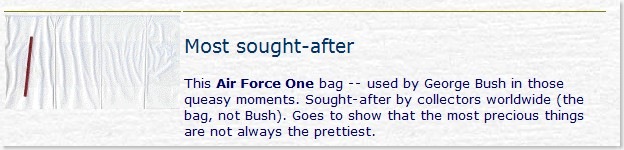 buttons, and of course, custom barf bags, all to sell to disembarking passengers ("I survived a ride on the Hawaii Superferry!"] Hahahaha! Each t-shirt comes with a couple of souvenir imprinted barf bags for the return trip.
Quick, before the Dept. Of Health does take action.
Thursday, December 13, 2007
Protests challenge myth of Lingle's popularity
It's not just the Superferry that Neighbor Island residents are protesting. Increasingly they are focusing attention on Governor Lingle. It may be that the ferry affair shook something loose that is taking on a life of its own.
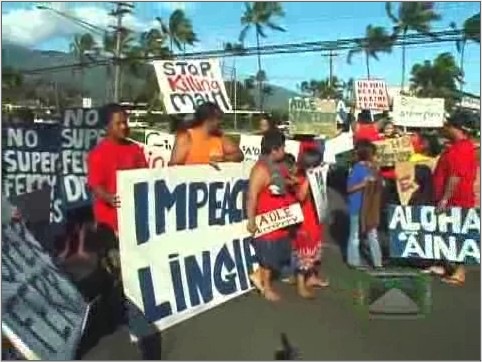 (Image captured from Akaku public access television)
A Star-Bulletin breaking news report, Superferry resumes service to Maui, noted that there were "Impeach Lingle" signs among others held at today's Superferry protests:
About 100 protesters gathered at Kahului Harbor to protest the Superferry’s arrival on Maui. At about 10:30 a.m., 80 people lined Kaahumanu Highway outside Kahului Harbor holding signs that read “Give back our Harbor,” and “Boycott the Superferry.”
Another small group of protesters lined the beach holding signs that said, “No Superferry,” and “Impeach Lingle.” A few protesters paddled into the harbor on surfboards and a canoe. Frank Zajac, who was on the canoe, said, “We’re really not happy the Superferry is coming without studying all the potential problems.
The signs were also noted in this Maui News article, Superferry’s return to Maui met with noisy but peaceful protesters:
Near street corners, a few dozen protesters carried signs saying, "Impeach (Gov. Linda) Lingle" and ’’Boycott the Superferry." A handful of demonstrators also shouted "go home" to Alakai passengers in their cars and trucks.
Lingle herself was on Kauai to receive an award from the Humane Society. Even there, she was met with protests, as reported in this Garden Island story, Protesters greet Lingle:
WAIPOULI — Upwards of 50 protesters gathered at the site of the Kauai Humane Society annual membership luncheon yesterday to catch Gov. Linda Lingle on her way into the event.
Lingle was invited by the nonprofit to talk about new laws that will better protect Hawai‘i pets. But the demonstrators, many of whom showed up with their own four-legged friends, said they wanted more protection afforded to marine mammals.
Rich Hoeppner, member of environmental group 1,000 Friends of Kaua‘i, which filed suit against the state and Hawaii Superferry, stood with a few dozen others near the entrance to the ResortQuest Kauai Beach at Makaiwa yesterday afternoon. Holding a sign that read “Whale Killer,” Hoeppner said it should be no surprise that residents were using the visit as a forum to express their displeasure.
“Here she is passing laws to support the Superferry that I guarantee are going to kill whales — and to have her honored for wildlife is total insanity,” he said.
So far I have not caught any reports of the "Impeach Lingle" signs in the Advertiser, but I'll keep watching.
The theme is popping up here and there on the Neighbor Islands and on the web. Two letters in the Haleakala Times recently followed that theme. The first was titled "Impeach Lingle" although the phrase did not appear in the letter. Headlines are usually assigned by the editors, not by letter writers. The second did, indeed, call for impeachment and observed,
Never in my memory has there been a call to impeach the governor. What a disgraceful position for Linda Lingle.
While there hasn't exactly been a "call" for impeachment, the fact that the subject has been raised is certainly an indication of strong displeasure. Googling "impeach Lingle" brings up 181 hits, a small number by Internet standards, but significant if it grows over time.
Whether or not there are grounds for impeachment, it's likely that the bumper stickers will persist as reminders that Lingle's popularity may at this point be a myth.
Wednesday, December 12, 2007
Weird newspaper day
It's been weird. First, hot water comes out of the cold water faucet. That's not supposed to happen. Then I looked at this morning's paper.
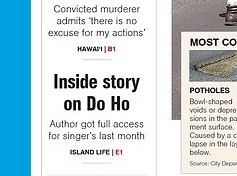
Don Ho! Don Ho! How can anyone miss that? What has become of the exalted profession of Copy Editor (disclosure: I was copy editor then managing editor of our college newspaper) (exalted meant you got to stay very late and later drink lots of beer).
In the old days, even after a paper's copy staff was finished with the paper, people continued to read and check it. I remember pictures of burly pressmen ripping off sheets as they roared through the oil- and ink-covered monster machine that was a traditional printing press.

(This photo is clipped from the Advertiser's special article on the installation of its new presses at Kapolei, Aug. 22, 2004)
Someone at Kapolei should have screamed "stop the presses!" on this one. Don Ho is sacred here, is he not? Thou shalt not misspell his short enough name.
Then the lead story, Hawaii Democrats may sue to close primary, contained a few amusements. Here's one:
"The party is tired of having unknown people nominating its candidates by a secret, shadowy process," said Tony Gill, a labor attorney who is prepared to file suit against the state on the party's behalf.
Yes, what the party wants, of course, is to have known people nominating its candidates by a secret, shadowy process. I found it strange and amusing that one might sue to achieve that.
And finally, maybe someone should sue Disney over this. Disney hotel kicks out Hawaii families after brawl:
A brawl involving two Hawai'i Pop Warner football teams and a team from Baltimore landed one child in an Orlando hospital and led to the families being thrown out of a Walt Disney resort.
Shortly after the fight, at about 3 a.m., the 70 players and family members from O'ahu as well as families from Baltimore were given written notices from the Walt Disney resort informing them that they had 20 minutes to vacate the property or Orange County sheriff's deputies would be called to remove them.
The notice prompted panic. Entire families, including small children, were awakened and told to gather in the corner of a parking lot as emergency lodging arrangements were made, Kong said.
20 minutes to vacate a Disney hotel. Uncle Walt would be upset about this. Collective punishment. It doesn't matter if there are rules, this is inhospitable treatment of guests. I hope this gets all the publicity it deserves. I hope also that people will think twice before staying at Disney hotels if they don't appropriately discipline their management for this.
All this and it's only page one.
Wait! One more: breaking news today—Santa Claus is coming to town Saturday for parade. Yup, he's on his way. This is a news story, it must be true.
Ok, the maintenance people found the crossed pipes and the cold water is running cold again. It won't make the evening paper (news of the weird, or something). Tomorrow there will be more news, most of it serious. For now, time to post this and hope I don't have any typos that Advertiser staff can mock me for.
Do Ho, indeed.
Friday, December 07, 2007
Merry Christmas, poor people of New Orleans
U.S. to Destroy New Orleans Housing While Poor Sleep in Tents
By James S. Russell
Dec. 6 (Bloomberg) -- In New Orleans, public housing doesn't mean bleak high-rise towers. The city has thousands of units with Georgian brickwork and lacy ironwork porches that came through Hurricane Katrina barely scathed.
Yet the U.S. Department of Housing and Urban Development, or HUD, last week approved $31 million worth of contracts to demolish 4,500 public housing units of such high quality that some are on the National Register of Historic Places.
The demolitions, scheduled to start as soon as Dec. 15, come as the city faces an unprecedented shortage of rental housing. To add insult to injury, the Federal Emergency Management Agency announced last week that it would evict hundreds of residents of emergency trailer parks in New Orleans over the next six months, even though they don't have houses to return to.
Merry Christmas, poor people....
[Bloomberg.com: News]
The Bus company should be replaced
Honolulu residents who have never been to Portland, Oregon or other places where people depend on public transportation may not realize how pathetic the system is that we have here.
Here's a pic I snapped while walking home from the State Capitol recently. It's 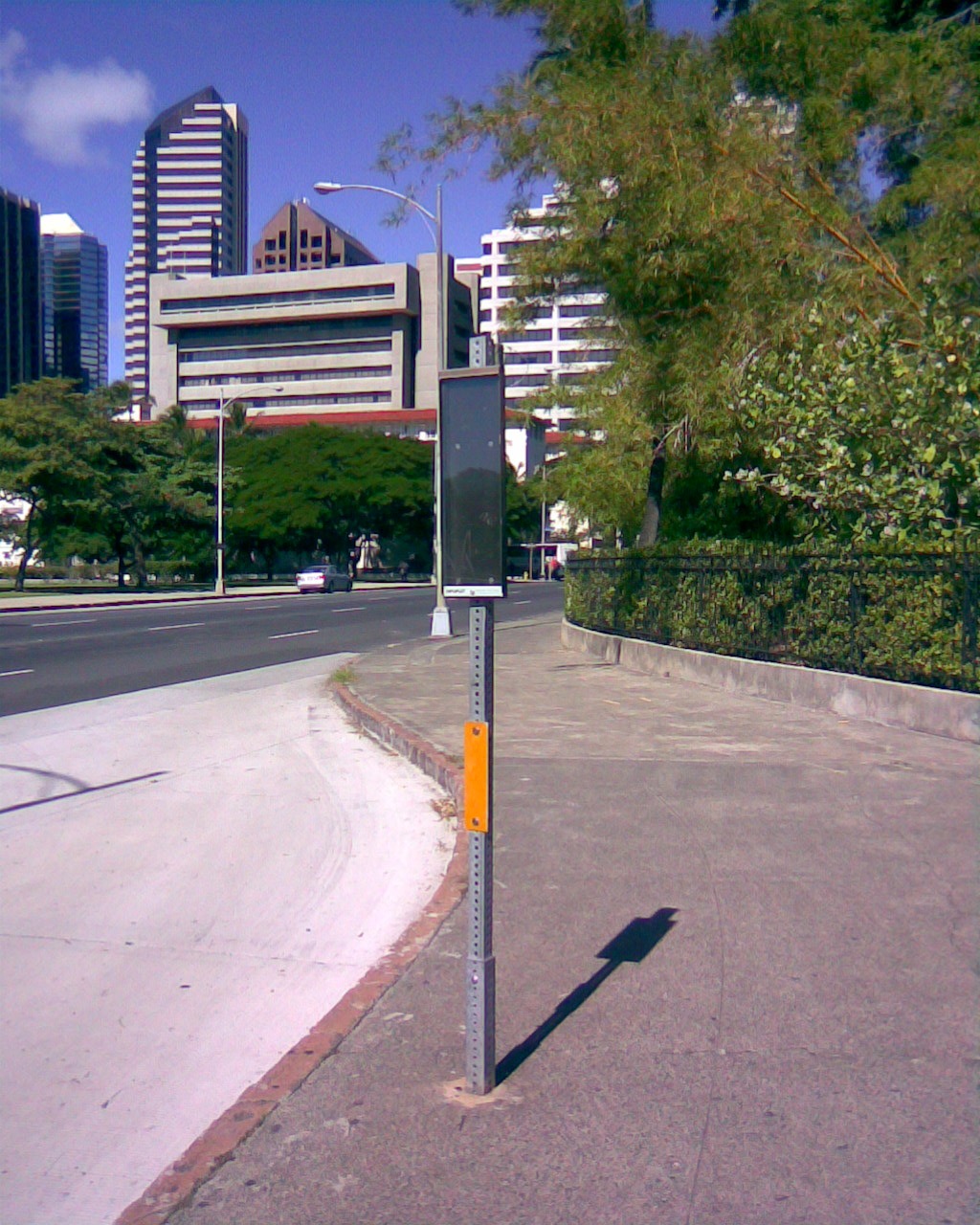 the bus stop across from the Capitol, in front of the Department of Health. It's a major transfer point and a tourist destination, but there's no map and not even an indication of what buses might stop there. Nevermind a timetable or anything like you might find in other cities.
I'm concerned that the City is about to spend a ton of our money on a rail system that they may not have a clue on how to operate. The fact that it doesn't go where it is needed should be a hint. The clashes between the City Council and the Mayor on the system don't bode well either. While many private citizens and several City Council members are still looking for alternatives to a train, it's rumored that the Mayor has already settled on a Hitachi system, and so that's the one that will be shoved down our throats.
Strong language. Weak system. I just don't trust City Hall to spend our tax money wisely, based on the evidence we have before us: a third-world bus system that can't even put up basic signage, a decent website, or keep to a schedule (when you learn what it is).
Many people who depend on the Handi-Van can also give you an earful about problems with that service.
Finally, one of my pet peeves. After living in Tokyo for nearly 17 years, I was used to bus fare boxes making change. They made change when we moved there in 1972. Honolulu bus fare boxes still don't make change. Also, do you remember the "smart cards" scandal of a few years ago?:
A government contractor that is a subject of a criminal investigation into Honolulu Mayor Jeremy Harris' political campaign received a $2.2 million city contract for a state-of-the art bus fare system, even though the company has no experience in providing such systems.
City officials awarded a two-year contract in March to Royal Contracting Co. to provide a smart-card fare payment system for the city's bus system.
...
City Prosecutor Peter Carlisle's investigation into the Harris campaign began taking a close look at Royal Contracting in February after [Royal Contracting Vice President Leonard] Leong told the Star-Bulletin that his firm delivered dozens of historic city curbstones to city Managing Director Ben Lee.The curbstones, which were provided at no cost, were to be used for a walkway at Lee's Punchbowl-area home. [Bus fare card contract goes to firm with no experience, Star-Bulletin 8/14/2003]
That sounds like petty, third-world corruption.
Before the first spike is driven, we should get competent management for our city transportation system. Don't you think?
Is the City of Honolulu competent to run a transportation system?
Bureaucratic decisions can cause more than inconvenience. They can cost lives.
A letter in today's Advertiser illustrates the rage of many Aina Haina residents to the slashing of their bus service without their knowledge or consent.
More important, in my view, is that although Hawaii sets records for pedestrian fatalities, the planned change will, as the letter writer describes, force more people to cross heavy traffic and risk their lives. The decision puts people directly in harm's way.
THEBUS NOT TRUTHFUL TO 'AINA HAINA RESIDENTS
In his Nov. 26 letter on the change in 'Aina Haina bus service, J. Roger Morton accuses Lee Cataluna of misleading readers concerning our bus service. He asserts that slashing service to 'Aina Haina from three buses an hour to one is part of an "entire improvement plan." The number of Route 1 buses will also be reduced. Many riders will be forced to transfer and/or cross Kalaniana'ole Highway to make connections [Letters to the Editor - The Honolulu Advertiser]
I don't think people realize that these decisions can actually cost lives. Here's the end of Lee Cataluna's column of November 20, What's to like about bus plan?:
Many of the old folks there [gathered at a home on East Hind Drive] just listened and didn't say much, but their presence spoke volumes. Those thin legs, cloudy eyes and bent backs can't handle much more than a direct bus route. After Dec. 2, they'll either wait for somebody to drive them or sit at home.
Last week, the thing they fear the most came to pass: An elderly man who usually took the bus from his home in Wai'alae Iki to Chinatown about five days a week was struck by a car while crossing Kalaniana'ole. He died in the hospital.
Please read the entire column.
This will not be the last death. But who do we charge with murder if more people are killed as a result of this unwanted change in bus service? I'm very serious about this. There ought to be a way to challenge and reverse these decisions based on their very real human cost.
If people are killed as a result of this change, it's pretty much the same as though someone at The Bus put out a contract on their lives. No, that person didn't pull the trigger, but the responsibility is still theirs.
This decision needs to be reviewed and probably reversed.
Superferry link, pics
Brad Parsons has put together some links to other blogs and also links to his collection of photos.
See it over at the Hawaii Superferry blog.
His article with links is here, and the article with photos of Kahului Harbor and the protests is here.
If you're using a newsreader (aggregator) to follow Superferry events, Brad doesn't show a feed on his blog, but this one works. Put Brad's feed into your newsreader to be updated instantly on Superferry-related events over on Maui.
Good thing the cops didn't have Tasers
Police brutality exists even in Hawaii.
This video, shot by a fan from the stands, is less than clear. It appears that the police are pounding a man who rushed onto the field with their fists although he is already down, but we can't see it clearly.
More information will undoubtedly come out. For the moment, let's just be glad that these cops didn't have Tasers.
[Click on the pic to play from YouTube]
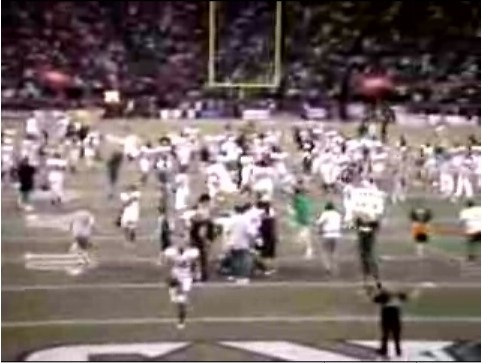
The video also illustrates the value of citizen journalism. Perhaps the photographer wasn't a journalist before uploading the video, but I think the term fits perfectly once the info has been displayed to the public. Because of the video, this incident has been noticed and reported by the establishment press.
We can all be citizen journalists. Use your cell phone camera, your digital camera, or your video camera. Let the rest of us know what you have seen. Then you are a journalist, at least for that moment, and no college degree is necessary.
Thursday, December 06, 2007
There was a Honolulu Stock Exchange?
 After ranting about how Hawaii is always trying to be the center of the Pacific for something, whether it is high-tech, communications, or even a stock exchange, I Googled to find out just how that crazy stock exchange idea came about. You know, who thought of it, who was pushing it. Strangely, I hit an article saying it had opened! Whoa! No way.
But yes. The above article appeared in the New York Times on December 21, 1902.
Apparently it operated until 1976 (1977 according to the Wikipedia)! Obviously the first try didn't get to be the center of much, although over the 75 or so years of its existence it must have done something. The second try didn't happen. Yet.
The research has been fascinating, though. Google finds little vignettes of Hawaii as seen by the New York Times. Stuff like this longer article. Do you notice hints of slave labor on the plantations?:
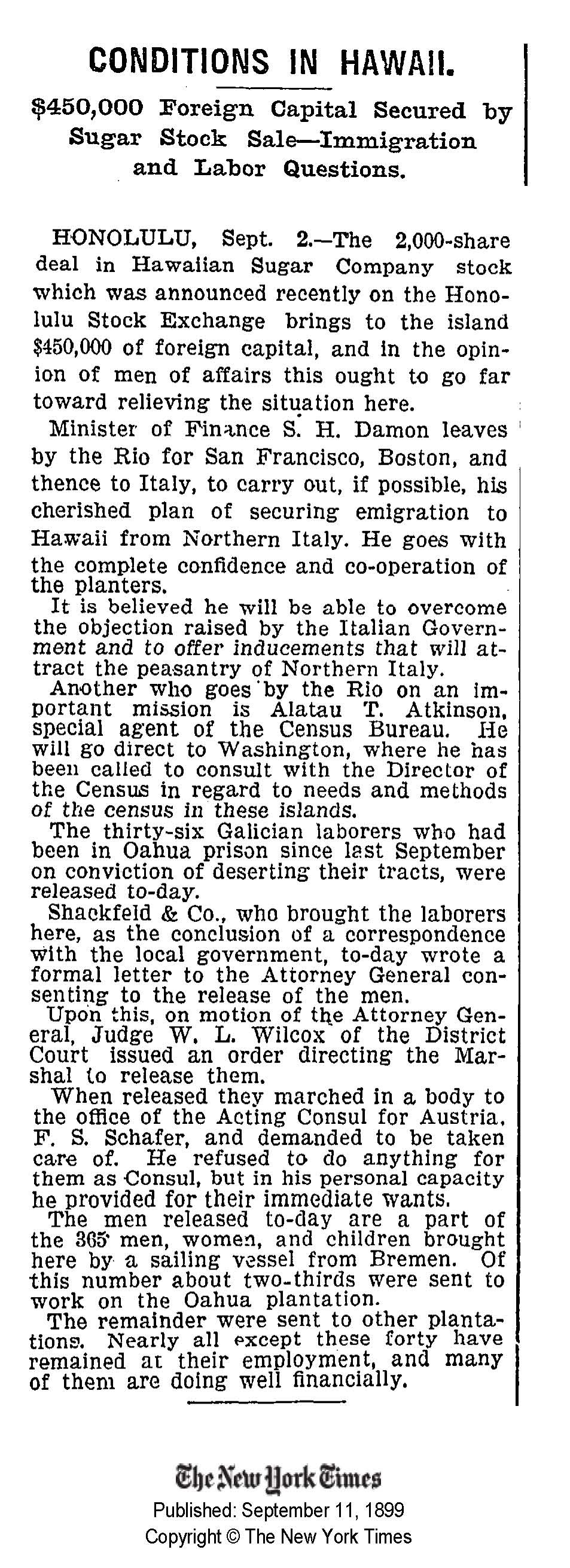
The trouble with this is that it mentions (in an 1899 article) the Honolulu Stock Exchange, yet the prior article, from the same New York times, says that the stock exchange opened in 1902.
Planning for HSF to go to Big Island
Brad Parsons unearthed and is circulating a 14-page file of discussion which I believe was obtained as a result of an FOI request. Much of it concerns the plans for accommodating the Superferry at Kawaihae on the Big Island. There's a date at the top, 7/5/2006.
There's much to read and I haven't done that yet, nor would I be able to relate the wave height and other figures to the real world. Perhaps someone with more experience can comment.
Just to whet your appetite to download this file and have a look, here is a snippet (OCRd):
5. Current users of pier 1 are cattle boats and cement barges. Cattle boats will go to Hilo. Cement barges will share pier 1 with HSF. Phone up cement operators and DOT Harbors and get their view of whether this is practical.
6. Alternatives 2b and 3 conflict with current location of HSF operations and are not practical unless an alternative location is arranged.
7. Terry White indicated that operation for HSF is 3 feet waves at dock and 30 knots wind, or a lesser combined criteria, for instance, 25b knot wind and 2 ft or 2.5 ft waves. This is a rough criteria and will be refined through operating experience. They have no good predictors of conditions at this time, and expect to have both unnecessary cancellations and cancellations after the HSF has left Honolulu. This is the critical issue for the analysis. Tom Smith has been told by DOT that they feel the 3 ft. criteria are completely unrealistic. If we are to use alternative criteria, how do we arrive at it, and how do we evaluate the uncertainty of those criteria? This is an engineering question, not an economic one, and should be evaluated as such.
8. Terry White affirmed HFS's long term commitment to pier 1 as the site of operations. However, in evaluating the project from a NED standpoint, are we constrained by the current political decision to locate the HSF at pier 1?
This is a quote out of context, but you have access to the full document. I welcome comments, if anyone has anything to say about this.
After the cleanup, questions remain
Yikes! A condo roof blown away? This wasn't even a hurricane. Power poles down. A bus struck by lightning.
In one sense, dealing with the weather is part of island life. Sometimes stuff happens. I was glad that the papers did not indicate any deaths due to the storm.
After the cleanup perhaps some questions need to be asked. For example, according to CHORE, Doug Carlson's watchdog blog, 16 utility poles were blown down and blocked a highway along the same stretch of road where 13 poles blew down in March, 2006. Doug asks about that and much more.
I just made my routine call to Oceanic to collect my credit for yesterday's outages. Believe it or not, they are not required to give you credit for their lapses in service unless you call and claim it! (There oughta be a law... hint to legislators).
Yesterday was a big storm, but sometimes Roadrunner or the entire cable is out even though the sun is shining brightly in the sky. But they still get to charge you for service that's not delivered.
If you use several services (say, digital tv, broadband internet, VOIP phone) these are not available to you during an outage. In my book, you deserve a credit at least. You also deserve more reliable service, and I'll get back to that. If you're paying for one of the premium broadband services, you were paying though you got nothing. Maybe corporate customers will get a bigger credit if they call, because they pay substantially more.
Calling 643-2100 (on Oahu) will get you a friendly representative who will cheerfully issue a refund. It's surprisingly small, maybe $3-$4 for yesterday. But imagine if they had to give that to all their affected subscribers each time?
This brings me to the issue of reliability. Just because we live on an island doesn't mean we have to put up with so much downtime. Maybe it's a Disappeared Technology, but it's called "redundancy." When I worked for GE, each computer center had redundant data feeds. One by satellite, one by cable. One left the center by an underground cable, the other by overhead poles. In fact, there was often a third or fourth line. Each line would go via a different carrier where there was a choice. The point was to not be down. The computer centers put in redundancy because any outage would be extremely costly to the company.
It's a simple principle, applicable everywhere. There's obviously a tradeoff which is mostly economic. It may not be possible to provide two diverse feeds for every community. But A can connect to B which can connect to C which can connect to A. There's often quite a lot that can be done. Same for electric power, and often they do have redundancy. Power may come from the East and from the West. But often they don't have that.
If Oceanic were required to issue automatic credits, that could be one small part of an incentive to improve reliability through redundancy and other methods.
If we remain docile consumers we'll get no improvement. If the communities affected by the 16 downed power poles hold the electric company to account, maybe they'll put in a more reliable system. If no one says anything, guess what will happen next time the wind blows.
Same for Oceanic. Maybe you're using their VOIP phone service and no one could reach you. Asking for a credit is a small thing and won't bother them (unless we get that law passed...), but raising a fuss and demanding better service might.
Oh, I know you won't do it. They know you won't do it. We're sheep. We just take anything that's dished out to us. We pay but we don't get. You won't email your state representatives and ask for automatic refunds for service outages. HECO will be allowed to replace the poles with more of the same. Maybe they've already done so.
Now that your cable is working, and maybe you got credit for yesterday, go check out CHORE. Doug Carlson wants answers. He wants sirens to work and power poles to stay up. It could be the start of a movement. Please join in.
Wednesday, December 05, 2007
Hearing Impaired Man Tased by Police
Yes, cops tortured a deaf man because he wouldn't follow orders. Snippet:
Donnell Williams had just gotten out of the bath tub, wearing only a towel around his waist, when he turned the corner to see guns pointing right at him.
"I ain't never been so scared," says Williams.
Police forced entry into Williams home while responding to a shooting, but it turned out to be a false call. They had no idea at the time the call wasn't real and that Williams is hearing impaired. Without his hearing aid he is basically deaf.
"I kept going to my ear yelling that I was scared. I can't hear! I can't hear!"
Officers were worried about their own safety because at the time it appeared Williams was refusing to obey their commands to show his hands. That's when they shot him with a Taser. [KWCH - Kansas - Hearing Impaired Man Tased by Police]
Advertiser chooses fluff over substance in presidential candidate profiles
As I read the Honolulu Advertiser's profiles of presidential candidates Giuliani and Clinton, I was wondering, if the series should continue, whether they would mention Edward's $400 haircut. I wasn't disappointed.
The series started on November 25 with two articles from the McClatchy-Tribune News Service. One can't blame McClatchy because the Advertiser chose these particular articles to present to us. You can follow the series on-line at the Advertiser's website. Or as long as you are browsing, you can do much better.
We'll have to click elsewhere for information that might compare the candidate's positions on issues of concern to all of us, their voting records, and their history.
Just as an example, click here for a short compendium of articles on Giuliani. Did you learn more, reading those excerpts, than what the Advertiser brought you? The alternative press has covered his leadership failures pretty well. The Honolulu Weekly carries a cartoon about him in the current issue. Even cartoons are more helpful in understanding this candidate than the McClatchy piece.
Or check out this description of the difference in Democratic candidates' universal health insurance proposals.
Readers are served by in-depth analysis. We can handle it. Why bring us fluff? Does it sell more newspapers?
Speaking of comparisons, Progressive Review editor Sam Smith has been trying an interesting experiment in poll-watching. Check out his simple mathematical analysis here.
Hilo principal unable to control bullying and assault, punishes victim
Bullying has struck again in a Hawaii school, this time leading to injury—and punishment of the victim. This isn't exactly "Disappeared News", it was a featured news story in today's Star-Bulletin. What is missing (and perhaps they will follow up) is what action the Department of Education will take in view of the situation at the school and the attitude and actions of the school administration, as reported in the story.
HILO » On Nov. 15, schoolgirl Evelyn Higgins, 12, suffered bruises and a gash in her head in an attack by a group of girls.
One schoolmate grabbed her hair and hit her head against a wall four times. The gash required 10 surgical staples to close.
Tomorrow Waiakea Intermediate School will formally respond to the attack by punishing ... the victim.
That's when Evelyn will receive one day of in-school suspension for calling one of the girls a "slut," according to her father and stepmother.
Punishment will also be meted out to the girl who slammed Evelyn's head against a wall, said Evelyn's father, Jeff Higgins. [Beaten girl suffers school discipline, Star-Bulletin 12/5/07]
One of the problems with this is that the story suggests that the school has been tolerant of bullying. It is hard for a "pack" of 14 students to form under the nose of school officials unless they are looking the other way. That they are using the excuse that the victim struck back verbally to punish her while apparently letting the other bullies off the hook is troubling. What of the other 13 "pack" members? The story says nothing, supposedly because the school said nothing to the reporter.
The victim was no dirty-mouthed troublemaker:
She made the honor roll and won placement in an advanced math class. And initially she had no trouble with the other students.
"The first three months were fine," [her mother] said.
Then the same group of girls started making fun of her blond eyebrows, and bad feelings escalated. The day before the attack, she told her father, "Don't be surprised (if something happens) because these girls have been threatening me."
The next day, a "pack" of up to 14 girls followed Evelyn around.
"My friends were terrified for me," Evelyn said.
Higgins believes the attack was racially motivated because the attacker used the phrase "f---- haole."
The article doesn't say what punishment might be planned for the attacker, but the police have classified the attack as a felony.
The article mentions no action against the other 13 members of the "pack" nor any measure that the school is taking to end what appears to be organized bullying or even gang activity on its watch.
[Principal Maureen] Duffy said children sometimes hear "messages" in popular music and media that are "not always the most respectful or tolerant of others.
"The way they respond is not always appropriate," she said.
" 'Messages' in music" is a lame excuse (IMHO) used to shift blame to society as a whole. In this case, the school seems to have a lot to answer for.
Shouldn't there be an investigation and perhaps discipline of the school administration? What action is the DOE taking? Waiakea High School has had an anti-bullying program for a couple of years. Does the intermediate school have a program? If not, why not? If it does, why isn't it working?
Report: Hawaii Needs to Protect Students from Bullying (October 2007) (snippet):
Hawaii schools should create anti-bullying programs by 2010, give annual training for all employees about harassment and discrimination, and require students to attend assemblies to discuss the problem, the [Safe Schools Community Advisory] committee said.
The state public school system, which educates nearly 180,000 students, lacks uniform guidelines for administrators to report and respond to bullying on their campuses.
"There were probably a lot of unreported incidents happening at the schools," said committee member Jean Nakasato, an educational specialist with the Education Department's student support section.
The committee recommended that the Department of Education hire staff to investigate, respond and document cases of students being teased because of weight, looks, economic status, race religion, national origin and sexual orientation.
More than half of middle school students and 44 percent of high school students in the state reported being bullied at least once a year, according to the 2005 Hawaii Youth Risk Behavior Surveys.
In view of this report, the Department of Education could demonstrate its concern in part by saying how it will investigate the actions of the principal and conditions at Waiakea Intermediate School that led to both the situation and to the victim being punished.
Update: This received today (Thursday) via email from Supt. Pat Hamamoto:
Larry,
After an intensive round of investigation, we have concluded that both parties knowingly engaged in this incident.
Both were disciplined appropriately and there is follow up counseling and school wide programs in place to support the healing for the individuals as well as the school.
Hope this helps.
One-man newspaper in Puna, Big Island
Journalist Hunter Bishop couldn't post many articles while he was on jury duty here on Oahu, but he's making up for it since his return to the Big Island.
Anyone interested in news and concerns over there can subscribe to his news feed and stay in touch.
What's a news feed? It's what turbo-charges blogs and gives them an edge in certain ways over traditional newspapers. Your newspaper gets plopped at your door (or somewhere in your driveway) usually once a day, and you (or your dog, if well trained) have to go fetch it. Blogs can be like that—you don't get to read them unless you go to the website.
But with news feeds, the blog comes to you. Using a news reader (also called an aggregator), the news is delivered to you, as frequently as you set it for. News readers are often stand-alone programs, or they can be built into a browser like Opera or Firefox (with an add-on). Google has one you use on-line. I use feeds on the left side of this blog to bring you the last three headlines from various blogs.
The Legislature will be providing status updates and other information via news feeds (usually called RSS feeds), so learning to use them can be handy if you follow issues during the legislative session.
So find yourself a news reader (many are free programs, use Google to find) and tune in to Hunter Bishop on the Big Island.
Oh, newspapers have feeds too, they are trying to catch up to blogs.
Tuesday, December 04, 2007
Varroa mites may already be on the Superferry due to Dept. of Agriculture neglect
It seems that the Department of Agriculture is supposed to eradicate wild (feral) colonies of bees near ports so as to prevent the spread of the devastating Varroa mite to Neighbor Islands.
Part of an email sent by Dr. Michael Kliks to key legislators and others yesterday explains the situation. He notes in the email that the feral hive described below was tested and found to be infested with Varroa mites:
Last Tuesday afternoon, November 26, we removed a large hive of bees from a pipe flange on the roof of 206 Merchant Street, which is literally a stone's throw from where the Super Ferry was berthed at the time. . . and had been berthed for about 2 weeks.
Our concern is that feral colonies close to any port or airport, such as this one, were to have been removed physically or through the use of attractant or toxicant-baited traps, by the HDOA long ago. If the HDOA is actually conducting active monitoring and surveillance, and if an effective trapping and extermination program is in place, there should be no more feral colonies in the zoosanitary cordon zones around these sensitive facilities. Whatever the HDOA claims to be doing, it is not preventing feral hives from existing in, and swarms from entering into, and the sanitary cordon around our ports and airports.
In a nutshell, the Dept. of Agriculture failed to remove wild bee colonies from nearby the Superferry as they were supposed to, according to Dr. Kliks (can we call this a "security zone?"). Now one of these colonies has been found to be infested with deadly mites.
If Varroa mites make it to Neighbor Islands, Hawaii's organic honey industry could be wiped out. The mite is also thought to be a contributing factor to Colony Collapse Disorder which is wiping out bee hives on the Mainland. Hawaii currently exports queen bees to the Mainland—those exports would be endangered as well if the infection spreads.
If the infection spreads and wipes out bee hives on the Neighbor Islands, any agriculture dependent on bees for pollination would also be adversely affected. In other words, it's not just a bunch of little insects we're talking about here. It's a whole economic ecosystem. Farmers would be hurt too.
Although Dr. Kliks did not call for it, shouldn't the Dept. of Agriculture take steps to disinfect the Superferry before it is allowed to go to another island?
Watch out Maui, the first invasive specie (and it's a baaad one) may be headed your way.
Pics of waves and paddy wagons
Brad Parsons posted links to some pictures he took as comments to an earlier article. Since comments are pretty much buried in this blog, I wanted to put the links up front.
The first bunch shows the impressive wave action in Kahului harbor yesterday.
The second set is more ominous, a gathering of what looks like paddy wagons for the "Unified Command."
Of course, waves will go away, but most likely the military buildup will stay.
I'm not sure what the surf forecast holds for the ferry's planned sailing Thursday. There's a flash flood watch posted until Thursday afternoon for the entire state. There's also a high wind warning until Wednesday evening: sustained winds of 40 mph or gusts of 58 mph are expected (tie down your garbage cans, Christmas decorations, and ferry platforms).
Stuff is happening.
How many tugboats will it take to keep the ferry platform in check? Who is paying for those tugboats, anyway?
It's still safer and more dependable to fly if you are headed to Maui.
Please feel free to send links to any pictures that may interest readers.
Update: Brad sends this link to a webcam located at Kahului Harbor. For some reason my Vista machine won't load this, but my XP machines have no trouble. Go figure. The video shows quite a bit of wind right now (about 2:15 p.m.).
Giant launch pad refueling in Hawaii should put an end to our space ambitions
It seems some people took at look at an old oil rig and said, "Hey... what a great way to launch stuff into space!" Investors must have agreed. Check out the article in today's paper about this thing showing up briefly in Hawaii to refuel:
The vessel was built in 1982 as one of the world's largest oil rigs, and was used in the North Sea. It was converted into a launch platform in the mid-'90s.
The company says the ocean launch is cheaper and more reliable than a conventional satellite rocket launch on land. [Giant launch pad makes Isle pit stop - The Honolulu Advertiser - Hawaii's Newspaper]
An oil rig has large submerged hulls 'way down under the surface, where there are no waves. So the platform itself, up in the air, is actually resting on very stable supports, unaffected by your average surface chop. And it can move around. So it can go pick up the bird in California, float out to the equator, and at the right moment, launch it into space.
Investors obviously liked the idea. What they have not liked, of course, is the idea that Hawaii is an ideal place in the universe for doing the same thing.
Between 1988 and 1995 Hawaii had an Office of Space Industry that ate funds badly needed elsewhere (e.g., schools? fix the dams?) The idea was to promote a commercial spaceport in Kau, on the Big Island. We even had a Space Czar.
No one was biting. You may note that about this time the oil rig was converted. Why lug spacecraft up to the Kau desert to launch when you can just launch from the ship that picks them up? Duhhh. Skip Kau or any land-based launch site.
Everyone got it but our high-tech development people.
Public opposition also grew, and the Legislature cut funding in 1995.
Then, as now, Hawaii remains a number of small islands located far away from anything else, in the middle of the Pacific. But promoting high-tech is big business here, so dreams never die, they are simply recycled and new agencies brought into being.
Our poor schools. Hot, still lacking textbooks. But last session the Legislature apportioned $500,000 to Hawaii's space program. They passed SB907 into law. This bill begins:
The legislature finds that Hawaii's diverse natural resources, unique geographic terrain, first-class technological infrastructure, and resident scientific and engineering expertise make our island state an ideal location to develop, grow, and sustain a wide variety of aerospace-related activities.
As the oil rig launch pad demonstrates, having diverse natural resources and unique geographic terrain is optional for launching stuff into space. I doubt the platform has any natural resources at all, unless you can sit at the edge of it and throw a fishing line into the ocean.
Try and build a circuit board here. Our infrastructure is a bit hard to find. Our scientific and engineering expertise are not special, and our best graduates still flock to the Mainland for employment in their chosen fields. From 1988 to 1995 we couldn't begin or sustain a space industry; what exactly has changed? Other than the industry carrying on without us, and replacing our pet idea with a recycled oil platform.
Maybe a dream can come true. The measurement will be how many jobs are created. I don't mean in DBEDT and in the other agencies working to promote space projects, I mean in the projects themselves. Paying promoters is not the same as creating high-tech jobs. That $500,000 is not going into the pockets of our engineering graduates.
There's no harm in trying. We, the people, should keep watch on this, however. If the promoters keep coming back to the Legislature for more money to pump into what looks like a black hole, someone should suggest to our lawmakers that dreams don't repair schools nor keep our infrastructure intact.
Remember the dream of Hawaii as the communications center of the Pacific? Remember that we were supposed to be an international financial center? Were you told that we're in an ideal location to do international business, in a time zone between Asia and the US Mainland? Nevermind that that's pure bunk. The location is a liability that must be overcome.
The space dream is funded by our tax money. How many of us would choose this way to invest it?
We might attract far more jobs if people knew Hawaii had decent schools for their kids. Our kids might learn and make better decisions than their elders.
Non-violence training on Maui tonight
I know Joshua Cooper, who will lead the non-violence training described below. He's one of our state's outstanding peace researchers. The training should be very useful, and also a chance to meet Joshua if you don't know him. Highly recommended if you're on Maui.
This is a forward of a circulating email:
The first of a series of Nonviolence Training for people protesting the Superferry will be held in the shade under solar panel Hale at Maui Community College, Dec. 4, at 5:15 p.m. If there is rain, we will move to one of the Hale (House Classrooms).
Joshua Cooper, Director of the Hawaii Institute for Human Rights will lead the NV training. Prior to the training at 5 p.m. there will also be a declaration of individuals and organizations that participated in the Maui Social Forum 2007, not representing or speaking for the forum as an entity in their declaration, but representing themselves in declaring their own aspirations, intentions, and vision for a better Maui and World. The Maui Social Forum 2007 is being held on Monday, Dec. 3 from 12 noon to 9 p.m. at Maui Community College, at the Hale classrooms. See the Maui Social Forum website for more information at:
www.party2win.com/hihr click on "Find A Party."
Monday, December 03, 2007
Post- intro-fare Superferry is no bargain
Thanks to Dick Mayer for the suggestion to do a test booking:
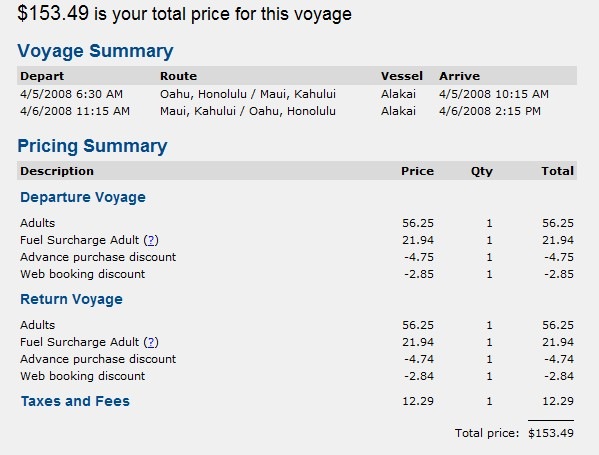
Thank goodness no Taser involved in this one
Some comments to my Taser articles and some emails indicate that people should just go along and obey the cops and the fact that they have Tasers won't matter.
This is a very naive position, but then, I listen to the nightly news on WBAI via the web so I catch whenever the New York police have erroneously broken into someone's home, thrown the occupants onto the floor, injured or killed them perhaps in front of their kids, and destroyed property. All on a bad tip or mistaken address.
Hawaii is not immune to police abuse. This article is just over a month old, from the Garden Island News—‘Wrong house’ raid costs county $325K:
The couple baby-sitting their grandchildren when police mistook their home for a drug dealer’s residence has been awarded a $325,000 settlement, their attorney said yesterday.
Police had been tracking a package that allegedly contained 11 pounds of marijuana that had been picked up at the Koloa post office by a man who was driving a Toyota truck on March 15, 2005, according to court documents.Though police followed the car onto Kaumuali‘i Highway and onto a private road with seven houses, when the transmitter inside the box went off indicating the package had been opened, police had lost visual contact with the vehicle.
That’s when, without a warrant authorizing entrance into the home of William and Sharon McCulley, but rather with an “anticipatory search warrant” that authorized them to search any property where the marijuana was transported, police entered their home.
Though the Toyota truck they had been following and the transported box wasn’t at the McCulley’s home, police then threw Sharon McCulley on the ground next to her grandchild and handcuffed her, pressing a gun so hard into her head it left a circular mark, according to the complaint.
Her husband, William McCulley, who has a severe nerve disorder and has a walker and leg brace, was also ordered to lie on the ground, but was unable to do so quickly because of his disability. Thrown to the ground by an officer, William McCulley’s implanted electronic shocking device to alleviate pain malfunctioned causing him to convulse, court documents state.
Attorneys Michael Green and John Rapp said in addition to the pain and suffering the McCulleys endured, their privacy rights were violated.
In addition, they alleged that police not only failed to ensure they were entering the right home authorized by the warrant, but also committed assault and battery, trespassing, and negligently inflicted serious emotional distress upon the McCulleys.
...
Can you imagine what would have happened to Mr. McCulley if police in that instance tased him?
To all those out there who are thinking of commenting on this post that Mr. McCulley should simply have followed police orders, skip it. And think: one day you too will be older and perhaps in this man's situation. Or your family, friends or neighbors.
US government security contractors take over public beach, bust expensive camera
Beaches in Hawaii are public areas. You know that. Bob Sato, the producer of a local public access TV show for children, knew that. The security contractors who attacked and choked him knew that. But just as in Iraq, they behaved as though they were above the law:
Sato had set up at Mana Beach to begin filming for his TV show when a number of men sporting ITT Security shirts confronted him.
The result is currently available for view on YouTube under the heading "Attack at Mana Beach." If the footage ever does air on Channel 52, it will be one of the more important things local kids will ever see.
It in the film, these military contractors (think "Blackwater") tell Sato he has to move from his spot on the beach but he refuses. With no signs posted and Mana Beach a public place, it just so happens that Sato is within his constitutional rights to stay put. Not that this matters to the armed security agents who respond by turning up the heat. They threaten Sato, demanding he turn off his camera and give them the tape; one man even grabs the 60-year old film maker by the neck.
Sato's camera captures the confrontation and while the ten-minute clip is not as refined as the standard Hollywood depiction of an Orwellian future, it's jusy as scary . . . actually more so because it's reality TV and it's not about what could happen but what is happening, right now, rght here in Hawai`i. Over and again Sato is told, "You going up against the U.S. government, bra, you not going win." [Big Island Weekly - Read > Comment > Small World Big Island -- A line in the sand]
This should not be allowed in Hawaii. We're not Iraq. [Update: I've been deservedly taken to task in an email. This should not be allowed in Iraq either.]
As the story goes on, Sato called the police to report the assault and was rewarded with a disorderly conduct ticket.
I don't know who is working for justice in this case, but I hope it will not be dropped. Security contractors are not above the law on US soil.
Good thing that they didn't have a Taser. The thought just entered my mind.
Superferry barge is indeed challenged by Mother Nature
Brad Parsons has been monitoring the surf forecasts for Kahului Harbor and emailed a forecast for big surf today. His watchfulness seems to be on the mark. This "breaking" news has just been posted by the Advertiser:
KAHULUI, Maui — An NCL cruise ship and the Hawaii Superferry barge broke several lines today as large swells rolled across Kahului Harbor.
Two lines connecting the barge to a pier snapped, according to Michael Formby, head of the state Department of Transportation's Harbors Division.
The stern line has been replaced and other lines connecting the barge to the pier are being tightened, he said. [Harbor swells snap Superferry, cruise ship barge lines - The Honolulu Advertiser - Hawaii's Newspaper]
So what will the ferry do if it arrives at a port and the barge is dancing around so much that disembarking would not be safe or pleasant? I thought that would be the worst case, but an even worse situation would be if it couldn't go back where it came from for the same reason. In other words, if the surf kicked up back on Oahu while the ship was enroute.
Did he ever return, no he never returned and his fate is still unknown he may ride forever neath the Streets of Boston he's the man who never returned. Did he ever return, no he never returned and his fate is still unknown he may ride forever neath the Streets of Boston he's the man who never returned.
Oh, did you know there is a Superferry protest song? It's probably been around quite awhile, but I just discovered it. Recorded by Enuf Already. Click here to listen. Lyrics and chords here. Thanks to the various websites that have posted this song.
Akaku posts interview with Coast Guard on security zone
Thanks to a pointer from Brad in comments.
Click on over to Akaku to view a video interview:
Lt. John Titchen, USCG Governmental Affairs Officer from Oahu and Lt. Darwin Jensen, USCG Ranking Officer on Maui sat down with Executive Producer, Dave Coennen, to discuss the temporary expansion of the security zone in and around Kahului Harbor that goes into effect on December 6 for the arrival of the Hawaii Superferry, Alakai.
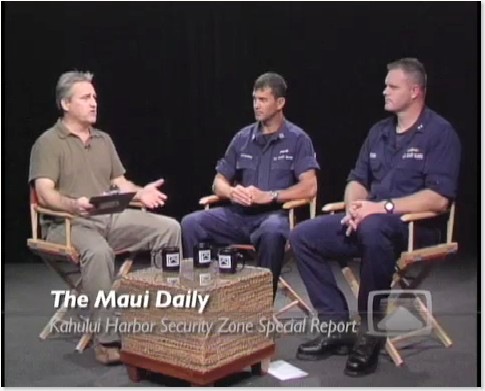
There is additional coverage of weekend protests on the page, along with a request for citizen journalism that could give the major networks a run for their money:
Be the Media: Upload your webcam or cellphone video report from the scene to this site or send us the link and we may broadcast your video. Call in or Skype and iChat us during the coverage and share your experience.
Check with Akaku for their Skype or iChat contact info and become a reporter yourself.
Also, Akaku and the other public access channels need your support in the face of a planned state takeover. Akaku is fighting a requirement that the channels be put out to competitive bidding. That could turn public access television in Hawaii over to anyone, including potentially Mainland organizations like a subsidiary of (say) Fox News.
If you appreciate their work, please take the time to find out how you can help save public access TV in Hawaii.
Sunday, December 02, 2007
Bought and paid for
A useful tool has been posted on the Voter Owned Hawaii website. If you look over at the bottom of the left-hand column, you'll see two links, Donor Lists and Lobbyist Data. These get you a quick look at some data from followthemoney.org.
This data can give you some insight as to the possible motivation for voting in our state legislature. It shows who paid what to whom.
How to use it? Let's say you were curious about a particular state legislator (or the Governor) who took a certain position on an issue. For example, I was indeed curious about this quote and the campaign Rep. Meyer waged during the 2007 session to overturn Hawaii's smoking ban at bars:
"The people who go into bars are grownups. Smoking and drinking have gone together for many years," said Rep. Colleen Meyer (R, Laie-Kahaluu). [starbulletin.com | News | /2007/02/21/]
So I did some research. You can do the same more quickly now by going to Voter Owned Hawaii and clicking on the Donor Lists link. Then on the Hawaii House of Representatives link, and then on Meyer, Colleen Rose (R). Voila! Amidst the data you will see this chart (for 2006 only):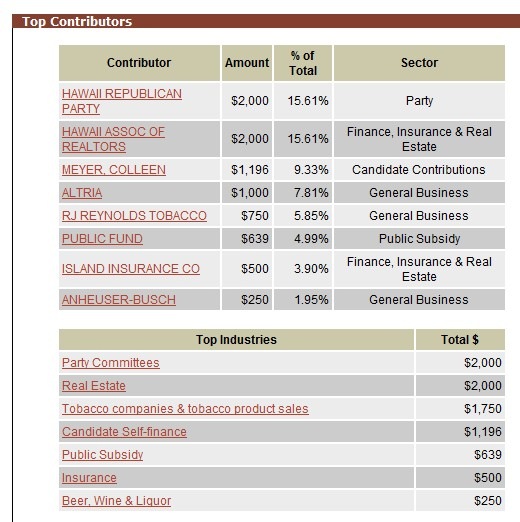 A little Googling will let you know that Altria is related to the tobacco industry.
So notice the tobacco and alcohol in this chart and in the snippet from the Star-Bulletin article. What am I implying? I'm implying nothing. Nothing at all. Any correlation is in the mind of the reader. I was just using this as an example of how handy the link is and how quickly you can gain some knowledge.
You may find this link to be useful for your own research during the coming 2008 legislative session. Note, though, that due to loopholes in Hawaii law, lobbyist numbers are probably very understated.
For more detailed data go directly to followthemoney.org. There you will find an advanced search engine and Hawaii data for many recent years.
So thanks to the Voter Owned Hawaii folks for this handy research tool.
Saturday, December 01, 2007
Where is the outrage?
KAILUA-KONA, Hawaii (AP) _ Big Island police are training to use Tasers.
By the end of the month, 90 percent of Kona officers should be carrying the Tasers.
Hawaii County aims for all sworn personnel to eventually be trained and equipped with the devices. [KPUA.net - KPUA Hawaii News - Big Island police training to use Tasers]
It can't be that a couple of bloggers are the only ones raising red flags about this. There ought to be others trying to do something about it. Who?
Which organizations are opposing allowing the Big Island police to carry and use these potentially deadly weapons, especially in the absence of a public policy?
Who is working on this? What's being done?
Kona police use Taser--an instrument of torture--to gain compliance in an arrest
Thanks to Doug at Poinography (Kona abuse suspect shot with Taser, 12/1/07) for catching this. Please read his article.
Kona police officers used a Taser during an arrest for the first time Thursday afternoon.
Police responding to a domestic dispute in the Kealakehe area attempted to arrest a 34-year-old man, Patrol Capt. Randy Apele said. When the man "failed to comply" with police orders, an officer deployed a Taser. [West Hawaii Today - from archives > Local > First use of Taser in Kona arrest]
The article gave no indication that the police officers were in danger of deadly force from this man, in fact, they had wrestled with him. The article did not mention that he had a gun or a knife.
The article goes on:
Use of Tasers has become controversial in other parts of the country and in Canada. A United Nations committee on Friday announced it believed use of Tasers could be considered a form of torture; an Amnesty International report noted 290 deaths of people in the United States and Canada from June 2001 to Sept. 30, 2007, after those police used Tasers on those people.
The UN committee takes this very seriously, saying:
"The use of TaserX26 weapons, provoking extreme pain, constituted a form of torture, and that in certain cases it could also cause death, as shown by several reliable studies and by certain cases that had happened after practical use," the committee said in a statement.
"Well, it means that it's a very serious thing," Amnesty International USA Executive Director Larry Cox told CBS Early Show co-anchor Julie Chen. "These are people that have seen torture around the world, all kinds of torture. So they don't use the word lightly."
Tasers have become increasingly controversial in the United States, particularly after several notorious cases where their use by police to disable suspects was questioned as being excessive. Especially disturbing is the fact that six adults died after being tased by police in the span of a week. [U.N.: Tasers Are A Form Of Torture, CBS News, November 25, 2007]
The Poinography article points out that the Big Island police policy under which the man was shot is not available to the public. The excuse that it has typographical errors is a travesty in my view. I hope they won't tase the typist for the errors. I'm almost serious.
Should we allow police to potentially kill a suspect in a domestic violence call?
If we do nothing, predictably police use of Tasers will increase. It won't be long before anyone stopped for a speeding ticket could have their life endangered by a trigger-happy cop in Hawaii. See the speeding ticket torture video here. It won't be long before someone in Hawaii is not only tortured by police but killed.
Protests begin on Maui against the Superferry
Citizen journalist Brad Parsons has posted his pics of the protests today held in advance of the Superferry sailing, currently delayed until Thursday.
View them on his Flickr page here.
If anyone has taken or knows of other photo or video coverage, please let me know. You can put links in comments.
Since Brad spotted an Akaku cameraperson, perhaps there will be some video soon.
Stay tuned to your favorite on-line blog for instant coverage.