Sunday, September 30, 2007
Burma 3: Pagan
From the Timeline of Buddhism, probably not completely up-to-date, you can get a flavor of the repression of the monasteries in Burma, and also of the critical role they have played in the struggle for freedom in that country:
# 1965: The Burmese government arrested over 700 monks for in Hmawbi, near Rangoon, for refusing to accept government rule.
# 1974: In Burma, during demonstrations at U Thant's funeral, 600 monks were arrested and several bayoneted by government forces.
# 1976: Following a demonstration in Burma, the government sought to discredit the critical monk La Ba by claiming that he was a cannibal and a murderer.
# 1978: In Burma, more monks and novices were arrested, disrobed and imprisoned by the government. Monasteries were closed and property seized. The critical monk U Nayaka was arrested and died, the government claiming it was suicide.
# 1980: Burmese military government asserts authority over the sangha, violence against monks continues through the decade.
# 1990, August 27: Over 7000 monks met in Mandalay in Burma to call for a boycott of the military. They refused to accept alms from military families or perform services for them. The military government seized monasteries and arrested hundreds of monks, including senior monks U Sumangala and U Yewata. The monks faced long-term imprisonment, and all boycotting monks were disrobed. Some monks were tortured during interrogation.
From the Interfaith Alliance of Hawaii today:
Reminder: Candlelight Vigil to support brothers and sisters in Burma, Sunday, September 30th, 7 pm, Magic Island, Ewa side. Bring your own candle.
Burma: Stop the Bloodshed - Update
Dear Interfaith Friends,
The worst is happening - over the last few days, Burma's generals have unleashed terror on the peaceful monks and protesters – shooting and beating many to death, and taking others away to torture chambers where at this moment they must be enduring the unbearable.
We can stop this horror. Burma's powerful sponsor China can halt the killing, if it believes that its international reputation and the 2008 Olympics in Beijing depend on it. To convince the Chinese government, Avaaz is launching a major global and Asian ad campaign on Tuesday that will deliver our message and the number of signers. Our petition has exploded to over 200,000 signers in just 72 hours, but we need 1 million voices to be the global roar that will get China's attention. If every one of us forwards this email to just 20 friends, we'll reach our target in the next 72 hours. Please sign the petition at the link below -if you haven't already- and forward this email to everyone you care about:
http://www.avaaz.org/en/stand_with_burma/p.php
The petition will also be delivered to the UN Secretary-General, and we will broadcast the news of our effort over radio to Burma's people, telling them not to lose hope, that the world is with them.
The Burmese people are showing incredible courage in the face of horror. The fate of many brave and good people is in our hands, we must help them – and we have hours, not days, to do it. Please sign the petition and forward this email to at least 20 friends right now.
Nanette and I arrived in Pagan. We knew the drill: one of us finds a guide with a vehicle while the other checks in with the local police. Everyone arriving by air had to register, on each stop. We found a guide and a jeep. If I recall correctly, that was one of only two cars available in Pagan. We lucked out. The jeep was started with a crank in the front. Cool. Off we went, first stop was to drop off our bags at the hotel where we were to stay.
In Rangoon we had to stay at the government hotel, but after that we chose local. We wanted to be sure that the money we spent went into local hands rather than into government coffers. Pulling up in front, the jeep stopped immediately (gotta conserve every bit of gasoline). I grabbed our itinerary sheet and went inside.
Since I worked for a company in Japan we had the use of a travel agent, who had actually sent the faxes, made the airline reservations, printed our tickets, and so forth. By now, though, we were used to the disconnect that this trip was different. So it was no surprise that the hotel, a small family-run place, had no record of our reservation. What we came to understand is that the arrangements had been confirmed by Burma's airline, Union of Burma Airways, but that since they had no way to communicate anything back home, they just confirmed anything and everything to the travel agents. Yup, no matter what you asked them for, they confirmed it. Airline reservation? Confirmed. Hotel? Confirmed. That's what it said on my piece of paper, neatly printed for my convenience by the computer.
The hotel didn't have a room for us. But not to worry, they asked the driver to take us to another place where we were likely to find a room. And they suggested in the future that we write to ask for a reservation. There was no guarantee that the mail would go through, but if it did, and if their reply made it back to us, we'd know we had connected. We did find a room, and of course everyone was very kind and helpful. I have to add that the kindness was not what tourists experience in a typical hotel, where the staff hopes for tips and takes care of you because it is their job. The people were genuinely kind and helpful.
 I think it was at this point that we were joined by a young boy. So the four of us, our guide, a man of about our age, the boy, and the two of us set out. We did have a few objectives, and we had time to explore and learn and meet people for this leg of the journey. The guidebook explained why we had picked up a young companion. At some point, it said, he would try to sell us some rubies, where were mined nearby. Of course, they would be glass. The real rubies all go to the government. Buying (real) rubies was supposed to be a good deal in Burma, if one knew beforehand what they were worth so as to avoid being taken in the government stores.
There was one thing we wanted to do without fail: we wanted to be on top of the Shwesandaw Paya (temple) at sunset. There is an outside staircase--a long but worthwhile climb. Thatbyinnyu Pahto (temple) (bottom picture) is taller, but the top levels are not allowed for tourists. Besides, one can see Thatbyinnyu Pahto, which is the highest in the plain, from the other.
We also wanted to see Burmese lacquer being made and to spend some time just walking around.
There are about 3,000 pagodas left in Pagan out of a max of around 13,000. We were there before the 1975 earthquake that toppled many of them, so our memories are precious to us. The military government has been "renovating" the area without regard to historical accuracy or significance, so I shudder to think of the damage that has been done since our visit, by nature and by man (if one can call them men).
 The pagodas are very different from those in Rangoon. While most of the decorations are long gone, having eroded down to the bricks over time, some can still be found. The decorations were principally ceramic tile.
Many of the temples and Pagodas at Pagan are decorated with glazed earthenware tiles in varying shades of green and blue-green, white and yellow-brown. These are Jataka tiles which are Buddhist “birth tiles” depicting the various birth stories of the Buddha. Glazed carved stone-tiles were also found. A common Burmese motif seems to be the lotus flower which is found in stone-tiles as well as decorating Burmese ceramics. [from The History of Ceramic Pottery in Myanmar (Burma)]
The famous lacquerware is often built up in layers on an armature of horsetail hair, so that bowls are flexible in the hand in contrast to the rigid Japanese lacquerware we were more familiar with. We learned that some was made for tourists and that the paint would rub off. In fact, that's the test--our handy guidbook instructed us to bring a piece of cloth for the rubbing test.
The design of fine Burmese laquerware is made by applying layer on layer and scratching through the layers to reveal the color below. Then the next layer is added, and so on. There may be gold leaf (as opposed to cheap paint for the tourist items), and the lacquer is cured in underground storage. We did buy some pieces. The amount of hand work is impressive.

We were also interested in the giant torpedo-shaped cigars many of the adults smoked. In Burma, even the children smoke, generally small jagged cheroots. We had a friend back in Japan who cultivated fine cigars and wouldn't it be cool to bring him one. While we saw them everywhere in Pagan, we had never seen them for sale. Our guide explained that they were made by the women. Later he took us to the home of a woman who wove intricate baskets. She also made the cigars. He asked, and she put aside her work for a moment and took at a beautifully made basket with leaves and other things in it, and deftly folded some of them into one of the giant cigars. There did not seem to be a translation of what the leaves inside were... and we were wondering if Japanese customs would confiscate them and lock me away forever on our return. But we were young then, and lived dangerously... we offered a couple of packs of State 555 cigarettes which the guidebook assured us was the best thing to bring with us when visiting Burma. Speaking with her, through our guide, was a high point of the trip. And fortunately, Japanese customs just waved us through, or I suppose I wouldn't be writing this today.
Towards dusk we headed back to the pagodas and climbed the outside brick stairway. The four of us sat on an open terrace and watched a spectacular sunset evolve. The guide on one side, Nanette, then me and the young boy next to me. It was getting dark and getting gorgeous. Finally, the boy reached into his pocket and pulled out a white cloth. He unfolded it and showed it to me. Inside were some rubies. He asked if I would like to buy some rubies. I said, "They're glass, aren't they?" "Yes," he said, and folded the cloth back over them and returned it to his pocket.
The four of us watched the rest of one of the most beautiful sunsets in the universe in silence, then climbed down the ancient and irregular brick stairs in the twilight.


Saturday, September 29, 2007
Burma 2: Mandalay
From Agence France-Presse 09/28/2007
YANGON -- Thousands of young people riding on motorbikes protested in Myanmar's second city of Mandalay on Friday, but broke up their demonstration after soldiers fired their weapons, witnesses said.From the Wall Street Journal:Soldiers and police sealed off the city's monasteries to prevent Buddhist monks from taking part in the protests, and at least four monks were arrested, witnesses said.
Mandalay is a major center of Buddhist learning, and home to a majority of the country's 400,000 monks.
A monk in Mandalay has a simple message: Help us. As tens of thousands of protesters marched across Burma for the ninth straight day amid escalating violence, the monk spoke to me on the phone yesterday, to tell me about the protests. Hundreds of monks have been beaten and arrested in the protests that began on Aug. 19, and at least nine have died this week. With foreign journalists barred from Burma, being able to hear one man's story is rare, and powerful.
We should find a way to help the monks in Mandalay. We're talking here about one of the world's most sacred places. Please also see the announcement from the Burmese community of Hawaii at the bottom of this article.
Remember, I had let my guard down and drank some sugar cane juice with tainted ice cubes just before leaving Rangoon. So I can only tell you a little about Mandalay.
 At the base of Mandalay Hill is the Kuthodaw Temple, home of the world's largest book. The 729 stupas at Kuthodaw house 730 leaves and 1460 pages; each page is three and a half feet wide, five feet tall and five inches thick. According to the Wikipedia, the pages hold the Tipitaka Pali canon of Theravada Buddhism inscribed on them in gold. One more page was added to record how it all came about, making it 730 stone inscriptions in total.

The city of Mandalay was named after the hill. For about 200 years the path up the hill has been a Buddhist pilgrimage site. We began, of course, at the bottom, where two Chinthes stand guard (hey, they look like lions to me too).

The path narrows and there are small shrines or temples on either side, crowded together. For the rest of the tour you'll have to click on the link above, because very suddenly I needed to get back to the hotel. For me, that was all of Mandalay I would be seeing.
At the hotel, I realized that I would need some medicine. Yikes! This is Burma! What to do? They 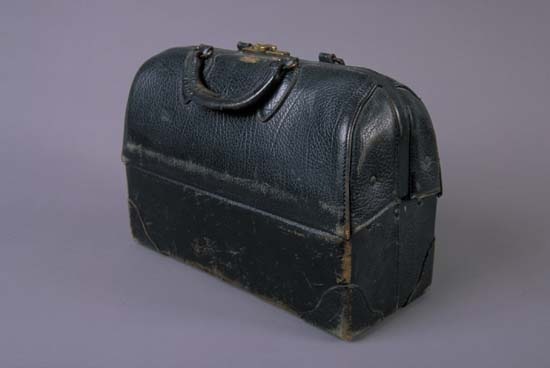 advised the doctor would be right over. That sounded good, because at that point I could not stray far from my room. Shortly a doctor did arrive. A young boy (maybe 10-12 years old, I'm only guessing) accompanied him a few paces behind and carried his black leather medical bag. I remember that my pediatrician, back in Brooklyn, had such a bag when I was a little kid. The young man placed the bag on a table near the bed and opened it. The bag opens at the top and the two sides unfold in the middle like trays.
The doctor was dressed in a black jacket over a white doctor shirt (same as here, it's how you know you're speaking with a real doctor). Below he was wearing a traditional white longyi, which is kind of tubular cloth wrapped around and folded over, without any knot. Burmese men are continually adjusting these things.
He felt my tummy, we both agreed on what was ailing me, and he motioned to the boy. The boy reached into the medicine bag and retrieved a glass Kodak film container with some pills inside. The container had a metal top embossed with the word "Kodak" in large letters. Even in the days before eBay I could recognize a priceless antique when I saw one. I asked if he needed the bottle, I could just take the pills into a container of my own. The doctor said no, it's ok, and left. The boy closed the medicine case and informed me of the fee. I don't recall the amount now, but I do remember that it was hardly anything at all. And it included the medicine! I paid the boy. He thanked me, picked up the bag, and imitating the doctor's dignified gait, turned and left the room.
I still have that glass Kodak bottle and I refuse to check on eBay to see what it might go for. It's mine.
No, Burma did not have a national health care system at the time, or else maybe tourists didn't qualify. No matter, my treatment hardly cost anything. By the time we needed to leave town, I was cured.
Meanwhile, Nanette linked up with a French couple who had a guide with a Jeep. It's her story to tell, not mine, but part of it I can relate.
The driver was a young woman with long, straight hair which she wound up with a wooden comb. She adjusted it often. She took them to remote temple where the head monk spoke French and English. Nanette discovered that he also spoke Japanese, but he couldn't understand the polite language that she naturally used to address him. It seems that he was a prisoner during the Japanese occupation. As a prisoner he never would have heard polite language. The Japanese soldiers had been far from respectful to him. Later he became a businessman and then a Buddhist monk.

Nanette learned that he had traveled to Japan to dedicate the World Peace Pagoda in Gotemba, Japan, near Hakone and Mt. Fuji. The pagoda is often visible from the bullet train on the way from Tokyo to or from Kyoto or Osaka, or from Lake Ashi in Hakone (see pic).
The French couple offered the monk money to buy one of the small images of Buddha near the entrance. They lived in Thailand where the King ordered that no Thai image of Buddha be removed from the country because tourists were not only depleting the country of important cultural properties but were treating them with disrespect. But it was apparently ok to have Burmese images and to take them out of the country. The monk refused.
Nanette left a generous donation. Unlike Thai monks, there was no prohibition against touching him, and they shook hands.
After returning to Japan, where we lived then, we were able to visit the Peace Pagoda in Gotemba. Nanette described her meeting with the head monk in Mandalay to the monk in Gotemba, who remembered him. She remarked to me that both of them had a spiritual quality, an internal strength and peace. She said it felt good to be near them.
Apologies for this inadequate travelogue of Mandalay. Check out the Wikipedia links above for more views of the city, second largest in Burma and one of the world's centers of Buddhist knowledge and wisdom.
Learn what you can about Mandalay and Burma. Don't let the current crisis be just a fleeting news story for you. The situation in this beautiful country is said to be worse than in the Sudan. Maybe if we know more about the place we can find how to do something about what is happening there now.
Tomorrow it's on to Pagan, and I promise a better tour than I've given you here.
Announcement:
THE BURMESE COMMUNITY OF HAWAII, HAWAII ASSOCIATION OF INTERNATIONAL BUDDHISTS and VIPASSANA HAWAI'I Invite you to a Candle Light Vigil and Chanting for Peace in honor of the victims of peaceful demonstrations in Burma.
Sunday September 30th 2007, 7:00 PM
WHERE: Magic Island, Ewa side
As you know, in the past days over 150,000 Buddhist monks, nuns, and lay people have turned out in marches all over Burma, a display of peaceful power in numbers not seen since 1988. They are calling, among other demands, for an apology from the military rulers for the death of one monk and physical attacks on other monks participating in a peaceful protest in Pakkoku earlier in the month.
On the 17th and 18th of September, a number of communities of monks carried out the formal act of "patta-nikkujjana", 'turning over the bowl', in accordance with disciplinary rules laid down in the Buddha's time for instances of transgressions against the community. The motion first describes the ways in which the community has been transgressed against (in this case the killing of one monk and abuse of others in Pakkoku), and the transgressors (in this case the military rulers). By accepting the motion, the monks agree to refrain from associating with the transgressors by giving teachings, receiving alms, and so on. The act is temporary; if and when the offenders see their error and change their ways, the prohibition can be revoked. The power of the act lies in its peaceful intent.
The junta government reacted to these peaceful walks with a military crackdown Wednesday. At least a dozen people have been killed, including a Japanese journalist and a revered Buddhist abbot who received a beating as soldiers raided his temple before dawn.
Hope you can join us for this event or sign petitions supporting the Burmese people.
http://www.avaaz.org/en/stand_with_burma/tf.php?cl_tf_sign=1
The recall scam: why companies win even if their products are recalled
Harvard Business School professor John Quelch writes:
Mattel has been criticized heavily for having to recall not once but twice in as many weeks 20 million toys manufactured in China with lead paint and/or loose, potentially dangerous magnets.
Clearly Mattel did not have sufficiently tight quality control procedures in its supply chain to compensate for the extra risks of outsourcing to relatively new Chinese subcontractors. Clearly there were design flaws in the toys with the magnets that could come loose.
But Mattel deserves praise for now stepping up to its responsibilities as the leading brand in the toy industry.
Professor Quelch and other business writers seem to think Mattel is handling the recall well. He writes also:
Ultimately, the success of the recall will be determined by the percentage of affected products that are returned. Anything less than 90 percent within 3 months for a child safety hazard will represent failure.
As long as the 2 recalls to date are the whole of the problem and not the tip of an iceberg, Mattel's brand reputation should survive.
Let's see... 20 million hazardous toys, 90 percent recalled. That's 2 million still out there. I wouldn't call that a success. That's 2 million children at risk, but Mattel's brand reputation should survive? Not.
Mattel may literally be getting away with murder.
The company offered parents coupons good only for other Mattel products in exchange for the known hazardous toys. Maybe parents don't trust the company enough to buy any more of its products. Who knows what risk the replacement toys might bring. This is not the best incentive to return the dangerous items.
Clearly, the company has totally failed to protect children, and a recall does not remove the hazard they have created. Marketing gurus such as Quelch are talking about damage control for the corporations, not for the children. Shame on them.
Outsourcing to China with lax quality controls in place is good for executive salaries and for the stock price. So we have a triumph of greed over responsibility here. Those who still believe that the "free market" looks out for the best interests of consumers should be called on the stupidity of that claim.
Other lead-painted toys have been discovered in stores. I hope Congress will consider legislation that penalizes corporations beyond requiring recalls when/if they are caught. Mattel realizes profits on every toy not returned, and is compensating parents with its own products at first cost. Suppose they were required to forfeit the retail price of all toys still in the distribution chain?
That sort of penalty might cause companies to think twice before abandoning basic quality control on their products.
Hey, if you haven't written or called your Congresspeople recently, why not drop them a note on this. Let's start a consumers' revolt.
Friday, September 28, 2007
Student regent doublecrosses students and votes for UARC
UARC is just another Hawaii thing where ordinary people are discounted by "powers that be," whether they rule from the governor's office or Bachman Hall.
It's an aberration when government decides to rule instead of serve the people. George III is dead. Well, ok, George W. is doing the same thing, waging war no matter how many people march for peace. Governor Lingle doesn't care what the Legislature or the people think. It's strange to me that popularity ratings can be so low for our elected representatives yet our government rolls merrily on. How come we let that happen?
It's because George III isn't completely dead, I guess, that we need to defend and strengthen representative government in this country.
And in Hawaii.
In this case, the student regent, Mike Dahilig, voted to go forward with the military contract, "despite the overwhelming student opposition to the proposal, including multiple votes against the program from the Association of Students at UH and the Hilo Student Caucus," according to an email currently circulated by UARC opponents.
It sounds like the students have been thoroughly doublecrossed by their student representative.
More from the email:
He defended his decision by saying that he spoke with many of his professors, many of them from SOEST, and failed to find strong opposition from scientific professors.
He explained that he saw his role as "a decisionmaker and not an advocate." He said that the student member to the Board of Regents is obligated to make decisions on behalf of the university as a whole, not just for students. He said that while he has an increase sensitivity to students' needs, he is "a regent before a student, not a representative of the students."
When asked why he chose not to abstain in light of the contradiction between his personal perspective and that of his fellow students, Mr. Dahilig said "I don't like to do that."
I hope students will have a few words with their "representative." The vote can't be reversed and it wouldn't matter anyway, but there will be more decisions and more votes ahead.
George III's ghost must be exorcised or he will continue to rule over us.
Burma 1: Rangoon
In the newspapers you'll see pictures of Burmese Buddhist monks marching near the Schwedegon Pagoda in Rangoon. You won't see pictures of the killings that are taking place, nor stories of the ongoing repression, murders and mass displacement of villagers.
For the latest, including disturbing photos that will never be printed in our newspapers, see Ko Htike's blog. Google has news. For some background, try these two segments from Democracy Now!:
Burma Military Junta Cracks Down on Protesters; 8 People Killed, Hundreds of Monks Rounded Up
More Dead in Burma as Troops Fire on Defiant Anti-Government Protesters
From today's Democracy Now:
In Burma, the military junta is continuing its violent crackdown on the most vocal popular uprising against its rule in nearly two decades. Burmese soldiers and police are baton-charging groups of demonstrators gathering in the city of Rangoon.
It's so scary to me that the United Nations seems powerless to save this beautiful and sacred country. From yesterday's Democracy Now:
Unfortunately the United Nations Security Council just simply hasn't lifted a finger, because of China. And I think as the Olympics approach, our organization is calling on individuals, organizations to boycott the Olympics. It's just unconscionable what they're getting away with there. I mean, when a country can destroy 3,000 villages -- and these are civilians I’m talking about here, who are fleeing a military regime -- and there be no consequences whatsoever because of one country, I think there's something seriously wrong with the international system.
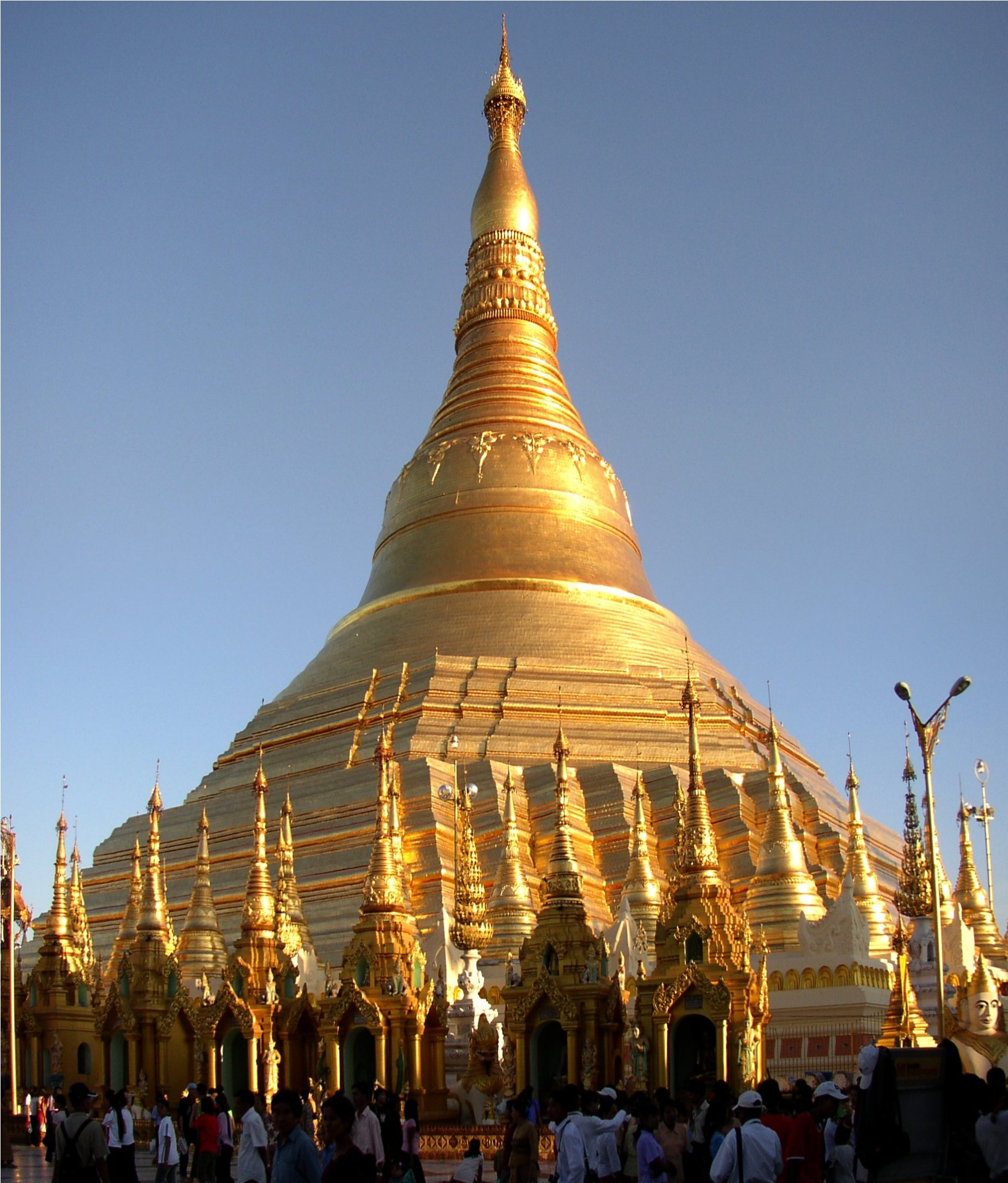
We visited Burma more than 30 years ago, before the earthquake that knocked over many of the ruins in the ancient city of Pagan. Aung San Suu Kyi, the Burmese activist and Nobel Peace Prize winner, had not yet been locked up. Nor were we, as travelers, fully aware of the political situation in the country. We visited on the suggestion of our neighbors, who urged us to go right away, "before the last vestige of the British Raj crumbles into the dust." They described flying from Rangoon to Mandalay on a low-flying DC-3. Looking out of the window they thought they saw fireworks and asked if there was some kind of festival or celebration. No, said the crew, "they're shooting at us." The territory between Rangoon and Mandalay was not under government control.
The country is stunningly beautiful and the people are peaceful and caring. I don't think we've ever felt as accepted and comfortable anywhere as we did on that trip to Burma. It is also now one of the poorest countries on earth. Burma went from "the rice basket of Asia" to abject poverty due to the destruction wrought by its military government. Any outside visitor is unimaginably rich when compared to the citizens of Burma. We were constantly aware of that. We could afford to travel to an "exotic" place whose people could never hope to scrape up the air fare for even one trip out.
Time was limited because it was only possible to stay in the country for a week. I have no idea what would have happened had we missed the deadline to get out, but it wasn't worth finding out. So we planned to visit the Burma Airlines office first thing after we checked into our hotel and reconfirm all of our reservations.
We stayed at the President Hotel for some reason. I think it might have been required to stay there for at least one night--the President was the government hotel. I can't find it on current maps, maybe it's gone or maybe I'm wrong about the name. If it has been torn down, good riddance.
Getting to the hotel was a trip. We rode in an old Nash. The import of cars had been banned for so long that the cars were straight out of old Al Capone movies. Cars with rumble seats. Plate glass windows. Crank starters (electric starters burn out and can't be replaced).
When we arrived, the room stank unbearably. The windows were screwed shut around a laboring air conditioner. I opened the ancient case to find a replaceable filter that had most likely not been changed since they bought the machine--it was covered with noxious jelly about 1/2 inch thick on both sides. Little air could get through. I did what I assume other tourists before us had done--I removed the filter and placed it on the floor in the bathroom. That's where it stayed while we were there. Nevermind that the air conditioner was being ruined for lack of a filter. When we left, I carefully replaced it. Who knows what the penalty might have been if the government found out.
The airline office was down the street. So off we went, clutching our passports and tickets. The office was something out of an old British movie--two story high ceilings, tall khaki-colored file cabinets against the walls, and an incredibly long, high, wide wooden counter that snaked the entire length of the building, crossed over in a U-turn, and came back on the other side. Behind the counter sat the clerks, reading, eating, not chatting among themselves (it probably wasn't allowed). There was a poster at the entrance announcing the time for our flight to Mandalay, but something was wrong, because it indicated that the flight would depart in the morning of the next day, which means we would lose much of our time in Rangoon.
Anyway, we figured we'd make any necessary adjustments. In English, we interrupted the reading of the closest clerk and asked where we could reconfirm a flight. "Reconfirm?" he asked. "Reconfirm," I said. He pointed down the counter and went back to his reading.
Going down about half way, there was another clerk reading. Interrupting this one, we asked again if we could reconfirm our flight to Mandalay. "Reconfirm?" he asked. "Reconfirm." I said. He pointed down the counter saying only "Mandalay."
Going all the way down to where the counter began its U-turn, again we asked: "Where can we confirm our flight to Mandalay??" "Reconfirm," he said. Progress at last. It wasn't a question. "Mandalay?" He asked to see the tickets and stared at them for a long time, then went to one of the file cabinets, opened it, and removed the second of many huge ledger books that were stacked on the top shelf. Each shelf had dozens of brown ledgers, bigger than any piece of paper I had ever seen. Imagine a newspaper sheet unfolded so you have two facing pages. Each ledger page was bigger than that.
He opened to a particular page. There were two lines of information already penciled in. We became the third and fourth line. He then closed the ledger book and put it back where it had been in the stack, closed the file cabinet doors and gave us back our tickets. "Are we reconfirmed," I asked? "Reconfirmed?" he said. Never mind.
As we later learned, there was no electronic communication between the airline office and the airport. What was written in those ledgers stayed in those ledgers. And of course, the time on the poster was wrong. When we got to the airport at the appointed hour, we simply had to wait. The plane came in from Pagan when it was ready to do so, the pilot ate a good and leisurely lunch, then it was time to fly us all to Mandalay. We had been the first to show up for the flight. Everyone else apparently knew how the system worked, but we were afraid to miss our flight so we showed up an hour early like the good and careful travelers we were.
While in Rangoon we visited the Schwedegon Pagoda, truly one of the wonders of the world. It is a huge space covered with gold-leaf spires, painted brightly, clean and beautiful. There were spaces for families to gather and pray. At the foot of the stairs leading up to it we were told we must leave our shoes, since footwear is of course forbidden. A number of thoughts went through my head at once, regrettably. Would our shoes be there when we came back? How would we find the spot we left them? In a country where most people don't have decent shoes, why wouldn't they be stolen? Would other tourists steal them? Where could I buy replacement shoes? And so forth. We left them, and on our return, hours later, they were still waiting for us. Try that in New York, Honolulu, or anywhere in the "advanced" countries of the world.

Please check out the link above or Google for more images of this sacred and beautiful place.
At the foot of the stairs gold beaters sell pounded flakes of gold leaf to be affixed to the pagodas and images. In this poorest of poor countries, people save up to buy gold to adorn the pagoda.
We also had time to visit Inya Lake. On one shore of this placid pond was a museum. Smaller rooms had military-issue portable blackboards as dividers, and some chairs, nothing more. Or should I say khaki-boards, everything was the same ugly color. The building itself was (like other buildings in Rangoon), slowly self-destructing. Bricks fell off the wall and just lay there. No one picked them up. No one fixed the wall. Inside, children were kicking around the bones of a dinosaur, long fallen apart. In other museums you get to look a the dinosaur, who would even think of handling its bones or letting kids play with them? No one cared. But what a fantastic experience for the kids! Real, not plastic dinosaurs to play with! Awesome.
On the lake was some kind of royal barge, kept in good condition. Nearby was the Inya Lake Hotel, built by the Soviets, so it was a very classy place.
Back in the city center, I just had to have some sugar cane juice. I loved to drink the stuff in Singapore, and I could taste it, I wanted it, I had to have it. It should be safe to drink, too. Unfortunately, in my greed I forgot about the ice that the vendor added to the glass. You know what the consequences of that would be.
I think we passed up the chicken in the restaurant that night. The chickens hanging in the window did not appear to have lead good enough chicken lives. We were tired after a wonderful day exploring Rangoon. That was sustenance enough. On the way back to the hotel we saw people in an alley refilling and resealing ancient glass CocaCola bottles. With something. Better not to think of that and just replay the images of a day in magical, mystical Rangoon.
Thursday, September 27, 2007
The rest of the story: high-level intimidation at Kauai meeting you didn't see on TV
For television and print news reporters, the Sept. 20 Superferry meeting on Kauai with Governor Lingle was great stuff. Rife with conflict, sure to lead to many weeks' worth of letters to the editor. Conflict attracts eyeballs on TV and builds single-copy sales of the daily papers.
I've spoken to many people who take a hard position one way or another on the meeting (and on other aspects of the Superferry fiasco, of course). From personal comments and from reading letters to the editor, it seems that there are many who hold opinions on the conduct or tone of the meeting.
Now, the cameras didn't show you the papers handed out before the meeting. If reporters had done an honest job of it, they would have gone beyond the spectacle for a closer look. I wasn't there but I received a copy of the handout today (thanks to journalist Joan Conrow, whose article in yesterday's Honolulu Weekly covered this issue also).
Kauai residents were disrespected at least two ways at the meeting.
 The first affront was the handout, a specially prepared document threatening all sorts of dire penalties including confiscation of property, jail and prison time, huge fines, and even the intervention of Child Protective Services to take away any children involved in protest activity. Download a scan of the document here, or an OCR copy here.
They were dissed again when Lingle informed them that regardless of what they said, it didn't matter. From Joan's article:
Residents were expecting to discuss the ferry's return with Lingle, but when she stated that the decision had already been made, the crowd erupted into loud boos...
Also contributing to the put down were the Superferry employees brought over from Oahu to stack what should have been a Kauai residents' meeting. That tactic (stacking the meeting with supporters) might work during an election campaign, but it backfired on Kauai.
And finally, of course, the media delivered mostly one-sided coverage, showing only loud protest and skipping the sordid details of intimidation and disrespect.
Readers might form a new opinion of the meeting if they were informed that those attending were either intimidated beforehand or goaded into becoming fodder for a bloodthirsty media.
Update: I somehow missed that the papers did mention threats of arrest and the governor's "unified command" earlier, before the paper distributed at the meeting. In fact, the threats were mentioned in a front-page story in the Honolulu Advertiser on September 13.
Joan's communications with Ian Lind are on his blog, still the best place for Superferry reporting I've found on the Web. Her blog is KauaiEclectic, go visit. Also read here how the Advertiser, perhaps wanting to control the slant of its coverage of the Superferry, let her go as a stringer. So much for fair and balanced in Oahu media.
Yup, for the rest of the story, you need to search the Web.
Tuesday, September 25, 2007
High level meddling in Superferry affair
It wasn't surprising to read that 150 Superferry employees and supporters were brought over from Oahu to cheer for Lingle during her confrontation on Kauai last week. That tactic has been used before in Hawaii.
I recall attending a debate between gubernatorial candidates Mazie Hirono and Linda Lingle sponsored by AARP. It appeared that Lingle supporters arrived early and took seats up front and along a window wall. Whenever Lingle said something, they began applauding and cheering, and of course, the crowd followed suit, the way they do at any political speech here or in Washington. Of course, news reports would reflect the outpouring of support without mentioning that it might be manufactured.
With PR savvy like that, it's no wonder she got elected. It's also a reason that I question assumptions of popularity. Popularity can be manufactured.
One unrelated example: a special meeting of the Hawaii Medical Service Association in 1998 was reported to have been stuffed with HMSA employees.
Members attending a special meeting of the Hawaii Medical Service Association have approved, in a series of sometimes raucous voice votes, the transfer of powers from the members to the board of directors.
The outcome, as described in the article, was that members no longer have a say in their own "mutual benefit society." That's how meeting stuffing is used. It's always unfair and underhanded.
Both HMSA and the Superferry have been outed. At least we know what they were up to.
But back to the Superferry.
Meeting stuffing is only one aspect of high-level meddling. A Youtube video includes this fuzzy slide that shows how the whale issue has allegedly been entangled by the Superferry company.
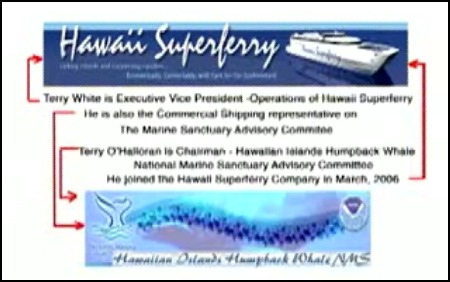
The video is interesting enough that I'll include it here for your clicking pleasure. Please note that it is dated January 9, 2007, and so predates the current protest activity.
Google reveals that many Superferry videos have been posted on Youtube. The protests have been well documented. Have fun browsing. Isn't the Internet wonderful? You can see and evaluate events with your own eyes instead of being fed articles and opinion as vetted by daily newspapers.
Lingle threatens children, parents, alienates community, to protect Superferry investors
...could be subject to an investigation by the Department of Human Services.
if we allow our children to protest this invasion, and exercise their own constitutional right to free speech, the government will not only arrest them, but will take our children away from us and charge us with child abuse.
"People cannot choose which laws they will obey and which ones they will not because of their personal views," [Attorney General Mark Bennett, Star-Bulletin 9/13/2007]
Never mind that courts may decide that the state broke the law by skipping an environmental assessment or environmental impact statement.
From the Garden Island article:
Jimmy Trujillo, spokesman for Hui-R, said he was in the water last month because "I was compelled to do what is necessary to protect the laws of this state."
Many others agreed, saying it was the Superferry that was breaking state and federal laws, not them.
Lingle's threat to have children taken by CPS should be disavowed by the Department of Human Services. CPS is not a political weapon to be used against anyone.
The state also issued guidelines intended to intimidate protestors of any age. Imagine that just for floating around in the ocean in your innertube you could be charged with "terroristic threatening and assault against a police officer." That's a tactic that Lingle's mentor, George W. Bush, could admire ("Linda, you're doing a heck of a job!").
The tactic makes no friends for Lingle. In an article, ACLU questions timing of protest guidelines, there's a reaction to these planned gestapo tactics:
...But analysts such as ACLU-Hawai‘i Director Lois Perrin and Ira Rohter, a professor of political science at the University of Hawai‘i, question the motives behind the guidelines.
Rohter questioned the context within which the government is disseminating its “summary of consequences,” calling it less informative than it is self-serving.
“It’s not a veiled threat, it’s an explicit one,” he said. “This is crowd-control management.”
In addition to stating the potential criminal charges for demonstrating dissent against the Superferry, the list includes the potential penalties for such related crimes as terroristic threatening and assault against a police officer, both of which are punishable by up to five years imprisonment and a $10,000 fine.
Just as George W. Bush is unwilling to use negotiation and prefers to bully opponents with extreme force, Linda Lingle is planning arrests over reconciliation. The way the state has handled the entire Superferry affair calls for making amends, not police brutality.
Nor does police action work. In the end, it only solidifies opposition. Besides, as the protests have shown, the people will not be cowed by fear. Neighbor Islanders in particular have found a calling in defending against the invasion of alien bullies from Oahu.
Update: It's worth adding this snippet from a post on the Kauaieclectic blog (thanks to ilind.net for pointing to this article on his own blog, one of the best places to go for Superferry information):
The governor’s reaction to the Kauai meeting only serves to show how totally out of touch she is with the situation here. I’m not a rude girl myself, and Andy Parx really didn’t need to yell, “F--- you,” (the only profanity I heard) but truly, what did Lingle expect? She was facing a crowd that has never, ever been consulted about the ferry, whose elected officials (well, some of them anyway, the ones with guts and brains) had begged her to let the legal process run its course, and whose members had already experienced two days of land and sea confrontation with law enforcement that resulted in numerous arrests.
And what about Lingle's own message? It was not one of peace, reconciliation, mediation, compromise or respect. Lingle came solely to lecture the crowd on her planned crackdown against dissent, and to threaten everyone with fines, federal prison sentences and even investigations by Child Protective Services if they dared step out of line.
Did she really think, at this point in the game, that 1,000 people (we won’t count the 150 Superferry employees and supporters brought over from Oahu) who took the time to drive into Lihue were going to politely listen to her propaganda, and then meekly obey?
Maybe Lingle needs to leave the deadness of the city and visit the real world more often.
But even if Lingle didn’t get the message, Superferry did. Kauai is a scrappy place, and now a number of its residents feel sufficiently empowered to actively resist.
To paraphrase Edward R. Murrow, We will not be driven by fear...we might remember that we are not descended from fearful men, not from men who feared to write, to speak, to associate and to defend worthy causes.
Friday, September 21, 2007
Could Superferry protests sink the myth of Lingle's popularity?
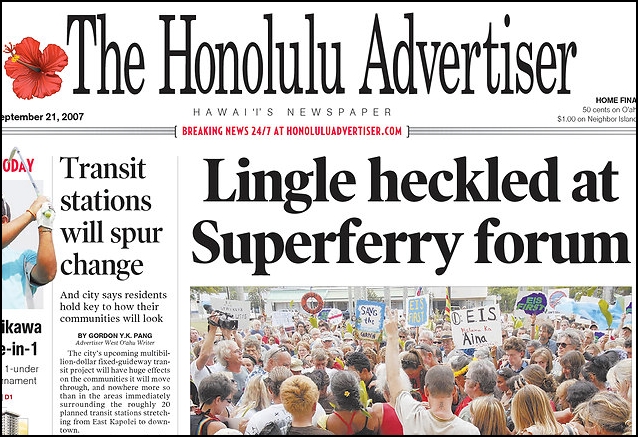 Linda Lingle's image as a popular governor may be crumbling in the face of growing Superferry protests. According to press reports, about a thousand people, the majority of whom objected to the way her administration is pushing the boat on them against community wishes and before an Environmental Impact Statement is completed, booed and heckled throughout the meeting.
That's quite a crowd, and for each person who showed up there are likely dozens who are discussing the issue at home, in bars, or at work. Lingle has inserted herself into the controversy, but on the wrong side.
What about her popularity? She has done well in elections, but that could be attributed to the weak opponents the Democrats have run against her (Randy who?).
She has withheld money from badly needed social services and refused to  release money for pedestrian safety that the Legislature has apportioned. Those things rile advocates, but the Superferry issue has hit a nerve among ordinary citizens. Perhaps it is something like the "last straw."
Should the state move against adolescents or their parents at a future showdown with the big ship, anti-Lingle sentiment can only grow and spread. Perhaps the Coast Guard can clear the water, but Lingle has to clear the air.
She is standing on unfirm ground. Her party is too weak to sustain her. Republicans have been losing elections or defecting from the party (Mike Gabbard). You can count Senate Republicans on the fingers of one hand. Were she truly popular, having coattails would be one indication. Only two senators stuck with her by opposing override votes this past session, the rest voted with the Democrats.
All that is inside page stuff. The Superferry makes page one, and how she handles this issue could shatter her image and her chances for moving from Washington Place to Washington DC next election.
Should Lingle launch the ferry into a sea of protests next week, that could blow the myth of her popularity out of the water and sink her chances at the next election (sorry, sorry).
Thursday, September 20, 2007
Microsoft stealth patches can melt your laptop
Two weeks ago I arrived at a meeting over at the State Capitol to find that my beloved Tablet PC had been left on inside its padded case. It was very hot. The screen was scrambled and I figured it was a goner.
 Of course, I kicked myself for being so stupid as to not having checked properly to see that it was off before rushing out of the house. My brain was simultaneously processing where I will get the money to replace what has become my constant little companion.
But guess what—I learned today that this is happening to other people also! And it's not their fault! It seems that it can happen because Microsoft has been caught updating the software in your computer even without your permission. If you have a laptop running a Microsoft OS, you should at least know about this.
Basically, even if you have told it not to, your laptop can update its software from the Microsoft site. To do that, it can awaken if it is in standby mode and tucked away inside its padded case. It doesn't turn off again, though. So your computer could bake in there. At least, when you take it out to use it, you could find the battery dead.
Even if the laptop is not in its case, you might find the battery dead unexpectedly and of course, just when you need to use it (my wife found her battery inexplicably run down one day this week).
Not only can this be hazardous to the health of your laptop, but upgrading software without your permission appears to be a violation of Microsoft's End User License Agreement (EULA).
The situation is more fully described in this post from the blog Nynaeve:
I am not a happy camper.
Today, I got in to work and unpacked my laptop from my laptop bag and discovered that it had gone into hibernation due to a critically low battery event. That was fairly strange, because last night I had suspended my laptop (fully charged) and placed it into my laptop bag. Somehow, it managed to consume a full battery charge between my putting it into my bag last night, and my getting in to work.
This is obviously not good, because it meant that the laptop had to have been powered on while in my laptop bag for it to have possibly used that much battery power (a night in suspend is a drop in the bucket as far as battery life is concerned). Let me tell you a thing or two about laptop bags: they’re typically padded (in other words, also typically insulated to a degree) and generally don’t have a whole lot of ventilation potential designed into them, at least as far as laptop compartments go. Running a laptop in a laptop bag for a protracted period of time is a bad thing, that’s for certain.
Given this, I was not all that happy to discover that my laptop had indeed been resumed and had been running overnight in my laptop bag until the battery got low enough for it to go into emergency hibernate mode. (Fortunately, it appears to have sustained no permanent damage from this event. This time….)
My Tablet PC survived also, after I restored a lot of settings and checked the hard disk.
For those concerned, the comments to the above blog post have several suggestions on what to do about this. Probably Google will reveal much more.
Honolulu Advertiser is award finalist for Wonderful World web project
I didn't see a mention in the paper itself, but the Honolulu Advertiser is listed as one of the finalists in the Outstanding Use of Digital Media category of the 2007 Online Journalism Awards announced by the Online News Association on September 11.
 The web page that won their attention is the "Wonderful World" page created in conjunction with the release of the hit album featuring the late Israel Kamakawiwo‘ole's voice against an orchestral background.
The web page is outstandingly attractive and well designed, and of course, there is the music. Click and you can hear the album. For Mainlanders this must be a special treat.
Hope this wins. I think it should.
Tuesday, September 18, 2007
Did Air Force Thunderbirds endanger residents by flying over homes instead of over water?
I love to watch precision flying as much as the next guy. I've always wanted to fly, even a small plane.
The Air Force Thunderbirds did their thing last week over the restricted area off Waikiki, but of course they didn't stay just in that small area.
Several of us were standing on King Street watching the planes fly low from East to West over the ridge line, including the Manoa Valley and the nearby hills. It looked from street level as though they were lower than the tops of the hills—about mid-way.
What we talked about though, was what if one of those jets, loaded with jet fuel, ran into a problem, and crashed into a densely populated area at 550 mph?
It's not very likely, of course, but why could they not have made a right turn and returned over the water instead of a left turn to fly back over the ridgeline? After all, the air show was an optional thing, there was no necessity that those planes fly over those houses.
So I emailed the FAA and was referred to the local office. I called and learned that the jets are allowed to fly over homes as long as they do it 500 feet or higher.
Those are noisy machines. Being 500 feet from one is no pleasure. But again, why could they not return over the water?
There is supposed to be an air show over Kaneohe, I don't know the details. Should residents be exposed to noise and risk there also?
I was told that historically the number of accidents has been low at these air shows, the last one was in Idaho. I Googled that one:
An Air Force F-16C plowing into the ground before 85-thousand stunned spectators. The pilot maneuvered the jet into a dive and steered toward the crowd. Then seemed to suffer engine failure when he pilot tried to pull up, witnesses said.
Here is a video of the Idaho crash. It's pretty horrible to watch, and thank goodness it was not near a populated area:
Looking beyond air shows, F-16 jets have their share of accidents. You don't want them flying over your home if they don't need to. We're not at war here, this was just an entertainment.
The dailies went gaga over the show and aside from mentioning the shock and awe among humans, dogs and elephants, so far I haven't seen any questions about the risks or why the planes didn't return over the water.
I know that the FAA worked with the Air Force to ensure that the air show would be conducted within the rules, and that's a good thing, but maybe we need one more rule.
If any readers have thoughts on this or any suggestions, please let me know. Meantime, I'm going to see if our congresspeople might weigh in on this (I'm not holding my breath, though).
Disappeared news: starting in February, you will need permission from the United States Government to travel
The Transportation Safety Administration is about to hold public hearings on a system that will require the TSA to clear you to fly whenever you or an airline tries to print a boarding pass. Yes, we've arrived at that point.
This rule proposes to allow TSA to ... receive passenger and certain non-traveler information, conduct watch list matching ... and transmit boarding pass printing instructions back to aircraft operators.
This Thursday, September 20, TSA will hold public hearings on their ¨Secure Flight Plan,¨ which will put the American public, even on domestic flights, in the same position that ancient Japanese commoners found themselves—unable to leave the place they lived unless they had an approved passport issued by the feudal government.
Details are in this article: The Nightmare of DHS´s *Secure Flight* [Hat tip to the Progressive Review News].
Yes, the system will control domestic flights, and no, you can't find out if you're in it or why.
The article describes how to file comments in the docket for this proposal. In short, you can go to the web page and enter docket number TSA-2007-28572.
I've wondered if filing a comment could put you on the TSA list. No, ignore that. Just file your comments.
Also from today's Progressive Review News:
Fascism doesn't start with concentration camps...That's where it ends. -- Jon Bishop
We need to somehow stop all this before we get to that point.
Monday, September 17, 2007
Health care panel covered only by Ka Leo
The universal health care session held Saturday at the UH Architecture Auditorium featuring a panel that included presidential candidate Dennis Kucinich.
It seemed to have escaped the attention of our daily papers. But Ka Leo, the UH student newspaper, did cover it and you can read their article here.
Universal health care might scare commercial newspapers—after all, they get lots of ad revenue from the industries that would be eliminated if we all had government-paid health care.
Just disappeared news or censorship? NPR's Coqui Frog program can't be heard so far on HPR
Over at hunterbishop.com you can learn about a brewing controversy over why Hawaii Public Radio does not air a National Public Radio program on the coqui frog invasion of Hawaii.
While the program covers both sides of the issue, it does appear to be sympathetic to the loud little pest. There's a theme done in a cute little frog voice that could make you love the little critter. The frog noise that drives people crazy appears rather innocuous on the program soundtrack. Due to audio compression used in preparing the program you won't be deafened by listening to it.
Without taking a position on why this is not aired on HPR, it's worth bringing this program to Hawaii somehow. Please click on the above link to learn about the controversy, or click here to listen to or download the program itself (25 minutes, 23.1 Mbytes).
Update: ok, I wasn't too happy with the way I left this. HPR pays for NPR programs, probably there is some cost for this. They don't run programs from this producer, so probably there is paperwork and so forth to get it. And some other program would have to give up 1/2 hour to air this long piece.
Finally, the folks alleging censorship appear in the program and obviously want their position to be heard in Hawaii.
Having said all that, it would be great if more people could hear the program. At least you can, simply by clicking on the link above.
Maybe HPR could just run a news item about the program being produced and refer listeners to the website. That's a poor suggestion, but it's all I can think of.
Disappeared news for sure: full text of Bin Laden's speech
Like, where is it? Just try and find it. American corporate media won't go near it.
Danny Schecter, the News Dissector, found a translation and blogs about it today.
The text is on Wolf Pangloss's blog, and there you can read that Wolf detects in it signs that Bin Laden has been beaten.
I won't comment further, check out Danny's article above. Also please consider supporting the News Dissector and mediachannel.org, they are in need of funds to cover expenses of the operation. You could not support a more worthwhile media project than the News Dissector.
You can petition the Coast Guard on the "security zone" issue
Unbeknownst to most people, over at a government website there is a place where people can file official comments on the security zone that the Coast Guard intends to apply should the Superferry get started again.
It's like a big blog, really, except more formal. You have to fill things out, but in the end, you can personally speak to the powers-that-be and put your opinion on record. The deadline is September 26. Best not to wait until that date, though, because they might close comments some time during that day Eastern Daylight Time.
First thing might be to look at some of the comments that have been filed. To do that, go to:
http://dms.dot.gov/search/searchResultsSimple.cfm?numberValue=29153&searchType=docket
which is the docket page for comments. Comments will be read and supposedly weighed by the Coast Guard. You can read through a few to see how they are done and what others are saying.
You'll see that many are completely informal. While that's ok, it's better to write a reasoned argument. It's ok to steal bits and pieces from things you've read, or to quote others. But the better you do the more influence your comment might have. Just stating an opinion is not as good as providing your reasoning. The best comments are written like a formal letter to the Coast Guard. They like formality.
When you're ready to post your comment, go here and type in 29153, which is the docket number. You can upload a file if you prefer, or just type comments into the little box that will appear.
There's more on this process and on a petition on the same subject over on the Island Breath blog.
For alternative news and views from the Garden Isle, check out the main Island Breath website.
Bush's mercenary army to be kicked out of Iraq? Well, not likely...
America has two armies in Iraq: one is the official one, subject to US military rules and accountable to military justice, and another one, fully armed but composed of civilian contractors and completely outside the system. Today, following an incident in which Iraqi civilians were killed, the Iraqi government moved to expel the largest of these contractors, Blackwater USA.
Private contractors including Blackwater are reported to number approximately the same as the "official" military, and without their assistance US forces would likely be unable to survive against insurgent forces.
The presence of so many visible, aggressive Western security contractors has angered many Iraqis, who consider them a mercenary force that runs roughshod over people in their own country.
...
The Iraqi government announced Monday it was ordering Blackwater USA, the security firm that protects U.S. diplomats, to leave the country after what it said was the fatal shooting of eight Iraqi civilians following a car bomb attack against a State Department convoy.
The order by the Interior Ministry, if carried out, would deal a severe blow to U.S. government operations in Iraq by stripping diplomats, engineers, reconstruction officials and others of their security protection. [AP Sept. 17, 2007]
Trust the AP to report only part of the story, omitting a full statement of how deeply these contractors are involved in the war.
Will Blackwater actually get kicked out? Probably not. The US will certainly move to bring the errant Interior Minister around to a different point of view.
It started with Donald Rumsfeld
Donald Rumsfeld put a long-cherished program into effect in Iraq: the privatization and outsourcing of military and policing. He did this by employing civilian contractors such as Blackwater. It's no stretch calling Blackwater a "mercenary army"—it draws its personnel from several countries, according to Wikipedia:
For work in Iraq, Blackwater has drawn contractors from their international pool of professionals, a database containing "21,000 former Special Forces troops, soldiers, and retired law enforcement agents," overall. For instance, Gary Jackson, the firm's president, has confirmed that Bosnians, Filipinos, and Chileans (many trained under Augusto Pinochet), "have been hired for tasks ranging from airport security to protecting Paul Bremer, the head of the Coalition Provisional Authority."
Although the Iraqi government would like to hold these folks to account, it probably can't. According to a decree issued 2004 by the Coalition Provisional Authority, security contractors are immune from Iraqi prosecution. Nor will the US take action, most likely, or at least no action that will remove Blackwater from the scene:
American officials refused to explain the legal authority under which Blackwater operates in Iraq or say whether the company was complying with the [Iraqi] order. It also was unclear whether the contractors involved in the shooting were still in Iraq. [AP]
From the Washington Post:
"The security company contractors opened fire randomly on the civilians," [Brig. Gen. Abdul-Karim Khalaf, an Interior Ministry spokesman] said. "We consider this act a crime."
Early Monday, Iraqi state television reported that Prime Minister Nouri al-Maliki had condemned the "criminal operation" in Mansour and said he would "punish" the private security company and shut down its operations.
A Washington Post employee in the area at the time of the shooting witnessed security company helicopters firing into the streets near Nisoor Square in Mansour. Witnesses said they saw dead and wounded people on the pavement.
It will be interesting to see if the mainstream media report in detail on the role these contractors have been playing in the Iraq (and Afghanistan) war. Many if not most of their readers may not even be aware that contractors are operating in Iraq.
Saturday, September 15, 2007
Get Lingle to release withheld funds as precondition for special session
Governor Linda Lingle is considering calling a special session of the Hawaii State Legislature so that a law could be passed allowing the Superferry to operate while an environmental assessment is to be completed.
I (and many others, I'm sure) don't think it's the right thing to do. There should have been an EIS in the first place, and if the Superferry is so darn safe for whales etc. it would have passed easily and be making money for its investors today.
But if the Legislature is considering a special session, I heard a great suggestion today--legislators should first exact a concession from the governor.
Before even calling a session, the governor must agree to release the $3 million that the Legislature apportioned for the pedestrian safety law. That's right, cash up front or no special session.
Is that fair? You bet it is. The governor peevishly refused to release that money when the Legislature overrode her veto of the law. As a result, most likely some people will needlessly be killed in crosswalks. It's no laughing matter. Nor is her continued support of big business at the expense of ordinary people.
If she really feels contrite, there is other money not yet released for needed social services that she might let go of as a goodwill gesture.
The Legislature should still weigh the pros and cons of letting the Superferry get away with breaking the law before giving them a free pass. I'm not saying that for $3 million anyone should cave in on that. We still expect a critical debate on the issue should there be a special session. They should not buck the courts and the objections of so many people and county councils. Objections to the way the ferry project has been done are strong and should not be ignored.
Wednesday, September 12, 2007
What's next for Hawaii's schools? Metal detectors?
Proposed new changes to Chapter 19, the Department of Education's disciplinary rules, that are almost certain to be adopted, will give the few bad ones a whole new universe of ways to bully and intimidate. Students who bullied before will be able to take advantage of these new rules to move into even higher levels of intimidation. And of course, others will suffer from this bumbling campaign of our Board of Education.
According to an article in today's Hawaii Tribune-Herald by Nancy Cook Lauer (not yet on the web), not only would drug-sniffing dogs be introduced in schools, but searches of student lockers with or without cause would be permitted.
And get this: strip searches, too! According to the article, students may be required to remove coats, jackets or baggy pants.
You can bet this will be abused. Imagine a teacher asking a student to remove his/her pants in front of class. Or one student setting up another to be strip searched. And the article points out:
"I could harass a student by checking their locker everyday," said [Board of Education] member Garrett Toguchi.
Adults are giving them a way to have lots of fun. In fact, instead of reducing bullying, the new rules could make whole new ways of intimidation and revenge possible. Imagine: "gimme your lunch money or there will be a ton of pot pushed through the vent in your locker this afternoon."
The proposed new disciplinary rules also cover "cyberbullying" even if no school computer is involved, which is sure to run into constitutional challenges. It would also allow schools to ban items from cell phones to rubber bands (which can be shot at other students--we used to do that when I was a kid).
From the article:
The American Civil Liberties Union, the Drug Policy Forum of Hawaii, Drug Policy Coordinating Council and a University of Hawaii sociology professor spoke in opposition. They said the rules may not help, may make things worse and send a message to students that they're not to be trusted.
"Drug-sniffing dogs is an untested, unscientifically sound program," said Katherine Irwin, associate professor of sociology at the University of Hawaii Manoa campus.
ACLU Hawaii attorney Laurie Temple said the cyberbullying rules violate free speech rights, the exceptions to the strip searching rules, along with the locker searches and drug-sniffing dogs, could violate Fourth Amendment protections against searches and seizures and the rules in general, because they are vague, will threaten Fourteenth Amendment due process rights.
Dennis Kucinich on Hawaii Public Radio Town Square Thursday 5-6 pm
Yes, you have a chance to call in to the program and actually speak to a real live presidential candidate.
Congressman Dennis Kucinich will be on Town Square, hosted by Beth-Ann Kozlovich, on Thursday, September 13, 2007 from 5-6 p.m. Tune to 89.3FM or stream on your computer from the Hawaii Public Radio web page.
Call in to the station at 941-3689 on Oahu or toll-free from Neighbor Islands at 1 877 941-3689.
Tuesday, September 11, 2007
Will Governor Lingle invite a citizen to planned disaster preparedness meeting?
Maj. Gen. Robert Lee, state adjutant general, responded to only one of Doug Carlson's questions on the Advertiser's Hot Seat session today. On whether the heretofore secret meetings convened by the governor to discuss Hawaii's disaster preparedness would be open to the public, actually, he didn't answer it exactly. He suggested that Doug request an invite to the meeting from the Governor:
Comment from: Commaaina [Visitor]
As co-chair of the Comprehensive Communications Review Committee, which was created to assess the communications breakdown after the October 15th earthquakes and to recommend improvements, will you today reveal details of the agenda for the Committee's September 27th meeting? It currently reads only:"Group discussion on status of final committee recommendations and
implementation status of those recommendations (by each organization)."Details would help the public understand the scope of your upcoming meeting. One item worth covering: How many broadcast stations have added backup generators since October that will allow them to remain on the air during a power blackout? Which are they, and which stations have not added a backup capability? Also, is the public invited to the 9/27 meeting, and what is its location?
Thank you.
+++++++++++++
Aloha Commaina,
We are still working on the agenda for the Sep 27 meeting. Please contact the Governor's office to request an invite to the meeting.
I'd be curious to learn her reply (if any).
The Legislature held hearings that were completely open to the public, but so far the governor's meetings have been shrouded in secrecy. There's no law that requires them to be open.
But don't you agree they should be? We have very little information on whether our state has done anything at all to improve our safety in the event of any disaster befalling the islands.
Life after Advertiser: Jan TenBruggencate unfettered
If you miss Jan TenBruggencate's science writing in the Advertiser, check out his blog Raising Islands--Hawai'i science and environment. I've added him in to the live blogroll over on the left column of Disappeared News.
I'm glad that his writing will still be available to faithful readers. Unfettered by deadlines or word counts, we can only expect more and better!
Superferry is Hawaii's second sumo match this year
Hawaii seems to plan its transportation projects by staging wrestling matches. The match that resulted in Mufi's train being re-routed through Salt Lake impressed me as great sumo at the time. A pretty low-ranking division, to be sure, especially when Councilman Romy Cachola unexpectedly pushed all opponents out of the ring to get the train routed his way (nevermind whether it's good for UH students, airport travelers, etc.).
Just push and shove and you can win at transportation planning in Hawaii.
Maybe the ongoing fight over the Superferry is just another sumo match. Again, the governor's maneuver to avoid the EIS requirement failed and she was pushed so far out of the ring that her voice was only a distant squeak afterwards. She seems to be pretty much sidelined since the opening round concluded.
But like a real sumo tournament, there's big money involved, so for sure the match isn't over yet.
Our state Department of Transportation fell in the mud (or is it a pothole?) this time, to add to the embarrassment it earned recently by claiming that it is actually spending $18 million on pedestrian safety so that Lingle doesn't need to release the $3 million apportioned by the Legislature this session.
Funny how the DOT isn't an effective player in the transportation game in Hawaii. Remember how badly they handled the Van Cam? It might have worked, saving lives, 'cept for the way DOT did it.
 It looks like power has returned to the people for the moment, and folks are enjoying a short and well-deserved dance of victory.
To understand more about Hawaii's transit planning methodology, see this Wikipedia article.
For ongoing alternative news about the Superferry, check in regularly at ilind.net.
Should Pacific Business News worry or laugh at the Advertiser's new Business Today section?
In fact, the first two issues raise the question, "Why?" Ok, I let yesterday's first attempt go. I like to give things a second chance, whether it's a new restaurant that hasn't got its act together or even an innovation in business news coverage.
Today was their second chance, and maybe they need three. Could it be that with reduced staff the Advertiser is simply feeling challenged to get its work done?
I found much of the information to be bland. As a former business executive I can say that I found little that would be of any use or interest to me.
Much of the information concerned distant places rather than Hawaii. I'm glad that the Big Apple is launching a program aimed at foreign visitors, but so what?
Nice article about Limahui Garden on Kauai. It would have fit perfectly in the travel section. It was instead given about 1 2/3 pages in this new "business" section. Nice article, wrong section.
More disappointing was an "interview" with Peter Savio that is really a paid ad. I wrote earlier about the Advertiser running advertisements with bylines as though they were written by a reporter, here and here. This has no byline, but there is a strategically placed hibiscus on the page. The hibiscus is the recognizable mark of the Advertiser and appears throughout the paper. Now, this hibiscus is different, but you might not catch that. Is it an ad or is it an article? One clue: it doesn't appear as a news article on the Advertiser web page (the Kauai garden piece does).
Moving to today, over breakfast we both grabbed for the section at the same time. The headline is Senior advisor loses license. Did Linda Smith run into some kind of trouble? Is Karl Rove back? No, the article is about an investment advisor who has defrauded elderly clients. On the web the headline is Hawaii financial adviser loses license, which is much better. And it is business news, not travel news. But the article about the shortage of engineers in the oil and gas business and A&B's investments are Mainland, as are most of the minor articles—iPhone, Intel, Disney. Actually, there is some local news creeping in, maybe there's hope.
Today the full-page ad by BlueEarth Biofuels is identified as "An Advertising Feature," which is better. Maybe soon they'll be able to admit that it is really a "Paid Advertisement."
This section can only get better.
While it's ok to experiment, unless it will have a life of its own outside the newspaper, I would hope they'd try rotating the pages back to fit inside the rest so it's convenient for us readers.
If this section is supposed to compete stand-alone with Pacific Business News, PBN has nothing at all to worry about so far.
Monday, September 10, 2007
Recalled toys list and relation to our failed trade policies
Why is this happening? Our trade policies promote relocation to low wage countries of production of goods once made here. The same trade deals put limits on the safety standards we can require for imports and how much we can inspect imports. This is not just about China, but about our failed trade policies that prioritize the volume of trade over your children's safety or fair working conditions.
They also have a downloadable report, Trade Deficit in Food Safety. You may want to at least read a summary of this report. A snippet from the Public Citizen description:
Today, nearly $65 billion in food goods are imported into the United States annually – nearly double the value imported when the North American Free Trade Agreement (NAFTA) and World Trade Organization (WTO) went into effect in the mid-1990s. Contrary to what consumers believe, the vast majority of imported foods that end up on the dinner plates of U.S. consumers is unexamined and untested.

The Food and Drug Administration (FDA) estimates that it will only conduct border inspections on .6 percent of the food that it regulates (vegetables, fruit, seafood, grains, dairy and animal feed) at the border in 2007 - down from an already disconcerting eight percent prior to NAFTA and WTO. FDA data makes clear that Americans are three times more likely to be exposed to dangerous pesticide residues on imported foods than on domestic foods. Only 11 percent of beef, pork and chicken imported so far in 2007 has been inspected at the border by the U.S. Department of Agriculture (USDA).
Emphasis is from the original article.
As "free trade" agreements are pressed with additional countries, the situation for consumers can only be expected to grow worse.
The toy recalls and the adulterated food products from China are hot news now, but expect them to disappear from media radar very quickly after awhile. Or depending on what happens in Iran or with Paris Hilton. If you are concerned, think of how to bring the issue to life again as we go into the coming national election cycle.
And meanwhile, this is a reminder to buy locally where possible and to patronize restaurants and stores that buy their foodstuffs locally.
Sunday, September 09, 2007
Judge David Ezra to hear case Monday challenging legality of a Hawaii special ed law
Hawaii seems to have jumped the gun, passing a special education law before it had authority to do so under the federal Individuals with Disabilities Education Act (IDEA). At a hearing tomorrow, Judge David Ezra will hear a challenge to that law.
The law imposes an onerous 90-day statute of limitations that traps parents who wish to seek private placement for their special needs students -- usually in cases where the public school is unable or unwilling to provide the needed services.
The short statute of limitations and a small pool of attorneys in Hawaii willing to take up these cases means that many children simply lose out. The consequences for their future lives and careers are heavy.
The hearing is open to the public and dozens of concerned parents are expected to attend. You can also, especially if you would like to support parents in their ongoing fight to get services from a reluctant Department of Education.
It will be in Judge Ezra's courtroom on the 4th floor of the Federal Courthouse starting at 9 a.m. on Monday September 10, 2007. Plan to be there a little early since there is security screening. You might leave your cellphone and PDA in your car because they throw them in a file cabinet if you bring them through security.
Latest from China: worms and moths in chocolates
American companies that fired their quality assurance staff when they shifted manufacturing to China had better go out and hire them back.
I don't expect a sudden movement to re-open shuttered factories in the USA. Companies know a good thing (i.e., lush CEO profits) when they see them, so they won't give up outsource to China and elsewhere.
If we, as consumers, continue to purchase from these companies we'll be enabling their behavior. The message for us (and we could learn from Japan) is to insist on quality.
Ok, you want your $24 oscillating stand fan from Longs. Go ahead, buy it. In fact, there's no alternative. The $24 oscillating stand fan made in China has driven anything else off the market.
Somehow, though, we have to turn this around. We're pawns in our own economy who exist, it seems, only to help fat corporate cats get even fatter.
Saturday, September 08, 2007
TV music
I love TV music. Not only the themes from the popular shows I used to watch as a kid, but the incidental music you hear throughout a program. Take away the music and things get dull real fast, for me at least.
The theme from M*A*S*H can stick in my head all day if I hear it just once.
When I was a kid I noticed that anyone famous has their own personal theme. Dr. Kildare's appearance in the OR was heralded by his theme music. He didn't seem to go anywhere without it. Same for Bret Maverick. When Maverick spoofed Gunsmoke on one particular show (Gun-Shy, 1959), they also had to spoof Gunsmoke's theme music. When a politician comes on stage on any Comedy Central program, there's theme music.
In contrast, when I have had occasion to be wheeled into an operating room, I lie there on my back watching the ceiling lights fly by, but the only sound is the doors creaking open automatically. No music for me, and nothing at all when the doctor enters the room. Clearly, I'm not famous and neither is he.
(sigh)
Have you ever wanted to know where a particular musical piece you've just heard came from, or who wrote it? Click on over to Heard on TV.
(Thanks for this and lots more valuable information from Ex Libris: an E-Zine for Librarians and Other Information Junkies <http://marylaine.com/exlibris/>)
A do-it-yourself Christmas, because Mattel didn't do it themselves
Whatever happened to Mattel's QA department? Didn't they test samples of the toys that they are having others make for them?
The answer is obvious. They failed miserably and endangered their customers.
It doesn't matter whether the factories are located in Kentucky or China, companies are supposed to have their own Quality Assurance testing.
Apparently the US Consumer Product Safety Commission is considering an investigation into whether Mattel notified authorities of the problems as promptly as it should have. But that's all after the fact. Millions of toys should not have made their way onto retail shelves in the first place.
[Keep this in mind the next time you hear that the "free market" is good for us, and that business should be unregulated. Or that corporate greed is somehow supposed to produce the best value for consumers. Nope, this is what you get. Only corporate greed. Even at the expense of vulnerable little children.]
From the Yorkshire Post (the UK is experiencing the same recalls we are here in the USA):
"I really don't have any sympathy for Mattel," says Christopher Devereux, managing director of ChinaSavvy, which helps foreign buyers to source manufacturers in China.
"They have 20,000 direct or indirect staff in that area of China, and yet they appear not to have checked these products thoroughly for lead, something that has been illegal for 30-odd years. And as for the items containing magnets, well that is a design problem as well as a safety one.
"I would say their quality control is extremely bad. The reason I am so angry is that the Chinese are being blamed for all of this, and I think it is Mattel's fault. In China you have to have the buyer or the buyer's representative checking everything."The Chinese are really good at manufacturing, but you have to keep an eye on things at every stage.
Since most toys are now manufactured in China, there could be a backlash this Christmas. Expect some toys to be purposely mislabled also, in order to avoid the stigma. Or watch out for toys to be assembled in another country to avoid the "Made in China" label.
What can you do? A quick Google search revealed that there are many opportunities to make your own toys. Here's one article: Safe Toys You Can Make .
Just be careful where your paint is made! (Hint: when I was a kid, my wooden block set was unpainted. I didn't know the difference. Kids don't mind. They don't need to have the latest action figure they see on TV.) (But what do I know about that...)
Town Square resumes podcasting
Hawaii Public Radio's popular Town Square program hosted by Beth-Ann Kozlovich has returned to the blogosphere. You can read about upcoming programs and listen to recent broadcasts at the Unofficial Town Square blog. Audio is linked from Hawaii Public Radio's website, where you can also go to listen or to learn about other programs they make available.
If you didn't get a chance to call in, why not post a comment on the program notes to keep the conversation going.
Town Square airs every Thursday, 5-6 p.m. Hawaii time, on KIPO 89.3 FM. It also streams live from their website. There's a large drive-time audience and even folks tuning in via the web from the Mainland and overseas. Town Square is the premier public affairs program on public radio and also covers education, the arts, and lots more.
Friday, September 07, 2007
Why can't we do something for the polar bears, anyway?
The Arctic ice cap is melting at an alarming rate. You might have read something in the inner pages of your newspaper.
Experts say they are "stunned" by the loss of ice, with an area almost twice as big as the UK disappearing in the last week alone.
So much ice has melted this summer that the Northwest passage across the top of Canada is fully navigable, and observers say the Northeast passage along Russia's Arctic coast could open later this month. [Guardian, 9/4/2007]
Even President Bush is talking climate change these days. It probably got through to him that there is oil someplace under there. The Russians have planted a titanium flag to claim territory for themselves. They have several ice-free ports along the Northeast Passage and are well-position to grab that oil
I don't know why, but this thought came to me upon reading that the Arctic could be ice-free by 2030. Bush may gain some oil, but the polar bears are doomed. They're drowning right now because they can't swim the increasing distance between ice floes. It's crazy, but I was wondering if somehow we could build some rafts and drop them at intervals in their neighborhood.
It would be the least we could do. We work hard to save the whales, right? Why not do something for polar bears.
There was some discussion on a radio program about "positive feedback" and what it means. The context was that ice reflects heat back into space, and if it melts, even more heat will be absorbed by the water. This will speed up the melting process, etc. But it wasn't clear what the term meant.
Imagine that you're driving a car and want to stop, but you confuse the gas pedal for the brake. You need to stop, so you push harder. The car doesn't stop, of course, it speeds up. So you push harder... that's positive feedback. And just as there's no way the car will stop, there will be no way to prevent the ice from melting.
Another way to look at it--if they discover oil in the Arctic, Bush will have his foot firmly on the accelerator pedal, you can bet. Melt that ice! Pump that oil!
As the ice melts, the water level will rise worldwide. It's predicted that Waikiki will become the Venice of Hawaii. The real Venice will be gone. So will a number of our neighboring Pacific countries, and hunks of the US Mainland. I suppose the rest can divide up the newfound oil.
I hope articles will move from the inside pages to Page One. Clearly we need to do something about this. Positive feedback means we (and a whole lot of polar bears) are already in a lot of trouble.
Thursday, September 06, 2007
No one trusts Democrats in Congress to end the war
I find it strange that I'm asking you to click and read an article by Pat Buchanan. But this one is worth contemplating.
A snippet:
...Democrats have not only lost the pro-victory vote, but forfeited the peace vote, as well.Reading the article, I found myself wishing it weren't true.
According to a Zogby poll the last week in August, just two weeks before Gen. Petraeus and Ambassador Crocker report, Americans, by 45 percent to 20 percent, give this Democratic Congress lower grades on handling the war than the Republican Congress it replaced.
Fifty-four percent of the nation believes, contra Harry Reid, the war is not lost. That is twice the support that Bush enjoys for his war leadership, a paltry 27 percent. But, by nine to one, Bush's leadership on the war is preferred to that of the Congress of Nancy Pelosi and Harry Reid.
Incredibly, only 3 percent of the nation gives Congress a positive rating on its handling of the war. Congress has lost the hawks, and the owls, and the doves. No one trusts its leadership on the war.
What is to prevent Bush from attacking Iran and widening the war, at a time and place of his choosing, and sooner than we think?
Nothing and no one.
Labels: Bush, Congress, Democrats, Iraq, Iraq war
Wednesday, September 05, 2007
Swim safely on Kauai
by Larry Geller
Did you know that Kauai has the highest rate of visitor drownings in the country? I just heard it on KKCR, so it must be true.
They mentioned a website devoted to spreading safety information. It's http://www.kauaiexplorer.com/.
If you're headed to the beaches or hiking trails of Kauai, check out their safety info first. Or if family or friends plan to come visiting, let them know. So that they will enjoy their trip and return home safely.
Pass it on.
Honolulu Advertiser places "ward" where there is no hospital, possibly feeding NIMBY frenzy
by Larry Geller
Hawaii has a long history of discrimination against people with mental illness. Two lawsuits, one filed against the state Department of Education and the other by the feds against the State Hospital, lingered for a decade each. Many parents and advocates believe that the state should not have been let off the hook quite yet.
It's not just the state that discriminates. People with disabilities face employment and other discrimination constantly in everyday life. Two lawsuits don't change public attitudes overnight. It will take work on the part of advocates to reverse deeply entrenched ways of thinking.
A bias or stigma against those with mental illness derives from ignorance and is therefore curable. One must be vigilant.
Today's Advertiser included this unfortunate headline:
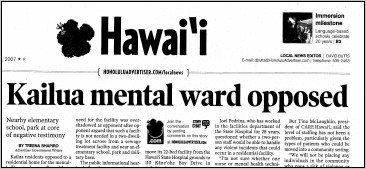
No "mental ward" has been proposed that needs to be opposed. What is proposed is a home for people who will be shortly returning to ordinary life in the community.
That bias is part of the equation can be seen in the use of somewhat shocking stereotypes reported in the article. One Kailua resident is quoted as using the phrase "this type of person." Another testifier was concerned whether ordinary walls would be sufficient to contain the violence. Hint to the uninformed: there is no "type of person" who is mentally ill. People of all socio-economic classes may suffer equally. And statistically there is no increased violence--quite the opposite.
But the worst thing is that the headline got through the editors. The on-line edition has a better headline:
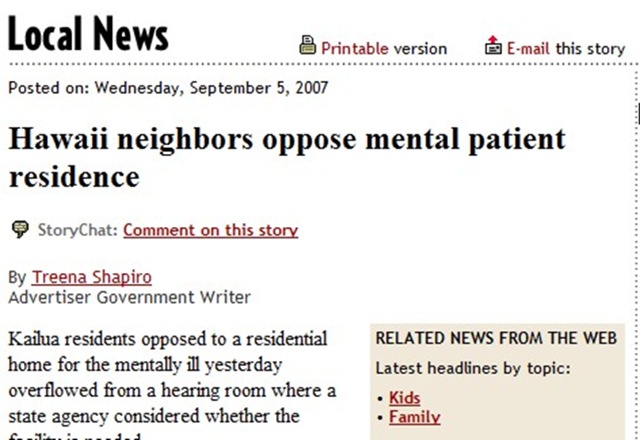
Kailua residents may have a point about the siting of this home near a sewage treatment plant etc. Maybe there is a better choice. The Advertiser headline will provide fuel for the next community NIMBY fight.
It's just going to make it tougher for these people to get community treatment.
The deeper meaning of "Not In My Back Yard"
NIMBY is a complex concept. If someone wanted to put a dump near where I live, in middle of Honolulu, I'd object also, saying that it's the wrong place (so far our city government hasn't been that stupid). On the other hand, sometimes a dump has to go someplace. Unfortunately it inevitably ends up in the backyards of those who have already been marginalized.
But let's dig deeper. Maybe the time for having dumps is over. As each community objects, one after another, the will of the people is ultimately made clear to its government. No more dumps. There needs to be another solution. We have had enough. It's time to stop adding garbage to landfills. Yes, NIMBY can become "enough already!".
When community after community objects to locating a private prison in their back yard, the message could be "no private prisons!". And so on.
It's sometimes described as a "micro-trend." The same thing happening over and over in different places. The "soccer mom" phenomenon is a positive example of this. It's a simple thing that just happened here and there until it was everywhere.
But civic issues are often complex, unlike kids' soccer. There is usually little in the way of public dialogue on civic issues. If there are to be no more prisons then there have to be community resources instead, or sentences have to be reduced (or we could legalize and regulate drugs!). Something has to change.
To tell the truth, this seems not to be going well elsewhere, either. Community resources are not coming on-line at the rate they are needed. In some states the only way to get mental health or substance abuse treatment is to get arrested and thrown in jail.
We in Hawaii have a lot of work to do. Kailua already has homes that provide treatment for those with mental illness and substance abuse issues. There's no violence, children are not abducted, and probably no one would recognize that "type of person" who is living nearby. Moreover, for sure, some Kailua families will have a family member in need of treatment now or one day. It's not like the state is asking to locate a bunch of space aliens in their community. These are their own people whom they don't want.
Newspapers can play a role in creating dialogue. I hope the Advertiser gets on board. As penance for today's headline, they could run a story about community treatment facilities as they really are.
At any rate, no more inflammatory headlines, please.
Monday, September 03, 2007
Hawaii is hell for Republicans, I guess...
by Larry Geller
I feel sorry for Hawaii's Republicans. They are getting fewer and fewer, and it re ally would be nice to have a decent opposition party. With the recent defection of Senator Mike Gabbard, Hawaii has only four (count 'em 4) Republican senators remaining. That's four out of 25.
Maybe there would be more of them if they'd stop and think for a moment about what is not working with the voters. One thing might be their endless mantra that Hawaii is bad for business. It certainly is an expensive place to do business. It's also an expensive place to live. And one reason for the latter is that it's such a good place to do business.
The theory is, of course, that if you repeat something over and over again, people may believe it. In this case, few voters are willing to buy the Republican bill of goods.
Hell to do business in?
From the Honolulu Advertiser, August 29:
State Senate Minority Leader Fred Hemmings, R-25th (Kailua, Waimanalo, Hawai'i Kai), said the Supreme Court's decision [to stop the Superferry] contradicts the law and insults the Legislature. He also blamed what he called "extreme liberals" in the environmental community.
"It's another reason why Hawai'i is a hell to do business in," Hemmings said.
Sure. The Superferry was caught trying to avoid an environmental assessment. It appears that the State may be complicit in the plot, but nevertheless, it didn't work in the end. The law seems clear and a judge has interpreted it. I'll take the judge's word on this one over Sen. Hemmings'.
Star-Bulletin reporter Dave Segal seems trapped in the Republican's frame. For his article in Sunday's paper (headlined A black eye for business) he seems to have sought out as many investors as he could. Sure, if Hawaii were an easy place to get away with what the Superferry folks tried, it would be better for investors. Bad for whales, bad for the large number of people on Neighbor Islands who object, bad for the county councils who have objected. The Superferry was not only trying to do business in Hawaii, they wanted to give us the business as well. Reporter Segal simply interviewed many people who shared his (?) point of view.
Imagine how well the ferry would have worked if they completed a successful environmental assessment showing that the ferry is safe for whales, etc.? Imagine if they treated the community with respect?
There are certain folks who will indeed find Hawaii a hard place to do business. And they should.
Let's break the frame
Let's examine "It's another reason why Hawai'i is a hell to do business in."
Costco is here and thriving. Their Iwilei store is their number one sales location. Wal-Mart appears to be doing well. Target and Whole Foods are on their way over. So retail is good (unless you're a local mom-and-pop, of course).
We have our share of celebrity chefs and the restaurant business looks healthy.
Tourism is tops, of course, with new hotels springing up and Kailua homeowners competing with each other to offer illegal vacation rentals. We have many firms doing exceedingly well providing goods and services to the military (some of these are also classified as our "high-tech" sector, and might not be here at all were it not for the large military presence in the state).
Our banks are obscenely profitable, coming in right at the top of the list.
With the building boom, electricians, carpenters and other trades are working long hours. Look around you at the construction cranes.
I'm told the movie business, fueled by generous tax breaks, is also booming.
So is real estate. It's amazing how many people are in the real estate biz.
Hawaii is a darn good place to do business.
Now, what do these businesses have in common? Most of them depend on exploiting the residents of these peaceful isles. We willingly pay more for food and other goods than most Mainland folks would tolerate. We are gouged at the gas pump and in the supermarket. When our "local" airlines had a chance, they socked us for the maximum fares that the market would bear.
The majority of jobs remain in tourism, low-paying, low-quality jobs not requiring an education better than our low-quality schools provide. Are hotels closing up? No, Hawaii is a great place for them to do business.
Oh, and those banks--no interest on business accounts, high credit card charges--again, you and I are making them the stars of the business firmament. They're doing well because we hand over our money to them. Even though there are non-profit credit unions in Hawaii, we feed those banks our hard-earned cash, making them richer than anyone can imagine. Are they leaving? No, Hawaii is a great place for them to do business.
If the Superferry gets going, don't count on bargain fares of course. Given the chance, they will take whatever they can get. Unlike the New York City Staten Island Ferry or the old Hong Kong ferry, the Superferry is a private company. (Did you know that the fare on the Staten Island Ferry is free? Yup. Zero.) (If I recall correctly, the Hong Kong to Macau ferry was less than $20.)
We have no model of an island economy other than exploitation. Thanks to us, business is doing better than it does on many islands, where there isn't much left to exploit. When all the guano is mined from an island, the place is abandoned and local folks have no income. That's the model. Exploit as long as you can, then leave.
Hawaii can still give both big and small business a good run.
It's not a bad place for business. The struggle here is to keep it a good place to live.
The misfits seem to be Republicans who can't stop complaining.
Hawaii Civil Defense--still a do it yourself project?
I'm tired of being informed how many gallons of water I need to store in the event a storm is coming. I want to know not what I have to do for myself (I've got that info, thanks) but what the state is doing to ensure my safety and that of my family and neighbors.
I'm not sure what FEMA requires for the average citizen, but at least for persons with disabilities (which includes many elderly), there is a law.
FEMA has released a preliminary reference guide as part of meeting the requirements of Section 689 of the Post-Katrina Emergency Management Reform Act of 2006, [enacted in Title V of P.L. 109-295, DHS Appropriations Act of 2007]. It's short. A copy of it is on the web: Accommodating Individuals With Disabilities In The Provision Of Disaster Mass Care, Housing, And Human Services.
So at least some people in Hawaii can now find out what the law requires. For persons with disability, the guide gives these requirements (in part):
Physical Access - Emergency programs, services, and activities must be provided at locations that all people can access, including people with disabilities.In order to fulfill these requirements, there's going to have to be information given out, right? And sign language interpreters will have to be contracted, right? Where exactly is the large print information?
People with disabilities should be able to enter and use emergency facilities and access the programs, services, and activities that are provided. Facilities typically required to be accessible include: parking, drop-off areas, entrances and exits, security screening areas, toilet rooms, bathing facilities, sleeping areas, dining facilities, areas where medical care or human services are provided, and paths of travel to and between these areas.
Equal Access - People with disabilities must be able to access and benefit from emergency programs, services, and activities equal to the general population.
Equal access applies to emergency preparedness, notification of emergencies, evacuation, transportation, communication, shelter, distribution of supplies, food, first aid, medical care, housing, and application for and distribution of benefits.
Effective Communication -People with disabilities must be given information comparable in content and detail to that given to the general public, as well as accessible, understandable, and timely.
Auxiliary aids and services may be needed to ensure effective communication. These may include pen and paper or sign language interpreters through on-site or video interpreting for individuals who are deaf, deaf-blind, hard of hearing or have speech impairments. Individuals who are blind, deaf-blind, have low vision, or have cognitive disabilities may need large print information or people to assist with reading and filling out forms.
I wonder what info I can find out on this. There's a law, right? So I should be able to find something.
Looking at the state civil defense website, all that's there is another "do it yourself" project: Information for People with Special Needs
Special Needs May Also Equal Special GiftsThe page goes on to explain, natch, what people can do for themselves.
People with special needs can be a great resource in our community.
They have an understanding of what is required and needed when caring for others with special needs. Many also have specialized abilities that can be very useful in times of emergency. These people should be encouraged to volunteer with organization such as The American Red Cross, County Civil Defense Agencies and others. In times of Emergency, Neighbor helping Neighbor.
It's September 2007, two years after Katrina. When will we get something besides self-help info from our state civil defense?
Dear Legislators: (hint) Please check into this. There are laws out there that need to be implemented, and should be, for the safety of everyone in Hawaii. Thanks.
Getting down to basics on the Superferry fiasco -- and more on Framing and what to do with the Superferry
The dailies are still running Superferry letters, although it looks like actual "new" news is tapering off. I've been wondering how many letters the papers actually are receiving on this subject and how they are sorting out which ones get printed.
If you'd rather read something more substantial, click on over to this post on Ian Lind's blog: Sunday…Still mostly Superferry. I learned more reading that one post than I thought was left to learn. Especially more than the Sunday "hot seat" blog summary Hawaii Superferry answers on past, present, future. Try your "reading between the lines" skills on that one, ignoring exactly what was said and trying to figure out the particular "frame."
The Superferry came with a huge investment, real big money--so we know that the story is far from over.
Most recently the papers report/speculate a bit on how some stranded ferry riders and their vehicles will be repatriated (e.g., Advertiser: Ferry may pick up travelers stranded on Maui). It should have been obvious that this would happen, and no doubt passengers were aware of the possibility. If only the ferry operators were better prepared to handle the inevitable.
For more on framing, try googling George Lakoff. Here are a few short Lakoff snips:
Language always comes with what is called "framing." Every word is defined relative to a conceptual framework.This one illustrates how framing is used by politicians:
Here's another example of how powerful framing is. In Arnold Schwarzenegger's acceptance speech, he said, "When the people win, politics as usual loses." What's that about? Well, he knows that he's going to face a Democratic legislature, so what he has done is frame himself and also Republican politicians as the people, while framing Democratic politicians as politics as usual — in advance. The Democratic legislators won't know what hit them. They're automatically framed as enemies of the people.
Meanwhile, some more names have come in via email for a potential restaurant/club should the Superferry decide to tie up at the docks and use its facilities (favorably rated by most reviewers) to serve up food or drinks (hey, it's ok to use comments, folks!). Here they are:
Club Titanic
Nowhereland
Moby Dick Ocean Bar
On the Rocks Cafe
If they can show movies, all the better. Remember, free parking is included.
Enforcement cabal sets sights on public schools to stage their next war on drugs
The "drug war" in Hawaii, as elsewhere, depends on keeping the populace in a state of fear. In order to do their work, drug warriors have to convince us (and the Legislature) that Hawaii is in the grips of a crime wave, or a drug epidemic, or that our children are about to be turned into addicts who stash illicit drugs or alcohol in their school lockers or in their backpacks.
City Prosecutor Peter Carlisle's letter to the editor in the August 28 Honolulu Advertiser pushes drug sniffing dogs as the answer to an imagined schoolhouse addiction problem. Perhaps it's time to revisit the issue of drug testing, student surveillance, and the prosecutor's own role in creating a self-serving paranoia that furthers his enforcement goals.
Carlisle and Hawaii's "enforcement cabal" (loosely US Attorney Ed Kubo, Peter Carlisle, Lt. Governor Duke Aiona and others in the Lingle administration) must have been disappointed in the August 16 Advertiser article contrasting a national survey with Hawaii results. A 2003 study of 30,000 Hawaii students conducted by our own Department of Health and cited in the sidebar Hawai'i Students 'Just Say No' found drug use at historically low levels in Hawaii's schools. The story said it was "the lowest ever," and "monthly prevalence rates for illicit drug use were lower in Hawai'i than nationwide." But that doesn't make for a successful drug war, so Carlisle conveniently ignored it in his letter and tried to smear Hawaii's schools with the less encouraging national statistics.
Usage of every kind of drug continues on a steady downward trend in our schools, so there's little reason to subject students to intrusive dog searches. Education and prevention seem to work effectively here. Citizens spoke out at the cabal's 2004 drug summit and denied them support for excessive enforcement. We clearly prefer education, prevention and treatment. And why not, they have worked for Hawaii, in both the schools and in the community.
Two years ago Carlisle was willing to risk sacrificing the reputation of Mid-Pacific Institute, the school his son attended, by pushing school administrators, over the protests of a parent group, to institute random "voluntary" drug testing of students. With the just-released 2003 Department of Health study of public (and some private) schools showing low and declining rates of drug use, Carlisle put the hammer down on Mid-Pac to drug test its students.
The risk? Why should this particular private school need to institute random drug testing? Were there incidents we weren't told about? If so, might parents decide to send their children to another school which didn't admit to needing drug testing?
The school may well have been pressured by Carlisle for self-serving reasons. It was easy to speculate that the real target would later be the public schools. Mid-Pac was only a dry run, a willing test case so to speak. Or else, of course, they really did have a drug problem (in which case, as the parents pointed out, there were evidence-based programs available to them that produce real benefit).
Not only is random testing of questionable value, but it doesn't equip students to make their own decisions about the dangers of drug abuse in the future. It's also hard to show that the program is working. Is it successful if a handful of students are caught? Is it successful if none are caught? In other words, the program was put in place without the possibility of measuring its success rate. That's one way to recognize when an action is not driven by science but by politics.
The dogs are unnecessary except to promote a state of constant fear. Whenever the dog and its handler appear on the scene, everyone is supposed to remember that we're engaged in a war against drugs in our schools.
In fact, there's no need to spy on student lockers. There's no need to look for drugs in every knapsack.
Board of Education members who would defy provisions of our federal and state constitutions guaranteeing rights of privacy even to students will gain little because the schools are not, in fact, hotbeds of drug dealing and addiction. Studies show exactly the opposite. Instead, the BOE will be playing into the hands of the enforcement cabal.
Prosecutors and the dog-sniffing service have a clear interest in hyping a threat, but there's no evidence that there is one.
Tying up a loose end: Crimes against visitors down
Well, credit it to poor timing if you like, in addition to poor judgement. No sooner does the Honolulu Weekly devote a cover to a sensational crime statistic revelation than the Advertiser prints a front-page story, Crimes targeting Oahu visitors drop by 40%. If correct, crime against visitors are certainly reduced at present (I'm not sure what I think of using cameras all over town to accomplish this, though).
Of course, many visitors will have seen the Weekly cover with the smoking gun and scare headline and not the Advertiser story. Whatever damage is done is done.
The point is not that we don't have crime or that visitors shouldn't be warned. But let's be realistic about it.