Friday, August 31, 2007
Linking New Orleans, Virginia Tech, and Hawaii--why do we ignore the wakeup calls?
Then the Kaloko dam actually burst, prompting some to wonder if Hawai'i is too complacent about the threats it faces."I call it the Traffic Light Syndrome," said Larry Geller, president of Kokua Council, a nonprofit senior citizens advocacy organization. "We don't put in a traffic light until pedestrians are killed."
Ed Teixeira, state Civil Defense vice director, says "we are definitely not there yet" when it comes to having enough shelters for the elderly and people with disabilities, when disaster strikes.
148 areas lack the means to issue disaster warnings, says Hawaii Civil Defense


Thursday, August 30, 2007
The "train wreck" method of running a government, and what the Superferry might do next
Origins of the blame game
It is said the Prussian army invented the organization chart. Knowing who was in charge of something would assure that when something went wrong, blame could be quickly and accurately fixed on the person in charge of it. The principle is not old because most of the world produced its goods for eons in little farms or cottages. You don't need an organization chart for a mom-and-pop operation. There is no "management" to chart. But an army could use one, so the Prussians either invented it or at least introduced it to the world. It worked. They could find someone "responsible" quickly, because their chart showed who was in charge of what.
Two Western Railroad passenger trains collided somewhere between Massachusetts and Albany, New York in 1841, and fortunately, they had a handy Prussian-style organization chart. So they could quickly say who was responsible. We then had a name for it: the train wreck method of management. Those responsible should be found and fired. Outsiders saw that the company was taking action. And surviving employees were motivated to keep their projects on track, so to speak. We still do that; after a train wreck, we find who is responsible, and fix the blame on that person. And we can fry that person in oil, no one will object.
Applying Prussian army learning to the Superferry situation
It doesn't take a train to have a train wreck. Here in Hawaii the finger of blame is spinning around since the Superferry was challenged successfully by protesters in the waters off Kauai. The ferry was there because they started early in order to defy a judge who banned the boat from Maui. The judge acted because there was a questionable exemption from state law. The exemption was questionably granted by.... and so the finger spins.
Fixing blame is a very big thing, ranking right up there with revenge, retaliation and jealousy as motivators in Hawaii government. But many of us are eager enough to join in the game. I admit I feel like pointing the finger myself.
I find it interesting how politicians, activists, newspapers, letters to the editor, bloggers and blog comments are all over the map on this. That's actually great for discussion and can help us decide what's the best thing to do. It also reveals the possible thought processes of different institutions and individuals, if you're a student of such things. We'd never get much insight into what makes the state Department of Transportation tick, for example, if it weren't for something like this. We can step back and take a bit of a meta view, because these different groups have been squeezed, and in their squealing there is information to be gathered.
Let's start with ferry management (conveniently, they do have an organization chart, so why not). Can you imagine, in Hawaii, defying the courts and the people by loading up the Superferry with $5 passengers and setting sail early? John Garibaldi, Hawaii Superferry CEO, is said to be a local guy, so he should have known better. So we learn something about attitude. We learn what we can expect in the future. Maybe we can predict what might happen to interisland ferry fares, given how this company seems to feel about local people.
They'd rather have the Coast Guard round up the protesters. Guantanamo is probably not good enough for those tree huggers. Never mind that for every protester in the water there are hundreds cheering what they are doing. Again, I don't have to argue who is right, I'm just looking at how they handle this.
Let's look at the protesters, perhaps those who have spoken the loudest. It is easy to sit here and write a blog. It's easy to write an editorial or a letter to the editor. It takes guts to shout down a superferry from the water directly in front of it. Again, you may have your views, but analyze the protester's position. They clearly are not speaking for themselves alone. There are too many for blame to be fixed on them as individuals. In fact, their act is strongly in accord with an American tradition of civil disobedience in the face of perceived injustice. We can conclude that there are a large number of people who have strong objections, even at this late date, to the way this ferry thing is being done. They were not heard before, but by golly, they have our attention now.
[I'm reminded of a number of small recreational boaters who took advantage of great sailing weather to practice in the waters off of Pier 29 a couple of years ago. It happened that the Full Means II, the ship whose captain was allegedly killed by the ship's cook after mistreating the crew, was trying to escape from Hawaii and avoid repatriating the crew. Too bad for the ship's owners, it's not allowed to crash into recreational sailors just because you're in a hurry to get your ship out of port. So attorneys had time to prepare papers and have the ship arrested.]
The Honolulu Advertiser editors complain about the planning process but won't look at both sides of the issue. This is fine, we expect to find opinions on the editorial page. Again, without agreeing or disagreeing with them, step back and analyze what position they took. Is it possible that they might be influenced by the thought of ad revenue? Who knows. The editorial begins:
You would think the Hawai'i Supreme Court had ample time to voice its opinion on the Hawai'i Superferry.
Actually, the court acted with lightning speed. Usually one could die waiting for a decision. They acted as soon as the matter was brought before them.
The editorial identifies a serious lack of planning. Since letting the ferry avoid doing an environmental study was very much a part of the state's plan, I'm puzzled at why an editorial finger is not pointed in that direction. But nevermind, the finger is still spinning, and we can learn something about newspaper thought processes from this and other editorials.
Sen. Gary Hooser, in an op-ed in today's Advertiser, spotlighted the failure of the DOT and the Lingle administration to require the environmental impact statement in the first place. He also chastises the administration and the ferry management for accelerating the sailing schedule.
The message from the fifth floor of the State Capitol to Hawai'i residents is clear: The interest of a single big business takes precedence over the interests of the environment, the law and the people.
Reading the entire article, it's clear that Sen. Hooser favors cooperation between different parts of the government, and that he is comfortable showing them how they could have served the people by acting differently:
A majority of Neighbor Island senators introduced legislation in the recent session and the Senate passed out a bill offering a compromise that would have required an environmental impact statement while allowing for the commencement of operations for the Superferry.
Instead of accepting a win-win solution that would have served both the Superferry and Hawai'i's fragile environment, the DOT and the Hawaii Superferry have steadfastly refused all requests and all offers of compromise, choosing instead the arrogance of the steamroller approach. After all, they had been able to block all attempts by the Legislature, they had the full support of the governor, and the benefit of hundreds of millions of dollars invested by a politically powerful and influential board of directors.
Without judging the merits of Sen. Hooser's points, we can learn quite a bit about his leadership qualities. To my ears, the article shouts out that were he governor, he might have exercised a different form of leadership. It helps to know that he has been consistent over time. I have certainly not read everything in print on the ferry issue, but Sen. Hooser is the first I have seen to point out that lawsuits will be costly (and who pays them? Do they come out of Lingle's salary? No, we pay the settlements out of our taxes).
It did not have to be this way. If the Lingle administration had from the beginning put the interests of the public, the law and the environment ahead of the interests of the Hawaii Superferry, we would not be having this discussion.
This comment is not made in isolation. In different contexts it can be leveled at an administration that withholds money from social services, from pedestrian safety, and yet supports the interests of big business.
Ok, I mentioned Governor Lingle. What can we learn from her statements? Find one, first. Maybe I and Google have overlooked something. As I type this, there is one just out–KHNL: Governor Lingle Requests Suspension on Superferry. Read it yourself, it's short. What can be learned? Staying on the sidelines any longer would make her look bad. But up to that point, she was very willing to lay low. In the KHNL article she reiterates that she feels the state made all the right decisions.
Again, whether or not you agree, what can be learned? Is this an example of leadership, taking the helm and steering the ship of state in the right direction (sorry, sorry)? In fact, is any leadership at all demonstrated by her silence and this short statement?
I know that readers may not agree with my analyses. But it's an interesting exercise to read between the lines, or to try to deduce what a statement means or shows beyond what it says. In an age where politicians lie easily, we all do this to some extent already. Each of us may come away with different views. That's fine. Applying critical thinking (that is, not swallowing what we are told whole cloth) does not mean we will agree. But I think we will learn a lot.
Superferry as part of a system of frames
We must, in my view, look critically at the frames that our government is imposing on our conversations. This is how we are made to meekly go along with transit plans, housing shortages, overdevelopment, loss of beach access, increased taxes, control over women's reproductive choices, immigration "reform," and so on.
Reading between the lines is a first step to understanding the process. Go beyond the words someone is using. Look at the entire context. They may be lying, but they can't fool you if you are not depending on their words to convey all of the meaning.
The second is to understand how issues are presented to us, how they are framed. Perhaps the most common frame people are aware of is the set of words associated with "pro-choice" and "pro-life."
A third step might be to accept what is good and resist the rest.
What frames does the Superferry appear in? Something around privatization. Big business trumps local needs. Government is above the law. In each of these (and there are probably more), other components make up the frame as well. The objective is always to control public dialogue. If we read between the lines habitually, we won't be taken in.
As to the Superferry, I suggest they park it and apply for a liquor license. I understand from speaking with someone who took a $5 trip that it's a pleasant place to spend time, and it comes equipped with its own parking lot. What a great venue for musical or club style events. Or for a nautical themed restaurant.
Update: Some readers suggested names. I think that's a great idea but it needs more work. "Club Nowhere Now." "Club See Worthy."
Hear more about the bus alternative - Town Square, Thurs 8/30, 5-6 p.m. 89.3 FM
If you read this in time, and are still concerned about Honolulu's seemingly irrational push for a train that many people just don't want, tune in for tonight's Hawaii Public Radio Town Square program. And consider calling in.
Guests will be city council members Ann Kobayashi and Charles Djou. They're still willing to consider alternatives.
Is it too late? Only if we let it be too late. Take this opportunity to find out how we can still have an influence on the decisionmaking process if I may call it that.
I believe there will also be an unofficial survey of callers-- will the proposed train go where you need it to go? Where do you travel each day, and what would work for you?
The call-in number is 941-3689, or 1 877 941-3689 if you live elsewhere and just want to set us Honolulu folks straight.
Saturday, August 25, 2007
Superferry or Stupidferry?
So the Superferry is selling tickets at $5 per person or per vehicle and pushing the startup date to tomorrow. There's still the possibility a judge may grant an injunction in a couple of days which would prevent it from operating.
Ok, so you scored a bunch of $5 tickets for Maui. You, your spouse, kids. grandparents, boy/girl friend, will pack the SUV with camping equipment and the dogs and head for a dream vacation on the cheap.
Now, suppose the judge grants an injunction against the ferry while you're there? Figure how much it could cost you to get all that stuff back. Don't forget possibly having to pay for a hotel stay if you're not the camping type.
Of course, you'll try to get the money back from the Superferry. Fair chance you could win.
But the ferry operators will lose a lot of goodwill in the process if large numbers of people are stranded.
According to an article in today's Star-Bulletin, a certain Maui committee chair could have avoided the possible shipwreck had he not blocked a bill he should have allowed to go to a vote in the Legislature. Read about it here.
[Aside: The bill referred to in the Star-Bulletin article had strong popular support. Wouldn't it be nice if committee chairs could no longer refuse to hear bills that have lots of testimony attached? This is an illustration of why we need some major reforms in our state legislature, particularly in the House.]
Wednesday, August 22, 2007
The Honolulu Weekly strikes a blow against tourism--again
 Tourists pick up the Honolulu Weekly because it's free, and because it's a good reference for many kinds of music and the arts, not to mention those handy "dating" service ads.
With a cover story like this, some of them might take the issue home to show their friends they survived the wilds of Honolulu without getting killed, and to warn them what a dangerous place it is. Look, right there on the cover of the Weekly, a "smoking gun" and a sensational sub-head promising startling crime statistics.
I wonder if the Weekly thought about the power of such a cover and its effect on visitors, children, and even the rest of us?
[Pop quiz: who told Spiderman "Remember, with great power comes great responsibility?" Answer below.]
Reading the article (which many tourists may not be able to do) reveals "As for the city of Honolulu, it has the lowest incidence of violent crimes for cities of 700,000 people or more." I think we all know that the property crime rate is high, but you don't get shot when they break into your car at night. A handy chart at the end of the article shows how safe Hawaii is compared to other states. Your car and household possessions may suffer, but you're not likely to get beaten up, murdered or raped. This is hardly "startling," it's the same news we read about every year.
In short, there's no "smoking gun" according to the usual meaning of the term "indisputable proof or evidence of a crime."
We wrote about an earlier unfortunate Weekly cover on April 13. It featured a fabricated a picture of a hand grenade supposedly washed up on the beach. That was another great issue for tourists to take home and show their friends and families. Man, this place is dangerous!
Except it's not.
Speaking of journalistic standards, this issue reports for I believe the third time (p. 5) that several of our city council members were given business trips to Europe to view the Netherlands' Phileas Advanced Public Transport System, a bus-based transit alternative for Oahu. I did not recall any such trip and verified with calls to two council member's offices that there was none. Maybe no one from the city council called the Weekly to correct the error, but it would have been nice had the Weekly done its fact checking on this charged issue by itself.
[Answer to pop quiz: Spiderman's uncle, Ben Parker warned him.]
Tuesday, August 21, 2007
"Surfing for Peace," or "God will surf with the devil if the waves are good"
It's seldom that Hawaii and "Mid-east peace" appear in the same paragraph. Here's an AP story, Hawaii Surfer Donates Boards for Gazans, describing a very unusual gesture.
In a nutshell, Dorian Paskowitz, a retired Hawaii doctor who, the article says, has been surfing for 75 years, donated 12 surfboards to Gaza's small surfing community today. Paskowitz is also the guy who introduced surfing to Israel fifty years ago.
Click the link above and read all about it.
Saturday, August 18, 2007
Homeless shelter or Guantanamo?
While reading the Advertiser story Hawaii homeless shelter's beds empty last week I was frankly shocked to read quoted comments of a mother staying at the shelter:
"Too much rules," said Kalani, 24. "They're just too strict. It's a good place. I kind of liked it there, you know — a roof over your head, and meals. And they're all good people there. It's just that when I would get in trouble they would keep me locked down. And their rules apply to our kids, too. If our kids mess up, they write us up."
Lockdown??? I thought that the facility was to provide assistance in the form of shelter for the homeless. I planned to check into that but never did. Meanwhile, Doug over at Poinography.com took up the same issue and elicited several comments from his readers in this article.
The comments are insightful, particularly the second one, by David Raatz. In part, "Only the poor, [9th cct Judge Harry Pregerson] said, must “give up their rights of privacy in exchange for essential public assistance." This is in contrast to the rich, of course, who are not subject to these rules (see David's comment and his link for the complete quote, it's worth your visit).
I'm not satisfied. Of course, a program is operating there and the program has rules, but I thought the state was providing a homeless shelter. Rules are necessary, especially if people are staying at the shelter with current drug or alcohol problems. A "lockdown" seems to be going too far, if that's indeed what it is.
Maybe we still need a place to shelter the homeless in addition to treatment programs with rules as strict as "lockdowns." One Guantanamo is one too many, we needn't turn a shelter into a prison for our own people.
Chinese chemicals in your "health" foods?
Astute shoppers know that many, if not most, of the products for sale in health food stores are not necessarily good for you. Maybe they're better than corresponding products in the supermarkets, or maybe not. Increasingly, shoppers are aware that these products contain problematic quantities of salt and sweeteners.
To entice you to purchase, packaged foods may be laced with added doses of vitamins and minerals that are supposed to be good for you. This is nothing new, if you remember Wonderbread ("Wonder Bread builds strong bodies 8 ways"). The "8 (later 12) ways referred, of course, to the number of added nutrients. And during the war (WWII I mean), this wasn't a bad thing. The government program to enrich white flour greatly reduced the incidence of beriberi and pellagra.
Manufacturers add chemicals, sometimes called "nutraceuticals" to health foods not to be sure you won't get beriberi, but to entice you to take them home with you. Of course, you have no idea how much of these chemicals you are really getting in each portion or where these chemicals are manufactured.
Guess.
Yes, many are manufactured in China. And China has been in the news recently as a source of tainted food products.
Digging into the box
Supermarkets now compete with health food stores, sometimes with the same brands and sometimes with their own. For example, Safeway has its own brand of organics marked with the "O" brand. I also found Eating Right products, including breakfast cereal, which claim dietary and nutritional benefits. I bought a box of Eating Right Muesli Cereal, which claims to be low fat and "good source of 14 vitamins & minerals."
Now, a low fat claim is innocent enough and a good thing. Let's read the label.
The ingredients list on the box started off with raisins, then a list of whole grains, and ended with the corn syrup, salt, and malt flavoring that usually appears much earlier in the list in other supermarket cereals. Oops, the period on the end of the ingredient list isn't really the end. Below the ingredient list is another list, "Vitamins and minerals." It should have been part of the ingredient list. But never mind, maybe it was a proofreader's error.
What follows is a list of chemicals. Indeed, this product is a "nutraceutical." It makes health claims based on the added mixture of chemicals which are there so that it can make health claims.
Of course, their country of origin is not given. Too bad, because some of them are likely to be made in China. Wherever they come from, they are usually produced by complex reactions from sources that are definitely not "O" for organic.
Checking the list of chemicals on my box against the index of Twinkie Deconstructed by Steve Ettlinger, I found, for example:
Thiamine hydrochloride--produced when crystals of thiamine are reacted with methanol, hydrochloric acid, and ethanol (p. 38). The largest plant producing thiamine is located a couple of hours north of Beijing, a joint venture between the German firm BASF and Tianjin Zhongjin Pharmaceutical Co.
According to the book, the manufacturing process varies from company to company, but usually starts with coal tar. Yup. We can argue whether that's a natural ingredient or not. The book says that "Thiamine chemicals are finished with about fifteen steps that may include, depending on the company, such appetizing processes as oxidation with corrosive strength hydrogen peroxide and active carbon; reactions with ammonium nitrate, ammonium carbonate, and nitric acid (to form a salt); and washing it with alcohol. It is edible at this point..."
Riboflavin--according to the book, the largest manufacturer in the world is Guangji Pharmaceutical Co. in Hubei, China. This plant makes over two thousand tons a year of riboflavin (perhaps also the riboflavin in this cereal?). In huge tanks that stand as much as six stories high, the book says, enzymnes work for a few days to excrete riboflavin. From what, you may ask? "It might be a stinky mix of nutrient-rich waste fats, or cod-liver oil or canola or soybean oil." There are other, less noxious choices, such as millet seeds kept for a week at 90 degrees F. Whatever.
Folic acid--for this, we go to Changzhou, China, two hours, according to the book, from Shanghai. There some is made from fermented as well as petroleum products. The latter "is maade from a high-tech soup of an amino acid (glutamic acid, the one that turns into MSG when mixed with sodium; ketchup is full of glutamic acid), a foul-smelling, flammable form of acetone (also found in nail polish remover), and pteroic acid, otherwise known by the catchy nickname 2-amino-4-oxopteridin-5-yl, or sometimes 4-([2-amino-4-hydroxy-6-pteridylmethyl]amino)benzoic acid, a blend of paraffin and butyric acid, both petrochemicals. ... This forms folic acid--pteroyl-L-glutamic acid--that is in turn refined, reduced in acidity, purified with zinc and magnesium salts, crystallized, dried, and sterilized until only a fine, dark powder remains, ready to ship off to the flour mills."
Beta carotene--this comes from carrots, right? No, it's synthesized. The book doesn't say where it comes from.
And how much of these fine chemicals do you get in a serving?
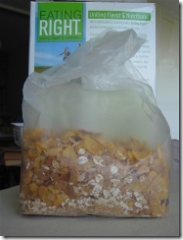 I pulled the inside bag from the box and noticed that the corn flakes had largely migrated to the top. At the bottom were white things that might be oats or barley along with powedered or crushed substances. So unless you dump everything out and mix it up when you buy it, my guess is that the first few servings would be short of the advertised nutrients and your last bowl could contain megadoses. That's just a guess, I'm not Consumer Reports (and too bad they don't report on things like this).
It's not like taking a daily vitamin pill. The dose you get is a crap shoot. Nor are all the ingredients necessarily effective. Remember, they are there to convince you to buy the box, not because they'll necessarily do you any good.
And who knows where they are made.
Wednesday, August 15, 2007
Follow Peru earthquake, possible tsunami, over on CHORE blog
Flossie fizzled out, but there seems to have been a possible tsunami generated by a Peruvian earthquake today. Doug Carlson is tracing how the warning system works (and if a warning is issued for Hawaii, how it is handled here) over on his blog. Refresh the page there to see Doug's latest log entries.
Right now, there's an advisory for Hawaii but no warning. Of course, if you were not specifically checking for it, you'd never know. But you can find out by clicking over to Doug's log.
Tuesday, August 14, 2007
Follow Flossie
Watch this loop from the Weather Underground to follow the storm's path across the Big Island. To get the latest map, hit the refresh button on your browser.
Once again, you'll find a variety of weather maps and information gathered at Edward Dung's useful web page.
This image is linked from the Weather Underground -- Big Island Hilo rain area:
Monday, August 13, 2007
American corporations and consumers also to blame for recalled Chinese products
The next time someone lauds the benefits of the "free market" or "free trade," that is, how corporate greed is supposed to result in competition beneficial to the consumer, remind them of poison pet food, lead paint in children's toys and counterfeit toothpaste. All these things were made in China (though the problem isn't limited to China) but are sold to you by corporations who know that their quality control was not adequate to protect you. They also knew that consumers don't care any more and will buy anything if it's cheap.
Their profit is at the expense of your pet's health, your health and your children's health. They profit seemingly without risk, nor are we effectively regulating what they can do ("free trade," remember). If they compete, they compete for how cheaply they can make something. It's a competitive edge if they can find a cheaper sweatshop.
Consumers share the blame, in my view, because we have seldom held companies accountable. Boycotts are not effective in this country. So in our acquiescence we share the blame. We let them do this to us.
I understand that the heads of some Chinese companies caught exporting toxic goods committed suicide. Apparently it is a tradition there. There's no such tradition here, nor do corporate executives do jail time, so consequences are few. Sure, maybe a few will lose some of their bonuses. I don't think justice is being done here.
Surely, the death of quality control in the USA is a disappeared news story. While Google will teach you all about QA, TQA and ISO standards, I have my own little story.
My father was foreman in a button factory for a time. When he brought home some books to study, I also got to peek at them. He also brought home books on plastics and metals. I learned all about thermosetting and thermoplastic materials, what makes a button strong enough so that when it is sewn onto a garment by machine the center part doesn't break off, how the holes are chamfered. etc. I learned about surface treatment for metals, and lots more. Who knows why I found that interesting. I learned about materials and why one is better for a particular use than another, and how long they would last.
My first summer job before my junior year in college was at a tape recorder factory. You remember the old reel-to-reel monsters with neon recording indicators? You had to make the orange light flash as you talked, but not glow constantly or the sound was overloading. I became a quality control engineer even though I hadn't graduated yet. I designed testing jigs for the tape recorder electronics boards, among other things.
The neon bulbs were sampled. Every shipment. The bearings were tested. And so forth. It was much better to catch bad parts before they were installed in equipment which would then have to be taken off the line or worse--returned by customers for repair.
Exactly how many in each batch would be tested varied with our confidence in the manufacturer, but all incoming parts were sampled for QA.
This is what's gone by the wayside. Companies just import and distribute. The lead paint in toys should have been caught, but shareholder profit and obscene executive salaries meant that they weren't. In other words, greed has eliminated quality control. And companies are willing to take the heat when they are caught.
Now, consumers want the cheap $24 oscillating floor fan that they can buy at Longs. They want the cheap battery-operated vacuum cleaner for use in their cars. Never mind that the wrong plastic has been used in the casing of many of these fans, and that after a few years of operation, the plastic literally shatters when you touch it, exposing live electrical parts. Never mind that the batteries in the vacuum cleaners die prematurely, usually a short while after the warranty is up.
In other words, we want our cheap goods and we don't care about quality control either.
Corporate greed means that another source of cheap goods must be found if China continues to disappoint. It doesn't mean that the fired quality control engineers will be re-hired.
The only way to turn things around would be if consumers stood up to corporations and refused to buy from them unless they change their ways. And that's probably extremely unlikely.
Hurricane Flossie: How to follow
I dug through my growing bookmark heap to dredge out this useful weather site originally mentioned on Ian Lind's blog post of March 2, 2006. Just leave it in one browser tab and you can easily check in on Flossie whenever you want. The collection by Edward Dung has stuff like this on the page. As I look at the picture at about 6 p.m. on Monday evening, it looks like we're doomed! The newspaper reports look so innocent, saying the eye of the storm will pass to the South of us. This picture should send you straight to the store to buy water, batteries, etc. Get yourself prepared. Here it comes!

Guess what--the broken sirens aren't working yet, and as far as I know, auxiliary power isn't available for additional radio stations. You'll remember that during the power failure following the October Big Island earthquake it turned out that KSSK was the only station still on the air, and they didn't have information until quite late. Doug Carlson urges citizens to monitor the performance of radio stations this time around. If your power is out and there's no TV to watch, why not do just that and report to Doug anything you observe that worked well or needs improvement.
Finally, in the August 6, 2007 West Hawaii Today paper, columnist Reed Flickinger flames Big Island Mayor and former civil defense director Harry Kim rather severely. Along the way he refers to the "criminal rate of failure" of the emergency warning sirens, which would have gone on had not the media brought the issue to the public's attention. Indeed, as Flossie approaches, as far as I know, much of the public still won't be served by sirens that are broken or not installed yet. Flickinger also blasts Kim for "local radio stations broadcasting dead air." Well, we had the same problem here on Oahu. It's part of not being prepared.
So here's Flossie to test us. I hope all goes well. If we discover more lapses in preparedness I hope we won't forget as soon as Flossie blows out to sea.
Sunday, August 12, 2007
Hawaii's Rep. Mazie Hirono introduces legislation to strengthen pre-kindergarden education
Dear Friends & Family,
My Representative in Congress, Mazie Hirono, has introduced the PRE-K
Act to strengthen early childhood education throughout the country. This
legislation is intended to help states reach the goal of voluntary pre-k
for all families that want it.
Ensuring access to high-quality early childhood education is the best
investment we can make for the future.
May I please ask you to take a moment and ask your Member of Congress to
co-sponsor this important bill. Here's how:
http://www.preknowinfocenter.org/campaign/prek_act07_cosponsor
Here's a related article from Friday's Maui News:
Hirono helping children on Maui get a Head Start
And here's a video of Rep. Hirono introducing her bill on the floor of
the House of Representatives:
Thank you for your consideration. Please forward this message widely.
Mahalo!
David Raatz
Saturday, August 11, 2007
Flossie is coming! Flossie is coming! Do you know where your nearest shelter is? Or who has the keys?
Today's breaking news is that Flossie did not weaken as expected and is now a Category 4 hurricane with 135 mph winds. The articles (here and here) note that it is expected to miss the Islands but that a one or two degree change in direction could make a difference.
Hey-- my reading is that on a whim, Flossie could cause us trouble. Katrina was a Category 3 storm on the morning of August 29 when it devastated southeast Louisiana (down from a Category 5 while it was at sea).
So here we are again. After the Lingle administration held secret, rather than public, meetings on disaster preparedness, many of us still don't know if the sirens will work or where their shelters are. I know that I'm supposed to go to Farrington, but who will open the doors to all the classrooms? These are questions we've asked before.
Doug Carlson has a blog wholly devoted to improving Hawaii's disaster preparedness but it doesn't look like the administration has responded to his concerns either. Where are the answers? Do we have to wait until a storm or tsunami devastates the state to find out that we still were not prepared?
If Flossie does indeed veer toward us, I hope the newspapers will print some information for us beforehand. That is, if they can get it.
Osama had better not read this morning's Advertiser
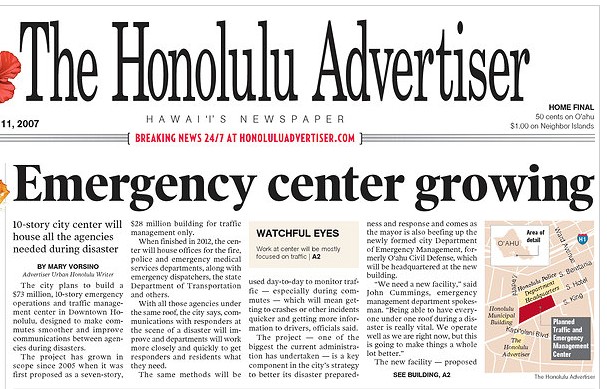 by Larry Geller
Rudy Giuliani's costly decision to place his Office of Emergency Management's center in the World Trade Center has come up again now that he is a candidate for president.
Tuesday, August 07, 2007
Community access TV under assault
The State of Hawaii has been engaged in a systematic assault on free speech through the offices of the Department of Commerce and Consumer Affairs, Cable TV Division.
For the past decade, a disturbing pattern of arbitrary and capricious rulemaking from the DCCA's Cable TV Division has consistently benefited Time Warner at the expense of Hawai'i consumers and the public interest.
The latest atrocity is the State's mismanaged "RFP" process that places each of the Public, Education & Government (PEG) access provider organizations at risk of (increasing) State micromanagement and control.
Instead of being strong and independent advocates for media justice, the PEG providers of free community access to media are on the defensive, forced to fight for survival.
Thankfully, the good people of Akaku: Maui Community TV have continued to stand up for truth, liberty and justice!
Here's the latest action from Akaku to PROTEST the State's assault on community media!
http://akaku.org/images/files/documents/rfp/akaku%20RFP%20protest%20070806.pdf
Congratulations to the Board and staff of Akaku, especially their CEO Jay April and attorney, Lance Collins!
Hopefully, Akaku will find support in the larger community of people in Hawai'i who care about Media Justice!
Please let the Governor and your State legislators know: it is time to audit the DCCA's cable regulation, stop the assault on free speech, support localism, and ensure independent community access to media!
Aloha,
Sean McLaughlin
Hawaii Consumers
P.O. Box 179375
Honolulu, HI 96817
808-447-9610
Monday, August 06, 2007
Sen. Akaka votes against warrentless surveillence law but Sen. Inouye votes Yes
by Larry Geller
The "Protect America Act" expands on the horrible Patriot Act. For one thing,it allows the Bush administration to order the nation's telephone and Internet companies to create permanent spying facilities that will gather information on American citizens.
I've never written to a Congressperson questioning their vote. After all, it's after the fact and the vote can't be changed. And in the future I hope they will pay attention when I urge them to vote one way or another on something I feel strongly about, so I try not to antagonize.
This was just too much, though. I assumed that both Hawaii senators would vote against this bill, and Senator Akaka did not disappoint, nor did Rep. Abercrombie or Rep. Hirono on the House side. Inouye was alone among Hawaii's Congressional delegation to cast a Yes vote.
So just now I fired off the following fax to Sen. Inouye's Hawaii office. I just had to.
I was disappointed to learn that you voted for, rather than against, this terrible legislation.
As a result of its passage, the administration will have broad new powers to conduct warrantless surveillance on American citizens. Congress handed President Bush a major legislative victory. Voters returned control of both houses of Congress to Democrats in order to put an end to these raids on our civil liberties, among other reasons.
Terrorists are already using encryption and other methods to avoid monitoring. It will be the average American who will be entrapped by this law. It will be the American citizen who suffers identify theft when data is lost or stolen, as must inevitably happen in a project of this scope. The data may also be used to suppress dissent. Congress has allowed the president to do as he wishes with our private conversations.
I am deeply disappointed and hope to hear from you on your motivation for casting a Yes vote on this measure.
So there. I sent it. It doesn't make me feel much better, but it's sent.
Maybe if a few people express some disappointment or even outrage, he may think twice about supporting this again in six months when it comes up for a revote.
If you feel so inclined, please write, call or fax Sen. Inouye. Here is his contact information:
300 Ala Moana Blvd., #7-212
Honolulu, HI 96850
Phone: (808) 541-2542
Fax: (808) 541-2549
Saturday, August 04, 2007
Let's not be "railroaded" by the mayor--there are alternatives to The Train
by Larry Geller
Let's hear about transit alternatives for Honolulu
It seemed like a cool tropical breeze had arrived to blow away the hot, bad-smelling air that has settled around Honolulu's transit plans. Yesterday's Honolulu Advertiser's article, Hawaii transit hits another barrier, indicated that some city council members are still considering alternatives to a rail transit system that bypasses anyplace we (the people) would like it to go.
The mayor is clearly pushing for rail (see today's article, Rail transit is only way, says Honolulu mayor) even though his plan risks bankrupting us and our children who will end up paying for an unwanted system forever. There's no federal money to assist tearing the tracks down, of course.
The city council's choice of a Salt Lake route that bypasses the airport and wouldn't serve UH Manoa was discouraging (an understatement) to one who has enjoyed the convenience and economy of riding trains to and from airport elsewhere and who commuted for many years to high school and college by subway in New York.
The city council viewed a film Thursday on the Phileas Advanced Public Transport Systems proposal for high-tech buses. The system offers advantages over fixed rail that should be considered, and even the possibility of route change or replacement if it doesn't work out. With rail, we're stuck with the initial decision and the expense.
I would have liked to have seen the film. Perhaps we'll have that opportunity in the future. For now, Disappeared News brings you a YouTube promo for the Eindhoven installation of Phileas APT's system that should give some idea of what it might offer for Honolulu. It's chopped in three pieces and has some short foreign language segments, but if you bear with it you'll have some idea of what can be done as an alternative to Mufi's rail.
After the film are some links where you can get even more information about Bus Rapid Transit and the Phileas system in particular. And if you would like to weigh in on this yourself, some city council phone numbers and emails you can use to lend your support to seeking the best transit solutions for Honolulu.
Phileas bus rapid transit Eindhoven. Part 1
Phileas bus rapid transit Eindhoven. Part 2
Phileas bus rapid transit Eindhoven. Part 3
Links:
Info on Bus Rapid Transit systems from Wikipedia. Wikipedia has information on other types of transit systems as well--information you won't find in the daily papers.
Phileas Eindhoven project
Philea's website, unfortunately much too Flash-intensive, and some useful information
A better Phileas site
A Phileas FAQ
Contacts in case you want to encourage the city council to consider rail alternatives:
Give support to Councilwoman Ann Kobayashi on looking for alternatives at 547-7005 or email akobayashi@honolulu.gov
Call Council Chairwoman Barbara Marshall at 547-7003 or email bmarshall@honolulu.gov
Main numbers for Honolulu City Council: Phone: 547-7000 Fax: 523-4220
List of everybody on the City Council is here