Monday, July 30, 2007
Psychologists: The shocking link between prescriptive authority and torture
During the 2007 legislative session Hawaii psychologists came as close as they ever have to attaining prescriptive authority--which has been a national as well as Hawaii battle for many years. The legislature passed a bill which was vetoed by the governor. Whew! How close can you get?
Hawaii may have been a pawn in a huge quid pro quo between the military and psychologists. Details of a strong linkage between the CIA, the military and psychologists is just coming out now.
During the session I was troubled by several things, but could not put them together. Thanks to a Vanity Fair article just out--The War on Terror: Rorschach and Awe and today's Democracy Now! program, the link I was searching for is now complete. And I hope legislators will read about the push for prescriptive authority, the American Psychological Association's refusal to ban complicity in military torture, and the participation of psychologists themselves in acts of torture.
It seems that some of the same people pushing for prescriptive authority are the ones involved in interrogation and torture. Prescriptive authority may be a quid pro quo.
(continued below)
Previous Disappeared News articles related to the psychologist bill:
March 13, 2006: Disappearing Doctors: Hawaii looks for quick but questionable fixes
April 5, 2007: Bad, bad day for sunshine at the Legislature
April 9, 2007: No reply from Senate President Hanabusa on resurrection of psychologist bill
June 6, 2007: Hawaii and Guantanamo -- combat zones for psychologists' wars
Many things troubled me about the prescriptive authority bill. A few:
- Particularly for older folks, psychologists haven't a clue about how psychoactive drugs interact with geriatric medications and side effects, and nothing in their proposed training would prepare them to treat the special needs of senior citizens
- One testifier claimed that in 10,000 psychologist prescriptions there was not a single problem (rough paraphrase) which is ridiculous but was never challenged
- The claims that the DOD program was successful and that Hawaii's program was essentially the same (it isn't)
- My belief that while prescriptive authority would enrich Hawaii psychologist it would put the nail in the coffin for a solution to our problem of attracting psychiatrists to rural areas (psychiatry is one of several medical specialties in short supply on the Neighbor Islands)
- How it was pushed by a legislative insider, a hired gun
- The bill imposed a restricted formulary, assuring that anyone treated by prescribing psychologists would be receiving second-class treatment
At the same time, I was aware that the American Psychiatric Association banned psychiatrists from participating in any program of torture, but the American Psychological Association refused to do the same. I smelled a link between the two issues but could not find anything. If there was one, it would cast a dark shadow on the motives and ethics of those pushing for prescriptive authority for psychologists in Hawaii and elsewhere.
Now the link has been discovered. And it's a good reason for Hawaii to swear off any future participation in this program if we have any concern that the United States is becoming a nation known for torturing innocent civilians in violation of international human rights covenants that our country is party to. According to the article, "psychologists weren't merely complicit in America's aggressive new interrogation regime. Psychologists, working in secrecy, had actually designed the tactics and trained interrogators in them while on contract to the C.I.A."
More from the Vanity Fair article by investigative reporter Katherine Eban:
Both army leaders and military psychologists say that psychologists help to make interrogations "safe, legal and effective." But last fall, a psychologist named Jean Maria Arrigo came to see me with a disturbing claim about the American Psychological Association, her profession's 148,000-member trade group. Arrigo had sat on a specially convened A.P.A. task force that, in July 2005, had ruled that psychologists could assist in military interrogations, despite angry objections from many in the profession. The task force also determined that, in cases where international human-rights law conflicts with U.S. law, psychologists could defer to the much looser U.S. standards—what Arrigo called the "Rumsfeld definition" of humane treatment.
Arrigo and several others with her, including a representative from Physicians for Human Rights, had come to believe that the task force had been rigged—stacked with military members (6 of the 10 had ties to the armed services), monitored by observers with undisclosed conflicts of interest, and programmed to reach preordained conclusions.
One theory was that the A.P.A. had given its stamp of approval to military interrogations as part of a quid pro quo. In exchange, they suspected, the Pentagon was working to allow psychologists—who, unlike psychiatrists, are not medical doctors—to prescribe medication, dramatically increasing their income. (The military has championed modern-day psychology since World War II, and continues to be one of the largest single employers of psychologists through its network of veterans' hospitals. It also funded a prescription-drug training program for military psychologists in the early 90s.)
Amy Goodman interviewed Brad Olson, Assistant Research Professor at Northwestern University and a founding member of the Coalition for an Ethical APA:
AMY GOODMAN: Why is the APA so closely tied to the military and military intelligence? What is the history of this relationship?
BRAD OLSON: Well, I mean, the history certainly goes way, way back. I mean, certainly in -- you know, some people might question the morality of any wars, but certainly some people would argue that World War II, that psychologists really were -- really created some effective means and techniques to do some positive things, although that -- there's also a great history of that being very sordid and sinister and harmful, which is exactly why we need to stick to our ethics code. But, I mean, now it’s a question, why -- where are the ties? I mean, some people argue that this has a lot to do with our competition with psychiatry, psychologists' competition with psychiatrists.
AMY GOODMAN: And now that the APA has refused, has said that they won't be involved with military interrogations -- that’s the American Psychiatric Association -- the APA can take over and play a greater role?
BRAD OLSON: You know, that’s one possibility. Other people argue --
AMY GOODMAN: What about the use of --
BRAD OLSON: -- that there’s this issue of psychopharmacology. Should psychologists -- I mean, that’s the main distinction between psychologists and psychiatrists, or one of them, and that’s that psychiatrists can prescribe. So, there is a big movement within psychology, so to make it so that psychologists have prescriptive authority. And Walter Reed, the Department of Defense, set up the pilot program that essentially put -- that gave psychologists the foot in the door to start prescribing. And, in fact, some of these psychologists are the very -- the “Biscuit” psychologists are the ones who are -- have been part of this prescriptive authority program. But there’s all sorts of different reasons, and some people argue that it has to do with appropriations and funding for research and just all sorts of possible connections.
AMY GOODMAN: Explain, Katherine Eban, who the “Biscuits” are. And this is very interesting, this idea that the military might be the path through which psychologists can be able to prescribe drugs.
KATHERINE EBAN: The “Biscuits” -- it’s an acronym for the Behavioral Science Consultation Team.
AMY GOODMAN: BSCT.
KATHERINE EBAN: BSCT. And what happened at Guantanamo -- I mean, the “Biscuits” have been a focus of the ire of some psychologists who oppose involvement in interrogation by their profession. But initially the BSCT teams were a tool of those who were pursuing rapport-based interrogation methods.
I describe Colonel Brittain Mallow, who was initially in charge of trying to investigate who at Guantanamo should be prosecuted or not. And he foresaw -- he has an advanced degree in Middle East studies -- he foresaw that there would be a tremendous cultural divide. So his group, the Criminal Investigative Task Force, reached out to Dr. Michael Gelles, who is a psychologist who was also a member of the APA task force, the PENS task force, and he set up a group of psychologists who would act as cultural advisors and advise on ways to bridge the cultural divide and employ rapport-building techniques in interrogations.
Well, what happened was, as Mitchell and Jessen's tactics were promulgated throughout the system, it was like a sort of gravy train. It was the new hot idea to bring psychologists into the interrogation booth. So the head of the Joint Task Force Guantanamo, which was the main arm of the Defense Department to extract intelligence from detainees, said, “I want my own psychologists, so I’m going to go set up my own BSCT team, and I’m going to pull psychologists who are involved in clinical care at Guantanamo and put them into these behavioral science consultation teams.” So, basically, something that started out as a good idea to advance rapport-building methods in interrogations turned into a tool to use coercive tactics.
Prescriptive authority requires legislation at the state level. 48 states do not allow psychologists to prescribe. Hawaii looked like a ripe target. With a critical shortage of rural medical specialists and no sign that solutions such as increasing insurance company reimbursements in rural areas would soon be implemented, granting psychologists prescriptive authority looked like a cheap way out. Nevermind that children and senior citizens would lose big time due to their special needs.
If Hawaii caved in, another state might follow, and then another. We would become part of the larger plan, the quid pro quo.
Now we know more about the military and psychologists. We don't have to buy into their plans.


Sunday, July 29, 2007
DHS defense in child starvation case falls far short
Perhaps the choice to return the 5-year-old girl to her family made sense to CPS workers in 2000. On the other hand, perhaps they were under pressure to "reunify the family" and felt that their job was done once they accomplished that.
But reports that neighbors told police the girl was locked in her room for 12 hours a day without food, water or bathroom access raise important questions about why there was never a followup by CPS.
This key question was left unanswered in a self-serving article in Sunday's Honolulu Advertiser by DHS director Lillian Koller. The article seems designed to deflect criticism from her department at a time when she should be taking responsibility for making changes to reduce the possibility that similar cases may slip through in the future. After all, Koller is off the hook on the 2000 events--they took place on her predecessor's watch. She hangs herself by defending possible errors committed at that time. Of course, we have not seen the records she has reviewed. It's easy to be critical. But let's face it--so was the state auditor. As I wrote in my post Is DHS still prioritizing family reunification over child safety?:
A 1999 legislative audit concluded that "DHS and Family Court emphasis on family reunification exceeds federal requirements." The report described situations where "child safety is often displaced at the expense of efforts focused on reunification with and rehabilitation of parents who refuse services." A 2003 follow-up audit found that "fully half of CPS cases failed to meet the requirements of the federal law and that child safety is sometimes jeopardized by family reunification goals."
We need to know that now, if not in 2000, 2003 or 2004, there is no confusion on the part of CPS workers as to their priorities. We also need to resolve, for this and future cases, whether DHS recognizes its responsibility to protect the child even after return to the family.
Koller's statistic showing a favorable number for January-March 2007, while encouraging, proves nothing:
Selective use of statistics
Virtually any time an argument relies on statistics or facts, the arguer chooses statistics and facts which verify his/her claims while ignoring those which contradict or undermine his/her argument. This is human nature. It is the duty of the listener to decide whether an out-of-context number or sentence is representative of the whole story. Any argument can be made by using data selectively [Emphasis added].
The single statistic does not answer the question of why there was no CPS followup after the 2000 incident nor does it counter the conclusions of the state auditor that DHS has placed family reunification as a priority above the well-being of the child.
Koller's proposal to expand the mandatory reporting law (HRS 350-1) is no solution. She is certainly aware that this law is seldom if ever enforced. In the absence of prosecution, the law is completely toothless. Including family members as mandated reporters won't solve DHS's problem, and is bad policy for the reasons given towards the end of the Advertiser article by former state representative Dennis Arakaki.
As an advocate for Felix children I noticed that school personnel regularly ignored their responsibility to report alleged abuse that they observed. Calls to the city prosecutor's office or the police about prosecution under HRS 350 did not even merit a return call. It can't be too far off to say that someone's chances of being held responsible under this law must be comparable to the risk of being arrested for tailgating on the H‑1.
The mandatory reporting law should be an important tool for the reduction of child abuse in Hawaii, but it will take some special action to ensure that it is enforced.
DHS cannot pass its responsibility over to the legislature by calling for a tougher reporting law--particularly if the record shows that a neighbor's claim that there were indeed multiple reports proves accurate. From the Sunday article:
Nicole Jordan, one of the Wrights' neighbors who in 2000 called police after hearing "wild screaming" from the apartment for more than six months, said Friday she was shocked the child was returned to the Wrights within 72 hours.
She said she and other neighbors called police at least six times to complain of the screaming before officers came and found the child in January 2000.
Returning the abused girl to her family may or may not have been the right thing to have done in 2000, but Koller's task in 2007 is to demonstrate that the lack of followup which led to the current tragedy has been adequately addressed.
Child abuse continues to plague society, and DHS must respond appropriately and responsibly in each future case. While the parents will be tried in court, Koller needs to demonstrate to the rest of us that her department has made the necessary corrections. If not, perhaps legislators should consider a further followup audit..
Thursday, July 19, 2007
Is DHS still prioritizing family reunification over child safety?
Ruthann Quitiquit, identified in the story as a former investigator for the state Department of Human Services, asked:
"Why did they return this child to this family seven years ago? Only the judge and the worker (child welfare worker on the case) can tell you that, but it's a hard job and the push from the government is to reunify the child with their parents."The 1997 Federal Adoption and Safe Families Act required DHS to give children's safety precedence over family reunification. Hawaii that same year passed Act 134 which reaffirms that the safety and best interest of the children involved in child protective proceedings are to be viewed as paramount in any family reunification plan.
So at the time the 5-year-old girl was returned to her parents in February, 2000, CPS should have based its actions in the case not on a "push" for family reunification but first on consideration of what was in the best interests of the child.
The Advertiser (September 3, 2004) reported Circuit Judge Victoria Marks' decision that the state can be held accountable for the claim that it was negligent in the Reubyne Buentipo, Jr case. The lawsuit claimed that CPS did not adequately follow up on reports that his mother was abusing him after he was returned to her. Disturbingly, the article also reported that Lillian Koller, DHS director, insisted her department "must have the immunity to fulfill a federal mandate of trying to preserve the family."
Judge Marks held also that the state's responsibility to protect the boy continued even after Reubyne was returned to his mother.
Is this an issue only in the few cases that break into the news? No. A 1999 legislative audit concluded that "DHS and Family Court emphasis on family reunification exceeds federal requirements." The report described situations where "child safety is often displaced at the expense of efforts focused on reunification with and rehabilitation of parents who refuse services." A 2003 follow-up audit found that fully half of CPS cases failed to meet the requirements of the federal law and that child safety is sometimes jeopardized by family reunification goals."
We need to know that now, if not in 2000, 2003 or 2004, there is no confusion on the part of CPS workers as to their priorities. We also need to resolve, for this and future cases, whether DHS recognizes its responsibility to protect the child even after return to the family.
We need clarification from DHS on whether the above statement, "the push from the government is to reunify the child with their parents" is accurate. The reason family reunification is not a priority by law is quite clear: it results in too many dead children. CPS workers must be absolutely clear on that.
Is there evidence that Hawaii's children are better protected today? Let's have that also.
Wednesday, July 18, 2007
"Bad for us poor folks"
A neighbor ran into me today and said he had seen me on television. He thought it was something to do with Hawaiian independence. I said, no, more likely something to do with the governor not releasing money for traffic safety improvements, my latest hot issue.
He said something like, "Yea, that's bad for us poor folks." Or something close, I was carrying things and couldn't mark down his exact words.
Yup, the governor has her shiny SUV to get around (Cayetano's was even bigger). You can see it parked right in front of the guard window in the State Capitol lot. She may never cross the street the way the rest of us do. She also has her bodyguards, including that imposing new guy imported from the Philippines.
I just can't imagine them scurrying across the street, dodging turning cars, carrying a bunch of Safeway bags, the way we do all the time. No Philippine bodyguards for us. All we have to protect us is our stink eye for the speeding motorists. Does the governor even shop in a supermarket? Ha!
It's unfair!
If the governor had to walk the streets like the rest of us, the money for SB1191, the pedestrian safety bill that became law despite her veto, would not only be funded quickly, the money would be doubled or tripled. Because the paltry sum appropriated by the Legislature is only a beginning. Much more needs to be done.
Neglect has resulted in dangerous intersections all over Hawaii. So the withholding of money to correct the problem and save lives turns out to be a class issue, not affecting rich folks in SUVs or our governor in hers. Just us poor folks.
It's only we poor folks who will be killed 'cause a measly small sum is withheld by our administration.
Am I overdoing this? No. Really, everyday people's lives are at stake. The rich got their $74 million tax credits, the rest of us beg to get $1.5 million for two years to fix the intersections. For lack of that money, for sure, people will be killed. For real. Truth. Poor people. Avoidable deaths and injuries not avoided.
You can call the governor at 586-0034 and ask that the money be released. Don't worry, you won't get an argument, she has people who answer the phone for her, of course. If you listen to talk radio, call them. Let your fingers do the walking, as they say in the phone company commercials. It's the safest way to walk in Hawaii.
Monday, July 16, 2007
Why not open source voting machine software?
The Progressive Review News ran a comment I sent them in response to their article, Major New Questions in Electronic Voting Scandal. I was pushing my idea of open-source voting software. It's worth repeating here (see below).
Today's Star-Bulletin had a short article mentioning the state's use of Hart voting machines which now have thermal printers attached. Of course, the voter doesn't check the printout. The printer is in an inaccessible place. So what good are they if the machine fouls up (or alters) your vote? In a recount, if the machine has printed something different from what you intended to vote, no one will know. That's one way elections can be rigged.
The scandal mentioned above was in Los Angeles. As I recall, the software used in the machines may not have been the software that ES&S put in escrow. But the software is proprietary, so no one can check exactly what is in the machines. What a mess. Hawaii's situation is different, but we could use the same approach that I propose.
Here is my suggestion:
Why not open-source voting machines?
Many Progressive Review readers know about the open source movement. It's possible to operate your home computer entirely without expensive commercial software since open source programs exist that do pretty much the same work.
So why doesn't a huge district like Los Angeles or a state such as California make a relatively small investment and fund the development of open source voting software that anyone can inspect?
It's clear from the current situation with ES&S that the proprietary nature of the software is not only at the heart of this particular controversy but is behind the possibility, for example, that Diebold did, indeed, deliver Ohio's vote to the Republican Party.
So before the 2008 election is upon us, how about producing some software that is available for any citizen to inspect, and which will run on standardized platforms from voting machine makers or on touch-screen PCs? To start with, manufacturers will not release the interface specs on their machines, so standard tablet or touch- screen PCs can be used. If Diebold, for example, wants to get back into the race, it will eventually have to conform--to open source standards.
Sunday, July 15, 2007
Sewage problem at the State Capitol
The State Capitol is not an island off in the distance, it's a place we go to make good things happen
There can't be antagonism just between a governor and legislators. There are others in the picture as well. You and me, for example.
Nasty problems can't be fully contained within the walls of the State Capitol since the fights are over bills, policies and laws that affect all of us as citizens. Many legislative acts bring badly needed improvements. The people demand that more be done on critical issues such as health care, affordable housing, the high cost of living, livable communities, and traffic congestion. Just to name a few.
We don't need ongoing political disputes between the governor and our elected representatives. We've worked long and hard on bills. We've spent hours offering testimony. We've called, faxed and emailed. Legislators debated. They voted and came together to override vetoes. In the end, some good things came about. We should be able to stop for a moment and enjoy the sweet smell of our collective success, of doing good for people, of achieving necessary improvement and even saving lives, as result of new laws passed during the 2007 session.
But now the dispute at the Capitol building is spilling out into the streets. And it doesn't smell like roses. In fact, it absolutely stinks. And the mopping up will take further effort that could be directed at better things.
Citizens go to their representatives when they need something done
Generally, individuals, groups, advocates and lobbyists work directly with legislators between and during the session to develop and advance bills that may eventually become law. Sometimes the work occupies one session, sometimes it requires years before there is a meeting of minds and a measure succeeds.
While the governor does introduce an administration package each year, those bills are most often created behind the scenes, often (but not always) by special interests. There isn't the same interaction that takes place between people and their representatives. You can visit your legislators at their offices or run into them at Zippy's. You'd be surprised how many bills start with discussions over lunch at Zippy's. But the governor probably never eats at Zippy's.
So the strong polarization or antagonism that Borreca referred to is not just between the governor and the legislature, but between the governor and the people as well. In particular, by withholding funds when laws are passed, she frustrates and infuriates those who have worked hard to pass decent and fair laws in our state.
There was a flurry of activity before the July 10 special session called to override some of the governor's vetoes. People were calling their own representatives or Senate and House leadership with their positions on the targeted bills. AARP held a demonstration in the rotunda in support of the pedestrian safety bill.
Now that the session is over, planning normally moves to the next round. Advocates limber up and politicians plan for the next session. Unfortunately, some of the good work accomplished this past session will be undone unless we put still more time, effort, and sweat into removing obstacles to implementation of our shiny new laws.
So it's not over for the people. The governor has stated she won't release funds for pedestrian safety, even though the bill was overridden. Exasperated lawmakers strengthened the Rx Plus law (by writing "shall" instead of "may") to require negotiations with drug companies so that seniors who must choose between food and medicine can get some needed relief, but DHS presents nothing but excuses for why this still isn't happening.
We are the ones at risk crossing the street. It's our parents and grandparents who are made to sacrifice for drug company profits. The Legislature has done it's job. If these laws are not implemented, it's between us and the governor.
The governor vetoed the Safe Haven bill which is now law. Will her departments implement it despite her objections? Will signs will be posted and information distributed so that the law is effective?
These are just examples.
The people react
With a shrinking minority party (which often, but not always, reflects the governor's policy views during legislative debates) and without the services of her key intermediary, Bob Awana, it may be that the communications gap Borreca describes could grow to an unbridgeable chasm. One can argue that the vanishing number of Republicans is a reflection, at least in part, of voter reaction to this governor's policies and to her lack of success at the legislature.
Seniors groups are upset. Pedestrian advocates are upset. Heck, the AARP seems upset, and there are a lot of folks in that organization who vote.
Bush has his signing statements--he refuses to implement laws he doesn't like. Lingle just withholds funds when she disagrees with legislators. It's not much different.
I have faith that this can't go on very much longer. The intersections will be repaired, and seniors will get some relief from high drug bills. Perhaps the governor would like to assist somehow in this process.
Saturday, July 14, 2007
Maui representative serving two masters as member of Maui planning committee and the legislature at the same time
Rep. Bertram has experience on the Maui Planning Commission, but after his election to the state House, it appears that he should resign his seat on the Maui General Plan Advisory Council in order to wipe out the conflict of interest that holding both positions seems to raise.
A lengthy opinion obtained by the Legislative Reference Bureau in June concludes that continuing to hold both positions is problematic. From the document's last page:
In our view, there is a substantial risk of incompatibility inherent in the overlaps between the State's and the County of Maui's planning, land use, and land management functions, and efforts. Given these overlaps, it is very possible that a legislator could find him or herself in a position of having to weigh in on the same issue, subject or question from two different perspectives, or in furtherance of two separate, if not competing interests, focuses, or priorities. For these reasons, therefore, a legislator could be prohibited from serving on that Committee by the common law doctrine of incompatible and inconsistent offices.
Very truly yours,
Charleen M. Aina
Deputy Attorney General(Approved:)
Mark J. Bennett Attorney General
This post is not to imply that Rep. Bertram is not a skilled planner--only that he ought to resign from the Maui GPAC and continue to use his skills at the Legislature now that he has been elected. The Honolulu Advertiser wrote of him as a candidate:
OPEN-SPACE MAN
Bertram, 49, a former Maui Planning Commission member, is well known for his work toward establishing green belts, open spaces, bikeways and coastal management plans on the island. If elected, Bertram said he would push for state and federal funding to implement the myriad greenway and open space planning documents drafted in recent years.
"We've made all these plans, it's been done. We need to get these master plans off the shelf and get the funds to implement them," he said.
Maui's public transit system needs more funding for expansion and such basic components as benches and bus stop shelters, according to Bertram. Harking back to the Valley Isle's plantation heritage, he said he would like to see small-gauge railroads re-established on Maui for public transportation, which could be almost entirely supported by revenues from visitors.
The railroads would be cheaper and more easily built than light rail and other transportation modes that have been debated on O'ahu over the years, he said.
"You can put it anywhere. We need to think outside of the box about re-establishing what we had before. There were small towns and people walking and biking, with trains that connected everything. We need to get back to that."
We could certainly have used out-of-the-box thinking such as his for Oahu's transit planning, which looks to be a very much in-the-box nightmare in the making. Imagine! A transit system that can be paid for by visitor revenues instead of generations of our childrens' taxes.
Bertram's view on prison location, from the Maui News article:
While he said a new jail is needed, he said site considerations are important. A jail “needs to be walkable” to employment if it intends to provide for inmates on work programs out in the community, he said.
These are suggestions worth debating (my own preferences are treatment and prevention, and reducing the prison population instead of building new jails). But Bertram should erase any conflict of interest by resigning from the Maui GPAC. It appears that it's the right thing to do.
Lingle was first U.S. governor in history to veto a Safe Haven bill
Safe Haven laws are safe surrender laws that protect newborn infants who might otherwise be abandoned in an unsafe environment. Instead, they can turn the babies over to designated authorities.
Lingle's mentor, President George W. Bush, may not be too happy with her for this veto--as governor of Texas, he was the first in the country to sign a Safe Haven law in 1999. 58% of these laws have been signed by Republican governors (see table below). Heck, even Oprah supports these laws. You'd think Lingle would take the hint.
On July 10, 2007 both houses voted to override the veto, so HB1830 became law as Act 7 of the 2007 session.
The bill had a long list of introducers from both parties: Reps. Mizuno, Awana, Berg, Cabanilla, Evans, Geen, Hanohano, Ito, Karamatsu, Maumoto, McKelvey, Morita, Nishimoto, B. Oshiro, Shimabukuro, Sonson, Takai, Takumi, Thielen, Ward, Belatti, Bertram, Brower, Carroll, Magaoay, Manahan, Nakasone, Rhoads, Sagum, Souki, Tokioka, and Tsuji.
Rep. John Mizuno was the principal advocate in the legislature throughout, and kept advocates informed of the bill's progress.
The following table has been circulating in emails. It was compiled by Baby Safe Haven New England, who maintain a wonderful MySpace web page (click on the link to go there) with national information. Scroll down to see pictures of Rep. Mizuno presenting an award from the state House of Representatives to Mike and Jean Morrisey for their long and hard work advocating for passage of the bill. On the right side of the MySpace page is a link which will take you to the award itself. Don't miss the pics of attention-getting black-and-yellow signage on the MySpace page. I'm not sure what state that sign is from, but I hope we'll have something similar in Hawaii.
1, Texas, Safe Haven Legislation Passed June 6, 1999 * First in nation.
Governor: George W. Bush ( now President) Party: Republican
2, West Virginia, Safe Haven Legislation Passed March 11, 2000
Governor: Robert E. 'Bob' Wise Jr. Party: Democrat
3, Indiana, Safe Haven Legislation Passed March 17, 2000
Governor: Frank L. O'Bannon Party: Democrat
4, Minnesota, Safe Haven Legislation Passed April 2000
Governor: Governor Jesse Ventura Party: Independence Party
5, Louisiana, Safe Haven Legislation Passed April 17, 2000
Governor: Murphy J. 'Mike' Foster Jr. Party: Republican
6, Kansas, Safe Haven Legislation Passed May 2000
Governor: Bill Graves Party: Republican
7, Alabama, Safe Haven Legislation Passed May 11, 2000
Governor: Don Siegelman Party: Democrat
8, Florida, Safe Haven Legislation Passed June 2, 2000
Governor: John Ellis 'Jeb' Bush Party: Republican
9, Colorado, Safe Haven Legislation Passed June 3, 2000
Governor: Bill Owens Party: Republican
10, South Carolina, Safe Haven Legislation Passed June 6, 2000
Governor: James H. Hodges Party: Democrat
11, New York, Safe Haven Legislation Passed June 18, 2000
Governor: George E. Pataki Party: Republican
12, Michigan, Safe Haven Legislation Passed June 26, 2000
Governor: John M. Engler Party: Republican
13, New Jersey, Safe Haven Legislation Passed July 7, 2000
Governor: James E. McGreevey Party: Democrat
14, California, Safe Haven Legislation Passed September 2000
Governor: Joseph Graham 'Gray' Davis Jr. Party: Democrat
15, Connecticut, Safe Haven Legislation Passed October 1, 2000
Governor: John G. Rowland Party: Republican
16, Ohio, Safe Haven Legislation Passed January 5, 2001
Governor: Bob A. Taft Party: Republican
17, Arkansas, Safe Haven Legislation Passed February 13, 2001
Governor: Michael D. 'Mike' Huckabee Party: Republican
18, South Dakota, Safe Haven Legislation Passed March 3, 2001
Governor: William J. 'Bill' Janklow Party: Republican
19, New Mexico, Safe Haven Legislation Passed March 14, 2001
Governor: Gary E. Johnson Party: Republican
20, Utah, Safe Haven Legislation Passed March 15, 2001
Governor: Michael O. 'Mike' Leavitt Party: Republican
21, Mississippi, Safe Haven Legislation Passed March 23, 2001
Governor: Ronnie Musgrove Party: Democrat
22, Wisconsin, Safe Haven Legislation Passed April 6, 2001
Governor: J. Scott McCallum Party: Republican
23, Idaho, Safe Haven Legislation Passed April 9, 2001
Governor: Dirk Kempthorne Party: Republican
24, Montana, Safe Haven Legislation Passed April 19, 2001
Governor: Judy Martz Party: Republican
25, Arizona, Safe Haven Legislation Passed April 23, 2001
Governor: Jane Dee Hull Party: Republican
26, Iowa, Safe Haven Legislation Passed April 24, 2001
Governor: Tom Vilsack Party: Democrat
27, Oklahoma, Safe Haven Legislation Passed April 30, 2001
Governor: Frank A. Keating Party: Republican
28, North Dakota, Safe Haven Legislation Passed May 28, 2001
Governor: John H. Hoeven Party: Republican
29, Nevada, Safe Haven Legislation Passed May 31, 2001
Governor: Kenny C. Guinn Party: Republican
30, Oregon, Safe Haven Legislation Passed June 2001
Governor: John A. Kitzhaber Party: Democrat
31, Rhode Island, Safe Haven Legislation Passed July 9, 2001
Governor: Lincoln Carter Almond Party: Republican
32, Delaware, Safe Haven Legislation Passed July 9, 2001
Governor: Ruth Ann Minner Party: Democrat
33, North Carolina, Safe Haven Legislation Passed July 19, 2001
Governor: Mike Easley Party: Democrat
34, Tennessee, Safe Haven Legislation Passed July 19, 2001
Governor: Don Sundquist Party: Republican
35, Illinois, Safe Haven Legislation Passed August 20, 2001
Governor: George H. Ryan Party: Republican
36, Maine, Safe Haven Legislation Passed March 28, 2002
Governor: Angus S. King Jr. Party: Independent
37, Washington, Safe Haven Legislation Passed April 3, 2002
Governor: Gary Locke Party: Democrat
38, Georgia, Safe Haven Legislation Passed April 2002
Governor: Roy E. Barnes Party: Democrat
39, Maryland, - Safe Haven Legislation Passed April 2002
Governor: Parris Glendening Party: Democrat
40, Kentucky - Safe Haven Legislation Passed April 2002
Governor: Paul E. Patton Party: Democrat
41, Missouri - Safe Haven Legislation Passed July 2, 2002
Governor: Bob Holden Party: Democrat
42, Pennsylvania - Safe Haven Legislation Passed December 9, 2002
Governor: Mark S. Schweiker Party: Republican
43, Wyoming - Safe Haven Legislation Passed March 6, 2003
Governor: Dave Freudenthal Party: Democrat
44, Virginia - Safe Haven Legislation Passed March 21, 2003
Governor: Mark R. Warner Party: Democrat
45, New Hampshire - Safe Haven Legislation Passed April 9, 2003
Governor: Craig Benson Party: Republican
46, Massachusetts - Safe Haven Legislation Passed July 30, 2004
Governor: Mitt Romney Party: Republican
47, Vermont - Safe Haven Legislation Passed May 3, 2006
Governor: James H. Douglas Party: Republican
48, Hawaii - Baby Safe Haven Legislation Passed and Enacted on July 10, 2007
Overriding a veto by Governor Linda Lingle, Party: Republican
States that do not have a Safe Haven statutes
Alaska - Governor: Sarah Palin Party: Republican
Nebraska - Governor: Dave Heineman Party: Republican
Remaining: 0 (D)Democrats, 2 (R)Republican Governors
Governors who have signed:
27 Republicans -- 58%
18 Democrats -- 38%
2 Independents -- 4%
Vetoes -- 1, by a Republican
Veto Overrides -- 1
(data used with permission of Baby Safe Haven New England)
Friday, July 13, 2007
It's Friday the 13th, so be careful crossing the streets today in Hawaii
I got several comments on a cross-post of my article "Governor to Pedestrians: Drop Dead" last night. One caught my interest. Here's a snippet, posted by a reader identifying himself as a traffic engineer:
Here in Chicago, we've been putting in countdown pedestrian signals. I personally think they're an overpriced gimmick, and the piecemeal way they've gone in precludes doing serious studies on their effectiveness.
Hmmm... this is one of the few things we may get out of our new legislation (maybe when the next governor assumes office).
I've held that we need to enforce the traffic laws. We also need to lengthen the pedestrian walk time, not just count it down. Countdown timers can't help granny or grandpa make it across any faster. And don't drop your iPod while crossing, you could use up your precious seconds picking it up.
Another comment:
Yay to the leg for overriding.
Yes indeed. You can see the votes here. Actually, I might as well reproduce the short list of those who voted against pedestrian safety right here:
Senate: Senator(s) Hemmings, Slom. House: Representative(s) Cabanilla, Finnegan, Green, Meyer, Pine. To the rest of the legislators, of both parties, indeed "Yay" for overriding this unfortunate veto.
Everyone be careful until this gets fixed. You can also call the governor if you like at 586-0034 and ask her to relent and release the funds. Just leave a message. Do it for granny.
Thursday, July 12, 2007
Governor to pedestrians: Drop Dead

It's one thing to threaten a veto in order to encourage the Legislature to compromise on an area of disagreement--in this case, whether the badly needed money to correct dangerous intersections should come out of the highway fund (as the Legislature decided) or out of the general fund (as the governor would prefer).
Lingle said earlier today [Tuesday] that she would not release the pedestrian safety money even if her veto was overriden because it would come out of the state highway fund instead of the general fund. (Legislature overrides 11 of 27 vetoes, Advertiser, July 10, 2007)
Ok, she tried. But she failed. The Legislature has the right to set priorities for use of highway fund money in statewide projects, and it did so.
The Legislature recognized that the important thing is to get those fixes in as soon as possible, before more people are killed or injured. Read on:
The Republican governor asked lawmakers to amend the bill to change its funding source but state House and Senate Democratic leaders refused, describing it as a proper use of the highway fund.
The policy dispute puts the pedestrian safety money in limbo and baffled advocates for the elderly, who wanted the money after several pedestrian fatalities this year. ($3 million for Hawaii pedestrians in limbo, Advertiser, July 11, 2007)
So "Governor to pedestrians: Drop Dead" is her final position. The Legislature came away from this clean as a whistle. The vote to override her veto included Republicans who crossed over and deserted her unreasonable stand.
And yes, advocates for the elderly may have been baffled yesterday, but no longer. In the end, the money will be released and the intersections fixed. It's not as important where the money comes from as that it be spent. In fact, the $1.5 million per year is only the beginning of what Hawaii, both state and counties, will have to invest in order to overcome years of deadly neglect that have earned Hawaii top position in elderly pedestrian deaths among the 50 states.
These deaths and injuries are largely avoidable, but we have to begin to work on the causes.
The only question is when the governor will get out of the way and let the repairs be made.
If she continues to withhold funds, every time a pedestrian is killed in an intersection we will remind her who is responsible (hint: it's not the Legislature and not the advocates).
We can argue that future deaths and injuries are now the responsibility of Linda Lingle, because for the sake of a political squabble she refuses to let a small sum be spent to correct the deficiencies.
Sunday, July 08, 2007
Bloggers dig where papers fear to tread on the Awana story
Ian Lind boldly posted an open letter to Governor Lingle last week. The letter also appeared in Wednesday's Honolulu Weekly.
One of Ian's questions is certainly too hot for the dailies:
One clear policy question is whether there is any truth to the reports that Mr. Awana, the second most powerful person in state government, was directly or indirectly arranging sexual “entertainment” for members of one or more official state delegations to foreign countries known for their famous but much-criticized sex trades.
The questions were asked on July 3 and we're still waiting for the answers.
There is more on this story that the-governor-probably-wishes-would-go-away-but-it-won't on both blogs. Check them out and try adding blogs to your daily reading. Newsreader programs (also called aggregators) make it easy, and it's possible to customize a home page to fetch articles from blogs that you like.
Lingle willing to raid funds for the needy for her "innovation" project, but squeals at using highway money to make roads safer for pedestrians
According to the SB article, Lingle plans science academies: But a top Democrat questions the use of funds for the needy:
About $3.6 million in federal funds earmarked for assisting needy families will go toward establishing new science and math academies in up to eight schools, Gov. Linda Lingle said.
...
House Speaker Calvin Say questioned whether that was the best use of the federal dollars.
"Does that fit into the overall federal program for needy families?" said Say (D, St. Louis Heights-Wilhelmina Rise-Palolo Valley). "Would resources such as food, shelter and clothing be a bigger priority for TANF funds? Would food stamps and health care be a priority?"
Indeed, this is a question of priorities, and it seems the Legislature is standing up for the health, safety and well-being of Hawaii's citizens. For the governor, there seem to be other priorities.
A sidebar to the SB article describes a $500,000 grant that the state won for the STEM educational program. Now, that's more like it. No need to take food out of the mouths of the poor. There's a question mark at the end of the sidebar though:
Lingle said the state plans to match the grant money to put a total of $1 million toward STEM programs.
Where is that additional $500,000 going to come from? We better watch closely to see that essential programs for our people don't suffer.
Saturday, July 07, 2007
The battle (with the governor) to take back Hawaii's streets
Now it appears that saving lives will be subordinated to a political squabble.
A City Charter amendment to remake Honolulu as a pedestrian and bike-friendly city passed by a landslide (78% approval) in the last election. In a "Kids Vote Hawaii" poll last November 85% of the kids wanted every city in Hawaii to be safe for pedestrians and bicyclists. And happily, the Legislature responded by passing SB1191, which allocates $1.5 million for each of the next two years to make the necessary crosswalk and roadway improvements that both the city and state have so far declined to do. SB1191 is only a beginning, and we need to begin.
Governor Lingle put the bill on her veto list. Worse, it was reported yesterday at a meeting of the Kupuna Caucus that the governor would not release the funds should the legislature override her veto. The explanation is that the money should not be taken out of the state highway fund. The elderly--and Hawaii's kids--may lose out unless we find a way to convince the governor to do what's right.
This certainly seems to be a case of "let the people be damned." Is the governor saying it's ok to continue the years-old neglect of Hawaii's road safety infrastructure? Although an AARP survey conducted over a year ago identified dangerous intersections throughout the state, nothing was done to correct them and save lives.
Hawaii still holds the regrettable distinction as the most dangerous state for elderly pedestrians (people age 60 and older). Yes, we're number one on the wrong list. These deaths and injuries are largely avoidable. The state has been negligent in not making the corrections even without legislative action, but the stonewalling apparent during legislative hearings and now the governor's refusal to proceed with the work are morally insupportable.
The legislature is entitled to set priorities for statewide projects paid for from the highway fund, and it has asked for only $1.5 million a year for two years. At the same time, lawmakers approved a one-cent increase in the gasoline license tax that would bring in about $14 million, more than enough to offset the small sum needed to protect pedestrians. The highway fund currently stands at about $92 million.
What to do? I hope readers will call the governor (586-0034) to ask her not to veto SB1191. Also call or email your state representatives, Speaker of the House Calvin Say (586-6100) and Senate President Hanabusa (586-7793) to ask the the veto be overridden.
That won't be the end of it, of course, but it's essential that the pedestrian safety bill become law to begin with.
What to do when the governor withholds funds? That's a tougher problem. From her first year, Lingle has had a pattern of approving tax breaks while vetoing appropriations or withholding funds from essential social service programs. Only after community outcry was $500,000 released for Kupuna Care, which provides a variety of services for vulnerable seniors including meals and housecleaning when they are released from hospitals. Without these services, expenses are higher if seniors are retained in a hospital or must be returned later. Lingle coughed up the money only days before the November 2006 election.
There are many more unfortunate examples.
Perhaps the legislature should consider a bill next session to remove her power to withhold funds. Currently, by statute, she may withhold funds for two reasons: if money is not available, or for policy reasons. The Legislature could remove or restrict the governor's ability to withhold money for policy reasons, considering how harmful her policies have proven.
Undoubtedly that would not be the end of the matter, but it would be a clear message that when the people and their representatives get together on important issues like saving lives and making our cities more livable (or like feeding and caring for seniors in a successful program), the governor needs to acquiesce.
There's no good reason morally or politically why our elected representatives should not be able to act, as they responsibly have, to protect lives. A veto is uncalled for--in particular, when the state and city transportation departments have refused to correct dangerous intersections as they should have.
The governor should let good be done and get out of the way.
Monday, July 02, 2007
A pedestrian-friendly Honolulu could look to New York
New Yorkers Walk
The City Charter amendment passed last year puts it on record that Honolulu is to be a pedestrian-friendly city, but frankly, it doesn't look like our leaders have heard the message. There's a lot that can be done here to make the spirit of the city charter amendment jump out of the paper and come to life.
New Yorkers walk everywhere. And they jaywalk everywhere. Well, not quite--the overwhelming majority jaywalk only in intersections, with far fewer people crossing in middle of the block, but you see that also.
And why not? New York has not seen the carnage Honolulu has seen. Something must be working despite the flagrant jaywalking. There are no right turns allowed on red, which further protects pedestrians. In fact, when no cars are coming and pedestrians jaywalk against the light, they are very safe because no car will be turning into the crosswalk in front of them. Honolulu pedestrians never have that level of safety.
New York City is designed for pedestrians. Honolulu is primitive in comparison. We've sold out to the car, and we might look to New York for guidance in recreating our streets for the benefit of those who walk, skate, bike, or use wheelchairs to get around. More accurately, our government and police department have sold out to drivers. Instead of focusing primarily on pedestrian behavior, the deadly habits of our motorists are allowed to go unchecked.
Motorists will not become endangered species if we insisted on enforcing the traffic laws. We should demand that the Mayor do this.
New Yorkers Walk
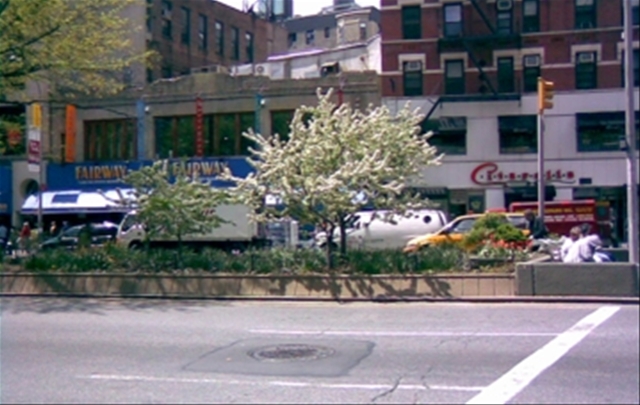
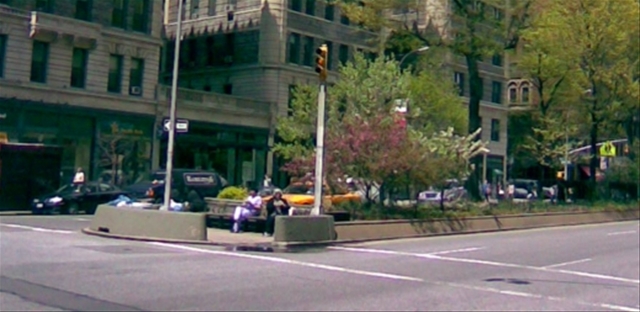
New York is filled with great little parks and park-like areas on traffic medians. There are usually benches and often tables, with or without umbrellas, provided by the city. They're a great place to eat lunch with friends or co-workers, or just to relax and observe the scene. The city fills them with flowering trees and seasonal flower arrangements. During our recent trip we saw thousands of tulips and hyacinths as we rode uptown on the buses. The medians allow pedestrians to rest for awhile. Benches are provided so they can sit down. It's not too radical an idea for Honolulu to adopt, is it?
These two pictures were taken on Broadway near 73rd Street. Shoppers at the nearby Fairways market rest on the benches as they carry or wheel their purchases home. Note that since the median is planted and there is a low wall, pedestrians are discouraged from jaywalking in middle of the street. Note also that there are barriers to protect the pedestrians and the benches.
The pedestrian crossing signals on this section of Broadway were the shortest we've observed--the red hand started flashing when we were about six feet from the far side of the street. This is in contrast to Honolulu, where the red hand can start flashing a few seconds after you step into the crosswalk. At other intersections we were able to get across without ever seeing the flashing red hand. Even if we were a few feet from the corner we always had time to get to it and walk across without the light turning against us. It goes without saying that crosswalks were well-marked. You'd think Honolulu could also make sure its crosswalks were in tip-top shape. It's the least we can ask. How come pedestrians always have to beg here?
New Yorkers Eat
In a town made for walking, it's nice that there are plenty of places to eat outdoors. From a couple of tables outside a pizza joint to this formal outdoor dining spot, New Yorkers can enjoy their meals alfresco all over the city.

New Yorkers love to eat on the street, and there's a large fleet of street vendors to accommodate every taste. This entrepreneur offers hot dogs, Italian sausages, hot knishes, shish kebab, chestnuts, pretzels, sodas, water and Snapple. Only in New York? Not really. Tokyo, Seoul, other world capitols and many US cities allow street vendors. Very pedestrian friendly. Why not Honolulu? I think knishes would be a big hit with the Bishop Street crowd.

New Yorkers Ride
Why Honolulu's bus service keeps boasting of its prizes without bringing us the services bus riders enjoy elsewhere has been a mystery to me. For example, timetables and maps. Heck, at most bus stops in our fair city, we can't even tell what buses stop there or where they are going! And drivers don't mind being early, so that if you are on time, you've already missed your bus, and it could be a long wait for the next one. If a bus in New York is running fast, it waits.
We've lived in many places, and the least one can expect is good signage. Ideally this will include maps and timetables. In a pedestrian-friendly Honolulu we will have to take the bus sometimes, and we should put pressure on the City to provide us with basic services. No more banana-republic transportation for us. They need to shape up.
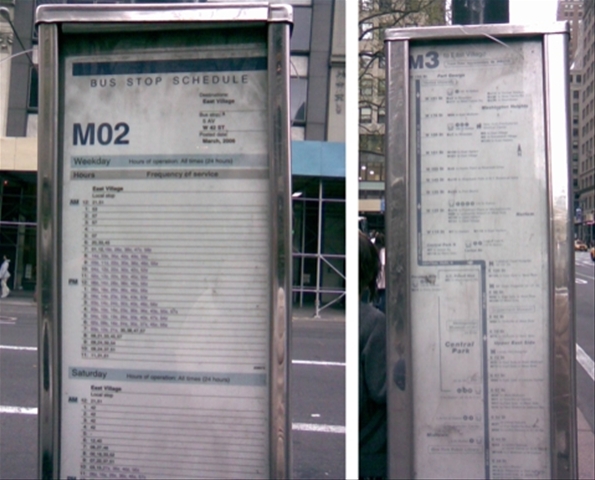
We need a revolution here before Mufi's train is built. I've concentrated on pedestrians, but bicyclists deserve their space and safety also.
Let's reclaim our streets.
Sunday, July 01, 2007
"Extreme Makeover" -- the hidden story revealed
“Extreme Makeover” home built on land purchased with state grant to a nonprofit agency