Wednesday, April 25, 2007
More than you want to know about your food
I cantell you that it made me sick. Here are some excerpts:
Billions of dollars' worth of foreign ingredients that Americans eat in everything from salad dressing to ice cream get a pass from overwhelmed inspectors, despite a rising tide of imports from countries with spotty records, according to an Associated Press analysis of federal trade and food data.Please do read the entire article. There you can read how
...
When U.S. Food and Drug Administration inspectors at ports and border checkpoints look, they find shipments that are filthy or otherwise contaminated. They rarely bother, however, in part because ingredients aren't a priority.
...
You don't have to be a Ph.D. to figure out that ... if someone were to put some type of a toxic chemical into a product that's trusted, that could do a lot of damage before it's detected," said Michael Doyle, a microbiologist who directs the University of Georgia's Center for Food Safety.
...one supplier drove a truck over tea leaves to dry them with exhaust, which leached lead into the leaves.I almost feel bad about posting this at all. I'll bet you felt ok before reading it, but now???


Safety of US food supply in doubt
In an article in today's USA Today, Human foods to be tested for melamine, the writer recapped the discovery of melamine in hog food and revealed that grain-based products used in human food will be inspected.
The threat is obvious: the FDA has to resort to testing after the fact. That is, if the stuff is found, it's because it's already in our food supply. Too late to keep it out. So what happens if someone puts something really bad in our food supply?
The article mentioned that melamine might be found in products such as:
baby formulas, breads, pasta, cereals, pizza doughs, protein shakes,energy bars and some vegetarian foods.
Yikes! What is there left to eat?
I'm not sure that this country's food supply can be adequately protected even with the best FDA oversight.
We buy most of our food from the KCC Saturday Farmers' Market. But still, the bread sold there, for example, is not made with ingredients sourced in Hawaii. Still, I think the melamine crisis is one more good reason to develop Hawaii's agriculture to the extent reasonable and possible, so that we will be less dependent on the foibles of imported products.
Try some North Shore Farms tomatoes or organic veggies from Ma`o Farm. Read The Free Range Gourmet. Eat local, stay healthy.
Discrimination alive and well on the Mainland
Yes, lucky we live Hawaii. Yesterday I went back down the very long escalator to the Bethesda Metro station. Riders of the Metro have a very well-established custom of standing on the right on an escalator or people-mover in order to allow those who want to walk by to pass on the left side. So yesterday, on my way to the Capitol to visit our Congressional delegation, I found myself standing immediately behind a blind person with a guide dog. The dog was at her left side, so of course no one could pass by. Those behind us waited patiently, not saying anything. Hey... it would only be a minute or so delay in their rush to get to the trains.
Except for one woman who started yelling. She kept it up, getting obnoxious at first and then louder and more obscene. It didn't help things, there was nothing to be done about the dog, which couldn't be in front or back of its owner anyway. Yet this lady was just spouting continuous filth at the top of her lungs about not being able to walk past someone with a guide dog. Imagine how the woman with the guide dog felt as the obscene filth echoed throughout the escalator tunnel.
Ok, I've blogged. This incident made me appreciate living in Hawaii and the tolerance of those I live and work with.
Hotels leave consumers out of ecology benefits
At the same time, I'm disappointed because I don't feel that environmental consciousness is driving these programs. Maybe I'm just too cynical, but this smacks of the profit motive at work. I have a suggestion for hotels that would show that I'm wrong about that, and possibly benefit them as well.
The Hyatt's doorknob hanger message reads in part:
Did you know that linens and towels washed daily by hotels worldwide use millions of gallons of fresh water and add tons of detergents to our environment?
As part of Hyatt's ongoing commitment to improving the environment by using less energy and creating less waste, we offer a solution. During your stay, we will change bed linens and towels every three days, while still refreshing your guestroom daily. If you do not wish to participate in this program, please contact guest [relations] or the hotel operator and your linens and towels will be replaced daily.
Ok, no one can object to this, can they? I think it's a good idea, for the reasons given. At the same time, look at the savings to the hotel itself. Not only do they save the cost of hot water and detergents, but they pocket a large saving in labor. It takes time to strip and make up a bed each day. And think of all the pillows that must be taken out of their pillowcases and stuffed into fresh ones. There is less transportation and storage of the linens, plus less wear and tear due to fewer laundry cycles. I'll bet the savings to the hotel are significant, and of course, this adds to the profitability of the chain and augments the already obscenely large salaries of its executives.
So I suggest this: pass the profits on to the consumer. Yes, give a meaningful discount to guests who choose to participate in the program. After all, your profit is at our expense. We should share in the savings brought about by the change in our behavior, that is, by sacrificing the daily change in linens in order to "save the planet."
The rack rate for the room I'm in is $500. Not that anyone ever pays that for the room (I think they're going to bill around $300 for it). So why not give back some of that outrageous charge if guests play along? That might encourage more people to stay at the hotel, leading to even better executive salaries.
There is nothing that will make consumers use alternative energy or undertake conservation programs on a large scale unless they can also save money at it. So how about it, Hyatts of the world, why not give us a discount, kick your ecology program up a notch, and at the same time improve your bottom line?
Sunday, April 22, 2007
How Montgomery County, MD. uses federal money to become bike and pedestrian friendly.
At Arlington Road there's a school. A sign says "Fines doubled 8:00 a.m - 4:00 p.m. School Days." Behind it is a 25 mph flashing school zone speed limit sign. I asked a woman walking with her son if the police ever actually enforce the law, and she said yes, they come by with a speed gun sometimes. She doesn't know whether there are few or many accidents there. No one else passed by I could ask. But you know what I'm implying with this.
But there's more.
Montgomery Avenue in Rockville is having a bike lane put in to cross I-270. According to the April 18, 2007 edition of the Gazette Regional News,
The project along Route 28 (Montgomery Avenue) is a City of Rockville project that includes building several bridges over I-270 and other ramps. The total cost is $7.6 million, of which the State Highway Administration contributed $3.7 million through the Transportation Enhancement Program (TEP)--a federal program in which money is provided to the state for nontraditional, community-based transportation projects. That means the money cannot be used for things like resurfacing or widening roads.
The bicycle and pedestrian bridge across I-270 is part of the city's 2004 Bikeway Master Plan, which is aimed at creating a network of bicycle and walking routes.
The bridge will connect routes that are east and west of I-270 and give pedestrians a safer way to cross that area and to reach Town Center.
So why isn't Honolulu tapping into that money? Does our state Department of Transportation even know about the TEP program? Do we have a "Bikeway Master Plan" to implement the city charter amendment passed by voters to make Honolulu a pedestrian- and bike-friendly city?
Stop laughing.
We merely have to raise hell a bit to get things moving and transform Honolulu into a pedestrian paradise. Stop laughing, please!
If anyone or any group wants to undertake that task, I'll happily post the news here to help gather the forces around the effort.
Here's what the Honolulu City Council doesn't want us to have
 This is the escalator to the Metro at Reagan International Airport in Washington DC. It looks like it's about 30-40 feet from the turnstile where I yanked my heavy bag off at about 4:54 p.m Saturday. That was the last time I had to lift it.
  Going up the escalator, there's a bridge to the nearby Metro station. No need to lug the bags, though, they have people movers. See pic.
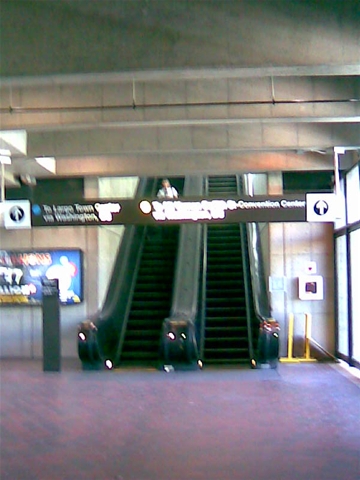 Here's the Metro station. Still no need to lift my bags. There were escalators everywhere. I paid the fare to a machine, $2.35. Actually I used my credit card because I was too lazy to get my small change out of the hand-carry bag. Yes, this research cost me only 1/10 the cost of a cab from Honolulu Airport.
So let's see... I got to Bethesda Station at 5:47. There's a really, really long escalator to the street, which I took not realizing there was also an elevator. Now, into the hotel, check in, say "hi" to some friends, and I'm relaxing in my room at 6:02.
I just want the City Council to know what they have cheated Honolulu commuters out of. Having the train go from the airport to Waikiki would add to Honolulu's attractiveness as a tourist destination, and of course residents along the way would love it too.
Monday, April 16, 2007
Rule 54, Where Are You?
 Update:Unfortunately, I got this wrong. Rule 54 applies to bills but not to resolutions. Thanks to Richard Borreca for setting me straight. While this is a bit embarrassing (I plead sleep deprivation), I'm going to leave the post here (I like the picture!). There ought to be a rule for resos, even if there isn't now. If not, it's just another opportunity for a committee chair to ignore all previous testimony and wreak her/his will on a measure. Oh, well.
I was happy to see Richard Borreca discuss legislative shenanigans in his column in Sunday's Star Bulletin, Take a guess what's going on at Capitol. Borreca's On Politics column can expose far more readers to this issue than my humble blog will ever attract.
As a reporter, of course, Borreca can't suggest that the behavior he describes (see below) can and should be changed, which is my hope. I think that if we people get together, we can have a legislature that better reflects the needs of ordinary people living in this state. And I feel we need to do that soon.
To read about "two whales mating" and some funny votes, please click on the link above for the full article. I just want to quote a short part that jibes with some of my recent gripes.
Watching the business practices of the Legislature can make you wish for an immediate tour of the local sausage emporium.As described, these actions would appear to run afoul of Senate Rule 54 (yes, the Senate actually has rules).
For instance, the Senate last week passed a resolution, SCR 77, with a title that asked the education department to study the need for teacher housing. But Sen. Norman Sakamoto's education committee then used that resolution to launch into a hearing on the needs of people from Micronesia and Palau living in Hawaii.
Sakamoto put the worries about teachers' housing into another resolution, SCR 169, even though its title was asking for an investigation of whether school dress codes "ensure the full protection and guarantee of all civil rights of students."
Here's what Senate rules say about this:
Rule 54. Bills: AmendmentsThe rule is longer, addressing floor votes as well.
...
(2) The fundamental purpose of any amendment to a bill shall be germane to the fundamental purpose of the bill.
It seems that the rules exist only to be broken. Where is Senate leadership on this? Allowing bills to be mangled at the whim of committee chairs (recall Sen. Hee recently gutted an ethics bill to put in his drug testing amendment) makes a mockery of the legislative process.
We need a rule about breaking rules. The leadership of both houses, by ignoring the rampant breaking of rules (and in fact, by routinely waiving public notice requirements) demonstrates their own lack of respect for the rule of law (kiddies, we are special, we can do whatever we want, but if you jaywalk you get a ticket).
They have indeed turned our beautiful state capitol building into a mere sausage factory. We deserve better, and we deserve a better example from our leadership.
Friday, April 13, 2007
Hunter Bishop on geothermal energy study
Why were my water/sewage bills steadily increasing while water that could be used at least to flush toilets and do the laundry was gushing off my roof? On nearby Tantalus, where houses aren't connected to city services, they make use of catchment water. Why not the rest of us?
And speaking of water, we're surrounded by waves but don't have any wave power generators. Europe is doing it, we can also.
What's new with geothermal power?
Reporter Hunter Bishop discusses a recent report on potential uses for geothermal energy and questions why we are not making more use of it.
The report explores possible economic uses besides power generation. When we lived in Japan, we visited hothouses (and of course, hot springs) which were fed by Japan's abundant geothermal resources. It's tru that Japan and other countries have this thing called "cold" for which geothermal heat is the natural antidote. But still, there are things we could possibly make use of. The mystery is why we don't.
Google is a great help in this informal research. My first hit surveys worldwide usage of geothermal resources in little capsule articles. At least, awareness of what others are doing could give us some ideas.
Nothing is truly free, perhaps, but it's clear that some forms of energy have the potential to replace expensive imported oil. It should be a priority for us to exploit these possibilities (and HECO should not be running the alternative energy show--it just doesn't make sense). Costs for energy as well as everything else keeps going up. Wouldn't it be neat to reduce the large hunk of your budget that goes to paying for water and electricity?
More on journalistic standards--are Hawaii beaches dangerous?
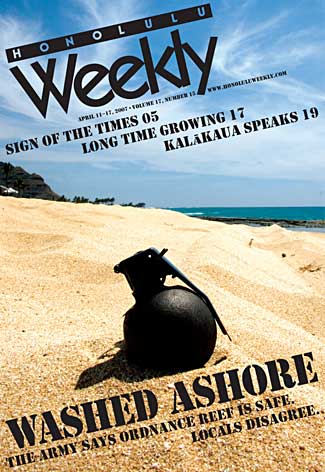 The cover of this week's Honolulu Weekly is ominous indeed: a black grenade nestled in the otherwise pristine sand and a headline in black stencil-style typeface: "Washed Ashore". Yikes! The sub-head is "The Army says ordnance reef is safe. Locals disagree." Well, sure, I would disagree if I ever found a hand grenade washed up on the beach!
Except that if you go to page 6 to read the alarming news, hidden in the lower left corner of another picture, this one of a grenade still wet and covered with seaweed, you'll find tiny white type that explains "We took a bit of artistic license with the cover image. As far as we know, our beaches are grenade free."
I wonder what tourists in Waikiki will think as they pass newspaper racks where the Weekly cover is displayed. Even those who have trouble with English and might not pick up a copy of the paper will conclude that Hawaii's beaches are dangerous. After all, a picture is worth a thousand words in any language.
Perhaps they won't come back next time. Worse, perhaps they'll take a copy of the paper back with them to warn their friends and family.
Visitors to the Weekly's website don't even get a disclaimer.
The almost hidden clarification can't undo the damage done by this unfortunate exercise of journalistic license.
Thursday, April 12, 2007
By error, the Legislature does what the people want
Regulation will not hurt either Kaiser or AlohaCare.
Kaiser has a very skilled and respected lobbyist, Chris Pablo. I think he was especially effective this session. I wish he weren't working for the dark side.
Possibly this was done as a compromise since House leadership demonstrated last session that they are against regulating health insurance premiums. This year, public pressure is on them to protect small businesses and individuals against excessive rates and to protect potential competitors against predatory low-balling of rates.
So I was thrilled to read in this morning's Advertiser, Error keeps Kaiser in insurance regulation bill. It seems there was a mistake. Indeed, the universe works in strange ways!
This morning's Star-Bulletin editorial, Restore oversight of health insurers calls for including Kaiser and AlohaCare. It seems that their wish, and the preference of many advocacy organizations, has been temporarily fulfilled.
The conference committee should leave it that way and regulate the premiums of all insurers, inclusively.
Should ads look like news stories?
In much teenier, lighter typeface, in fact in a size so small and thin that elderly readers will probably miss it, the infomercial does have the word "Advertisement." It wasn't placed there by the Advertiser, though, it's part of the ad. The Advertiser didn't do anything to let you know that the page is a full-page ad. I had to squint to read the tiny mice type.
I've previously written about two ads masquerading as stories in the Advertiser earlier this year, here and here. Those earlier ads had nothing whatsoever that would indicate they were not real news stories.
This practice raises obvious issues of journalistic standards. What are the ethics of trying to pass off ads like these as legitimate news?
Digging into the ads themselves leads me to wonder about why the Advertiser, supposedly quite profitable, decided it needed to run these ads in the first place. After all, an ad that would confuse their elderly readers should give them second thoughts before they accept it.
You can see a similar ad on the web here. Notice how teeny the single word "Advertisement" is. You know where to look or wouldn't you miss it? The ad is pretty much the same as this morning's Advertiser page except it asks for $18 instead of $8 for the free coins.
Hawaii readers get a deal--they must pay only $8 to "claim" their bargain. Readers of the Modesto Bee, on the other hand, for what appears to be the same coins, are asked to pay $18 to get the Presidential Coins free. I kind of resent that. Do they think we're some kind of banana republic or something?
Should the Advertiser be running these ads?
Obviously, that's up to them. I have nothing to say about whether they should run these ads or whether you should buy the coins.
Other newspapers have a policy, though, and won't do it without alerting their readers. Here is an example. The Advertiser might consider doing the same:
Mercury News renounces microscopic ad labelIf all of this raises your curiosity about the company, there is discussion here and more recently here. The Roanoke Times seems to have run the ad and has discussion in their article, Money for nothin'? Better read the fine print.
By Michael Stoll
Posted Nov 21, 2005
The U.S. Treasury engraves modern dollars with "microprinting" -- miniscule text that's hard to read and harder to copy -- to make it easier to spot a forgery. When typographical shrinkage appears in a major newspaper, however, it can actually make it more difficult to distinguish phony from genuine.
A page in the San Jose Mercury News on Nov. 8 had all the trappings of a news article informing readers about what seemed like a great deal: "rare" uncut sheets of real money, pitched as a perfect collectible Christmas gift that might be worth thousands someday.
But the page was actually an ad. While it was tagged with a disclaimer -- "Special advertisement feature" -- the type was so small that readers with less-than-perfect eyesight would need a magnifying glass to read it. It was about the same size as the fine print on a $1 bill, the part where it says, "This note is legal tender ..." The ad disclaimer was also printed over a gray bar, further diminishing its legibility.
Upon reviewing the ad, David Satterfield, the managing editor of the Mercury News, immediately determined that it violated the paper's policy, which explicitly states such material "must have the word 'Paid Advertisement' set above the ad content in Newton type no smaller than 14 points." The label on the page appeared to be about half that size. The policy also requires the ad to be enclosed in a two-point-thick border, which this ad was not....
As an advocate for senior citizens myself, I hope the Advertiser will re-think running these ads without a clearly visible indication of what they really are.
Imus is out--fired by CBS
Now, I wonder if something can be done about Rush Limbaugh and his racist remarks?
Wednesday, April 11, 2007
Factoid: Overthrow was not the first US military intervention in Hawaii
A report released by the Congressional Research Office, Instances of Use of United States Armed Forces Abroad, 1798-2006 updated January 8, 2007 lists no fewer than four military interventions:
1870 Hawaiian Islands. September 21. U.S. forces placed the American flag at half mast upon the death of Queen Kalama, when the American consul at Honolulu would not assume responsibility for so doing.This report attributes most US interventions around the world as intended to "protect" American lives, property or interests. The word appears 108 times in the report, so perhaps it is fair to interpret it as a euphemism.
1874 Hawaiian Islands. February 12 to 20. Detachments from American vessels were landed to preserve order and protect American lives and interests during the coronation of a new king.
1889 Hawaiian Islands. July 30 and 31. U.S. forces protected American interests at Honolulu during a revolution.
1893 Hawaii. January 16 to April 1. Marines were landed ostensibly to protect American lives and property, but many believed actually to promote a provisional government under Sanford B. Dole. This action was disavowed by the United States.
Beginning of the end of broadcast bigotry?
NEW YORK (Reuters) - NBC Universal said on Wednesday it would no longer simulcast Don Imus' radio program over its cable television network MSNBC amid an outcry over sexist and racist comments by the host.MSNBC doesn't want to give up a major profit source, but popular pressure forced their decision. I'm sure GE received numerous letters, faxes and emails, including from their own shareholders (I did my part and sent a fax to GE's shareholder communications department, where I hope it was added to a large pile of similar complaints).
NBC Universal said in a statement: "This decision comes as a result of an ongoing review process, which initially included the announcement of a suspension."
NBC Universal is 80 percent owned by General Electric and 20 percent by Vivendi.
Imus' derogatory remarks in reference to the Rutgers University women's basketball team members was only the tip of the Imus iceberg. It was met by an inadequate suspension, which the public didn't buy--he was left still on the air, with his suspension timed to begin Monday and end just before network ratings are to be measured. In other words, pretty much a pro-forma action.
But the public response continued, and major advertisers pulled out from the program. Now MSNBC is driven to do the right thing also.
An awful lot changed with the November elections. Suddenly, people are no longer as passive, as willing to take the crap conservatives and conservative media still dish out. While I don't expect any miracles, I do hope that media outlets and their corporate owners will notice the change in wind direction if for no other purpose than to continue feeding their own greed.
The candidacy of Barack Obama should also give them pause. The Imus of the world, formerly a source of corporate profit, could begin to hurt the bottom line if left to do their thing as Obama moves forward in his quest.
Tuesday, April 10, 2007
Who cares about the public anyway: House hides its floor amendments from view
Look at what happened today, for example. The House blindsided the public on the floor amendments it will consider today, while the Senate made them available for public scrutiny in advance. What a difference! If you wanted to have some last words with your Senator before they went in to debate a measure, you had all the information you needed. If you wanted to communicate with your Representative, you were given nothing. Nothing. Forget about it.
Here's how it played out on both sides today.
Each morning, both houses publish the Order of the Day, setting out what will be done in the floor session. Today's Senate Order of the day is here, and the House Order of the day is here. These are pretty dull reading unless you have been following some bills and want to be informed of what's going to happen to them. Especially important are floor amendments. These are amendments that will be proposed on the floor, and they're important because they can fix a problem or cause a problem (depending on which side of an issue you're on).
The Senate made its floor amendments available ahead of time. You could have reached one or more senators before the session started at about 10 a.m. I'll show you how that works in a moment.
The House did not make their amendments public. They remained secret. If you are concerned about a particular bill, I'm sure you'll appreciate what this means to you. You were left out of the legislative process for that bill. Your Representatives just did their own thing on it.
Ok, here's the proof. Not only that it can be done (the House can't claim "technical difficulties") but also that where there is a will to include the public it's easy to do so.
My proof is very simple: Here are the links to each of today's floor amendments on the Senate side. You needn't click, these are just by way of illustration. The point is that you can click. HB928, HB1836, HB1152, HB1909, HB1345, HB367, HB1018, HB1757, HB1608, and HB1848
Here are the floor amendments for the House. And of course, you can't click, these amendments are not available to me or to you. SB1803, SB12, SB1412, SB1792, SB1882, and SB148.
To end on a lighter note, in fact, I was curious what will happen today to the bill proposing to drug-test elected officials (HB1909). I was interested to learn the Senate's solution: would they allow themselves to be tested? The answer is "yes", but don't hold your breath. The floor amendment reads as follows:
"SECTION 6. This Act shall take effect on July 1, 3211."
Bioterrorism made easy: the contaminated pet food wheat gluten was "food grade"
I doubt any terrorists are still dreaming of mushroom clouds or hijacking airplanes. They now have easier alternatives. The latest possibility: attack the food chain, because it has proven so vulnerable.
No, I don't mean dumping more e-coli onto the spinach fields (though how do we know it wasn't a test of bioterrorism?). Check this out: the melamine-contaminated wheat gluten that killed pets and was responsible for a massive recall was food grade. Yes, it could have (and might have) been used in human food.
If you don't feel queasy enough already, read this article by Huffington Post blogger David Goldstein: Tainted Wheat Gluten Sold as "Food Grade." An excerpt from the article, and the reason we all should be concerned:
Wheat gluten is sold in both "food grade" and "feed grade" varieties. Either may be used in pet food, but only "food grade" gluten may be used in the manufacture of products meant for human consumption. Published reports have thus far focused on tainted pet food, but if the gluten in question entered the human food supply through a major food products supplier and processor, it could potentially contaminate thousands of products and hundreds of millions of units nationwide.Look how vulnerable we are here in Hawaii. We could be a prime target for terrorists because of the huge military population involved with the Pacific Command. Of course, where bioterrorism is concerned, the good stuff is classified, so there are things we know about and lots that we don't, and even the things we know about are very scary. Who would have thought that a Russian journalist could have been poisoned with a teeny bit of a radioactive substance very few of us had even heard about before?
Stephen F. Sundlof, director of the Food and Drug Administration's Center for Veterinary Medicine said the FDA is not aware of any contaminated gluten that went into human food but said he could not confirm this "with 100 percent certainty." Wheat gluten is a common food additive used as a thickener, dough conditioner, and meat substitute. It is widely used as an additive in commercial bakery items and special purpose flours.
Imagine that substance in the water supply. Far fetched? I don't know. If it's easier for you, imagine a gigantic recall of baked products should melamine be discovered in the baguettes.
An article discussing this further appeared on the DailyKos last week: DHS and the coming food disaster:
The pet food contamination incident is certain to catch the attention of terrorists looking for a vulnerability to exploit. But, even without a terrorist threat, the current food system would be a disaster waiting to happen.So I'll leave you with the above articles and the sobering thought that Bush's defanged FDA may be our only line of defense.
Monday, April 09, 2007
Your questions answered on drug testing elected officials in Hawaii
1) Q: Won't a hair test be used?
A: I don't think so. Anyway, some legislators don't have hair to test. And hair tests would mean no parties for elected officials for a long, long, time, not just for the prior weekend.
2) Q: If drug testing is good for teachers, isn't it good for elected officials?
A: I don't think Hawaii's teachers have a drug problem. If legislators think our elected officials do, they should go ahead and pass this bill. It would be the only responsible thing to do, right? I want them to feel responsible.
3) Q: Was it the Lt. Governor who asked Sen. Hee to insert drug testing language into HB1909?
A: Not as far as I know. It is alleged to be someone from the House side. (You know who you are...).
4) Q: Will tests be conducted in the Lt. Governor's office?
A: (Ok, I made that one up myself). Maybe. Why not. I don't think he'd turn down the opportunity.
5) Q: Do women also have to pee in a cup?
A: I believe so, this isn't my area of expertise. But don't worry, the amendment was designed to kill the bill, so no need to start practicing.
I'll add two more of my own:
 6) Q: Will the governor have to pee in a cup?
A: No. I assume she'd veto this first, if it ever passed.
7) Q: Will the Lt. Governor have to pee in a cup?
A: Wouldn't he want to set a good example?
Iraq troop escalation estimates escalate
A current estimate posted on bradblog.com reveals that this estimate may also be low. The author calculates the number of troops based on current announcements.
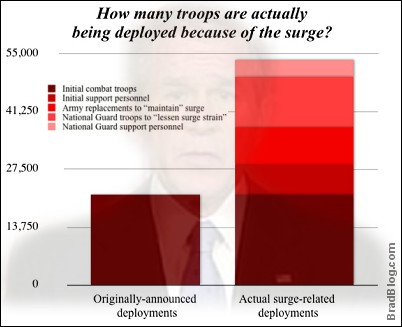 And all estimates so far omit the 100,000+ mercenaries--although Congress calls for reducing funding for troop deployment, that would not affect the huge mercenary army deployed by this country in Iraq.
illustration: bradblog.com
Budget estimates have also escalated from the original $6 billion to an estimated $27 billion, according to a Congressional Budget Office estimate, if the deployment lasts for 12 months.
No reply from Senate President Hanabusa on resurrection of psychologist bill
That bill would make it legal for psychologists to prescribe certain psychoactive drugs. It has been widely and sometimes noisily debated, but finally died.
There's no reply yet from Senate President Colleen Hanabusa on how it happened that the bill was hurriedly re-scheduled for a vote. It was re-heard and voted with less than even 24-hours public notice, forget about the rule requiring 48-hours notice. Tomorrow is the floor vote on that bill.
The Advertiser referred to its companion bill in an editorial this morning:
The shortage of psychiatric care in rural communities is dire, but the solution is to encourage telemedicine services and fund salaried positions for psychiatrists on the Neighbor Islands, not to create a second tier of care. This should not pass in its current form.The Advertiser thinks it's a bad idea, I think it's a bad idea, mental health advocates think it's a bad idea--but none of us have had the luxury of hiring a lobbyist who used to work in the Legislature to push their bill.
Senator Hanabusa should explain why exactly she approved a second vote on this bill. Other bills don't get a second chance, this one died and should have remained dead. She should also explain why the public was blindsided on the new vote.
I just wanted to keep you up to date on legislative shenanigans. This looks like a good one for someone to investigate.
OK, legislators, time to learn to pee in a cup
 Dear Legislators:
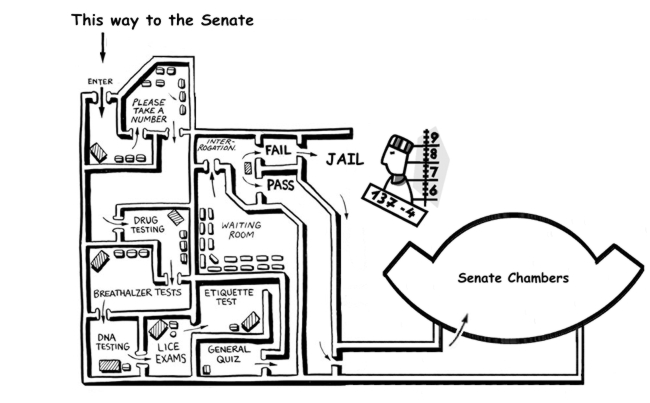
If teachers can do it, you can learn too! HB1909 was a popular bill setting up ethics committees. It's been gutted despite having gone all the way with supportive public testimony. What Sen. Hee put there is designed for you not to like--drug tests for elected officials. Yes, you!
Sen. Hee is proposing what we call a "gateway test" (you've probably heard that expression). First, you get used to having your personal privacy invaded with a drug test. Then one day, someone has an alcohol problem and so they add in an alcohol test and suddenly it's no weekend birthday parties for you anymore!
Your private lives will no longer be yours, they'll belong to the drug testing cabal. One drink and you'll have nightmares of Ed Kubo or Peter Carlisle bustin' your door down in the dark of night.
Hawaii's state constitution gives everyone an intrinsic right of privacy. That means that what happens on the weekend in your private life should remain private.
The public is demanding accountability from its government. The best thing you could do tomorrow is restore HB1909, putting back the ethics committees and taking out the invasive drug testing. It won't do to just vote it down and let this maneuver to kill the bill succeed.
It's ethics in government that the people want. Not to intrude on your personal lives.
Please do the right thing.
Sunday, April 08, 2007
Greg Palast on US attorney debacle
Greg Palast is best known here for his reports on the US 2000 and 2004 elections.
For an example of his investigative reporting see this article on the appointment of a Karl Rove aide as US attorney in Arkansas. Don't miss the hilarious explanation of how Palast came to receive Rove's emails on this appointee's shady past.
Check out Palast's audio and video reporting on his multimedia page.
Saturday, April 07, 2007
Unfair labor practice charges filed against the Hawaii Tribune-Herald to be heard by the National Labor Relations Board
All has not been well over at the Hawaii Tribune-Herald for some time. A press release yesterday from Local 39117 of the Hawaii Newspaper Guild details 13 charges filed against the Tribune-Herald for unfair labor practices.
You can read about it in this article over at the Newspaper Guild website. According to the Guild, the paper has until April 13 to respond to the charges. A hearing is set for 9 a.m., June 19, 2007, at an as yet undisclosed location in Hilo.
A prior charge in March 30, 2006 by the NLRB concerned the October 2005 firing of reporter Hunter Bishop. Bishop blogs over at hunterbishop.com but is careful to separate his union issues from his reporting on the blog. Reporter/blogger Ian Lind has followed this also (see his March 20 post).
While I am obviously a believer in the news value of the blogosphere (check out quick links on the left side of this page), it's not possible to make a decent living from it, nor are blogs a replacement (yet!) for proper newspapers. It distresses me to see experienced reporters in Hawaii separated from their craft.
Friday, April 06, 2007
Protecting elderly pedestrians and the Law of the Splintered Paddle, Ke Kanawai Mamalahoe
The safety of pedestrians has become a hot issue due to a sudden spurt of deaths this year. The state Department of Transportation had done nothing at all to improve pedestrian safety despite an August 2006 report by AARP on its survey of dangerous intersections. As we near the end of the legislative process, there are bills to require them to take action.
DOT's initial response was only to add countdown timers to crosswalk signals, but as the carnage continued, especially involving elderly pedestrians, advocacy groups and legislators debated the issue and refined the bills. Instead of studying the problem and taking action in 2010 (as the DOT responded), the bills now call for immediate action and include a provision for enforcement of existing laws. Something needs to be done to shift the focus from changing pedestrian behavior to correcting the dangerous driving habits of Hawaii motorists that result in death and injury.
There is some interesting reading in HB357. One section will be unique in the country if it passes into law. This section recognizes that pedestrians are entitled to protection according to the Hawaii State Constitution:
Making Hawaii's roadways safer for pedestrians is consistent with Kamehameha's famous law, Ke Kanawai Mamalahoe, the law of the splintered paddle, which assures that every man, woman, and child is able to travel freely and in peace. This law is established as state law in article IX, section 10, of the Hawaii state constitution:It's interesting to see King Kamehameha's famous law invoked to protect our elderly pedestrians.
"Let every elderly person, woman and child lie by the roadside in safety -- shall be a unique and living symbol of the State's concern for public safety."
Will the Honolulu Police Department follow the King's edict and step up enforcement of laws by ticketing motorists?
Here is some history, from the Wikipedia:
Mamalahoe, or law of the splintered paddle, is a precept in Hawaiian law, originating with King Kamehameha I in 1797. The law, "Let every elderly person, woman and child lie by the roadside in safety," is enshrined in the state constitution, Article 9, Section 10, and has become a model for modern human rights law regarding the treatment of civilians and other non-combatants during battle. It was created when Kamehameha was fighting in Puna. His leg was caught in the reef, and a fisherman hit him mightily on the head with a paddle. Luckily, Kamehameha was able to escape. Years later, the same fisherman was brought before Kamehameha. Instead of ordering for him to be killed Kamehameha ruled that he had only been protecting his land and family, and so the Law of the Splintered Paddle was formed.
The complete original 1797 law in Hawaiian and translated to English:
Māmalahoe Kānāwai:
E nā kānaka,
E mālama ‘oukou i ke akua
A e mālama ho‘i ke kanaka nui a me kanaka iki;
E hele ka ‘elemakule, ka luahine, a me ke kama
A moe i ke ala
‘A‘ohe mea nāna e ho‘opilikia.
Hewa nā - Make.
English Translation
Law of the Splintered Paddle:
O my people,
Honor thy god;
Respect alike [the rights of] men great and humble;
See to it that our aged, our women, and our children
Lie down to sleep by the roadside
Without fear of harm.
Disobey, and die.
Thursday, April 05, 2007
What to do about all this?
For many readers, all these stories of dark deeds at the Legislature may be boring stuff. For those of us who invest hundreds of hours giving testimony each year, it can be awfully discouraging when a worthwhile bill dies due to behind-the-scenes hanky-panky. It can also cost you real money--either in new taxes or in the loss of protection.
Last session health care rate regulation died. In the aftermath, the Legislature was forced to give up its "embedded lobbyists," but still, the damage was done and employers pay higher rates than they might if regulation were still in force.
A nasty maneuver introduced a 61-page amendment without public review, killing the gas cap law. We're all paying for that now, at the pump. Anyone owning a SUV or truck is paying big time. All thanks to an undemocratic attitude that says "anything goes" if legislators can get away with it.
I'm not exaggerating. There are rules, but they are broken. There's a 48-hour notice requirement, but it is routinely waived. And so on.
Let's not even talk about our lawmakers who take big bucks from the tobacco industry, for example, and then try to undo laws prohibiting smoking! There is oil money, tobacco money, and much more influencing legislation in Hawaii, same as elsewhere.
So what can we do?
It's doubtful that any legislative body will clean up its own act. Since we don't have initiative (the ability of voters to put their own measures on the ballot), bringing democracy to Hawaii will be tough to do.
After the legislative session closes will be the time to get together and organize for change.
If you would like to be notified of future meetings, please send an email to the "leak" address below. Oh... and thanks for all the tips!

Please keep your hot tips coming. If anyone is aware of any other amendments that are not available to the public before a hearing, or if you attend a hearing at which the chair pulls a secret amendment "out of a hat" and asks the committee to pass it, please send the info to leak@bringsunshinetohawaii.com.
Bad, bad day for sunshine at the Legislature
 Where to begin? I'm sure I don't know half of what went on yesterday.
One tip emailed some details on this almost-secret hearing held by the Senate Committee on Commerce, Consumer Protection, and Affordable Housing.
Defeated bill resurrected, public blindsided
There has been a pitched battle for several years between groups representing psychologists, psychiatrists, mental health advocates, and other advocacy groups over whether psychologists should be given limited prescriptive authority in Hawaii (only two other states allow it, meaning 48 states do not). The bills have been defeated in prior years. The psychologists hired former legislator Alex Santiago as their lobbyist.
HB 1456 SD1 failed this year too, but don't go away yet. It was heard by Senate CPH on 3/29/07 and failed to pass on a vote.
My tipster reported that on Tuesday Santiago begged senators to reschedule the bill for another vote--and they did! Not only did the hearing not have the required 48-hour notice, it appears that it may not have had 24-hours notice (the bill status message seems to have been updated at around 11:45 the previous day, and the hearing was at 10:00 a.m.). The status message is here, you can see how this played out yourself. Quite a mystery, right?
The public was blindsided, of course. We all thought the bill had died. Suddenly it was resurrected and passed. Why? I called Senate President Hanabusa's office yesterday to find out what was behind the rescheduling and the panic to hold another vote, but her office has not yet returned my call.
This is a dark day for transparency in government in Hawaii.
Drug testing snuck into ethics bill (unethically?)
Well, whether sneaking an unrelated text into a bill is unethical is something we'll have to leave to the ethicists. Here's what Senate rules have say:
Rule 54. Bills: AmendmentsChair Hee inserted a new section into HB1909. The text is at the very end of this message in case you'd like to see what our elected officials will have to go through if this passes.
...
(2) The fundamental purpose of any amendment to a bill shall be germane to the fundamental purpose of the bill.
Whether or not you support drug testing of elected officials, consider that this was the only referral for this bill. To the best of my knowledge there was no testimony to insert this language into a bill that regulates conduct of elected officials on the job. This language regulates what they do in their private lives. Putting it in was just something that the chair wanted to do.
Or is it that simple? Many legislators will correctly object to the provision that they be drug tested. So putting this language in could be a poison pill intended to kill the ethics bill.
Who might have spoken with Sen. Hee and asked him to put it in? There are rumors. There's no way I can verify them. But the legislator involved knows who he is.
Legislators should object to this sneak attack. Elected officials are needlessly intruded upon by testing. Should there be a false positive, they run the risk of being kicked out of office if they can't prove the test was faulty. Not to mention the hassle of having the test re-evaluated to challenge the result.
Hawaii also has a strong right of privacy in Article VI of its Constitution. Drug testing can be considered an intrusion into people's private lives or even an "unreasonable search." Article VI also requires the legislature to take affirmative steps to implement this right. Privacy means that what someone does over the weekend at home is their business and theirs only.
Surely, this has nothing to do with the rest of the bill, which concerns forming ethics committees and restrictions on lobbying.
And there will be no testimony taken on what Hee has done. In other words, the public has been blindsided yet again.
HB1909 will have a floor vote on Tuesday. If you object to drug testing of public officials, or if you object to sneaking amendments in at the very last moment without public input or review, you can ask senators to amend that part out of the bill. An email address that reaches all of them is sens@capitol.hawaii.gov. I suspect you would be doing them a favor by asking them to get rid of this amendment to HB1909 (the rest looks good to me).
It's been a dark day for accountability in the legislature.
Please keep your hot tips coming. If anyone is aware of any other amendments that are not available to the public before a hearing, or if you attend a hearing at which the chair pulls a secret amendment "out of a hat" and asks the committee to pass it, please send the info to leak@bringsunshinetohawaii.com.
---------------
Text of the new amendment:
§78- Elected officials; drug testing;disqualification and forfeiture of office.
(a) All elected officials shall submit to testing for illegal drugs after certification of their election and prior to taking the oath of office. Thereafter, elected officials shall submit to testing for illegal drugs if there is a reasonable suspicion that the official is using drugs. Testing shall be conducted in compliance with chapter 329B. Testing shall be funded from the budget of the branch of government to which the official has been elected. Test results shall be provided to the personnel officer of the branch of government to which the official has been elected or in which the official holds office and the personnel officer shall take action, as appropriate, to effectuate the purposes of this section.
(b) Any elected official who tests positive for illegal drugs shall immediately be disqualified from taking office and forfeit any office held.
(c) For purposes of this section: "Elected official" means the governor, lieutenant governor, members of the senate and the house of representatives, county mayors, elected county prosecutors, members of the county councils, members of the board of education and of the board of trustees of the office of Hawaiian affairs, and any person certified pursuant to section 11-155 to have won election to one of these offices but who has not yet taken the oath of office. "Illegal drug" means any controlled substance, as
defined in chapter 329, for which the person does not possess a valid prescription.
Principal of Mid-Pacific Institute admits failure of student drug testing program
What he said was that they had found no positives among the students who volunteered to be tested, but nonetheless deemed this a success.
I wrote about this earlier and questioned why Mid-Pac administrators felt the school had a drug problem at a time when studies showed that drug use among students in Hawaii and nationally has been on the decline for years. More and more, students understand that drugs can be misused and are looking out for themselves.
The lack of any results in the program certainly validates that students are smarter than administrators at Mid-Pac.
Tuesday, April 03, 2007
"Why does it matter?" you may ask?

My last post was the result of an email I received complaining about the third bill on the agenda of a House Finance Committee meeting today. Remember that what is on that agenda is not available to the public unless you ask for copies--that is, if you live close to the Capitol, can get off work, and are willing to wait ages to find a parking place, or have it sent to you if you have a fax machine handy.
What good is the 48-hour notice if what's to be discussed is unavailable to the public without a hassle?
The writer did go to the trouble to have the third bill (SB679 HD2) faxed to her, and found something to object to.
I read through the text also. It looks like a number of disaster preparedness issues have been dumped into this one bill. That is to say, it is now a potentially very important bill to very many people and organizations. I'm wondering if any of them have seen it. The committee will hold a hearing anyway and likely pass the bill. At this stage of the legislative session, it could become law without further hearing. And it will never have been exposed to the public in its final form.
I applaud the legislature taking control of the disaster planning process--somebody needs to do that, and hooray for our legislators.
But a bill this comprehensive should be fully exposed to the public. There might be concerns. For example (take a deep breath before reading):
- The proposed draft creates a commission with extensive oversight over almost everything in the state except public toilets (they forgot that). Members are unpaid but responsible for developing land use policies, recommendations for building codes, ensuring reliability of the state's power generators, providing backup power for selected radio stations (!), recommending tax credits, placing/replacing sirens, expanding radio and video into areas of the state that don't have any, working with the Department of Health to ensure the structural integrity of hospitals, ensuring access to ports for ships carrying munitions and weapons, working with DOT to develop alternate transportation routes to be used when major roads become inaccessible (hey--hurry up on that one, we could use those new roads!), etc. etc.
- It establishes a Director of Disaster Preparedness to be appointed by the governor, but puts the position under DAGS. Yikes! If you want something (anything) done, why put it under DAGS?? I would think it might be a cabinet position.
- Assisted living facilities must hire sufficient staff 24/7 to conduct evacuations (there's much more). Probably they are already holding disaster drills, but in any case, they might want to have input on all the details this bill proposes to require of them.
Yes, I'm concerned that care home operators might be taken by surprise if this bill becomes law, that the proposed commission is overextended and under(un-)paid even before it is created, that the bill could be a back door into sneaking martial law into Hawaii, and yes, that there won't be enough public toilets in an emergency as they move people over those wonderful alternate routes to somewhere still undisclosed.
You may laugh, but better add diapers to your emergency kits. The H-1 is already jammed without an emergency and there are no amenities.
There is much good in this bill and still some concerns. By not posting the text on the web, by omitting the news of the proposed HD2 from the bill status page, by changing the title of the bill and otherwise obfuscating its content, the House risks turning what might be a good law into sausage.
That's why it matters.
Please keep your hot tips coming. If anyone is aware of any other amendments that are not available to the public before a hearing, or if you attend a hearing at which the chair pulls a secret amendment "out of a hat" and asks the committee to pass it, please send the info to leak@bringsunshinetohawaii.com.
Monday, April 02, 2007
Who cares about the public anyway: House will hear unavailable bills tomorrow
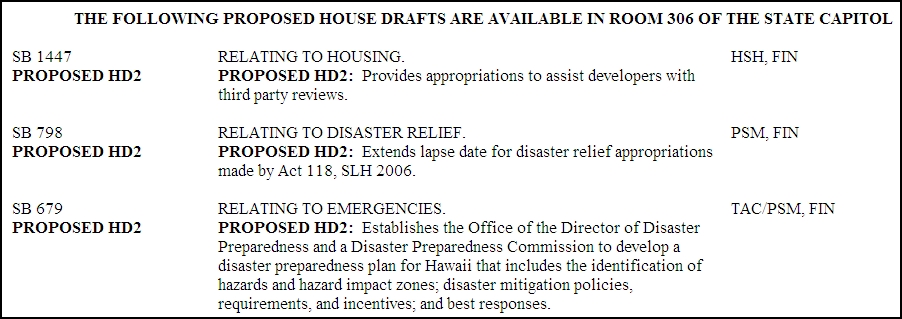
Of the three bills to be heard, none of the proposed amendments are posted on the website. Much of the public will never see the text and won't be able to prepare testimony on these bills.
Also, the third bill, SB679 is titled Relating to Emergencies on the hearing notice but the bill on the web is Emergencies; Tourism, and was a bill about having the governor declare a "tourist emergency" if something happened here or elsewhere in the world, for example. The proposed new bill is a complete gut-and-replace. I had a peek. Not only has the title changed (is that allowed?) but the contents are entirely different.
At this time in the session, bills are being mixed and combined. The Senate continues to post its actions on the web so that the public is informed, the House persists in ignoring the public's right to participate.
--William H. Vanderbilt
Hanky-panky at the Senate?
Comment from: Kalani K. [Visitor]Certainly, I can't say anything about the merits of the suit, which I have not looked into.
...Former Senate President Robert Bunda introduced SCR 48 to go after the Hawaii Disabilities Rights Organization because they sued one of his campaign donors and GIA recipients ORI Anuenue, Inc. aka Helemano Plantation. The Hawaii Disabilities Rights is suing ORI/Helemano Plantation because of allegation of severely underpaying workers-- below minimum wage. In fact the hearing on Wednesday went on for 3 hours. He went as far as asking them to drop the suit if he drops the resolution. ...
04/01/07 @ 14:38
Hawaii Disability Rights is Hawaii's Protection and Advocacy organization. I am familiar with the work they do and doubt that a frivolous lawsuit would be filed--they are overworked and just don't have the time. But that's not the issue here.
The issue is whether the Senate is being used for retaliatory purposes with the introduction of SCR 48, "Requesting the Hawaii Disability Rights Center to Provide an Analysis of the Laws Governing its Access to Patient Records and its Policies and Procedures for Conducting Investigations," and whether Sen. Bunda has a conflict of interest in introducing it.
Sadly, it would not be unprecedented for government to retaliate against those supporting the rights of persons with disabilities in Hawaii. Through the decade of the Felix Consent Decree there were examples including repeated, punitive audits against professionals who sought only to make sure the children got the proper treatment. I could go on, but let's just look at this issue.
I'm not sure that the Ethics Commission reads the Advertiser's blog. As a citizen of the state, I would be upset to find that the commenter's analysis is accurate, particularly the last quoted part above, "He went as far as asking them to drop the suit if he drops the resolution." So the best thing I can think of doing is popping a copy of this post over to the Ethics Commission to see what they might have to say.
I'll do that in the next 5 minutes.
Senators have their own grapevine. If they feel there is merit in the commenter's report, they should not let this resolution advance. The Hawaii Disability Rights folks don't need the extra workload complying would require--it would take away from the time they should spend fighting for people's rights.
Stay tuned.