Thursday, September 21, 2006
Ethics commission can decide on Randall Yee ad
Ok, I'm not an expert on these things. So I have asked for help from a higher power.
The September 19 ad in the Honolulu Advertiser which I mentioned in the previous post includes that box with the pic of Pat Hamamoto. I sent my question to her but so far no reply. There is now a press release on the DOE website that doesn't make it clear whether the superintendent gave permission or not.
But her statement in the ad ends, "We appreciate his support and leadership in working with the Department...” and is signed with her title “Superintendent, Department of Education”. This moves the question into a new realm. Could this be a Departmental endorsement of Mr. Yee’s leadership qualities? The reader might think so.
Could the superintendent say she didn't give permission? Remember, her annual review comes up in one month, and Randall Yee runs it...
So this afternoon I faxed the material to the Hawaii State Ethics Commission and asked if they might investigate. I'm not making an accusation, I am asking them to investigate. If there's no problem they won't, if there is, I hope they will. Yee is a member of a board, and politics and campaigning aside, there are ethical constraints on a person in that position.
The September 19 ad in the Honolulu Advertiser which I mentioned in the previous post includes that box with the pic of Pat Hamamoto. I sent my question to her but so far no reply. There is now a press release on the DOE website that doesn't make it clear whether the superintendent gave permission or not.
But her statement in the ad ends, "We appreciate his support and leadership in working with the Department...” and is signed with her title “Superintendent, Department of Education”. This moves the question into a new realm. Could this be a Departmental endorsement of Mr. Yee’s leadership qualities? The reader might think so.
Could the superintendent say she didn't give permission? Remember, her annual review comes up in one month, and Randall Yee runs it...
So this afternoon I faxed the material to the Hawaii State Ethics Commission and asked if they might investigate. I'm not making an accusation, I am asking them to investigate. If there's no problem they won't, if there is, I hope they will. Yee is a member of a board, and politics and campaigning aside, there are ethical constraints on a person in that position.
Tags:


Wednesday, September 20, 2006
Yee fails to do homework, runs misleading attacks in ads
Board of Education chairman Randall Yee's ad in yesterday's Honolulu Advertiser (p. B6) features a picture of Yee with Superintendent Pat Hamamoto along with an apparently positive statement, though not exactly an endorsement.
Since Yee is pretty close to being the superintendent's boss, this seems like an ethical violation at least. I have to say that I don't believe Pat Hamamoto would authorize the use of her picture and statement in this way.
Speaking of Yee's ads, his ad in today's Advertiser attacking the incumbent, long-time legislator Senator Les Ihara, seems to contain egregious errors of fact. For example, he states that his opponent has only introduced two bills that were passed by the Legislature. That's ridiculous, I am aware that there were plenty more than that. Les has been a leader in legislation affecting senior citizens, which I follow, and in other subject areas. I've sought his help and support many times with these issues.
Les has also been both a majority leader in both the senate and house, and so was responsible for shepherding lots of bills through the legislative process to enactment.
I'm sure he will reply to this slight.
Meantime, I'm going to check my spelling and grammar and email this post to Pat Hamamoto to see if she might have anything to say about inclusion in the ad yesterday.
Since Yee is pretty close to being the superintendent's boss, this seems like an ethical violation at least. I have to say that I don't believe Pat Hamamoto would authorize the use of her picture and statement in this way.
Speaking of Yee's ads, his ad in today's Advertiser attacking the incumbent, long-time legislator Senator Les Ihara, seems to contain egregious errors of fact. For example, he states that his opponent has only introduced two bills that were passed by the Legislature. That's ridiculous, I am aware that there were plenty more than that. Les has been a leader in legislation affecting senior citizens, which I follow, and in other subject areas. I've sought his help and support many times with these issues.
Les has also been both a majority leader in both the senate and house, and so was responsible for shepherding lots of bills through the legislative process to enactment.
I'm sure he will reply to this slight.
Meantime, I'm going to check my spelling and grammar and email this post to Pat Hamamoto to see if she might have anything to say about inclusion in the ad yesterday.
Tags:
Tuesday, September 19, 2006
"Please tell me: why is Waikiki so nice and why are our schools so bad?"
asks a girl drawn by artist Oren Schlieman on a poster titled Please explain this to my daughter today, not tomorrow. I was drawn to this poster as soon as I entered the Peggy Hopper Gallery this evening. It's part of a show entitled Seeing Red: 35 designers confront contemporary issues featuring "political posters by 35 local, national and international designers addressing issues from peace, global warming, affordable housing, international policy, women's rights, Hawaii schools, religion in politics and more."
Posters will be on display from Thursday, September 21, 2006 through the end of October.
Artist Schlieman asks a very pertinent question of course. The accompanying note says that the poster was inspired by two headlines in the papers, "Tourism Up" and "SAT Scores Down."
Posters are all screen printed. The only colors used are red and black, so that the exhibit itself has an intense visual impact created by the vibrance of the pure ink colors.
A poster is accessible, something you can own, good for putting on the wall, plebian. A gold filigree frame isn't needed for the people's art.
Proceeds go to charities designated by each of the artists.
Seattle artist nancy Stentz's striking poster
The Pegge Hopper Gallery
1164 Nuuanu Avenue
Honolulu, HI 96817
(808) 524-1160
www.peggehopper.com
Posters will be on display from Thursday, September 21, 2006 through the end of October.
Artist Schlieman asks a very pertinent question of course. The accompanying note says that the poster was inspired by two headlines in the papers, "Tourism Up" and "SAT Scores Down."
Posters are all screen printed. The only colors used are red and black, so that the exhibit itself has an intense visual impact created by the vibrance of the pure ink colors.
A poster is accessible, something you can own, good for putting on the wall, plebian. A gold filigree frame isn't needed for the people's art.
Proceeds go to charities designated by each of the artists.
Seattle artist nancy Stentz's striking poster
laments America's decline of power ... True power is not in the misuse of strength but how the people of this country and the rest of the world will be treated."If you can, go see this exhibit, maybe buy a poster. Chinatown municipal parking is just around the corner on Beretania.
The Pegge Hopper Gallery
1164 Nuuanu Avenue
Honolulu, HI 96817
(808) 524-1160
www.peggehopper.com
Monday, September 18, 2006
Do you think teachers should be allowed to strip search students? If not, act now...
How would you feel if your son/daughter came home from school and announced that she or other students were strip searched by a teacher or school administrator? Think that this could never happen? Then you don't know our Congress very well.
Senior House Republicans are pushing HR 5295 with the Orwellian name "The Student Teacher Safety Act of 2006" which would permit warrantless searches of every student, at any time, including strip searches, for any reason a teacher or school administrator wants. Far from ensuring student safety, it puts children at risk from any pervert who manages to get a teaching job in a public school.
Yes. Imagine that Republicans push this through. What is going on in that dark closet down the hall? Is a teacher "strip searching" your daughter?
This bill would allow schools and police to invasively search students based on the mere suspicion that (for example) one of them in the school might have drugs. That's right, no individual suspicion is required. They could search all students if they like.
Students have 4th Amendment rights just as do adults.
The bill is being fast-tracked to the House floor.
This is clearly an outrage. If you think so too, better contact your congressperson and put a stop to it.
Senior House Republicans are pushing HR 5295 with the Orwellian name "The Student Teacher Safety Act of 2006" which would permit warrantless searches of every student, at any time, including strip searches, for any reason a teacher or school administrator wants. Far from ensuring student safety, it puts children at risk from any pervert who manages to get a teaching job in a public school.
Yes. Imagine that Republicans push this through. What is going on in that dark closet down the hall? Is a teacher "strip searching" your daughter?
This bill would allow schools and police to invasively search students based on the mere suspicion that (for example) one of them in the school might have drugs. That's right, no individual suspicion is required. They could search all students if they like.
Students have 4th Amendment rights just as do adults.
The bill is being fast-tracked to the House floor.
This is clearly an outrage. If you think so too, better contact your congressperson and put a stop to it.
Tags:
Thursday, September 14, 2006
Thank Hawaii's House leadership for what you're paying now at the pump
Hawaii consumers have good reason to be unhappy with their state representatives for the way they are being robbed at the pump by oil companies right now. All but Bev Harbin (District 28) voted to get rid of Hawaii's gas cap legislation.
From the information below you can calculate how much the loss of the gas cap has cost you and your family. All you need to know is how many gallons of gas you buy.
The money taken out of your pockets by state legislators could have helped pay for the mortgage or rent, for food, or for that holiday to the Big Island or to Vegas. Instead, it's been diverted into the pockets of oil company executives and lobbyists. By whom? By your own elected state House representative (except, again, for Rep. Harbin who did the right thing).
It was too easy for oil industry lobbyists and House leadership to convince legislators that they should cave in to pressure and get rid of the cap, nevermind its effect on households and small business owners across the state. Perhaps Democrats were afraid that it would hurt them in the polls since propaganda against the gas cap was so successful. Well now this has backfired, and it should hurt them in the polls that they killed, rather than improved, the previous law.
If voters are upset that Hawaii's gas prices remain at stratospheric levels, they might remember who did this to them. Take this into consideration as you vote.
House leadership sticks it to consumers
In particular, voters should be upset at House leadership. In the press release below, which is reproduced in its entirety (hey--this is a blog, I don't need to re-write a good story), you'll read how Reps. Morita and Caldwell were pulled from the negotiations. Calvin Say needed to do that because if there were no compromise the old law would still be in effect. His actions directly hurt consumers. Add in House leadership killing health insurance rate regulation and you get a picture of pro-big business decisionmaking.
From the information below you can calculate how much the loss of the gas cap has cost you and your family. All you need to know is how many gallons of gas you buy.
The money taken out of your pockets by state legislators could have helped pay for the mortgage or rent, for food, or for that holiday to the Big Island or to Vegas. Instead, it's been diverted into the pockets of oil company executives and lobbyists. By whom? By your own elected state House representative (except, again, for Rep. Harbin who did the right thing).
It was too easy for oil industry lobbyists and House leadership to convince legislators that they should cave in to pressure and get rid of the cap, nevermind its effect on households and small business owners across the state. Perhaps Democrats were afraid that it would hurt them in the polls since propaganda against the gas cap was so successful. Well now this has backfired, and it should hurt them in the polls that they killed, rather than improved, the previous law.
If voters are upset that Hawaii's gas prices remain at stratospheric levels, they might remember who did this to them. Take this into consideration as you vote.
House leadership sticks it to consumers
In particular, voters should be upset at House leadership. In the press release below, which is reproduced in its entirety (hey--this is a blog, I don't need to re-write a good story), you'll read how Reps. Morita and Caldwell were pulled from the negotiations. Calvin Say needed to do that because if there were no compromise the old law would still be in effect. His actions directly hurt consumers. Add in House leadership killing health insurance rate regulation and you get a picture of pro-big business decisionmaking.
Advocates For Consumer Rights Calls On Governor To Reinstate Gas Price Cap
HIGHER UNREGULATED PRICES AND MULTI-MILLION DOLLAR COST TO ECONOMY CITED
HONOLULU: SEPTEMBER 14, 2006 —The Hawai`i consumer organization, Advocates for Consumer Rights (AFCR) issued an appeal today for Governor Linda Lingle to reinstate Hawaii’s gas price cap -- the first such oil-industry regulation in the US -- which she suspended in early May, 2006 by signing a new gas pricing regulation into law. That new law provides the governor with the power to reinstate wholesale gas price regulation.
AFCR spokesperson George Fox said, “Now that we can clearly see how much the suspension of the gas pricing law has cost consumers, it is time for the governor to act.” Fox encouraged the public to contact the Governor’s office on Oahu and ask her to “Please reinstate the Gas Cap.” The longtime Hawai`i consumer advocate also noted, “This is the perfect time -- only days before an election -- to corner every one of your own elected officials and candidates for office and get them onboard to support reinstating the Gas Cap. Phone or ask them in person to reinstate the Gas Cap.”
Recent calculations of the gas price cap by the two major Honolulu daily newspapers show that immediately after the Gas Cap’s suspension, gas prices went up, instead of down, as they would have under the cap. And since the suspension of the gas price law, Hawaii’s gas prices have gone up and remained high, despite the falling cost of wholesale and retail gasoline elsewhere. Had the cap remained in effect, gas prices would have been lower throughout the summer and substantially lower during long periods, including the entire month of July and the month of September thus far. If the newly passed gas price regulation was in effect today, using recent newspapers calculations, the price for regular unleaded would be $2.79, instead of the $3.28 that AAA reports as the Hawaii average price, a $0.51 per gallon difference, or more than an additional $10.21 to fill up a 20-gallon tank.
Given that about 800,000 gallons of unleaded regular are sold in Hawaii everyday, that amounts to approximately $480,00 more that local consumers will have paid today to the petroleum industry than they would have if the cap were still in effect. According to petroleum industry analyst Tim Hamilton, “It’s clear consumers could have paid less at the pump in Hawai`i since the price ceiling was suspended. Hawaii’s economy would be significantly better off if consumers were spending that money locally, instead of putting it in the pockets of the oil companies.”
Fox added, “Before the gas price law was suspended, we were confident it was working, but we couldn’t prove it, because the oil companies and their supporters always claimed the unregulated price would have been lower. Now we can see their prices and compare them to the formula in the law. Two things are now obvious: the price cap would have saved consumers millions of dollars and the oil companies have never departed from their historical pattern of gouging the people of Hawai`i, even when global market forces indicate there is no justification for the high prices. AFCR will be calculating prices in the future and reporting the difference between what Hawai`i consumers are paying and what they could be paying with the gas price cap.”
RECENT LEGISLATIVE BACKGROUND
George Fox noted that the House Democrats had “sold out” Hawaii’s consumers during the 2006 legislative session when a group led by Representatives Kirk Caldwell, Bob Herkes and Hermina Morita unexpectedly moved against the Gas Cap. At the last moment, Caldwell and Morita were removed from the conference committee and the current compromise legislation (sidelining the Gas Cap but keeping its reporting requirements) was passed. Fox said, “The only member of the House to support the original Gas Cap was Representative Bev Harbin. Because of her expertise in the petroleum industry, Harbin knew the reality and stuck to her guns when the rest folded under the political pressure coming from the powerful oil lobby. On the Senate side, Consumer Protection Committee Chair, Ron Menor held the line against the rapacious oil industry and their minions.”
SEE LATEST HAWAI`I GAS CAP INFORMATION & HISTORY @ www.scottfoster.org/afcr
Tuesday, September 12, 2006
Hawaii's Dept. of Human Services cheats seniors and low income residents out of prescription drug benefits
A law called Hawaii Rx Plus that became effective in July 2004 was supposed to require the state to negotiate lower prices for prescription drugs. Unfortunately, the Lingle administration and Department of Human Services Director Lillian Koller have circumvented the law and the intent of the legislature.
Between July 1, 2004 and June 30, 2005 Hawaii was to have collaborated with other states to negotiate bulk purchase discounts estimated at 15-60% off retail prices. Koller told a legislative briefing held at the request of consumer advocacy groups that she is allowed to ignore that provision of the law because it is worded "may" instead of "shall."
Hawaii Rx Plus not only was intended to benefit seniors who have used up their Medicare Part D benefits (the so-called "doughnut hole" effect) but would apply to uninsured and underinsured residents of any age with incomes below 350% of the federal poverty level.
The only beneficiaries when the state won't negotiate are the big drug companies. The losers are those who will need to choose between medications and food or shelter. There's no excuse for the administration's bucking the legislature and denying this important benefit.
For now, concerned citizens might call the governor's office at 586-0034. In January, please support whatever new legislation it takes to be sure that Lillian Koller and DHS will (not "may") implement Hawaii Rx as the people and the legislature intended.
Between July 1, 2004 and June 30, 2005 Hawaii was to have collaborated with other states to negotiate bulk purchase discounts estimated at 15-60% off retail prices. Koller told a legislative briefing held at the request of consumer advocacy groups that she is allowed to ignore that provision of the law because it is worded "may" instead of "shall."
Hawaii Rx Plus not only was intended to benefit seniors who have used up their Medicare Part D benefits (the so-called "doughnut hole" effect) but would apply to uninsured and underinsured residents of any age with incomes below 350% of the federal poverty level.
Scrooge has only resentment for the poor, thinking many would be better off dead
Ebenezer Scrooge entry in the Wikipedia
This refusal to negotiate with drug companies as the legislature intended is reminiscent of Lingle's early veto of social service bills, including services for the blind, and her withholding of funds for extended periods of time for a number of badly needed programs.Ebenezer Scrooge entry in the Wikipedia
The only beneficiaries when the state won't negotiate are the big drug companies. The losers are those who will need to choose between medications and food or shelter. There's no excuse for the administration's bucking the legislature and denying this important benefit.
For now, concerned citizens might call the governor's office at 586-0034. In January, please support whatever new legislation it takes to be sure that Lillian Koller and DHS will (not "may") implement Hawaii Rx as the people and the legislature intended.
Tags:
Clean Elections gaining support in Hawaii
Voter Owned Hawaii aka Hawaii Clean Elections has made awesome strides this summer. It's a time between legislative sessions when many activist groups take a vacation, but not these folks.
Among other things, they have obtained pledges from incumbents and candidates to support a comprehensive public funded financing bill in the 2007 session. The list is quite long, and they're not done yet. To see current signatures, go here.
Maine, Arizona and Connecticut have clean elections laws. Hawaii could be next. Given how cheaply some of our legislators sell out to special interests, we could really use one.
Among other things, they have obtained pledges from incumbents and candidates to support a comprehensive public funded financing bill in the 2007 session. The list is quite long, and they're not done yet. To see current signatures, go here.
Maine, Arizona and Connecticut have clean elections laws. Hawaii could be next. Given how cheaply some of our legislators sell out to special interests, we could really use one.
Monday, September 11, 2006
Associated Press thinks all is cool in Ramadi
One more trip for you. I can't resist. Check out the Associated Press story that appeared in this morning's Honolulu Advertiser and of course papers around the country: In Ramadi, U.S. Marines 'own the night'. The story ends with this pap:
Some homes in the city hardly seem affected by the war. Marines said on one recent patrol they found a college student reading Shakespeare's "Macbeth" — in English — as another man instant-messaged a friend on the Internet. A third young man was smoking a hookah, or a traditional Arab water pipe.But if you had paid attention earlier, there was a giveaway that Ramadi might not be such a peachy place to be:
"There's some really Westernized parts here," said 1st Lt. Daniel Greene, 25, of Stafford, Va. "Sometimes I wonder what I'd feel like if a couple guys banged on my door at night and stayed for a couple days."
When night falls on Ramadi, hundreds of Marines confined to bases during the day return to the streets.Maybe this is the story that Cheney read before he appeared on Meet the Press on Sunday. It's not what the rest of the world is reading in their daily newspapers or seeing on TV right now.
Tags:
Cheney's spin and Bush's lies
One of the best presentations I've seen chronicling the lies that brought our country to invade Iraq is not yet in the Washington Post. It's an interactive history that you can see over at Mother Jones magazine's website called Lie by Lie: Chronicle of a War Foretold: August 1990 to March 2003. Go check it out.
It seems I'm sending readers off to different places today. Take the trip, it should be worth it.
The first drafts of history are fragmentary. Important revelations arrive late, and out of order. In this timeline, we’ve assembled the history of the Iraq War to create a resource we hope will help resolve open questions of the Bush era. What did our leaders know and when did they know it? And, perhaps just as important, what red flags did we miss, and how could we have missed them? This is the first installment in our Iraq War timeline project.I don't think Dick Cheney has studied it, though, because he's still spinning the reasons we went to war. Here's another good read with references: Cheney, 9/11 and the Truth about Iraq.
It seems I'm sending readers off to different places today. Take the trip, it should be worth it.
Tags:
War on terror not going well, either
When Israel invaded Lebanon, Hezbollah responded with a barrage of rockets fired into Israeli cities. Fortunately for Israel, the rockets did comparatively little damage (the missiles killed civilians and were unquestionably war crimes). Israel's precision guided missiles took a far greater toll on Lebanese civilians, bridges, hospitals and other infrastructure in what may well be recorded by history as one of the new century's greatest atrocities. The fact that both sides targeted civilians does not exonerate either side.
Pundits claimed that the civilian slaughter in Lebanon was justified because Hezbollah hid in populated areas. Never mind that killing civilians is still a war crime whether or not that was true.
Condoleezza Rice refused to call for a cease fire, holding that the violence represents "the birth pangs of a new Middle East." Indeed. But probably not the Middle East she had in mind.
Hezbollah is now leading in the restoration of Lebanon and is way ahead of FEMA. Go figure. Crews from Syria are restoring downed power lines. They are not acting as though they were defeated.
There's much discussion over who won that war. It doesn't seem that Israel won. One reason is that Rice's "new Middle East" will be a place where neither Israel nor the USA can be successful with conventional military assaults. In other words, the point has come where killing people will not win wars.
In fact, the success of the so-called "War on Terror" might be in doubt as insurgents, terrorists and others who don't happen to have tanks and helicopters perfect new ways to deal with raw military aggression. In today's Washington Post article Losing the War on Terror: Why Militants Are Beating Technology Five Years After Sept. 11 the author describes what's going on:
The massive outpouring of violence, death and destruction is no longer an assurance of victory. What does this leave?
As we remember the horrors of the September 11, 2001 attacks in New York City and Washington, DC, we can also note that today is also the centenary of Mohandas Gandhi's first nonviolence campaign in South Africa. It is 100 years to the day that Gandhi launched the modern nonviolent resistance movement called Satyagraha.
Maybe it's Time to ask, 'What would Gandhi do?'
Pundits claimed that the civilian slaughter in Lebanon was justified because Hezbollah hid in populated areas. Never mind that killing civilians is still a war crime whether or not that was true.
Condoleezza Rice refused to call for a cease fire, holding that the violence represents "the birth pangs of a new Middle East." Indeed. But probably not the Middle East she had in mind.
Hezbollah is now leading in the restoration of Lebanon and is way ahead of FEMA. Go figure. Crews from Syria are restoring downed power lines. They are not acting as though they were defeated.
There's much discussion over who won that war. It doesn't seem that Israel won. One reason is that Rice's "new Middle East" will be a place where neither Israel nor the USA can be successful with conventional military assaults. In other words, the point has come where killing people will not win wars.
In fact, the success of the so-called "War on Terror" might be in doubt as insurgents, terrorists and others who don't happen to have tanks and helicopters perfect new ways to deal with raw military aggression. In today's Washington Post article Losing the War on Terror: Why Militants Are Beating Technology Five Years After Sept. 11 the author describes what's going on:
Israel's high-tech surveillance and weaponry were no match for Hezbollah's low-tech network of underground tunnels. Hezbollah's success in stealth and total battlefield secrecy is an example of what extremists are trying to do worldwide.Now, this article isn't from some extremist fundamentalist newspaper--it's from our own Washington Post. Our congresspeople and the White House staff have read it by now.
. . .
If this is indeed a long war, as the Bush administration says, then the United States has almost certainly lost the first phase. Guerrillas are learning faster than Western armies, and the West makes appalling strategic mistakes while the extremists make brilliant tactical moves.
As al-Qaeda and its allies prepare to spread their global jihad to Central Asia, the Caucasus and other parts of the Middle East, they will carry with them the accumulated experience and lessons of the past five years. The West and its regional allies are not prepared to match them.
The massive outpouring of violence, death and destruction is no longer an assurance of victory. What does this leave?
As we remember the horrors of the September 11, 2001 attacks in New York City and Washington, DC, we can also note that today is also the centenary of Mohandas Gandhi's first nonviolence campaign in South Africa. It is 100 years to the day that Gandhi launched the modern nonviolent resistance movement called Satyagraha.
Maybe it's Time to ask, 'What would Gandhi do?'
Tags:
Washington Post story: Anbar Is Lost Politically
Nearly a week ago I posted Has the US lost control over 1/3 of Iraq? citing a web article that asserted US forces have lost control of the area to the west of Baghdad, including Fallujah, Ramadi and other towns which would together comprise about 1/3 of the country.
Today's Washington Post story Situation Called Dire in West Iraq
Anbar Is Lost Politically, Marine Analyst Says reports:
Forecast: Category 5 hurricane to hit Washington
I don't think we'll hear much from Republicans about "turning the corner in the next six months" for awhile. Robert Dryfuss wrote on Friday in Iraq's Reality Sinks In about the Administration's loss of confidence in its Iraq invasion:
Today's Washington Post story Situation Called Dire in West Iraq
Anbar Is Lost Politically, Marine Analyst Says reports:
The chief of intelligence for the Marine Corps in Iraq recently filed an unusual secret report concluding that the prospects for securing that country's western Anbar province are dim and that there is almost nothing the U.S. military can do to improve the political and social situation there.The article is worth reading in its entirety, especially in light of Bush Administration posturing as the November elections approach.
. . .
The "very pessimistic" statement, as one Marine officer called it, was dated Aug. 16 and sent to Washington shortly after that, and has been discussed across the Pentagon and elsewhere in national security circles. "I don't know if it is a shock wave, but it's made people uncomfortable," said a Defense Department official who has read the report. Like others interviewed about the report, he spoke on the condition that he not be identified by name because of the document's sensitivity.
Forecast: Category 5 hurricane to hit Washington
I don't think we'll hear much from Republicans about "turning the corner in the next six months" for awhile. Robert Dryfuss wrote on Friday in Iraq's Reality Sinks In about the Administration's loss of confidence in its Iraq invasion:
President Bush strutted confidently last year in advance of the December Iraqi elections, brashly predicting that U.S. victory is just around the corner. Then, in the spring, after the bombing of the Golden Dome in Samarra, the president shifted to a kind of gritted-teeth forced optimism as the shaky government of Prime Minister Maliki took shape amid intensifying sectarian violence. Now, as Iraqi deaths mount at the rate of 3,000 per month, Bush has all but abandoned talk of victory and is reduced to issuing scary pronouncements about what failure in Iraq would mean.
. . .
What’s happening in Washington now is that the establishment political class—and that includes the military, moderate Republican and Democratic members of Congress, the jabbering pundits and op-ed writers, and the bulk of the thinktank denizens—are coming to grips with the stark fact that the war in Iraq is over. And that the United States has lost. It’s beginning to sink in, but it won’t be confronted directly by the political class until after the November elections. After that, all hell is going to break loose. If the Democrats win back Congress, it will happen faster—but even if the Republicans hang on, the gusting winds on Iraq now buffeting the White House will gather strength to become a full-fledged, Category 5 hurricane.
Tags:
Realtors push $602,017 through the eye of a loophole for Case
Investigative reporter and blogger Ian Lind traced some really big money spent by the National Association of Realtors Political Action Committee on behalf of Ed Case's campaign.
Click on over to Ian's article to read the story behind those ads and the slick mailers you probably received several of in your mailbox recently.
Click on over to Ian's article to read the story behind those ads and the slick mailers you probably received several of in your mailbox recently.
Sunday, September 10, 2006
Disappeared disaster plans - we get 404 for a shelter list
It is possible to be prepared for disaster and there are practical ways to speed up the project. I'll describe one methodology that our state and county might employ to get the job done. We need to push them to adopt this or something like it, or it's clear to me that we will be in big trouble when disaster should strike.
After last week's traffic jam fiasco, which demonstrated again that Oahu has failed to have a plan in place when there should have been one, I decided to revisit the issue of disaster preparedness.
First, let me say that I agree with and find very scary today's Star-Bulletin editorial Bureaucratic inaction caused motorist misery.
Plans missing or inadequate
Many web surfers recognize the "404 - not found" message -- when you click a link and get a "404" it means that a web page that should be there isn't there any longer. Check this out:
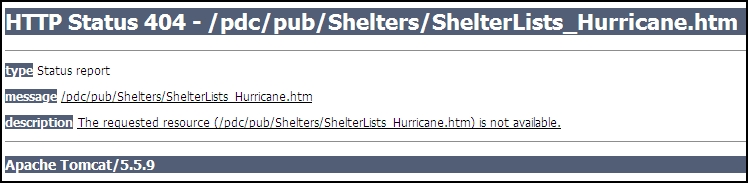 This is from the site set up to provide public awareness and statewide information for Hawaii's citizens.
Sure, this could be an oversight, but on the other hand, other documents show that there is a huge shortage of shelter space on Oahu, for example.
It's too easy to put together cute little booklets urging people to keep adequate water on hand and make sure that their roofs are secured against high winds. These are important things to do, but they are insufficient.
We pay our taxes, and part of that money goes to civil defense. Building an early warning system and providing emergency shelters are responsibilities we assign to our government. At present, whether it is dam inspection, traffic management, or disaster preparedness, they are failing us badly. And the failure to plan and execute predictably will cost lives.
Let's go back to the "preparedness" web page for a moment:
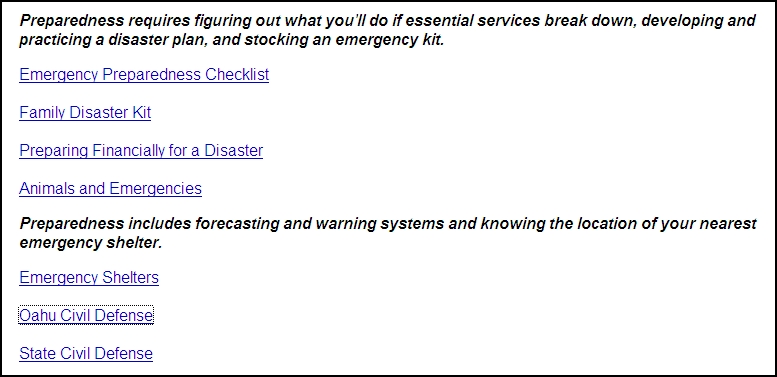
The first four items are stuff that we have to do. Fair enough. Then we get to the part that the state or city should do, and we hit that "404" page. Yup, it's missing.
There's one thing not listed above: prayer. State civil defense vice director Ed Teixeira suggested in his presentation to Kokua Council's members as part of an August 28, 2006 panel on disaster preparedness that we pray a storm doesn't come.
And if it does? "In the event of disaster, bend over, grasp legs firmly, and kiss your ass goodbye."
No, he didn't say that, but the thought entered my mind instantly.
It's easy to be critical. On one hand, it's not my job, or most citizen's jobs, to do the work our government is charged with. We are not supposed to come up with shelter plans, inspect dams, or replace rusting or inoperative siren equipment. There's no harm in making suggestions, though.
Last year the state legislature held hearings on disaster preparedness in the days after New Orleans was flooded. Katrina was an example of how failure to plan and execute a preparedness program can and does result in massive loss of life. So I welcomed the hearings and attended or watched every minute of them on `Olelo.
The current state of our (un)preparedness at that point was scary. I felt that shelters should already be in place and the information readily available to every member of the public. Schools were to supposed to be used as shelters, but they were inadequate. Windows would blow in, and anyway, who knows where the keys to the rooms are? If a storm approaches are we supposed to call the principals to let us in or the janitors? Clearly, disaster preparedness was in a state of shambles.
My little contribution was to suggest to legislators on the committee that they embrace a common planning technique, and that the ongoing process be completely open to the public. Why open to the public? Because otherwise it won't be done. Remember, everyone was talking about a budget surplus while the dams went uninspected, the sirens unrepaired, and shelters are still non-existent. There was no surplus, only the profits of neglect.
There needs to be an open planning process so that we, the public, can push for the state and counties to do their jobs.
If we manage to get to a nearby school it will take more than prayer to open the doors and assign spaces to everyone.
I sent the following sample forms to legislators. These are just examples, hastily filled in. Basically, they outline a process of planning designed to bring us to an adequate level of disaster preparedness as quickly as possible. Sorry about the sideways orientation, the forms are a bit too wide for the computer screen.
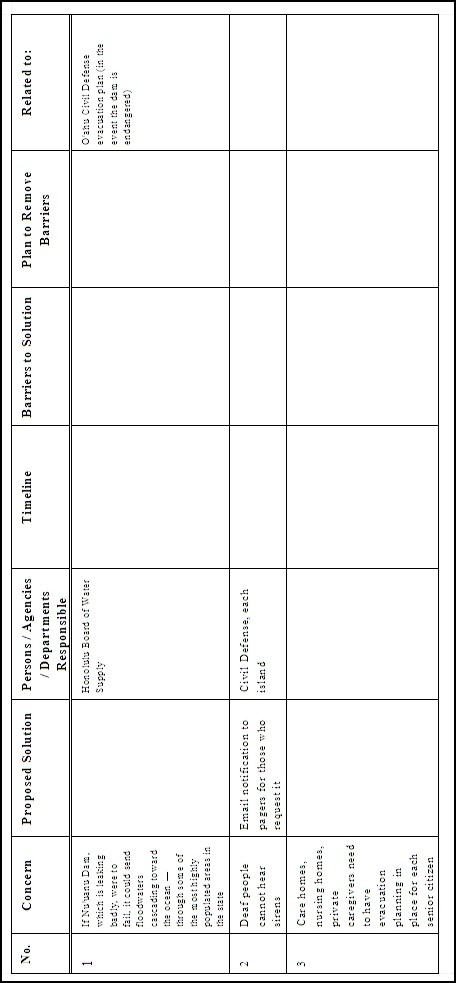
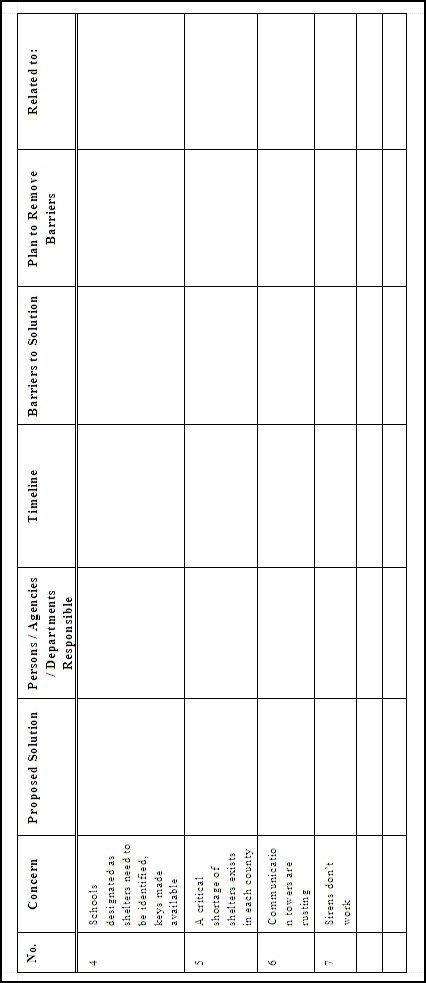
These forms allow people to collaborate on a solution. Anyone can raise a concern and list it on the chart. A timeline is important, because without it, we, the people, have no assurance that anything is actually being done. In other words, if Farrington High School is supposed to be set up as a shelter, there needs to be a deadline, a time-certain, by which that will be done. We need to know who will do it, and who is responsible, as well as how much must be allocated to get the job done.
This information also benefits the legislature in deciding priorities and apportioning money. It also gives us a lever if the administration holds up any of the funds--we'll be able to see the consequences immediately (for example, we'll know that if money is not released, Farrington High School won't be ready).
If there are obstacles or barriers to completion of a project, they need to be listed. We have been given far too many Powerpoint presentations in which concerns are listed, but we are never told when or if the concern will be removed or what stands in the way of completion. If there is something preventing completion, there needs to be a plan in place to remove that obstacle.
In place of detailed plans we've been given mostly Powerpoint presentations. The bullet-point oversimplification of Powerpoint presentations only obscures the truth about our ability to plan and execute. Instead, we should have tools like the charts above which give us a more complete view. Legislators and state planners would do well to ban Powerpoint entirely from their informational briefings on disaster preparedness.
We need real plans and we need the process to start immediately.
Related articles on DisappearedNews.com
Hawaii's medical infrastructure deteriorating, unready for disasters
Update: Lights out in the ER--Hawaii's deteriorating medical infrastructure
Disappearing Doctors: Hawaii looks for quick but questionable fixes
FEMA still not reformed
Why was Kauai's dam failure not prevented?
Must Hawaii repeat Louisiana's mistakes?
After last week's traffic jam fiasco, which demonstrated again that Oahu has failed to have a plan in place when there should have been one, I decided to revisit the issue of disaster preparedness.
First, let me say that I agree with and find very scary today's Star-Bulletin editorial Bureaucratic inaction caused motorist misery.
GOVERNOR Lingle has acknowledged that the state could have done more to deal with Tuesday's traffic debacle, but blame can be dished out at every level of government. No plan was in place for dealing with a lengthy shutdown of the H-1 freeway, as was apparent to everyone trapped for up to eight hours inching Ewa from downtown.Last week it was a bridge. Imagine that a storm approaches Hawaii and trees go down on the freeways in various places. Last week's gridlock was a dry run for what we can expect.
. . .
Lingle says the state Civil Defense will be notified promptly about any future closure of a freeway. The state needs to create a comprehensive plan to deal with such a situation if it should again arise, including ways to turn parts of the freeway into contra-flow lanes.
Plans missing or inadequate
Many web surfers recognize the "404 - not found" message -- when you click a link and get a "404" it means that a web page that should be there isn't there any longer. Check this out:
This is from the site set up to provide public awareness and statewide information for Hawaii's citizens.Sure, this could be an oversight, but on the other hand, other documents show that there is a huge shortage of shelter space on Oahu, for example.
It's too easy to put together cute little booklets urging people to keep adequate water on hand and make sure that their roofs are secured against high winds. These are important things to do, but they are insufficient.
We pay our taxes, and part of that money goes to civil defense. Building an early warning system and providing emergency shelters are responsibilities we assign to our government. At present, whether it is dam inspection, traffic management, or disaster preparedness, they are failing us badly. And the failure to plan and execute predictably will cost lives.
Let's go back to the "preparedness" web page for a moment:
The first four items are stuff that we have to do. Fair enough. Then we get to the part that the state or city should do, and we hit that "404" page. Yup, it's missing.
There's one thing not listed above: prayer. State civil defense vice director Ed Teixeira suggested in his presentation to Kokua Council's members as part of an August 28, 2006 panel on disaster preparedness that we pray a storm doesn't come.
And if it does? "In the event of disaster, bend over, grasp legs firmly, and kiss your ass goodbye."
No, he didn't say that, but the thought entered my mind instantly.
It's easy to be critical. On one hand, it's not my job, or most citizen's jobs, to do the work our government is charged with. We are not supposed to come up with shelter plans, inspect dams, or replace rusting or inoperative siren equipment. There's no harm in making suggestions, though.
Last year the state legislature held hearings on disaster preparedness in the days after New Orleans was flooded. Katrina was an example of how failure to plan and execute a preparedness program can and does result in massive loss of life. So I welcomed the hearings and attended or watched every minute of them on `Olelo.
The current state of our (un)preparedness at that point was scary. I felt that shelters should already be in place and the information readily available to every member of the public. Schools were to supposed to be used as shelters, but they were inadequate. Windows would blow in, and anyway, who knows where the keys to the rooms are? If a storm approaches are we supposed to call the principals to let us in or the janitors? Clearly, disaster preparedness was in a state of shambles.
My little contribution was to suggest to legislators on the committee that they embrace a common planning technique, and that the ongoing process be completely open to the public. Why open to the public? Because otherwise it won't be done. Remember, everyone was talking about a budget surplus while the dams went uninspected, the sirens unrepaired, and shelters are still non-existent. There was no surplus, only the profits of neglect.
There needs to be an open planning process so that we, the public, can push for the state and counties to do their jobs.
If we manage to get to a nearby school it will take more than prayer to open the doors and assign spaces to everyone.
I sent the following sample forms to legislators. These are just examples, hastily filled in. Basically, they outline a process of planning designed to bring us to an adequate level of disaster preparedness as quickly as possible. Sorry about the sideways orientation, the forms are a bit too wide for the computer screen.
These forms allow people to collaborate on a solution. Anyone can raise a concern and list it on the chart. A timeline is important, because without it, we, the people, have no assurance that anything is actually being done. In other words, if Farrington High School is supposed to be set up as a shelter, there needs to be a deadline, a time-certain, by which that will be done. We need to know who will do it, and who is responsible, as well as how much must be allocated to get the job done.
This information also benefits the legislature in deciding priorities and apportioning money. It also gives us a lever if the administration holds up any of the funds--we'll be able to see the consequences immediately (for example, we'll know that if money is not released, Farrington High School won't be ready).
If there are obstacles or barriers to completion of a project, they need to be listed. We have been given far too many Powerpoint presentations in which concerns are listed, but we are never told when or if the concern will be removed or what stands in the way of completion. If there is something preventing completion, there needs to be a plan in place to remove that obstacle.
In place of detailed plans we've been given mostly Powerpoint presentations. The bullet-point oversimplification of Powerpoint presentations only obscures the truth about our ability to plan and execute. Instead, we should have tools like the charts above which give us a more complete view. Legislators and state planners would do well to ban Powerpoint entirely from their informational briefings on disaster preparedness.
We need real plans and we need the process to start immediately.
Related articles on DisappearedNews.com
Hawaii's medical infrastructure deteriorating, unready for disasters
Update: Lights out in the ER--Hawaii's deteriorating medical infrastructure
Disappearing Doctors: Hawaii looks for quick but questionable fixes
FEMA still not reformed
Why was Kauai's dam failure not prevented?
Must Hawaii repeat Louisiana's mistakes?
Tags:
Saturday, September 09, 2006
Disney may be surprised in November
Everyone knows by now that Disney (the world's most prolific purveyor of fantasy)/ABC's plans to air "The Path to 9/11," a docudrama scheduled on September 10th and 11th which will accompany a live address to the nation by President Bush.
There has been some speculation as to motive. Certainly the right wing will cheer, and of course elections are coming up. Certainly there will be reaction to the bias that's expected based on reports of right-wing bloggers who have been given advance copies of the DVD. An interview on the Counterspin program (which won't air on Hawaii Public Radio until Wednesday but which you can hear on the web [mp3 or RealAudio]) suggests that Disney/ABC may be looking for favorable consideration from the government.
Won't they be surprised if control of Congress shifts in November and all of this backfires? Both sides of the aisle know the truth about 9/11 and how we got into the Iraq war. Republicans, since they control both houses of Congress, can stave off moves for accountability. Should the makeup of Congress change, Disney/ABC may find themselves held accountable (along with Bush/Cheney/Rumsfeld/Rice) if the "right" becomes the "wrong" side in 2007.
Be sure and vote, make this fantasy a reality..
There has been some speculation as to motive. Certainly the right wing will cheer, and of course elections are coming up. Certainly there will be reaction to the bias that's expected based on reports of right-wing bloggers who have been given advance copies of the DVD. An interview on the Counterspin program (which won't air on Hawaii Public Radio until Wednesday but which you can hear on the web [mp3 or RealAudio]) suggests that Disney/ABC may be looking for favorable consideration from the government.
Won't they be surprised if control of Congress shifts in November and all of this backfires? Both sides of the aisle know the truth about 9/11 and how we got into the Iraq war. Republicans, since they control both houses of Congress, can stave off moves for accountability. Should the makeup of Congress change, Disney/ABC may find themselves held accountable (along with Bush/Cheney/Rumsfeld/Rice) if the "right" becomes the "wrong" side in 2007.
Be sure and vote, make this fantasy a reality..
Tags:
US media continues to ignore humanitarian crisis in Gaza
The US media, in contrast to international outlets, continue to ignore the humanitarian crisis created by Israel in Gaza.
For a glimpse at what the rest of the world knows, see 'Gaza is a jail. Nobody is allowed to leave. We are all starving now' in the Independent. A short excerpt:
Our generation will have a lot to answer for.
For a glimpse at what the rest of the world knows, see 'Gaza is a jail. Nobody is allowed to leave. We are all starving now' in the Independent. A short excerpt:
Gaza is dying. The Israeli siege of the Palestinian enclave is so tight that its people are on the edge of starvation. Here on the shores of the Mediterranean a great tragedy is taking place that is being ignored because the world's attention has been diverted by wars in Lebanon and Iraq.This is collective punishment, it is well documented and widely known--why does it continue?
A whole society is being destroyed. There are 1.5 million Palestinians imprisoned in the most heavily populated area in the world. Israel has stopped all trade. It has even forbidden fishermen to go far from the shore so they wade into the surf to try vainly to catch fish with hand-thrown nets.
. . .
Two thirds of people are unemployed and the remaining third who mostly work for the state are not being paid. Gaza is now by far the poorest region on the Mediterranean. Per capita annual income is $700, compared with $20,000 in Israel. Conditions are much worse than in Lebanon where Hizbollah liberally compensates war victims for loss of their houses.
. . .
the Israeli army "has been rampaging through Gaza - there's no other word to describe it - killing and demolishing, bombing and shelling, indiscriminately". Gaza has essentially been reoccupied since Israeli troops and tanks come and go at will. In the northern district of Shajhayeh they took over several houses last week and stayed five days. By the time they withdrew, 22 Palestinians had been killed, three houses were destroyed and groves of olive, citrus and almond trees had been bulldozed.
Our generation will have a lot to answer for.
Tags:
Friday, September 08, 2006
Stop the train, I want to get off
 Star-Bulletin reporter Crystal Kua dropped a bomb on Honolulu's yet unbuilt transit system today with her article Rail plan cuts $4B cost, routes. Her story demonstrated that plans for Mufi's light rail system are more pliable than viable.
Honest, I don't know whether to laugh or cry. It's not just the cost of construction of this ever-changing system that's of concern, but the damage and destruction it will do to people's homes and businesses. And if no one cares where it goes, then it's predictable that it may not go anywhere anyone wants. And think of the traffic congestion at the two end points.
It's unbelievable to me that where the train line will start and end will depend on how much money is on hand rather than what is needed to do the job. Enough said.
Transportation planning is not done on a whiteboard, easily erased on the mayor's next whim. Transportation is integrated into and inseperable from urban planning. Honolulu's urban planning seems non-existent. Developers lay claim to some land and either build houses that contribute to urban congestion and worsen traffic, or cave in when residents protest in order to defend their quality of life. That is not a plan, it's chaos.
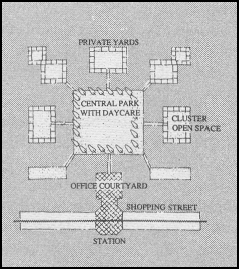
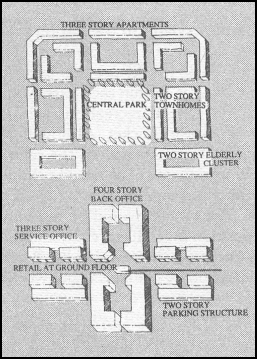
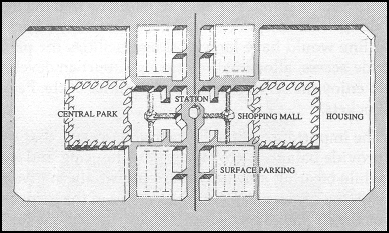
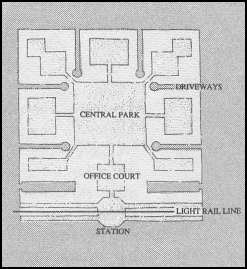 Here are two paragraphs from an article in the Spring 1988 Whole Earth Review by renowned architect and urban planner Peter Calthorpe. The article is titled Pedestrian Pockets. It's one version of an integrated planning model that every city has (with one exception, it seems). The illustrations in this post are snipped from the same article.
Regional Planning and the Pedestrian Pocket
Pedestrian Pockets are not meant to be stand-alone developments; they are intended to form a network of long-range growth within a region. They will vary considerably given the complexities of place and their varying internal makeup. Some may be larger than the 60-acre model we've been using as an example; the quarter-mile walking radius actually encloses 120 acres. Some may have a different focus; one providing a regional shopping center, one a cultural center, or a third simply housing and recreation. Some may be used to provide economic incentives in a depressed area as a redevelopment tool, others may rejuvenate an aging shopping area, others may be located in new areas zoned for low-density sprawl over a large area and serve to save much of the land from development.
But it is also important to use the Pockets and their rail line as a connector of the existing assets of an area. Certainly the major towns, office parks, shopping areas, and government facilities should be linked by the system. And several of the Pockets should offer an opportunity for park-and-ride so that existing housing in the region could take advantage of the line. Many new light rail systems which are built only to connect existing low-density development are experiencing some resistance from people not wanting to leave their cars. The importance of rezoning for a comfortable walking distance from house to station is to ease people out of their cars, to give them an alternative which is convenient and pleasing.
 An example from Japan
When we lived in a suburb of Tokyo ("suburb" is only a relative term in Japan, it was as dense as Waikiki), we walked ten minutes to the station. On the way one could grab some breakfast. There was bicycle parking near the station. Returning home in the evening I could shop for dinner, pick up my dry cleaning, some aspirins (for um, hangover), and even stop in a bookstore on the walk home. One station further was Kichijoji, with a park, a lake, and six (count 'em) large department stores and numerous eating places large and small, ancient and modern. One station the other way was medical care, the fish and vegetable market, office buildings, elderly housing, and so forth. Calthorpe would have recognized the design.
 Back to the Star-Bulletin article:
Originally, the route was proposed to be 23 miles long and run from west of Kapolei town to the University of Hawaii-Manoa campus with a possible spur to Waikiki.Well, no wonder. It would be hard to explain how the administrations' urban planning became such a shambles. Who would want to take a bus to get to a train, then switch to another bus to get to UH? Is this the transit system that is supposed to reduce traffic?
To save money, the start and the end of the route would change. Instead of beginning in Kapolei, the route would possibly start farther east at either the site of the proposed UH-West Oahu campus, which is just east of Kapolei town and along the future North-South Road, or at Leeward Community College.
The shortened route would end at downtown Honolulu, deleting the UH-Manoa and Waikiki ends.
Members of Mayor Mufi Hannemann's administration were not available to comment.
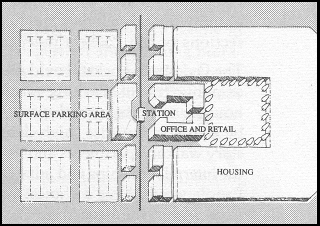 Calthorpe provides for those who need to drive their cars to the station (see the last illustration). He uses the same lot in multiple ways. But it only works if you can walk to your destination on the other side.
Tags:
Wednesday, September 06, 2006
Cthulhu Who? The descent of the Honolulu Weekly
I'm saddened to watch as the Village Voice, the alternative weekly I was raised on in New York City, is being dismantled by its new owners. We desperately need to have alternatives to the monolithic viewpoints of the commercial and conglomerate newspapers. The Village Voice set a standard for alternative publications nationwide. As its new owners gut it and remake it in their corporate ideological mode, faithful readers across the country are in mourning.
Now I live in Honolulu. I read alternative news and views primarily on-line. It works well for national and international issues, but less well for local news and analysis. We can make intelligent choices when there are a variety of voices to be heard.
Honolulu is big enough that it should have a vibrant alternative press of its own. The strongest player has always been the Honolulu Weekly, and under many of its editors it has stepped squarely up to the plate and done its best against significant challenges. It probably isn't easy being an underpaid editor and still facing the high expectations that people have for alternative media.
The pay situation and other internal controversies broke out at the time of the paper's 10th anniversary as a series of web pages and even a program on HPR. Some of the pages are still on-line:
http://web.archive.org/web/20021120075032/http://home.hawaii.rr.com/dougwords/HW10.html
http://web.archive.org/web/20020313081348/home.hawaii.rr.com/dougwords/HW10b.html
Given the working conditions described, I have even more appreciation for many of the editors, now moved on to other media positions, who made impressive contibutions to the alternative scene. I've clipped many articles over the years and used to rush out to the newspaper rack each Wednesday in anticipation of my alternative fix. So you see, my expectations really are quite high.
One has to give each successive new editor a chance, I suppose, but at some point it's time to demand results. In February I wrote about the waste of space that resulted from a totally contrived controversy: the Weekly's publication of cartoons of the Prophet Muhammed and then the letters and defense of the exercise that followed.
Let's face it, the number of pages that the Weekly devotes to alternative coverage is quite small. I'd prefer to read about real, rather than contrived, controversies. The editor essentially made his own actions into a long-running story that was, in the end, pretty purposeless because the Weekly didn't have to prove to anyone that it could exercise its free speech rights. If those rights were in question, somehow, they never mentioned it. They created a story and then devoted precious column inches to it that could have been devoted to something else. Almost anything else.
It's also not "alternative" to mount a series of personal attacks, attacks on the media, and to open its few precious pages up to smears. Yet that seems to be the current style. Last week's edition gave most of the letters space to a lengthy smear by Malia Zimmerman. She elaborated an encounter with an unnamed man whose alleged obscene actions she extrapolated to defame all of the protesters who challenged the ill-planned statehood rally at Iolani Palace. Editor Chris Haire gave her this space without noticing, perhaps, that she seldom appears in print these days or wondering why that might be.
All the letters pro or con Haire's writing are also a waste of space--he's not news. I'm also tired of the attacks. His attacks on and dismissal of Rep. Bev Harbin without researching her voting record, for example, do not amount to responsible journalism, it's pretty low quality stuff. I think he can do better. At least, I can say how I, as a reader, react to this--I don't enjoy attack dog tactics and would rather have thoughtful analysis or informed criticism in its place.
There's also a question of style vs. substance. My English teachers taught the class to write plainly, so as to be easily understood, not to try to convince the reader how smart we are. The purpose of our writing might be to entertain, or to communicate, or to pursuade. If the writing obscures, it fails. The reader should not have to penetrate an erudite verbal haze to discover the intended meaning.
Take the following excerpt from this week's issue:
Here's another snippet from the same page:
Some Weekly editors have gone on to significant positions at the Advertiser, but I'm guessing Chris won't receive an offer from those minions of Ctulhu any time soon.
I'm quite open to seeing where the Advertiser blogs go--they have just started. Dave Shapiro's blog has already proven immensely popular. Dave is not an editor of the Advertiser, or he might feel some constraints. Jerry Burris is an editor. It's good to see some more writing from him. I don't expect him to be as reckless as, say, a Weekly editor can be.
I still have high expectations for the Weekly. There will be another editor, then another. I wish the paper well in its struggle with Gannett for rack space. At the same time, I hope for a change in focus and tone. This will be up to Laurie Carlson, the publisher.
Maybe she thinks things are just fine as they are.
Oh, if you're not sure what a Ctulhu is, find out here.
Now I live in Honolulu. I read alternative news and views primarily on-line. It works well for national and international issues, but less well for local news and analysis. We can make intelligent choices when there are a variety of voices to be heard.
Honolulu is big enough that it should have a vibrant alternative press of its own. The strongest player has always been the Honolulu Weekly, and under many of its editors it has stepped squarely up to the plate and done its best against significant challenges. It probably isn't easy being an underpaid editor and still facing the high expectations that people have for alternative media.
The pay situation and other internal controversies broke out at the time of the paper's 10th anniversary as a series of web pages and even a program on HPR. Some of the pages are still on-line:
http://web.archive.org/web/20021120075032/http://home.hawaii.rr.com/dougwords/HW10.html
http://web.archive.org/web/20020313081348/home.hawaii.rr.com/dougwords/HW10b.html
Given the working conditions described, I have even more appreciation for many of the editors, now moved on to other media positions, who made impressive contibutions to the alternative scene. I've clipped many articles over the years and used to rush out to the newspaper rack each Wednesday in anticipation of my alternative fix. So you see, my expectations really are quite high.
One has to give each successive new editor a chance, I suppose, but at some point it's time to demand results. In February I wrote about the waste of space that resulted from a totally contrived controversy: the Weekly's publication of cartoons of the Prophet Muhammed and then the letters and defense of the exercise that followed.
Let's face it, the number of pages that the Weekly devotes to alternative coverage is quite small. I'd prefer to read about real, rather than contrived, controversies. The editor essentially made his own actions into a long-running story that was, in the end, pretty purposeless because the Weekly didn't have to prove to anyone that it could exercise its free speech rights. If those rights were in question, somehow, they never mentioned it. They created a story and then devoted precious column inches to it that could have been devoted to something else. Almost anything else.
It's also not "alternative" to mount a series of personal attacks, attacks on the media, and to open its few precious pages up to smears. Yet that seems to be the current style. Last week's edition gave most of the letters space to a lengthy smear by Malia Zimmerman. She elaborated an encounter with an unnamed man whose alleged obscene actions she extrapolated to defame all of the protesters who challenged the ill-planned statehood rally at Iolani Palace. Editor Chris Haire gave her this space without noticing, perhaps, that she seldom appears in print these days or wondering why that might be.
All the letters pro or con Haire's writing are also a waste of space--he's not news. I'm also tired of the attacks. His attacks on and dismissal of Rep. Bev Harbin without researching her voting record, for example, do not amount to responsible journalism, it's pretty low quality stuff. I think he can do better. At least, I can say how I, as a reader, react to this--I don't enjoy attack dog tactics and would rather have thoughtful analysis or informed criticism in its place.
There's also a question of style vs. substance. My English teachers taught the class to write plainly, so as to be easily understood, not to try to convince the reader how smart we are. The purpose of our writing might be to entertain, or to communicate, or to pursuade. If the writing obscures, it fails. The reader should not have to penetrate an erudite verbal haze to discover the intended meaning.
Take the following excerpt from this week's issue:
GOP MEET AND GREET SEPT. 12A blind dentist? A cannibal giving a back rub? Animatronic simulacra? I somehow missed experiencing any of that as I watched how the two politicians presented themselves on the one occasion we would have to see them together. The difference in presentation style has already been done to death elsewhere. It's no longer an interesting perception for me. As to letting us know that "these guys were for real," c'mon, now, I knew that.
Say what you will about Thursday night's debate between Sen. Daniel Akaka and Rep. Ed Case–it was a snooze fest along the lines of My Dinner with Andre, it was as painful as reading James Joyce's Ulysses without taking a bathroom break while a blind dentist gives you a root canal and a cannibal gives you a back rub—but at least it let us the voters know that these guys were for real. And not in the parlance of the hip hop wannabe. Actually "for real," as in not some Disneyland animatronic simulacra.
Here's another snippet from the same page:
Wait. Burris didn't just do what I just think he did. I mean, it's bad enough that he was afraid to voice his own opinion--in his very own blog--that he said Case "probably" did a better job than his 81-year-old counterpart, but Burris actually felt the need to put "won" in question marks, as if winning a debate is an impossibility and determining who came out on top is something that a blogger is unable to do?I thought Jerry had a clear opinion, and find the overboard attack tasteless and not terribly informative. Why, Chris, must there be a winner? At least explain yourself. It's also gratuitous, unnecessary, and unprofessional, in my view, to invent a motive (fear) for another person's writing style and then attack it with such vitriolic (if obscure) invective.
Come on, Jerry. Who were you afraid of offending? Your readers? Your bosses? The all-knowing, all-powerful 10-ton, 10-tentacled, octopus-headed Cthulhu-like beast to which all Gannett employees swear eternal servitude?
It's as simple as this: Case either won the debate or he didn't. And you either have an opinion or you don't have a blog.
Some Weekly editors have gone on to significant positions at the Advertiser, but I'm guessing Chris won't receive an offer from those minions of Ctulhu any time soon.
I'm quite open to seeing where the Advertiser blogs go--they have just started. Dave Shapiro's blog has already proven immensely popular. Dave is not an editor of the Advertiser, or he might feel some constraints. Jerry Burris is an editor. It's good to see some more writing from him. I don't expect him to be as reckless as, say, a Weekly editor can be.
I still have high expectations for the Weekly. There will be another editor, then another. I wish the paper well in its struggle with Gannett for rack space. At the same time, I hope for a change in focus and tone. This will be up to Laurie Carlson, the publisher.
Maybe she thinks things are just fine as they are.
Oh, if you're not sure what a Ctulhu is, find out here.
Tags:
Tuesday, September 05, 2006
Has the US lost control over 1/3 of Iraq?
If this report is sustained, US forces have lost control of the area to the west of Baghdad, including Fallujah, Ramadi and other towns which would together comprise about 1/3 of the country.
Meanwhile, in the North, the Kurds have reportedly taken down the Iraqi flag a week ago and replaced it with the Kurdish one.
If true, how soon before we see similar reports in our local papers? Will they continue to report that the US is making progress in Iraq?
Meanwhile, in the North, the Kurds have reportedly taken down the Iraqi flag a week ago and replaced it with the Kurdish one.
If true, how soon before we see similar reports in our local papers? Will they continue to report that the US is making progress in Iraq?
Tags:
Big news that disappeared: Israel reoccupies Gaza
Via Danny Schechter's News Dissector blog (essential reading!) this article from the Israeli paper Ha’aretz:
Gaza has been reoccupied. The world must know this and Israelis must know it, too. It is in its worst condition, ever. Since the abduction of Gilad Shalit, and more so since the outbreak of the Lebanon war, the Israel Defense Forces has been rampaging through Gaza - there's no other word to describe it - killing and demolishing, bombing and shelling, indiscriminately.More:
In large parts of Gaza nowadays, there is no electricity. Israel bombed the only power station in Gaza, and more than half the electricity supply will be cut off for at least another year. There's hardly any water. Since there is no electricity, supplying homes with water is nearly impossible. Gaza is filthier and smellier than ever: Because of the embargo Israel and the world have imposed on the elected authority, no salaries are being paid and the street cleaners have been on strike for the past few weeks. Piles of garbage and obnoxious clouds of stink strangle the coastal strip, turning it into Calcutta.
How contemptible all the sublime and nonsensical talk about "the end of the occupation" and "partitioning the land" now appears. Gaza is occupied, and with greater brutality than before.
-- Gideon Levy, Gaza's darkness, Ha’aretz
Why is this news not on front pages everywhere? Here is a final excerpt from this article. It saddens me to read it, and saddens me also that the story is being kept from the US readers:-- Gideon Levy, Gaza's darkness, Ha’aretz
And we still haven't mentioned the death, destruction and horror. In the last two months, Israel killed 224 Palestinians, 62 of them children and 25 of them women. It bombed and assassinated, destroyed and shelled, and no one stopped it. No Qassam cell or smuggling tunnel justifies such wide-scale killing. A day doesn't go by without deaths, most of them innocent civilians.When will the world realize that Israel is perpetrating death and destruction on innocent civilians and put a stop to it? Where is everyone? Hello!
Where are the days when there was still a debate inside Israel about the assassinations? Today, Israel drops innumerable missiles, shells and bombs on houses and kills entire families on its way to another assassination. Hospitals are collapsing with more than 900 people undergoing treatment. At Shifa Hospital, the only such facility in Gaza that might be worthy of being called a hospital, I saw heartrending scenes last week. Children who lost limbs, on respirators, paralyzed, crippled for the rest of their lives.
Families have been killed in their sleep, while riding on donkeys or working in fields. Frightened children, traumatized by what they have seen, huddle in their homes with a horror in their eyes that is difficult to describe in words. A journalist from Spain who spent time in Gaza recently, a veteran of war and disaster zones around the world, said he had never been exposed to scenes as horrific as the ones he saw and documented over the last two months.
Tags:
No cell phone plot, but will we get that news in tomorrow's papers?
Do you remember that just after the British broke up what they claimed was a plot to blow up US-bound airplanes, three Palestinian-American men were arrested for possessing a truckload of prepaid cell phones and charged with planning a terror attack on Michigan's Mackinac Bridge?
That story was big headlines across the country.
Let's see if the papers run equally big headlines now that all charges against the men have been dropped.
U.S. District Court Magistrate Charles Binder threw out federal conspiracy and money laundering charges against them today. Michigan charges against the men were thrown out Aug. 16
I'm still waiting to see what happens with the British case.
Most people only see the initial headlines and don't realize that the overwhelming majority of these cases never result in terrorist convictions or most often convictions of any kind. The British are even worse. So let's see what happens with that story.
Particularly as US elections loom closer, one can expect that more "plots" and "threats" will be uncovered, only to be discredited later.
Yet newspapers only give us one-half of the story. If they were doing their jobs, Americans would know that there were no WMDs in Iraq and that Saddam Hussein had nothing to do with 9/11. That news seems to have disappeared also, except occasionally in fine print on inside pages.
That story was big headlines across the country.
Let's see if the papers run equally big headlines now that all charges against the men have been dropped.
U.S. District Court Magistrate Charles Binder threw out federal conspiracy and money laundering charges against them today. Michigan charges against the men were thrown out Aug. 16
I'm still waiting to see what happens with the British case.
Most people only see the initial headlines and don't realize that the overwhelming majority of these cases never result in terrorist convictions or most often convictions of any kind. The British are even worse. So let's see what happens with that story.
Particularly as US elections loom closer, one can expect that more "plots" and "threats" will be uncovered, only to be discredited later.
Yet newspapers only give us one-half of the story. If they were doing their jobs, Americans would know that there were no WMDs in Iraq and that Saddam Hussein had nothing to do with 9/11. That news seems to have disappeared also, except occasionally in fine print on inside pages.
Tags:
Sunday, September 03, 2006
Sept 28: Drug Policy Forum of Hawaii Annual Dinner--Communities of Color and the War on Drugs
An important meeting for those interested in harm reduction and concerned with the negative effects of the war on drugs:
From the DPFHI announcement:
From the DPFHI announcement:
Aloha Friends -
The Drug Policy Forum of Hawaii will be holding our Annual Dinner on Wednesday evening September 27 from 5:30-8 p.m at the Japanese Cultural Center in Honolulu.
Our keynote speaker will be Corinne Carey, Deputy Director of Break the Chains: Communities of Color and the War on Drugs. Ms. Carey, an attorney, has been a front line service provider in a needle exchange program, a researcher with Human Rights Watch, and founded the Harm Reduction Law Project in New York City. She serves on the Board of Directors of National Advocates for Pregnant Women, an organization which works to secure the human and civil rights, health and welfare of all women, focusing particularly on pregnant and parenting women. She will be speaking about the need to listen to women affected by substance use to develop more effective programs and strategies to reduce harms.
The recipient of this year's Ho`omaluhia Award will be Tricia Wright, M.D. Dr. Wright is an Assistant Professor of Obstetrics, Gynecology and Women's Health at the University of Hawai`i. She specializes in taking care of pregnant women with substance use disorders and psychiatric illness. She recently shepherded a bill through the Hawai'i State Legislature to start a perinatal clinic for women with substance use - the first in the state. Since September is Women's Health Month, it is highly appropriate that Dr. Wright is our awardee.
The cost of the dinner (with no host bar) will be $35 for DPFHI members, $45 for non-members and $25 for students (which includes a 1 year membership.)
For further information or to RSVP, contact Jeanne at email info@dpfh.org.
Tags:
Friday, September 01, 2006
Transcript of Akaka/Case debate posted
Blogger and podcaster extraordaire Ryan Kawailani Ozawa performed an incredible public service by staying up last night and transcribing the Akaka-Case "debate". Click here to view.
Thank you, Ryan!
Thank you, Ryan!