Wednesday, August 30, 2006
Sometimes being ineffective can be a good thing
While Sen. Akaka struggles to advance the bill that bears his name, Rep. Case did the same with what became known as the "Case Amendment" to H.R. 1350, part of the 2003 reauthorization of the federal Individuals with Disabilities Education Act. If you Google "Case Amendment" (with the quotes) you'll find numerous articles and a video protesting the damage his amendment would have done to his constituents in Hawaii and to parents nationwide.
Case's anti-child amendment would have allowed governor Lingle and other state governors to set fees for attorneys representing parents of special needs children. If a school is not providing an equal education for a child as the law requires, parents have little recourse but to file for a due process hearing. They most often lose unless they have legal representation (the state Department of Education always has access to attorneys).
Hawaii's DOE embraced the Case Amendment as a means to greatly reduce the number of due process cases filed against them which continued even past the end of the Felix Consent Decree.
Parents, advocates and many others saw it differently, of course. In no other civil rights action can the defendant set fees for the plaintiff--and Governor Lingle is often the defendant, along with the DOE, in these suits. Given the power to limit fees, she would most certainly set them at a point which would make it impossible for attorneys to represent parents.
Across the country, parents groups petitioned their congressional delegations to defeat the Case Amendment.
About two dozen parents visited Case in his Honolulu office along with reporters and a video camera. Quoted in a Star-Bulletin article (April 22, 2003) on the meeting, attorney Chris Parsons told Case that "[allowing the governor to set rates would] give the fox the keys to the henhouse" and drive lawyers away from such cases. But Case was implacable.
In the end, he could not push it through. Fortunately, he didn’t have the clout to do it.
Clearly, Rep. Case acted against the parents who are his constituents. His amendment brought him (and Hawaii) tremendous negative publicity across the country.
So being ineffective can be an advantage. Imagine if the Case Amendment had passed.


Friday, August 25, 2006
Dear CBS: Please stop lying for Bush, he can do it himself if he wants to
Since they took words out, viewers would not know that something was missing. I didn't. You'd have to find out on the Web someplace that this egregious cut was made. Did Bush ask for the cut, or did they just do it automatically, like well-trained lap dogs?
The unexpurgated version would have been:
Q: But are you frustrated, sir?It appears that Bush realized what he had just said and tried to fix it up.
BUSH: Frustrated? Sometimes I'm frustrated. Rarely surprised. Sometimes I'm happy. This is -- but war is not a time of joy. These aren't joyous times. These are challenging times, and they're difficult times, and they're straining the psyche of our country. I understand that.
FAIR reports that:
Reporter Bill Plante previewed the answer by saying that Bush "conceded that daily reports of death and destruction take a toll, both on the nation and on him." The edited quote that followed:Why do we need to have journalists buffing up the president's image? Haven't they realized yet that he's sinking in the polls despite their attempts to save him?
Frustrated? Sometimes I'm frustrated, rarely surprised. These aren't joyous times. These are challenging times, and they're difficult times. And they're straining the psyche of our country. I understand that.
What's wrong with good, honest journalism anyway? Just give us the news, please.
This is your pilot speaking
See if these two reported incidents make you think that someone ought to stop this madness.
Danny Schechter's News Dissector blog reports today that airline pilots are restricted as to what they can take on board, just as we passengers are:
"Meanwhile, across the pond, airline officials and pilots are fed up with security measures and delays. RyanAir CEO Michael O'Leary said last week that measures such as banning shampoo and lipstick in carry-on bags are "farcical, Keystone Cops-like and completely insane and ineffectual.... We are not in danger of dying at the hands of toiletries." He said he would sue the government if security is not restored to normal levels within a week. His airline lost about £2 million during the latest security crisis. Pilots also have been banned from taking contact-lens solution into the cockpit, The Mirror reported. "There is no logic at all in this," said Capt Mervyn Granshaw.I know that my eyes often get dry on an airplane flight, so I carry contact lens fluids so I can re-wet the lenses when necessary. Imagine that your pilot's eyes are itchy and red, and he's in charge of getting you to your destination safely.
Another pilot told the Sunday Herald it was ironic that his glasses were taken away for security reasons. "While my glasses were deemed potentially deadly dangerous items, I once again took my seat at the controls of 185,000 kilos of aeroplane, people and fuel and managed to restrain myself from taking the crash axe to all and sundry prior to rolling, inverted and diving, into the Channel," he said. Another pilot said: "It's high time BALPA [the British pilot's union] and our representatives exposed these shameful rules for what they are -- some half -witted mandarins making up petty and useless rules to justify their existence, with equally inept and stupid people interpreting the rules."
It's nuts not to let pilots carry their contact lens solutions.
And the second one takes the cake -- a pilot can't take his glasses on an airplane? Again, this person is supposed to get us home safely, but they won't let him take his glasses on board??
This is so crazy that it had better stop.
Airlines are paying a premium for fuel due to this administration's antics in the mid-East and transfer of political power to oil and energy companies (remember that secret meeting with Cheney). The security measures, some of which probably make us more secure but most basically just keep us in a state of fear, are sure to discourage people from flying.
You'd think that airline executives would be great supporters of the impeachment movement.
Tuesday, August 22, 2006
Battle over proposed HECO fossil fuel plant begins
A schedule has been agreed by the parties for the arguments. From the Life of the Land email, the timeline is:
- HECO previously filed direct testimony.
- Life of the Land filed its case on August 17.
- HECO files a rebuttal case on October 1.
- The Public Utilities Commission evidentiary hearing will be held the week of December 11.
Can HECO's plan be defeated?
 Yes. The beauty of Manoa Valley was preserved when the community joined together to oppose the construction of a planned 138kV power line with huge poles that would have defaced the valley forever. We seem to be doing just fine without it. This demonstrated that yes, the community can win against even a behemoth such as Hawaiian Electric Company. You can still see many cars proudly displaying a "No 138kV" bumper sticker even though the battle is over. When I see one, I'm reminded that it is possible for the little guy to win.
Life of the Land's position
From their email today:
- Something is needed (megawatts)
- Climate Change is for real
- We oppose building another fossil fuel power plant
- We oppose ethanol
- We support energy efficiencies and renewable energy: solar; wind (on and off shore); wave (off shore), sea water air conditioning; and OTEC (off shore -- barge)
- We believe that renewables should be overbuilt so that the Downtown Honolulu Power Plant (adjacent to Aloha Tower) can be torn down
It certainly is. Henry also emailed their witness list:
-- Henry Curtis, Life of the Land
How to support this effort?
Contact info for Life of the Land:
Life of the Land, 76 N. King Street, Suite 203, Honolulu, HI 96817. Henry Curtis, Executive Director: 808-533-3454. Email: henry@lifeoftheland.net .
Monday, August 21, 2006
Hawaii's dirty little secret: Laws but no enforcement
A Star-Bulletin article today Many teens scoff at new driving law is right on point:
"Even if people are aware of it, they don't care," said Odenkirk's friend Justin Malone, also 16, who said he does not know anyone who follows the law.Laws are comforting in that they make people think something is being done about a problem. Laws alone don't fix anything, though, no matter how well written.
The article is correct in suggesting that more education and enforcement is needed.
Education is always good, but everyone who lives here knows that laws of all kinds are seldom enforced. This sends a message to teenagers that they don't need to follow laws. They can ignore them at will. Read the teenager's statement above. Can education change what Justin has said? He is educating us. We need to admit that what he said is true.
Pedestrians are killed in crosswalks (Hawaii is at or near the top in single-car collisions). People are killed or injured when cars run red lights, a common occurrence. Speeding and tailgating are so freqent that every driver sees or experiences it whenever driving on the highways. Just a few minutes ago a red car went tearing down Nuuanu Avenue outside the window here at a high rate of speed. No cops, no worry.
There are laws, but both children and adults feel they can ignore them.
I need to take you back to New York, where I'm from, for a moment.
A police car was almost always stationed at one of several points on the Long Island Expressway. One popular place was on the grass just past a gas station. I remember that spot because the car, #1814, was finally auctioned, and I bought it for $300 when I needed a cheap way to commute to graduate school. A coat of paint, fill in the hole on the top where the gumball machine was, put some oatmeal in the radiator, and I got myself some cheap wheels.
Patrol cars were everywhere in New York. How else to keep New Yorkers honest? Several times on my way to school I was reminded that I shouldn't speed--or I would get caught. Hey, it works. It works because the law is enforced. If I speed, I get caught. Simple as that.
When is the last time you saw a police car giving tickets to speeders, tailgaters, red-light runners, or to pedestrians or drivers who ignore our new crosswalk law? Hmmm? When? How often do you see tickets being given out for anything?
It's not just traffic violations. It's almost any law.
One day (we're back on Oahu now) I attended a community meeting in the auditorium of Roosevelt High School. Along the way, the principal mentioned that every Friday he locked up the swimming pool but that kids broke the lock on Sunday to go swimming. On Monday he replaced the lock. On Friday he locked up the swimming pool, on Sunday they broke in again. And so on, each weekend.
This struck me as curious. Also in my mind were the string of assaults on on occupants of cars parked at the Tantalus scenic view spots at night. These happened just above Roosevelt HS. The newspapers reported repeated incidents of assaults and robberies. Neighbors were distraught.
Since there were police there, I stood up and asked two related questions: Since there was no adult supervision on Sunday, kids could get hurt in the pool. It seemed to me that neither the school nor the police were doing anything about the problem. A side issue is that through their inaction, they could be liable for any injuries, since they were in effect condoning the breakins. Why couldn't a policeman just hang out near the pool and stop the breakins?
As to Tantalus, I asked why the police couldn't hang out up in the trees there (I was trying to be funny) and just drop down and capture the evildoers, since they were pretty regular in their assaults and robberies. It should be a piece of cake for them to put an end to this.
The answer was "we only have three cars to patrol the whole area". Like that was an answer???
At the time, I was living in a rental house. Shortly after we moved in, the owner began building an illegal "ohana" attached to it. When it was time for an inspection, the stove and other illegal things were carried out, the place was inspected, and they were put back. These illegal structures were all over the place. Related to this in a way: How did Kailua get to be a hotbed of illegal Bed and Breakfast businesses?
People are not afraid to break our laws. They know about them, and they don't care, and they know nothing will happen to them if they do what they like.
Simply put, Hawaii, or at least Oahu, is a Paradise for lawbreakers. They even had the nerve to testify to the legislature and write letters to the editor that it is their right to speed--thereby killing the Van Cams, which might [if done right] have saved lives. Too bad it was done wrong, there was an example of strong enforcement that might have worked. But speeders don't want strong enforcement.
Spread the word to your friends and family on the Mainland: come to Hawaii and you won't be bothered no matter what kind of illegal or dangerous things you may do. We've taught our kids to say that they don't care about the law. Let's just spread the word to everyone. It should be good for tourism.
Education is good and valuable, but both adults and children can see the lie--and the lie they just do this education thing on you at school, but never mind, out there you can go as fast as you like, even drive without a license...
... because you will never get caught.
Update on Following the Health Insurance Money
This morning they called back, and indeed they will follow up. It seems that some candidates hadn't even filed yet, so they have some work to do to get all the information in shape.
In the meantime, the Star Bulletin has written an editorial "Customers, businesses need oversight on insurance rates" on the need for health premium regulation, and there has been a letter to the editor "Insurance bill flawed on purpose". Neither of these noted that the original bill was simple, just calling for removal of the sunset provision of the existing law.
Where things went wrong was when that simple bill arrived at the Consumer Protection and Commerce Committee, Robert Herkes, Chair. It didn't stand a chance. The bill was amended by CSC. Pacific Business News reported that the amendment was written by industry.
-- PBN, May 3, 2006
The amended bill was intentionally complex and if passed into law could have tied the Insurance Commission up in litigation.
Remember that the Commissioner testified that the law probably saved $18 million in premiums. It should have simply been allowed to continue by removing the sunset date, as both the original House and Senate bills provided. Oh.. let me not forget to mention that the House refused to hear its own version of the bill, making its intention to kill health insurance rate regulation known early on.
We lost this valuable protection not because of a "defective date" inserted into the bill, but because it was altered drastically in favor of the industry. The sad story is in the public record.
It could have been saved even at the conference committee level but the House did not want it saved. Check out in the record who was appointed by Speaker Say to the conference committee. When Senator Menor tried to save the bill by recommitting it to committee, the House refused.
House leadership shares responsibility for the demise of health premium regulation. All they had to do was pass a bill to continue a money-saving law.
Saturday, August 19, 2006
4P rating for Mufi's transit planning

I'm confused. The map of Honolulu's transit system isn't even inked in, but now Mayor Mufi Hannemann appears to be throwing a financial roadblock in front of the train that doesn't yet exist.
In a letter to the editor in today's Honolulu Advertiser, the mayor appears to respond to critics who charge that the $3 billion estimate is unrealistic. Well, it's kind of a response. He seems to say that it won't cost more than $3 billion dollars because all we'll build is what we can get for the $3 billion.
In other words, lack of money would put the brakes on construction. That's very different from planning, budgeting for, and building an effective transit system:
The transit system the city ultimately will support will meet our immediate needs and our budget, estimated at around $3 billion. This is called a "minimal operable system" in the parlance of transportation engineering. Yes, a multifaceted, multimodal approach to solving our growing traffic mess falls within the need-to-have, but I want to be careful that we do not exceed our financial limits.Ok, I thought I should find out what the mayor means by a ' "minimal operable system" in the parlance of transportation engineering ' and visited the font of all knowledge, Google, to see what transportation engineers mean by that phrase. I'm curious: Will a "minimal operable system" take me from where I live to where I want to go? Does "minimal operable system" buy us a will get a world-class transit system or only a horse trolly?
If revenues from the general excise tax surcharge provide more money for our transportation coffers, or if private partnerships generate a major infusion of cash, or if we receive any financial windfalls for mass transit, then we can consider spending more money to expand the system.
Until then, I will continue to insist that we live within our means.
The Google search came up with only one single reference, in which I find the familiar name Parsons Brinckerhoff. These guys are the mayor's consultants on train-building. Now, perhaps the term has been used elsewhere--just checking with Google is a lazy way of doing research, but for this purpose, it's enough. The term "minimal operable system" does not seem to be in very wide circulation except in the mayor's letter and his consultant's paper.
So I didn't learn anything about what the mayor means, anyway.
But here's my fear: Mufi recently demonstrated by kicking 200 people out of Ala Moana Park without a place to go that he and his administration are not too strong in the planning department. And going beyond the current administration, we have gems like Aloha Stadium still rusting away--remember, the thing was supposed to develop an attractive patina and thenceforth require little maintenance. I recall a sports stadium where home plate wasn't visible from the stands. There's a convention center we'll be paying for forever. And so on.
And now, while we still don't even have clear plans and cost estimates, he's saying he'll stay within the $3 billion budget. Will he just stop work when $3 billion is spent? This sure saves money in up-front planning, anyway. Just build, and stop when you're broke.
I hope he starts construction at one end only. If he starts at both, it will look ridiculous if the Ewa end makes it only to Pearl City and the UH end makes it only to Piikoi when the money is used up. We'd be a world-class laughing stock.
If this is what passes for a financial plan, we are in trouble. Big, big trouble. We deserve to know how many miles of track that $3 billion will buy and where it will be. Now, before construction starts.
When the $3 billion is gone and they're still laying track, we know what will happen: There will be an emergency request, or a dreaded "private partnership" sell-off of the system to complete the work. There is no such thing as "a major infusion of cash," Mufi. You end up giving away public property to greedy private interests in order to bail out the city's piss poor prior planning.
Friday, August 18, 2006
It's time for the "Million Mench March"
A petition has been started on-line and is gathering signatures:
This statement was drafted by U.S. Jews committed to stopping and holding accountable Israel for its destructive policies and practices--most immediately for a halt to the current attacks on Lebanon and Gaza.When Israel invaded Gaza and started locking up its elected leaders, I thought that surely there must be many Jews who object to this and to the conditions Palestinians are forced to live in by their occupiers. How many Jews would dare to speak out?
The devastation of Lebanon and the civilian death toll cannot sit well with people of conscience of any religion.
Perhaps now is the time for a "Million Mench March" in Washington DC.
I don't know who could organize it (Rabbi Michael Lerner?). The time is ripe, I hope someone will consider this.
Who won, who lost in Lebanon
Most American news outlets began the timeline with the abduction of two Israeli soldiers by Hezbollah. There is already ample indication that Israel planned their invasion well in advance of this incident. Also, Israel had probably 9,000 or so prisoners at the time, including women and children under the age of 14, according to reports (which of course you won't see in most domestic newspapers). Plans to devastate Lebanon and destroy its infrastructure were already in place, just waiting for some incident that could be used as a "trigger."
But did you know that those two soldiers were captured in Lebanese territory? Here is a collection of articles: http://www.whatreallyhappened.com/israeli_solders.html. I see that AFP reported this, which means that European papers had the info. Aside from the first citation, from Forbes, there isn't anything else that might have appeared in stateside papers.
Now, local papers use either AP wire stories or reprint articles that appear in the major national dailies. They choose what to print and therefore select the information that people will read. There are alternatives to AP biased coverage. For example, this is by Michael Slackman in The New York Times August 18:
The war in Lebanon, and the widespread conviction among Arabs that Hezbollah won that war by bloodying Israel, has fostered and validated those kinds of feelings throughout Egypt and the region. In interviews on streets and in newspaper commentaries circulated around the Middle East, the prevailing view is that where Arab nations failed to stand up to Israel and the United States, an Islamic movement succeeded.The widespread view that Hezbollah won has both propelled and been propelled by a wave already washing over the region. Political Islam was widely seen as the antidote to the failures of Arab nationalism, communism, socialism and, most recently, what is seen as the false promise of American-style democracy. It was that wave that helped the banned but tolerated Muslim Brotherhood win 88 seats in the Egyptian Parliament last December despite the government's efforts to stop voters from getting to the polls. It was that wave that swept Hamas into power in the Palestinian government in January, shocking Hamas itself.
What has Israel therefore achieved? With the backing of the United States, not only has it committed war crimes resulting in possibly around 1,600 civilian deaths, the destruction of Lebanon's infrastructure and an oil spill that threatens the Mediterranean Sea, but it has strengthened its enemies. So maybe it is radical Islam that has won.
The United States supplied Israel with weapons for their deadly invasion, and opposed a cease fire that the rest of the world wanted. In doing this, it also destroyed any perception that bringing democracy to the region was an important objective. Here is a snippet from The Daily Star, a Lebanese newspaper:
The Lebanese educated middle class are asking Washington: "Why have you forsaken me?" as Lebanon's existence is bombed to smithereens. The current war is traumatizing Lebanon's Western-oriented middle class, as it witnesses the destruction of its hopes for a prosperous and independent Lebanon, as Israel, backed by the United States, systematically destroys Lebanon and places the destiny of 4 million Lebanese in serious jeopardy.Members of the Lebanese middle class see themselves as open-minded believers in a Western-style secular democracy. They did not hesitate to make their views known that when Southern Lebanon was freed from Israeli occupation in 2000 it was time for Hizbullah to disarm. Many, including Shiites, have written articles critical of Hizbullah and its state-within-a-state in Lebanon.
In the 1960s and early 1970s, the United States waged wars in Cambodia and Vietnam that involved heavy bombing campaigns and large-scale offensives that badly hurt the civilian populations. Critics used to say: "The US was destroying Vietnamese villages in order to liberate them." The same approach was utilized again in Kosovo in 1998 and in Iraq in 2003. The sheer force employed by Israel against Lebanon in 2006 has led many commentators to compare these Israeli apocalyptic bombing campaigns on Beirut and the Southern provinces to US war making.
The Lebanese will not soon forget the US role in the destruction of their country.
Nor will Europe, if the oil slick which resulted from Israeli targeting of a power plant 30 miles south of Beirut reaches the shore of other countries. The spreading oil slick threatens the coastlines of Cyprus, Syria, Turkey and Greece. It also threatens the habitats of sea turtles, including the endangered green turtle, and tuna fisheries. Israel has made no friends in Europe by threatening the livilihoods of these countries and the health of their citizens. Worse, the longer the oil remains in the sea the more difficult cleanup will be, and Israel, through its land, sea and air blockade, is preventing officials from obtaining information about the spill. For example, Israel denied requests to use French helicopters to survey the polluted area.
Of course, the reader of an average US daily newspaper wouldn't know that Israel intentionally bombed a power plant located 100 meters from the sea and allowed it to burn and leak oil for three weeks. The Voice of America headline today asserts "Lebanese Oil Spill - Collateral Damage of the Bombings," but I suspect that few readers believe them. It certainly was not "collateral damage."
At this point, I don't believe what I read in the daily papers either. I'm sure that many readers who track world events on the Internet are aware of the sharp contrast between domestic coverage and European/alternative sources. Domestic newspapers should be concerned about their circulations, at least. Why pay to have one dropped at your doorstep each day that omits important world news? That's a major product defect. Some readers may decide to simply read their news on the web. It's happening anyway. Poor and biased reporting can only accelerate the trend.
Meanwhile, bodies continue to be pulled from the rubble of targeted apartments in Lebanon. It isn't over yet, even if you can't find much about it in your daily paper.
Thursday, August 17, 2006
Will Bush stop wiretapping just because a judge reminds him it is illegal?
(08-17) 11:46 PDT DETROIT -- A federal judge ordered a halt today to the Bush administration's warrantless wiretapping of calls between Americans and alleged foreign terrorists, saying the program violates the Constitution as well as a law requiring judicial approval for all electronic surveillance.You knew and I knew and Bush knew that what the NSA was doing was illegal. Now a court has ordered it stopped.
"There are no hereditary kings in America and no powers not created by the Constitution,'' said U.S. District Judge Anna Diggs Taylor in rejecting President Bush's claim that he had the inherent power to authorize the program.
Anyone wanna place bets on whether it will be stopped or not just because a judge orders it? I hope it will be stopped, and at the same time I'm wondering what Cheney had planned for this contingency.
Wednesday, August 16, 2006
Fed up, want to know how to take action?
Host Beth-Ann Kozlovich will have representatives from several grassroots organizations on hand to unscramble the protest scene for you. Hawaii has a very active protest movement, so if you're getting mad as hell and want to help set the country or world back on the correct path, tune in to the program to find an organization you can join up with.
The program will also have an update after the first day of Lt. Ehren Watada's Article 32 hearing in Washington state.
You can also call with your questions. There's a toll-free number for those outside of Oahu.
If you can't catch the wave, aim your web browser at http://hawaiipublicradio.org/livestream.htm to listen to the streaming audio.
Tuesday, August 15, 2006
Hawaii's blogosphere expands
Ever wondered what the top of Jerry Burris' head looks like? You can see a decent picture over at the Advertiser's new blog pages at http://blogs.honoluluadvertiser.com.
More important, of course, is that there is some good writing and conversation going on there. Some of the bloggers reply to the comments, some don't. I find that I'm a regular reader of David Shapiro and Jerry Burris.
If they feel so moved, they can write and publish instantly via the blogs without the constraints of column inches and rigid deadlines.
They also get to write their own headlines, a great improvement.
It's good to have access to more editorial thinking and commentary. Now, if only there were a way to expand the Advertiser's national and international coverage. The whole paper is getting rather lightweight. I find it practically useless for news from the mid-East, for example, and you won't find much from other parts of the world at all. It no longer makes a thump when it hits my door except on Friday and Sundays. In fact, it sometimes gets blown away in the breeze. Sad.
The blogs may eventually put the paper in touch with something greater than it is now. Journalism has to survive. Bloggers (usually) aren't journalists, but journalists can cross the divide and bring their professional skills and standards to the Web. As newspapers shrink and newsroom staff disappear, I hope that there will be a countervailing move to the Web.
So the Advertiser's experiment with blogging is very welcome to me. It could and should be the beginning of something new and better for both journalists and readers.
Monday, August 14, 2006
We Love to Hate
An editorial headline in today's Star-Bulletin declares Findings should quell immigration rancor, but the second paragraph proclaims the opposite:
Though the study could find no evidence to support that assertion [that foreigners who arrived in the United States in the last 15 years took jobs away from native-born workers], the clash over immigration issues won't be quelled by statistics as long as economic and racial divisions engulf the discussion.I think the editor has it right. They could use a better headline writer, though.
The Right in our country has learned to play to the baser motivations of the people. If you wanna succeed, appeal to those economic, racial and other divisions. It works. The Left, on the other hand, often appeals through logic, debate, and argument. It's the honorable way to hold a discussion, but I wonder if it works.
The trouble is, when you strip away the reasons why people are acting the way they are (as for example by proving their arguments are wrong via a study), you strip them of their rationale for their behavior. Far from bringing about a switch to your point of view, this incurs their wrath and they harden in their position. Why? Because without that rationale, all that is left to them is their bigotry. Yes, the proof that their reasoning is wrong exposes them as bigots, and they hate it. So they dig in.
It's a paradox that we face in confronting many critical issues of the day. A war is raging on several fronts in the mid-East, for example. War crimes are being committed. These are based on hate, not on logic, though they are justified by logic. But we don't know what to do to turn the situation around. Military might won't work, it's even worse than publishing studies. At least studies don't kill people if they fail to convince.
French bigotry was exposed when immigrants rebelled and burned cars to bring home their point. US bigotry is exposed as our government attacks immigrants whether from Mexico, the mid-East, or elsewhere. We refused to demand a cease-fire in Lebanon until somewhere between 800-1600 innocent civilians were killed. Underneath it all is that we didn't care that they were killed enough to stop it. And it was in our power to do so. Nor can we separate ourselves as a people from the actions of our government. Our elected representatives voted almost unanimously to allow the killing to continue.
We simply love to hate.
Sunday, August 13, 2006
Ban drinks in Aloha Stadium, Ala Moana Center
Drinks, hair gel or anything liquid are now banned from airplane cabins. Good, I feel so much safer because of that (at least until terrorists discover solid explosives). But wait--what will they do now that all the liquids they have been stockpiling can't be taken on airplanes? My fear is they will use them elsewhere. Hey--an explosive is an explosive, and we have to be careful now that the sinister potential of these substances has been revealed.
According to the NBC story, the British had their suspects under surveillance for more than a year and didn't plan to arrest them yet. The US applied pressure, maybe in the wake of Lieberman's defeat in Connecticut. But hey, our government was right on it. They moved quickly to protect us. But now it is up to us to appreciate fully the vulnerability that these arrests have demonstrated and move to eliminate it wherever it raises its ugly head.
I want to point out that there are currently no restrictions on the amount of liquid that can be carried into Aloha Stadium. This clearly deserves rethinking.
Also, Ala Moana Shopping Center is full of foreigners, and some of them are certainly carrying concealed hair gel, not to mention the aforementioned soft drinks. Any one of those suspicious-looking foreign types carrying a shopping bag could have sinister designs against this country. A shopping bag is such an obvious method of concealment I am surprised that no one has looked into their potential use by those who hate our freedom.
At airports they make us take off our shoes, but at Aloha Stadium footwear simply passes unchallenged. A dirty little secret is that some shoes contain gel. Worse, some shopping malls actually require shoes! What can they be thinking?
Stadiums, shopping malls, the Waikiki Shell. These places are about as crowded as an airplane. Aside from loss of life, what would be the effect on Hawaii's economy, dependent as it is on tourism, if some hair goo should be detonated, say, at a Sunset at the Beach event?
This all sends shivers down my spine. I'd actually feel safer at the airport than at a ball game! Aloha Stadium, Kahala Mall, Ala Moana Center, all of them have been left totally unprotected against this new threat. Why? I want this looked into.
Friday, August 11, 2006
Following the Health Insurance Money
They did a quick job of it, though, with all reports expected to be available by this weekend. You can read the reports by going to this page on the CSC site.
I've anxiously waited for the data because I wanted to check into who gave what to lawmakers this past session, as bills that were critical to us ordinary citizens were manipulated by questionable legislative maneuverings so that we lost out.
-- How Business Campaign Contributions Subvert Democracy
by Dan Clawson, Alan Neustadtl, and Mark Weller
Ok, rolling up my sleeves, I dug in.
One of my biggest peeves this past session was the loss of insurance rate regulation because of amendments introduced by CSC chair Bob Herkes. The bills headed into that committee simply called for the sunshine provision of the rate regulation law to be lifted so that its protections could continue. Amendments sprung on committee members and the public favored the industry. At the same time, Rep. Herkes employed an "intern," Mark Forman, who was simultaneously the Executive Administrator for HMSA Foundation. But Rep. Herkes has already said that Forman did not influence him. So what did? Perhaps the campaign contribution reports are worth looking at.
In a KITV interview May 10, 2006 looking into the role of embedded interns in the legislature, HMSA's Cliff Cisco stated that responsibility for the health insurance rate regulation belongs not to Forman but to HMSA's registered lobbyist, Jennifer Diesman. So I wanted to see if her name appeared on Herke's list of campaign donors. (Sadly, the law doesn't require Forman's HMSA Foundation salary to be listed as a contribution to the legislator in whose office he works.)
Yup, her name is there. Have a peek at this:

(The full-size document is here).
Notice the date: it looks like 3/28/06. The hearing at which the supposedly industry-written amendment was sprung on the public was 3/22 and the committee voted on 3/23.
-- Paul Wellstone
Speaking of handwriting, I am still trying to understand this report. Take for example:
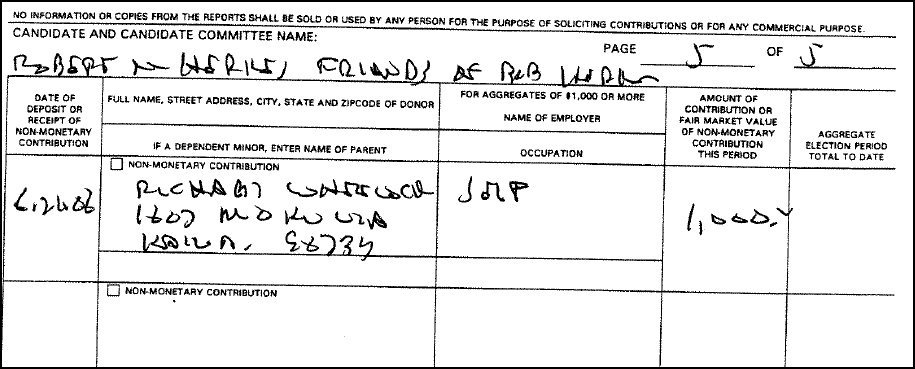
I would love to know who is giving these large sums, but I can't read the information. Why did the CSC accept this report? It should be marked D- for handwriting and returned to him to do over. I know my 4th-grade teacher would not have taken a paper from me which she could not read.
Speaking of 4th grade, there must be teenagers available to the candidates who chose not to use the on-line filing system who could have explained it to them if they needed help. Surely they have kids or grand-kids who would help them behind the scenes and avoid the embarrassment of demonstrating why using a computer would be a good idea for them. Never mind, I've seen some doctor's handwriting that's worse, but these days more and more doctors use computer prescription systems to avoid errors caused by poor legibility.
The public has a right to know who is contributing to a candidate or incumbent. Poor handwriting (and I haven't checked his math... ) obfuscates this information.