Monday, July 24, 2006
Associated Press bias keeps Americans in the dark on Israeli atrocities in Lebanon


 Most local US papers rely on the Associated Press for their coverage of Israel's invasion of Lebanon, and so they fail to give even a hint of the true nature of Israel's targeting of civilians and destruction of bridges, ports, power plants, communications facilities, bombing of ambulances and other infrastructure. Civilians--men, women and children--are being buried in the rubble of their homes that are targeted deliberately by Israeli air strikes.
You might not know this because local papers don't have their own correspondents in Lebanon--they rely on the Associated Press for international news.
The civilian deaths in Lebanon are not "collateral damage" of the hunt for Hezbollah terrorists--they are atrocities directed against the civilian population that have taken place from the beginning of the invasion and are indisputably war crimes. We don't read the European response in our daily press (even our allies the UK and Iraq (!) have broken with the US on its support of Israel's actions).
European readers and the rest of the world are getting a clearer picture. With the civilian death toll nearing 400 and 900,000 people displaced, it's apparent (except to US readers) that a major catastrophe is underway. The US, through its UN veto, has prevented that organization from stepping in to restore the peace. Perhaps the UN has indeed become "irrelevant," or has been made impotent by the same US government that is supporting the perpetration of these war crimes.
Condoleza Rice described the atrocities being committed in Lebanon as part of the “birth pangs of a new Middle East.” Perhaps she thinks it is ok to destroy the old in the process, regardless of the loss of innocent life. The US is indeed complicit, because it is illegally supplying Israel with weapons to conduct this massacre which the US press describes weakly as a "disproportionate response" when it is critical of Israel at all.
Reading these accounts one might think that Israel is retaliating against Hezbollah for the kidnapping of two Israeli soldiers. It has now come out that the attack was planned more than a year ago in minute detail.
There's much better coverage for the reader willing to surf the net for alternative reports or willing to read the on-line editions of European papers. A good place to start would be the transcripts of news and interviews on the Democracy Now! website. Democracy Now! is also on Channel 56 at 10 pm each weekday night on Oahu and again each morning at 7 am on Channel 53. On Maui, check Akaku's broadcast schedule.
The AP coverage has so sanitized events in Lebanon that one paper feels a decline in orchid sales is a more important issue, while the other's headline would lead one to believe that the invasion had not already started (about 330 people were already dead as that headline hit the streets, probably 1/3 (?) children). Compare these to the Guardian front page with a snapshot of devastation that resembles Ground Zero in New York City.
Only recently has the AP come around to showing some less dramatic pictures of bombed-out buildings. These have run here only on deep inside pages. Quite possibly the truth is leaking out now because it has been so starkly available on the Internet, other country's papers and the blogosphere. They are beginning to mention Israeli atrocities but continue to position the attack as one targeting Hezbollah. AFP, the Agence France Presse wire service, notes that while nearly 400 Lebanese civilians have been killed, Israel has killed only 19 Hezbollah fighters. They report that nearly 1000 civilians including police have been injured.
It can be argued that so far, Israel has failed to stop Hezbollah, and in fact, Hezbollah has responded by greatly increasing rocket attacks against Israel. The two soldiers have not been released, of course, and world sympathy for Hezbollah and the plight of the Palestinians has likely increased rather than decreased, while Israel (and the USA) lose as the killing continues.
Educate yourself. Local news is important, sure, but we are being fed badly distorted news by the Associated Press and so we continue to support, through our government's spending, an illegal and immoral war against innocent people and the destruction of what was one of the most beautiful and cosmopolitan centers of the mid-East.


Tuesday, July 04, 2006
Citizen or "cyber" journalism grows, links with traditional media
 It was a thrill to learn that the International Herald Tribune will be running headlines from OhmyNews.com.
OhmyNews.com is one of the most ambitious and successful citizen journalism ventures so far, reaching (according to its own reports) 600,000 repeat visitors daily. And the article notes that they can actually pay something for the articles submitted by an army of reporters (32,000?). A homegrown effort is backfence.com, where Dan Gillmore has moved his blogging.
It saddens me to read that readership of traditional newspapers is declining, particularly among young people, and that newspaper staffing is being cut either to reduce costs or as a result of consolidation. I think the strength of our democracy still relies on good local and investigative reporting that newspapers practice best, and requires the wide distribution that only newspapers currently provide.
At the same time, I'm amazed at the growth in "citizen journalism", or "cyber-journalism." Of course, not everyone who starts a blog is a journalist, that's not where I'm going. Most bloggers aren't journalists (though some may be). On the other hand, we see many print journalists writing blogs on their own or as their papers attempt to integrate (and digest the impact of) new Internet mediaforms. (My spell checker complained about that word, but as you see, I can get away with it -- bloggers generally have no editors).
Bloggers go where newspapers fear to tread
Of course, blogs are faster than traditional media. The paper is delivered tomorrow, and TV news waits for the evening, but a blogger can post anytime. Many conferences and public events are blogged, webcast or podcast as they take place.
Bloggers are also brave (foolish?) and venture where print newpeople fear to tread, or where their editors won't let them go. For example, this morning's Honolulu Advertiser carried a story Japan not complying with world tuna rules. But why has the same newspaper not chronicled the USA's failure to comply with numerous international laws and treaties with similar headlines? Or Israel's similar behavior in the mid-East? Because they can't. European papers are not shy, of course, but in this country, the bloggers have stepped into the vacuum, applying the scrutiny to our own government that most traditional media won't dare. This further attracts news-hungry readers to the Internet and away from traditional print.
So far, this is the gap that has been unbridgeable. If anything, it's widening as bloggers multiply while corporate conglomerates swallow up and gag traditional newspeople, making investigative journalists an endangered species. I believe that efforts to eliminate net neutrality are motivated in part by hopes of limiting or eliminating the competition represented by independent Internet voices.
Bloggers protected as news gatherers
While bloggers may not be journalists, their gathering and disseminating of news has recently been recognized in court.
[Apple's] efforts to subpoena e-mail received by the publishers of Apple Insider and PowerPage.org runs contrary to federal law, California's reporter's shield law, and the state Constitution
These days, through buzz on the blogosphere, an issue that the papers and TV have treated lightly may get the attention it deserves, and then some. So it's no wonder that traditional media want to be part of the Internet somehow. They know that people are reading the 'net regularly. So newspapers spiff up their websites with features such as discussion boards and post detailed followups to necessarily short print articles. They let their readers post the commentary that they themselves won't dare to put in print.
At the same time, they continue to be ruled by the corporate bias of their owners, so they can't play fully in the blogosphere, which is anarchic and not likely to be owned by giant corporations in the near future (if someone makes me an offer, though, I'll consider it). They are on the web, but not yet of the web.
With the growth in citizen journalism, however it is defined, the mixing has taken a new turn, and it's anyone's guess how this will affect traditional print media. Just as Craigslist and on-line employment sites have moved into (some may say steamrolled over) the corresponding print ads, brace yourself for the impact of citizen journalism. It's blogging but with editors, with standards of practice and a code of ethics. It could make a little money for the writers, something that has eluded most of the blogosphere (does anyone click on ads any more?).
To read more, just Google, or visit sites like cyberjournalist.net.
Tags:
Disappeared paint
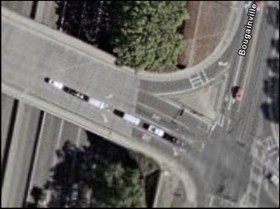 I can't resist, it's so easy... and I love to play with Google Earth.
A couple or three weeks ago I called in a problem to the City and County number that takes reports of road problems.
It was a dark and rainy night as I turned from Bougainnville Drive onto Radford Drive and moved to the left in order to make the turn into Center Street. The car ahead had done the same, but was one lane to the left of me, that is, in a lane for oncoming traffic. Fortunately, there was no one coming at him, and we both made it across without incident. The error was easy to make because there is no paint left on the pavement at that place, which is a concrete bridge over the H-1 Freeway.
So I called it in. But there is still no paint there. As an aspiring cyberjournalist, I thought I would document it with a photo next time. Being a lazy aspiring cyberjournalist, though, it's easier to fly over the spot with Google Earth for a look. Sure enough, although the satellite image was taken some time ago, it clearly shows the lack of paint on the bridge. Only the turn arrows are visible.
I know the City and County is short of asphalt to fix our many potholes, but I thought they had some paint left for traffic hazards. Here's one. Will they wait until someone is killed there to repaint the road markings? It seems that the only way to get a traffic light installed or correct other hazardous conditions on the streets of Honolulu is through human sacrifice.
Tomorrow I'll fax this post to them. Perhaps it's cyber-embarrassing enough to get some attention.
Tags:
Saturday, July 01, 2006
Governor's veto of bill limiting mercury in vaccinations would also kill the Hawaii Health Commission
Governor Linda Lingle, allegedly under pressure from the pharmaceutical industry and parts of the medical community, plans to veto SB 2133, usually described in news articles as a bill to limit the use of mercury preservative in vaccines. Parents of children with autism point to an increase in the incidence of the disorder that tracks the use of mercury in childhood vaccinations.
Unfortunately, due to mischief perpetrated by the state House, her veto will also kill the Hawaii Health Commission. As reported by the Star-Bulletin in a May 19 story,
Conveniently (?) a veto would derail progress on a single-payer health system and interrupt the work of the health care task force established by the previous session of the legislature and which has just wrapped up its work last month.
The loss of the Hawaii Health Commission and its $200,000 working budget has been "disappeared" even from the governor's website description of the bill on her list of candidates for a veto:
The full text of the bill is available here. Although the governor talks only about mercury, her stone kills the other bird as well (and no thanks to the House for making this possible!). Here's what the citizens of Hawaii will lose:
A veto of this bill would not only allow mercury to be continued to be included in vaccines (google the issue and decide for yourself whether this is a good thing) but short-circuits progress toward some form of universal health care.
Sure, a Republican governor might be happy with this, but should the people of Hawaii, many of whom have no health insurance or who pay high premiums to cover their families, let the opportunity to have universal health coverage be defeated with this stealth veto?
You can call/fax the governor and tell her that SB2133 should not be vetoed. Tell her why.
Phone: 808-586-0034
Fax: 808-586-0006
Unfortunately, due to mischief perpetrated by the state House, her veto will also kill the Hawaii Health Commission. As reported by the Star-Bulletin in a May 19 story,
The vaccine restrictions were added to a bill with the unrelated goal of establishing a Hawaii Health Commission.Most subsequent news accounts focus only on the mercury issue and ignore that the bill was hijacked, so that a veto affects the earlier provisions in the bill as well.
Conveniently (?) a veto would derail progress on a single-payer health system and interrupt the work of the health care task force established by the previous session of the legislature and which has just wrapped up its work last month.
The loss of the Hawaii Health Commission and its $200,000 working budget has been "disappeared" even from the governor's website description of the bill on her list of candidates for a veto:
SB 2133 Relating to HealthRead this and weep
Explanation: This bill limits the use of vaccines that contain a preservative called thimerosal. The limit could adversely affect the ability of the medical community to provide inoculations to people in Hawai`i seeking protection from the flu and other communicable diseases. The bill is too general and does not focus on those thought most susceptible to thimerosal, namely very young children. The medical community has expressed significant concerns that this bill could have negative implications for the public health and safety of the community.
The full text of the bill is available here. Although the governor talks only about mercury, her stone kills the other bird as well (and no thanks to the House for making this possible!). Here's what the citizens of Hawaii will lose:
Hawaii health commission; duties and responsibilities. (a) The commission shall be responsible for continuing the work of the governor's Hawaii health care task force of 2005, created by Act 223, Session Laws of Hawaii 2005, in the overall health planning for the State and shall be responsible for determining future capacity needs of health providers, facilities, equipment, and support services providers.Many organizations have worked long and hard to convince the legislature to work towards a comprehensive health care system for all of Hawaii's citizens. The legislature followed up on last session's appointment of a health care task force by creating the Hawaii Health Commission to continue to the work.
(b) The commission shall develop for all individuals in the State, a comprehensive health plan that includes:
(1) Establishment of eligibility for inclusion in a health plan;
(2) Establishment of all reimbursable services to be paid by the commission;
(3) Establishment of all approved providers of services in a health plan;
(4) Evaluation of health care and cost effectiveness of all aspects of a health plan; and
(5) Establishment of a budget for a health plan.
A veto of this bill would not only allow mercury to be continued to be included in vaccines (google the issue and decide for yourself whether this is a good thing) but short-circuits progress toward some form of universal health care.
Sure, a Republican governor might be happy with this, but should the people of Hawaii, many of whom have no health insurance or who pay high premiums to cover their families, let the opportunity to have universal health coverage be defeated with this stealth veto?
You can call/fax the governor and tell her that SB2133 should not be vetoed. Tell her why.
Phone: 808-586-0034
Fax: 808-586-0006
Tags: