Thursday, April 27, 2006
Yet another conflict of interest in the Hawaii Legislature
Rep. Sylvia Luke has become another poster child for conflict of interest accusations in the Hawaii state legislature. Today's Star-Bulletin editorial discusses the medical malpractice bill and ends by concluding:
It's one thing to holding an opinion on a matter, but if it happens that someone has a conflict of interest in it, the right thing to do is to step aside and let others act on it. Having a conflict of interest is not a crime, but one's actions become questionable if one doesn't both disclose it and remove one's influence on the matter at hand.
Luke also continues to sit on SB1061, the bill that would prohibit lobbyist contributions during session. Here again, she has a clear conflict of interest. According to data available, she has been the largest recipient of lobbyist largess in the House for the last (2004) election cycle. So here again, she should not be the one blocking this bill.
In both cases, Luke's refusal to hear these bills appears to be self-serving. When there is a conflict, the honorable thing to do is to step aside and have confidence in the wisdom of the committee members to do the right thing whatever that may be. A committee chair in her circumstances should also refrain from making a recommendation to the committee on how to vote, because quite often the "recommendation" is taken as direction from the leadership on how the member is expected to vote.
A resolution, SCR216 Creating a legislative task force to make recommendations for statutory enactment to enhance transparency in legislative proceedings has passed through the House Legislative Management Committee, but its next stop is guess where: Sylvia Luke's Judiciary Committee.
That task force could recommend rule changes or statutory measures to improve openness in Hawaii's government, including disclosures of conflict of interest.
I wonder if Luke will hear that resolution.
Luke is vulnerable to allegations that she is merely acting for the benefit of Cronin Fried Sekiya Kekina & Fairbanks, where she is an attorney. The firm is perhaps the most prominent in the state in handling personal injury cases. She should step aside from deciding by herself whether to consider this issue.Others may have reasons for objecting to this bill (my own preference would be to have the Insurance Commissioner regulate premiums, which has worked very well in other areas of insurance), but Rep. Luke is the one with a clear conflict of interest.
It's one thing to holding an opinion on a matter, but if it happens that someone has a conflict of interest in it, the right thing to do is to step aside and let others act on it. Having a conflict of interest is not a crime, but one's actions become questionable if one doesn't both disclose it and remove one's influence on the matter at hand.
Luke also continues to sit on SB1061, the bill that would prohibit lobbyist contributions during session. Here again, she has a clear conflict of interest. According to data available, she has been the largest recipient of lobbyist largess in the House for the last (2004) election cycle. So here again, she should not be the one blocking this bill.
In both cases, Luke's refusal to hear these bills appears to be self-serving. When there is a conflict, the honorable thing to do is to step aside and have confidence in the wisdom of the committee members to do the right thing whatever that may be. A committee chair in her circumstances should also refrain from making a recommendation to the committee on how to vote, because quite often the "recommendation" is taken as direction from the leadership on how the member is expected to vote.
A resolution, SCR216 Creating a legislative task force to make recommendations for statutory enactment to enhance transparency in legislative proceedings has passed through the House Legislative Management Committee, but its next stop is guess where: Sylvia Luke's Judiciary Committee.
That task force could recommend rule changes or statutory measures to improve openness in Hawaii's government, including disclosures of conflict of interest.
I wonder if Luke will hear that resolution.
Tags:


Wednesday, April 26, 2006
State House, daily press suck up to oil companies
People in Hawaii must live on an island or something. While the Mainland press places blame more and more where it belongs, on the oil companies, headlines in Hawaii blame our groundbreaking gas cap legislation instead.
A typical headline here is "Gas-cap price will jump 13¢" while on the Mainland, the Los Angeles Times reports that the President is at last calling for a probe into possible price gouging and is talking about a rollback of tax breaks for oil firms. Yes, our "oil president."
Here's what the Mainland is talking about:
Now, maybe those who are tired of being gouged at the pump and support improving the gas cap law would have an easier time of it if the newspapers quit convincing people that their problems are caused by the law itself.
The rest of the country is moving toward action against the oil and energy companies, which have turned in record profits this last quarter, including Exxon Mobile, which earned more money than any other corporation ever. We're bound on taking action against the lawmakers who are trying to save us money! Go figure.
Our daily papers might take a hard look at what they are doing by pounding the gas cap instead of the gas companies.
I can understand the behavior of our legislators, considering all the campaign contributions they are receiving. This is gonna be a great argument for Voter Owned Elections before it is all over. But how do our daily papers explain themselves?
Update: Thanks to the Star-Bulletin headline writer, whoever you are, for today's headline Cost of gas rises amid debate and for the internal headline Rising Gas Prices.
A typical headline here is "Gas-cap price will jump 13¢" while on the Mainland, the Los Angeles Times reports that the President is at last calling for a probe into possible price gouging and is talking about a rollback of tax breaks for oil firms. Yes, our "oil president."
Here's what the Mainland is talking about:
Several GOP senators called for a crackdown on what they described as windfall profits in the oil industry, and proposed taking a new look at antitrust laws that they said were outdated. . . .Elsewhere, people are taking action. This is from an article in the San Antonio Express News:
Florida's Republican attorney general said Tuesday that he had initiated an investigation into potential "monopolistic behavior" by companies such as Exxon Mobil and ConocoPhillips.
Bee County leaders urging boycott of Exxon MobilBut are we with it in Hawaii? Some of us are. But not our representatives in the House, who are stubbornly pushing for a repeal of the gas cap.
JEORGE ZARAZUA, SAN ANTONIO EXPRESS-NEWS - This week, Bee County became the first in the state, possibly the country, to pass a resolution
asking motorists to boycott fuel pumps beginning Monday. County elected
officials said they would ask others in the state to follow suit. . .
The resolution adopted Monday echoed the nation's anxiety over skyrocketing fuel prices that have now topped $3 in some states. Last week, average prices at the pump climbed 13.1 cents to $2.91 a gallon, according to the Energy Department. . .
The boycott call is targeted only at Exxon Mobil gasoline until
retailers agree to drop the price to $1.30 a gallon. Martinez said he's
especially miffed about reports that former Exxon Mobil CEO Lee Raymond
received a retirement package worth $400 million. The median annual
income here is about two-thirds of the state average of almost $40,000.
Many can't even afford to travel to nearby hospitals for treatment, he
said.
Now, maybe those who are tired of being gouged at the pump and support improving the gas cap law would have an easier time of it if the newspapers quit convincing people that their problems are caused by the law itself.
The rest of the country is moving toward action against the oil and energy companies, which have turned in record profits this last quarter, including Exxon Mobile, which earned more money than any other corporation ever. We're bound on taking action against the lawmakers who are trying to save us money! Go figure.
Our daily papers might take a hard look at what they are doing by pounding the gas cap instead of the gas companies.
I can understand the behavior of our legislators, considering all the campaign contributions they are receiving. This is gonna be a great argument for Voter Owned Elections before it is all over. But how do our daily papers explain themselves?
Update: Thanks to the Star-Bulletin headline writer, whoever you are, for today's headline Cost of gas rises amid debate and for the internal headline Rising Gas Prices.
Tags:
Press Release: Release the press -- Disappearing press freedom in the State Capitol
Press freedom has come under attack in Hawaii, and from an unexpected quarter. Our own House of Representatives.
Reading Ian Lind's article on it yesterday flashed me back more than 30 years to a more repressive era in world history.
When I moved to Asia in the early 1970s, generals still ran governments and censorship was not uncommon. Signs near the elevators of the Chosun Hotel in Seoul reminded guests that no photography was allowed above the third floor. Don't even think about popping a flashbulb where you shouldn't, who knows what could happen to you.
Over in Taipei, I installed a high-speed international data line (all of 9600 bps). One of the conditions for approval of the circuit was that a retired Taiwan Army soldier would be stationed in the room with the equipment to monitor the data traffic. As if he could, he'd have to be quite a speed reader, and it was undecipherable anyway. The company had to agree to pay his salary or pension. Soft job for him, but symbolic of government's desire to monitor and control communications.
It was the American Bicentennial, and I was very conscious that we have a First Amendment and freedom of speech in my country, and hoped the idea would spread around the world a little faster. What a drag, having to hire a government spy to monitor your own data line.
Which brings us to 2006 in Hawaii, specifically in the House, part of our State Legislature, a body committed to uphold our laws and traditions.
Ian Lind has revealed that two people from the House Majority Leader's office are to be stationed in the one remaining little press box at the back of the House floor. This gestapo-like tactic will assure that anything said in the box immediately gets back to House leadership. Reporter Crystal Kua, in an email linked to at Ian's website, correctly describes stationing these two people in the press box as a form of prior restraint.
What has happened to House leadership this session?
You've read here about amendments coming to hearings that have been kept from public view. Others were prepared in advance by committee chairs away from the eyes of the public, to be sprung on the committee after all testimony is in, along with a direction to pass the new language.
Ian's article mentions the closing of the second press box and restrictions on access to the House floor.
The problem may be more than a need for "sunshine" or a "disinfectant" to eradicate corporate interns infesting legislative offices. House leadership has been unresponsive on either issue. Here is a new challenge. How will they respond? Will they respond?
Reading Ian Lind's article on it yesterday flashed me back more than 30 years to a more repressive era in world history.
When I moved to Asia in the early 1970s, generals still ran governments and censorship was not uncommon. Signs near the elevators of the Chosun Hotel in Seoul reminded guests that no photography was allowed above the third floor. Don't even think about popping a flashbulb where you shouldn't, who knows what could happen to you.
Over in Taipei, I installed a high-speed international data line (all of 9600 bps). One of the conditions for approval of the circuit was that a retired Taiwan Army soldier would be stationed in the room with the equipment to monitor the data traffic. As if he could, he'd have to be quite a speed reader, and it was undecipherable anyway. The company had to agree to pay his salary or pension. Soft job for him, but symbolic of government's desire to monitor and control communications.
It was the American Bicentennial, and I was very conscious that we have a First Amendment and freedom of speech in my country, and hoped the idea would spread around the world a little faster. What a drag, having to hire a government spy to monitor your own data line.
Which brings us to 2006 in Hawaii, specifically in the House, part of our State Legislature, a body committed to uphold our laws and traditions.
Ian Lind has revealed that two people from the House Majority Leader's office are to be stationed in the one remaining little press box at the back of the House floor. This gestapo-like tactic will assure that anything said in the box immediately gets back to House leadership. Reporter Crystal Kua, in an email linked to at Ian's website, correctly describes stationing these two people in the press box as a form of prior restraint.
What has happened to House leadership this session?
You've read here about amendments coming to hearings that have been kept from public view. Others were prepared in advance by committee chairs away from the eyes of the public, to be sprung on the committee after all testimony is in, along with a direction to pass the new language.
Ian's article mentions the closing of the second press box and restrictions on access to the House floor.
The problem may be more than a need for "sunshine" or a "disinfectant" to eradicate corporate interns infesting legislative offices. House leadership has been unresponsive on either issue. Here is a new challenge. How will they respond? Will they respond?
Tags:
Tuesday, April 25, 2006
K Street West Part 1: Honolulu's unfolding lobbyist scandal
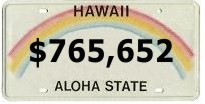 $765,652. Remember this number.
The incest between Congress, Abramoff and K Street lobbying firms has been splashed across front pages everywhere. That corporate money leads to corruption in government is no surprise. The influence of money is pervasive not only in Congress but of course in state and local government most anywhere. It seems to be the American Way. It's how we do business. Money is the license to play in politics everywhere and anywhere.
Abramoff played big and fell hard, taking down his buddy DeLay with him. Abramoff's fall caused panic in Washington as legislators rushed to dispose of their share of his tainted money. As though that would leave their hands clean.
Hawaii is no stranger to big money influence. Governor Lingle raised huge sums on the Mainland, and candidates for office are rated here, as elsewhere, on their ability to build a big "war chest." Developers and engineers don't seem to mind paying fines in order to support their favorite politician, and presumably there are rewards in store for them in exchange.
If you don't give money, don't expect to play, don't expect to win, is the clear message.
Recently, it was discovered (not that it was a secret) that big corporations, for example, HMSA and HECO, have one or more executives embedded in the state legislature. While still pulling down big corporate salaries, their presence is an in-kind though unreported contribution to the legislators they toil for.
Of course, this is in addition to whatever was forked over by these and numerous other companies and special interests as campaign contributions to buy votes. Is that too direct? I said "to buy votes." What else is the money for? If they wanted to give it to charity, they could have done so. Money directed to politicians is an investment. When a politician holds a fund raiser during the session, they are inviting these folks to invest. Investments are expected to payoff now or later. Corporations are not supporting politicians because they feel generous. You know that.
So what's that $765,652?
It's the first fruit of ongoing research into what makes our government go. This is the best estimate yet of the amount hauled in by 11 legislators (and yes, we know who you are) and two legislative PACs during the 2004-2005 sessions. (Political Action Committees, commonly called "PACs," are organizations dedicated to raising and spending money to either elect or defeat political candidates).
That's big money for our little ol' state. For sure, it must buy a lot of favors. And it is only part of the vast total. More details will be coming out soon.
We glean this information from disclosures that are required of the lobbyists and special interests. The data is there. It can be hard to decipher, though, because "drug money" doesn't come clearly labeled like pill bottles, nor does "tobacco money" come in a pouch labeled Phillip Morris. You'd have to know that a firm in New York City channels tobacco money to where it will have the best payoff for the cigarette manufacturers. That firm is registered in databases that are now accessible by anyone via the Internet.
You have to connect the dots to see how the money flows from these front organizations through Hawaii's key lobbyists to end up in the campaign coffers of your favorite legislator. Here's where the power of today's mighty desktop computers comes in handy. They are up to the task. The dots are being connected in the rows and columns of Excel spreadsheets.
I hate to disappoint the folks who feel strongly about representative democracy. They take time off for work to write and deliver testimony in person at the Legislature. When the committee chair ignores them and submits an amendment drawn up in advance but kept from the public, they wonder what is going on.
Wonder no more. $765,652 was enough to buy influence during the 2004-2005 sessions. With big oil working to defeat the gas cap, and since this is an election year, expect the jackpot to be even larger this time around.
Stay tuned. Check out also Hawaii's latest political blog, blast-em.blogspot.com.
Tags:
Saturday, April 22, 2006
Mayor and City still evade responsibility to evicted Ala Moana homeless
In the April 20, 2006 Honolulu Advertiser article Ala Moana park closure extended, City Parks Director Lester Chang said "We've had a lot of positive feedback about the nightly closures."
What about the outrage that others have expressed about how the families were routed from the park in pouring rain with no plans to put them up elsewhere? People from all over the island gathered food and supplies to keep these families from crisis as the Mayor and the City tried to look the other way.
What about negative feedback from social service agencies and advocates who pointed out that all of them have been separated from the social services that might have helped them regain permanent shelter?
What we expect from the City is a practical plan to end homelessness one day. While we wait, something must be done other than chase people from location to location.
Don't the Mayor and the City feel any shame for what they are doing to these families, which include many children?
Here is an alert issued by The Interfaith Alliance of Hawaii on the same day:
4/20/06 UPDATE
Ala Moana Park Houseless (Ohana O'Hawaii) Need Help
The houseless who were evicted from Ala Moana Park on March 27 were given shelter at Kawaihao and Central Union Churches until April 30, a date that is rapidly approaching. Those at Kawaihao have organized there own leadership council and are successfully governing themselves. They are successfully demonstrating that safe zones can work, where the houseless govern themselves. Even with this success, neither the city nor State is willing to create safe zones
The houseless at Kawaihao have been sign holding at City Hall ever since their eviction to support to encourage the Mayor and the Governor to find a place for them have a good night's sleep.
To support them, if you are able, please join their sign holding campaign, particularly on
Monday April 24 at 9:00 am to 10:00 am at City hall
Monday, April 24, 4 pm TO 5:30 pm
Tuesday, April 25 10am to noon
Make your signs (or you may borrow a sign) and join the houseless in calling for a place for them to stay. Currently under consideration.
1. Sand Island
2. Keehi Lagoon
3. Kamehameha Schools land
4. Church lands
5. Conservation Lands
6. DHHL Lands
7. Other
Funds are also welcome for a multitude of advocacy and emergency needs. Checks may be made out to The Interfaith Alliance Hawaii, 20 South Vineyard Blvd, Honolulu 96813, designated for the Ala Moana Houseless.
What about the outrage that others have expressed about how the families were routed from the park in pouring rain with no plans to put them up elsewhere? People from all over the island gathered food and supplies to keep these families from crisis as the Mayor and the City tried to look the other way.
What about negative feedback from social service agencies and advocates who pointed out that all of them have been separated from the social services that might have helped them regain permanent shelter?
What we expect from the City is a practical plan to end homelessness one day. While we wait, something must be done other than chase people from location to location.
Don't the Mayor and the City feel any shame for what they are doing to these families, which include many children?
Here is an alert issued by The Interfaith Alliance of Hawaii on the same day:
4/20/06 UPDATE
Ala Moana Park Houseless (Ohana O'Hawaii) Need Help
The houseless who were evicted from Ala Moana Park on March 27 were given shelter at Kawaihao and Central Union Churches until April 30, a date that is rapidly approaching. Those at Kawaihao have organized there own leadership council and are successfully governing themselves. They are successfully demonstrating that safe zones can work, where the houseless govern themselves. Even with this success, neither the city nor State is willing to create safe zones
The houseless at Kawaihao have been sign holding at City Hall ever since their eviction to support to encourage the Mayor and the Governor to find a place for them have a good night's sleep.
To support them, if you are able, please join their sign holding campaign, particularly on
Monday April 24 at 9:00 am to 10:00 am at City hall
Monday, April 24, 4 pm TO 5:30 pm
Tuesday, April 25 10am to noon
Make your signs (or you may borrow a sign) and join the houseless in calling for a place for them to stay. Currently under consideration.
1. Sand Island
2. Keehi Lagoon
3. Kamehameha Schools land
4. Church lands
5. Conservation Lands
6. DHHL Lands
7. Other
Funds are also welcome for a multitude of advocacy and emergency needs. Checks may be made out to The Interfaith Alliance Hawaii, 20 South Vineyard Blvd, Honolulu 96813, designated for the Ala Moana Houseless.
Tags:
Rep. Bev Harbin introduces resolution to reform House rules
Representative Bev Harbin introduced HR283 on Friday April 20 to prevent bills from being plunked down in front of House members for final reading without notice.
The resolution's purpose is stated as:
The resolution has been referred to the Legislative Management Committee chaired by Rep. Michael Y. Magaoay and the Judiciary Committee chaired by Rep. Sylvia Luke.
You can help this reso pass by calling Rep. Magaoay at 586-6380 or email repmagaoay@Capitol.hawaii.gov and Rep. Luke at 586-8530 or email mailto:repluke@Capitol.hawaii.gov and asking that the resolution be heard by those committees.
The resolution's purpose is stated as:
Amending the rules of the house of representatives to require that all bills to be considered for final reading be listed on the order of the day at least twenty-four hours in advance of final reading.If the rules were amended as in this reso it would remove one method that House leadership may use to bulldoze a measure through the final reading process.
The resolution has been referred to the Legislative Management Committee chaired by Rep. Michael Y. Magaoay and the Judiciary Committee chaired by Rep. Sylvia Luke.
You can help this reso pass by calling Rep. Magaoay at 586-6380 or email repmagaoay@Capitol.hawaii.gov and Rep. Luke at 586-8530 or email mailto:repluke@Capitol.hawaii.gov and asking that the resolution be heard by those committees.
Tags:
Interfaith Alliance of Hawaii asks support for non-discrimination bill
The following email has been widely circulated today:
Aloha friends,
Recently the Legislature passed House Bill 1223 - adding sexual orientation, gender identity and gender expression to Hawai`i's non-discrimination in public accommodations (stores, restaurants, hotels, etc.) law. Many people do not know that right now, it is legal to discriminate in these places.
The Bill is now sitting on Gov. Lingle's desk for her signature. Please contact her office and ask her to sign House Bill 1233 into law. We want to show Gov. Lingle that Hawai`i's people do not support discrimination. Gov. Lingle's office phone number is 586-0034. Her email address is governor.lingle@hawaii.gov. All you have to do is say, "please sign House Bill 1233". You can add more if you like but it is not necessary.
Mahalo for your kokua!
Aloha,
The Interfaith Alliance of Hawai'i
Aloha friends,
Recently the Legislature passed House Bill 1223 - adding sexual orientation, gender identity and gender expression to Hawai`i's non-discrimination in public accommodations (stores, restaurants, hotels, etc.) law. Many people do not know that right now, it is legal to discriminate in these places.
The Bill is now sitting on Gov. Lingle's desk for her signature. Please contact her office and ask her to sign House Bill 1233 into law. We want to show Gov. Lingle that Hawai`i's people do not support discrimination. Gov. Lingle's office phone number is 586-0034. Her email address is governor.lingle@hawaii.gov. All you have to do is say, "please sign House Bill 1233". You can add more if you like but it is not necessary.
Mahalo for your kokua!
Aloha,
The Interfaith Alliance of Hawai'i
Friday, April 21, 2006
Rally Monday to protest Department of Human Services plans to potentially displace 165,000 QUEST families
Message from the Hawaii Coalition For Health:
Please support our Quest families. The DHS is planning to force 165,000 Quest members to choose a health plan in October even if they are happy with the plan and doctor they presently have, and if they don't they will be autoassigned to where the DHS wants to send them. This is a medical outrage which is likely to disrupt the care of thousands of patients, and could even prove dangerous to the health of many seriously ill people. A good doctor/patient relationship is the cornerstone of improving health outcomes, and here the DHS cares not if they destroy such relationships.
Join us in a rally at the state capitol on Monday, 24th at 2:00 pm or call your legislators and complain.
Please call my office [Dr. Arleen Meyers]: 622-2655 if you have questions.
From: Noe Foster [NFoster@alohacarehawaii.org]
Aloha Friends,
We urgently need your help to stop the upheaval of 165,000 QUEST patients. The Department of Human Services is changing the enrollment process that will require ALL QUEST MEMBERS to actively re-choose their QUEST health plan and then at a later time re-choose their primary care physician (PCP) or provider. QUEST members will be notified of this change by mail. Those familiar with this population know the response will be minimal.
As a result, QUEST members who do not actively choose a new health plan and provider will be auto-enrolled into a new plan. Continuality of care will be disrupted as patients, providers and physicians find the majority of QUEST members re-shuffled. Many patients will not learn they have been auto-assigned until they show up at their doctor's office.
We need your urgent help to pressure our legislators to pass HB 2043 SD3, scheduled to be heard Tuesday, April 25, 10:30 a.m., room 229, at the State Capitol to prevent mandatory re-enrollment from happening.
Although 50-plus social service advocates, physicians, and community health centers provided emotional testimony, pleading with legislators to stop this from taking place. The senate version of this bill was successfully passed. However, there is resistance amongst key members of the House.
WE NEED YOU TO VOICE YOUR CONCERN AND URGE OUR LEGISLATORS TO PASS HB 2043 SD3 BY PHONE, EMAIL OR FAX BY MONDAY, APRIL 24:
Representative Alex Sonson, Chair, Human Services Committee
Phone: 586-6520
Fax: 586-6521
E-mail: repsonson@Capitol.hawaii.gov
Representative Dennis Arakaki, Chair, Health Committee
Phone: 586-6050
Fax: 586-6051
E-mail: reparakaki@Capitol.hawaii.gov
Click here for a fact sheet and excerpts from testimony presented to these legislators on this issue.
COMMUNITY ADVOCATES ARE ALSO HOLDING A RALLY MONDAY, APRIL 24, AT 2 PM AT THE STATE CAPITOL. WE NEED AS MANY SUPPORTERS AS POSSIBLE TO COME OUT TO THIS RALLY SO OUR VOICES ARE HEARD. I URGE YOU TO JOIN US AND RECEIVE A FREE SHIRT.
Please support our Quest families. The DHS is planning to force 165,000 Quest members to choose a health plan in October even if they are happy with the plan and doctor they presently have, and if they don't they will be autoassigned to where the DHS wants to send them. This is a medical outrage which is likely to disrupt the care of thousands of patients, and could even prove dangerous to the health of many seriously ill people. A good doctor/patient relationship is the cornerstone of improving health outcomes, and here the DHS cares not if they destroy such relationships.
Join us in a rally at the state capitol on Monday, 24th at 2:00 pm or call your legislators and complain.
Please call my office [Dr. Arleen Meyers]: 622-2655 if you have questions.
From: Noe Foster [NFoster@alohacarehawaii.org]
Aloha Friends,
We urgently need your help to stop the upheaval of 165,000 QUEST patients. The Department of Human Services is changing the enrollment process that will require ALL QUEST MEMBERS to actively re-choose their QUEST health plan and then at a later time re-choose their primary care physician (PCP) or provider. QUEST members will be notified of this change by mail. Those familiar with this population know the response will be minimal.
As a result, QUEST members who do not actively choose a new health plan and provider will be auto-enrolled into a new plan. Continuality of care will be disrupted as patients, providers and physicians find the majority of QUEST members re-shuffled. Many patients will not learn they have been auto-assigned until they show up at their doctor's office.
We need your urgent help to pressure our legislators to pass HB 2043 SD3, scheduled to be heard Tuesday, April 25, 10:30 a.m., room 229, at the State Capitol to prevent mandatory re-enrollment from happening.
Although 50-plus social service advocates, physicians, and community health centers provided emotional testimony, pleading with legislators to stop this from taking place. The senate version of this bill was successfully passed. However, there is resistance amongst key members of the House.
WE NEED YOU TO VOICE YOUR CONCERN AND URGE OUR LEGISLATORS TO PASS HB 2043 SD3 BY PHONE, EMAIL OR FAX BY MONDAY, APRIL 24:
Representative Alex Sonson, Chair, Human Services Committee
Phone: 586-6520
Fax: 586-6521
E-mail: repsonson@Capitol.hawaii.gov
Representative Dennis Arakaki, Chair, Health Committee
Phone: 586-6050
Fax: 586-6051
E-mail: reparakaki@Capitol.hawaii.gov
Click here for a fact sheet and excerpts from testimony presented to these legislators on this issue.
COMMUNITY ADVOCATES ARE ALSO HOLDING A RALLY MONDAY, APRIL 24, AT 2 PM AT THE STATE CAPITOL. WE NEED AS MANY SUPPORTERS AS POSSIBLE TO COME OUT TO THIS RALLY SO OUR VOICES ARE HEARD. I URGE YOU TO JOIN US AND RECEIVE A FREE SHIRT.
Tags:
Thursday, April 20, 2006
House Minority Leader calls attention to breach of 24-hour notice for 30 bills
 House Minority Leader Rep. Lynn Finnegan decried the lack of notification on a flock of bills passed out of the House this week.
"The majority rushed through some 30 bills yesterday, instead of giving members of the House and the public 24 hour advanced notice before voting on final reading."In her Tuesday press release, Rep. Finnegan acknowledges that the 24 hour notice is practiced as a courtesy.
Courtesy or not, the incident demonstrates that House procedures can be and are altered at whim.
This session has been unusual in the number of procedures or rules that have been bent, each time with the effect of keeping the public in the dark on legislative activities.
The Bring Sunshine to Hawaii website not only has a petition to urge the legislature to bring about badly needed reforms, but it also has an email address to which "leaks" may be sent.
Tags:
New California gasoline study shows profits are driving up pump prices
A study of California gasoline prices released by The Foundation for Taxpayer and Consumer Rights on Tuesday showed that oil company profiteering is responsible for the current price spikes, not the price of a barrel of oil.
Since Hawaii's Public Utilities Commission has chosen to interpret Hawaii's gas cap law to set the highest prices rather than the lowest, Hawaii has seen price increases similar to California.
And for the same reason: high prices mean higher corporate profits.
Increases in the "spot" market price of crude oil -- which is the highest price a major oil company would pay for crude oil -- accounted for only 12 cents per gallon. California's percentage sales tax increased fuel prices by another four cents per gallon. More than 40 cents of the 60-cent increase in gasoline prices over 3 1/2 months is attributable to increased refinery and marketing profit margins for the oil companies....The full study can be read here.
The profit increase of 42 cents, on top of record profits last year, means California gasoline will cost consumers approximately $546 million more in April 2006 than in April of last year.
Since Hawaii's Public Utilities Commission has chosen to interpret Hawaii's gas cap law to set the highest prices rather than the lowest, Hawaii has seen price increases similar to California.
And for the same reason: high prices mean higher corporate profits.
Tags:
Wednesday, April 19, 2006
Shame on Hawaii II
The article Shame on Hawaii described how Honolulu evicted 200 people from Ala Moana Park. It turns out that the removal was timed to allow a festival to take place.
As predicted, the City is not allowing them back. The Honolulu Advertiser reports that "The city has decided to extend the night closures at Ala Moana Park at least through mid- to late June."
The shame part is that in the interim, no arrangements have been made for the families, which of course include many children. All of them have been separated from the social services that might have helped them regain permanent shelter. Some can make use of job training as well, but in Hawaii many homeless have jobs, though the income isn't enough to pay soaring rents.
So Shame on Hawaii Again.
As predicted, the City is not allowing them back. The Honolulu Advertiser reports that "The city has decided to extend the night closures at Ala Moana Park at least through mid- to late June."
The shame part is that in the interim, no arrangements have been made for the families, which of course include many children. All of them have been separated from the social services that might have helped them regain permanent shelter. Some can make use of job training as well, but in Hawaii many homeless have jobs, though the income isn't enough to pay soaring rents.
So Shame on Hawaii Again.
Tags:
Small business beware: health insurance premium regulation is at stake in the legislature
 Hawaii's health insurance market has been a virtual monopoly for years and years, with Kaiser dominating the HMO market and HMSA the rest. And like the rest of the industry, HMSA in particular varied its premiums at will. Not only did HMSA raise premiums to what the market would bear, but it could also lower them below cost so as to drive out competition.
It was to bring order to this market and to protect the profits of Hawaii's small business owners, that the legislature passed a law that required health insurers to submit proposed rate changes to the insurance commissioner.
The Mainland has apparantly caught up with Hawaii as far as consolidation goes. A report was released by the American Medical Association on April 17, 2006 that begins:
AMA study shows limited competition among health insurance companies
"The remarkable reduction in the number of competing health plans is troubling for doctors and patients, as competition drives innovation and efficiency in the health care system," said AMA board member J. James Rohack, MD. "Most alarmingly, in the combined HMO and PPO markets, 95 percent of metropolitan areas have few competing health insurers."Senate Bill 2917 goes to conference and to an uncertain future. This is the bill that started out simply removing the sunset provision of the rate regulation law.
In addition, the study found that in 95 percent of markets, a single insurer had a market share of 30 percent or greater, and in 56 percent of the markets, a single insurer had a market share of 50 percent or greater. The AMA report, Competition in Health Insurance: A Comprehensive Study of U.S. Markets, analyzed 294 metropolitan health insurance markets against an index used by federal regulators for measuring market concentration. According to the federal index, markets that are highly concentrated have few competing health insurers.
"Patients do not appear to be benefiting from the consolidation of health insurance markets," said Dr. Rohack. "Health insurers are posting historically high profit margins, yet patient health insurance premiums continue to rise without an expansion of benefits."
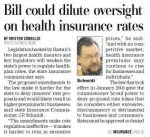
Changes were made favorable to the insurers, in particular, in Rep. Bob Herkes' committee, where a complex and damaging amendment was sprung on the committee for a vote after hearing public testimony. The amendment was written, according to a Pacific Business News article Bill could dilute oversight on health insurance rates, by the insurance industry itself.
Senate conferees appointed for this bill are Sen. Menor, Chair and Co-Chairs Baker, Espero, and Hogue. The House has appointed its conferees: Reps. Arakaki, Herkes, Takamine are Co-Chairs and Rep. Marumoto. Rep. Herkes, in the last paragraph of the PBN article, reveals that he has not read and doesn't understand the current law, which is not a rate "cap" as he describes it in the article. It's disappointing to see him appointed to this committee.
If you are a small business owner, your profits are in their hands. If the Insurance Commissioner cannot effectively regulate rates, the big increases will come out of your pockets directly. Also, any employees paying premiums for family members will have to pay whatever HMSA wants them to pay.
Think about it.
Now is the time to contact these legislators, Speaker Calvin Say, and your own representatives to have this bill, which has been manipulated by the insurance industry and a cooperative committee chair, set back to its original form.
Call now or pay later, depending on what the conference committee decides.
Tags:
Tuesday, April 18, 2006
Plato's Allegory of the Cave: a model for Hawaii?
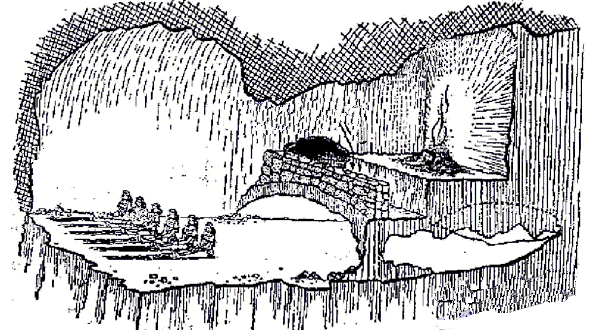
From ancient Greece to modern Hawaii. Wisdom across the ages and across the seas.
(With apologies to the Wikipedia)
Imagine citizens who have been chained since childhood deep inside a cave. Not only are their limbs immobilized by the chains, their heads are chained as well so that their eyes are fixed on a wall.I'm still waiting for that to happen. The puppeteers are firmly in control, casting their shadows from the parapets of the State Capitol itself, into which they have penetrated with their lobbyists and campaign contributions.
Behind the citizens is an enormous fire, and between the fire and the prisoners there is a state capitol building, through which shapes of various bills, resolutions, and other things are carried. The shapes cast shadows on the wall, which is like a giant television set. In fact, it is a giant television set, forget the simile. Also, when one of the shape-carriers speaks, a sound bite on the TV causes the prisoners to believe that the words come from the shadows.
The citizens engage in what appears to us to be a game - naming the shapes as they come by. This, however, is the only reality that they know, even though they are seeing merely shadows of images. They repeat what they see and hear on the giant TV screen: "Let the free market prevail!" Or, "the gas cap is a failure!!"
Suppose a citizen is released and compelled to stand up and turn around. . . .
At least in Plato's time they debated in the Athenian Senate. In our time, it doesn't take much to sway our legislators.
In the past quarter we have seen oil companies post the largest profits in the history of the world of any company. Surely, they have the means to put down an insurrection against their power in Hawaii. For that is what the gas cap law represents: a challenge to corporate monopoly and power. With just the small change in their pockets they have managed to convince many of the people of this state and their lawmakers that the gas cap isn't working and that we are better off without it.
Let's get one thing clear to start with: The oil companies are the ones better off without the gas cap. Imagine if the idea should spread to other states? Their huge profits might be pared down a bit. Their retirement benefits might suffer (recently retired ExxonMobil CEO Lee Raymond got $6.5 million a year).
So keep staring at corporate-controlled TV and advertising-dependent newspapers, fellow citizens, and repeat what they tell you to believe. If you thought about it, you'd see that there is no free market in gasoline in Hawaii, and you're merely part of an age-old game being played out on a huge economic stage today.
There really are no chains, so stand up and turn around ...
Tags:
Citizen Voice letter to Speaker Say
Citizen Voice released a letter addressed to Speaker of the House Calvin Say calling for the removal of intern Mark Forman from Rep. Herkes' office:
Now, if the law requires them to provide this coverage, shouldn't the legislature have some responsibility when HMSA/Kaiser try to co-opt the process by writing their own amendment to weaken the regulation of their rates and having a sympathetic committee chair push it forward without public input?
Small businesses of the state arise; you have nothing to lose but your profits.
Citizen Voice expects you, as speaker, to remove the healthcare insurance industry representatives from Chairman Herkes office and put Bill SB2917 back to its original wording and pass it in order to reinstate rate regulation of the healthcare insurance industry.I imagine that not too many people follow the legislative process very closely. If more small businesses were watching this bill, they might understand that it can very seriously impact how much they must pay HMSA/Kaiser and other insurers for the health plans that they are required to provide under Hawaii law.
Now, if the law requires them to provide this coverage, shouldn't the legislature have some responsibility when HMSA/Kaiser try to co-opt the process by writing their own amendment to weaken the regulation of their rates and having a sympathetic committee chair push it forward without public input?
Small businesses of the state arise; you have nothing to lose but your profits.
Tags:
Poinography.com reveals "intern" was past Democratic Party leader
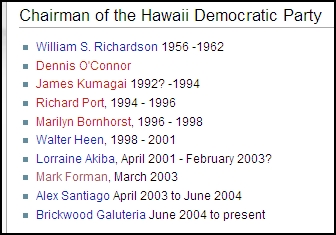 I'm indebted to Doug over at Poinography for his article yesterday Former Party chair is now an “intern”. Doug Googled Mark Forman and revealed that he is a former interim chairman of the state Democratic party.
This should lay to rest any assumption that this "intern" is there to learn how the legislative process works.
Mr. Forman is revealed to have enough position and influence to have served, however briefly, as leader of the entire party. No intern he.
Tags:
Monday, April 17, 2006
Foxes running the henhouse at Herkes' Consumer Protection & Commerce Committee
Thanks to fine investigative reporting by Pacific Business News' Kristen Consillio,a front-page article in Friday's PBN, Bill could dilute oversight on health insurance rates, reveals more about the troubled legislative process in Rep. Robert Herkes' office. It isn't pretty.
The article demonstrates that Herkes has turned the process of legislating health insurance regulation over to the industry that is being regulated. He has allowed the industry to write its own legislation and hasn't studied the law himself, despite all the testimony given to his committee by the Insurance Commissioner and the public.
Herkes' harboring of a corporate intern who is Executive Administrator of HMSA Foundation has been the focus of current attention. See Richard Borreca's column Lawmakers still struggle to get it right and this morning's editorial in the Star-Bulletin, Cleanse intern program of special interests.
But Consillio's article reveals that industry penetration into Rep. Herkes' office is more profound than just the donation of a senior executive to help him with his work--the same industry is literally writing legislation for him. She writes:
Effectively, all the testimony presented to the committee was wasted because the chair had already let the industry write an amendment to the bill on how to regulate itself.
The democratic process was bypassed--through its access to the committee chair, the health insurance industry is writing new law on how it should be regulated.
Rate regulation has saved Hawaii's premium payers millions, but Herkes is willing to let insurers undo the savings. The winners will be health insurers who already have a near-monopoly grip on the Hawaii market, and the losers will be small-business owners and individuals who would pay unlimited escalating premiums for health care coverage.
At the end of the article Herkes is quoted:
So let's recap: Rep. Herkes has demonstrated that he doesn't understand the law itself--and he has turned the process of writing his legislation entirely over to the industry being regulated.
This is an outrage, and if not reversed, will be very costly to small business in particular. House leadership should back off on their resistance to reform and should undo the damage to this bill in particular.
The legislative process surrounding SB2917 has been frankly shameful. What started out as a short bill to remove the sunset clause in the rate regulation bill has been allowed, through access and influence, to turn into a blot on the reputation of the House itself.
What is the remedy? SB2917 is headed to conference. It should be restored to its original language. If it is allowed to stand as it is, it will demonstrate to the voters, as the insurance companies pick their pockets, that legislators are willing to let special interests run what should be our government.
Call, email or fax your legislators and ask them to restore the original language of SB2917.
The article demonstrates that Herkes has turned the process of legislating health insurance regulation over to the industry that is being regulated. He has allowed the industry to write its own legislation and hasn't studied the law himself, despite all the testimony given to his committee by the Insurance Commissioner and the public.
Herkes' harboring of a corporate intern who is Executive Administrator of HMSA Foundation has been the focus of current attention. See Richard Borreca's column Lawmakers still struggle to get it right and this morning's editorial in the Star-Bulletin, Cleanse intern program of special interests.
But Consillio's article reveals that industry penetration into Rep. Herkes' office is more profound than just the donation of a senior executive to help him with his work--the same industry is literally writing legislation for him. She writes:
"Kaiser Permanente Hawaii lobbyist Chris Pablo acknowledged that he drafted the amendments to the bill and circulated them among other health plans, like the Hawaii Medical Service Association, to enlist their support."The resulting amendment, which Rep. Herkes sprung on the committee for passage, was no longer a simple bill to cancel the sunset provision of the rate regulation law--all the new language was highly favorable to the health insurers. One section in particular practically assures that any attempt at rate regulation would be tied up in litigation virtually forever.
Effectively, all the testimony presented to the committee was wasted because the chair had already let the industry write an amendment to the bill on how to regulate itself.
The democratic process was bypassed--through its access to the committee chair, the health insurance industry is writing new law on how it should be regulated.
Rate regulation has saved Hawaii's premium payers millions, but Herkes is willing to let insurers undo the savings. The winners will be health insurers who already have a near-monopoly grip on the Hawaii market, and the losers will be small-business owners and individuals who would pay unlimited escalating premiums for health care coverage.
At the end of the article Herkes is quoted:
"The bottom line is they are regulated," Herkes said. "I think [insurers] made more money on the previous law, and took advantage of it frankly, because they treated the [rate] cap like a floor and would go right up to it."Trouble is, the existing law isn't a "cap" like the gas cap law--the insurers propose a rate increase and submit supporting documentation. If the proposed increase is reasonable, it is approved. The actuarial process is long and full of numbers, but the insurers are supposed to do those calculations anyway. They have to do an honest job of it or their application would be turned down. The Insurance Commissioner has reported that occasionally errors are discovered and corrected.
So let's recap: Rep. Herkes has demonstrated that he doesn't understand the law itself--and he has turned the process of writing his legislation entirely over to the industry being regulated.
This is an outrage, and if not reversed, will be very costly to small business in particular. House leadership should back off on their resistance to reform and should undo the damage to this bill in particular.
The legislative process surrounding SB2917 has been frankly shameful. What started out as a short bill to remove the sunset clause in the rate regulation bill has been allowed, through access and influence, to turn into a blot on the reputation of the House itself.
What is the remedy? SB2917 is headed to conference. It should be restored to its original language. If it is allowed to stand as it is, it will demonstrate to the voters, as the insurance companies pick their pockets, that legislators are willing to let special interests run what should be our government.
Call, email or fax your legislators and ask them to restore the original language of SB2917.
Tags:
Scheduled fundraisers during session would not be permitted under SB1061
Senate Bill 1061 is still being deferred by House leadership and Rep. Sylvia Luke despite an appeal by 14 organizations to have it passed.
Lobbyist contributions during session are a non-partisan problem, but the Democratic Party has highlighted it by openly posting fund raising events on its website.
These fundraisers are a perfect opportunity for special interests to express their "support" of legislators even as bills affecting their companies or industry are going through the legislative process.
There are laws restricting lobbyist contributions in some other states and Hawaii should have one too. SB1061 is very simple. It's preamble says:
It won't be, unless the public pressures the House to move it out of committee.
Call Speaker Calvin Say at 586-6100, fax him at 586-6101, or email him at repsay@Capitol.hawaii.gov and ask that SB1061, which prohibits contributions during session, be passed by the House. If you enjoy writing letters to the editor, here's a great subject to write about.
Lobbyist contributions during session are a non-partisan problem, but the Democratic Party has highlighted it by openly posting fund raising events on its website.
These fundraisers are a perfect opportunity for special interests to express their "support" of legislators even as bills affecting their companies or industry are going through the legislative process.
There are laws restricting lobbyist contributions in some other states and Hawaii should have one too. SB1061 is very simple. It's preamble says:
The purpose of this Act is to prohibit registered lobbyists who lobby the legislature, principals of these lobbyists, agents and clients of these lobbyists, and any political action committee on which the these lobbyists sit from making a contribution to the governor, lieutenant governor, and members of the legislature while the legislature is in session. The purpose of this ban is to eliminate actual or perceived conflicts of interests.Don't you think this should be passed?
It won't be, unless the public pressures the House to move it out of committee.
Call Speaker Calvin Say at 586-6100, fax him at 586-6101, or email him at repsay@Capitol.hawaii.gov and ask that SB1061, which prohibits contributions during session, be passed by the House. If you enjoy writing letters to the editor, here's a great subject to write about.
Tags:
Saturday, April 15, 2006
Poinography on "interns"
For yet another point of view, see Interns, not just for photocopying and constituent service anymore.
Doug is also an insider at the State Capitol.
Doug is also an insider at the State Capitol.
Tags:
Ian Lind discusses corporate intern issue
Over at Ilind.net reporter Ian Lind has started the first real discussion of the issue of corporate interns.
He doesn't agree with me and hopes that David Shapiro (who wrote an op-ed on Wednesday) and I won't take offense. Quite the opposite--I think we need discussion on all sides of this issue. No doubt what's best to do (however that's defined) will end up somewhere in between.
I won't fire back any comments because I hope readers will go check out Ian's article and make up their own minds. The only thing I'd like to say now is that the intern issue is one of several reform issues that are happening at the same time. For example, the Clean Elections or Voter Owned Elections campaign is also in full swing. A bill (SB1061) can still be passed out of the House to prohibit campaign contributions during session. To me, all these are part of a larger fabric of winning back the citizen's role in Hawaii state government.
Cyberspace is a great place for discussion. It's hard to do that in a newspaper or even on a sustained basis on radio or TV. I respect Ian's opinions and hope that everyone will go over to his blog and read his carefully thought out views on this (and numerous other) subjects.
He doesn't agree with me and hopes that David Shapiro (who wrote an op-ed on Wednesday) and I won't take offense. Quite the opposite--I think we need discussion on all sides of this issue. No doubt what's best to do (however that's defined) will end up somewhere in between.
I won't fire back any comments because I hope readers will go check out Ian's article and make up their own minds. The only thing I'd like to say now is that the intern issue is one of several reform issues that are happening at the same time. For example, the Clean Elections or Voter Owned Elections campaign is also in full swing. A bill (SB1061) can still be passed out of the House to prohibit campaign contributions during session. To me, all these are part of a larger fabric of winning back the citizen's role in Hawaii state government.
Cyberspace is a great place for discussion. It's hard to do that in a newspaper or even on a sustained basis on radio or TV. I respect Ian's opinions and hope that everyone will go over to his blog and read his carefully thought out views on this (and numerous other) subjects.
Tags:
Friday, April 14, 2006
Rep. Herkes defends the role of his corporate intern, digs deeper hole
Senate Bill 2917 started life as a simple bill, just removing the sunset provision of the insurance rate regulation bill. It's also an important bill, because the ability of the Insurance Commissioner to review and approve rate increases has saved Hawaii's employers millions.
Then it got to Rep. Herkes' committee. Compare the HD2 to HD1. What was a simple bill got filled with all kinds of stuff favoring the insurers. Fortunately the next committee took most of it out. The final bill (the HD3) is better, but it still seems to favor insurers more than the original.
So I filed a complaint, because Rep. Herkes' office harbors a corporate intern from HMSA Foundation.
In today's Star-Bulletin story, Executive's role as intern at Legislature questioned, reporter Richard Borreca reports that Rep. Herkes is defending himself against the complaint about his intern:
So how will Rep. Herkes' intern from HMSA even begin to work on the problem if he can't work on any legislation that touches on HMSA? Is he likely to report back to Rep. Herkes that something has to be done about HMSA's slashing reimbursement rates? Not likely at all, of course.
What could be worse than a potential conflict of interest would be Rep. Herkes protecting HMSA at the expense of his constituents. By assigning someone to the job of solving the medical care crisis on the Big Island who could not work on its major cause, he would be doing just that.
Then it got to Rep. Herkes' committee. Compare the HD2 to HD1. What was a simple bill got filled with all kinds of stuff favoring the insurers. Fortunately the next committee took most of it out. The final bill (the HD3) is better, but it still seems to favor insurers more than the original.
So I filed a complaint, because Rep. Herkes' office harbors a corporate intern from HMSA Foundation.
In today's Star-Bulletin story, Executive's role as intern at Legislature questioned, reporter Richard Borreca reports that Rep. Herkes is defending himself against the complaint about his intern:
Herkes (D, Volcano-Kainaliu) said he is not in conflict and has avoided using Forman to help with legislation that touches on HMSA. . . . "As far as Mark is concerned, his biggest assignment from me was to find some way to provide medical coverage in rural areas," he said.This is indeed an important assignment. The Big Island may already be in crisis (see, for example, this article in the Honolulu Advertiser by Dr. Barry Blum). As Dr. Blum points out, though, one of the biggest problems is the reduction in reimbursements by the insurance companies.
So how will Rep. Herkes' intern from HMSA even begin to work on the problem if he can't work on any legislation that touches on HMSA? Is he likely to report back to Rep. Herkes that something has to be done about HMSA's slashing reimbursement rates? Not likely at all, of course.
What could be worse than a potential conflict of interest would be Rep. Herkes protecting HMSA at the expense of his constituents. By assigning someone to the job of solving the medical care crisis on the Big Island who could not work on its major cause, he would be doing just that.
Tags:
Wednesday, April 12, 2006
Call for reform spreads and grows
David Shapiro's Volcanic Ash column this morning picks up not only on a crazy bill which is moving through the legislature, but on some of the reform activities you've read about here at Disappeared News.
Thanks, Dave!
I'm feeling encouraged when an experience journalist validates my own observations with regard to the need for reform.
Now there's no going back.
The public pressure on the legislature is increasing. Tomorrow, one or more legislators will speak with House leadership about paying attention to the requests of citizens and organizations for reasonable reform. Asking for clean government is an honorable task, the more so because we're not getting it.
If nothing is done, and if legislators continue to take special interest money in exchange for sleight of hand in the hearing rooms, pressure will continue on them right up to election day 2006. The public does not like to be fooled so much of the time.
The best thing that the leadership could do would be to pull the embedded executives out of legislative offices immediately. There should be laws or rules to prohibit the conflicts of interest that plague the legislature year after year. Passing those laws would only increase people's trust in their lawmakers.
New Hampshire has passed laws restricting volunteer activities. The latest refers to the executive branch, but we could create a similar one for our legislature:
I've asked the Ethics Commission to check on the role of the HMSA Foundation Executive Administrator working as an "intern" in Rep. Herkes' office. Could he have influenced the wording of two bills that were amended, as far as I understand them, to favor HMSA and other health insurers, and which disadvantage small businesses who pay the bulk of insurance premiums and patients who may want to appeal denials of service to the insurance commissioner? I have no idea if any such thing took place, but the bills changed so radically that I am hoping the Ethics Commission will agree to look into it. After all, they say "where there's smoke there's fire. "
And we're talking here about decisions made in smoke-filled rooms.
Help clear the air. Please consider signing the petition if you haven't already done so. And thanks!
Thanks, Dave!
I'm feeling encouraged when an experience journalist validates my own observations with regard to the need for reform.
Now there's no going back.
The public pressure on the legislature is increasing. Tomorrow, one or more legislators will speak with House leadership about paying attention to the requests of citizens and organizations for reasonable reform. Asking for clean government is an honorable task, the more so because we're not getting it.
If nothing is done, and if legislators continue to take special interest money in exchange for sleight of hand in the hearing rooms, pressure will continue on them right up to election day 2006. The public does not like to be fooled so much of the time.
The best thing that the leadership could do would be to pull the embedded executives out of legislative offices immediately. There should be laws or rules to prohibit the conflicts of interest that plague the legislature year after year. Passing those laws would only increase people's trust in their lawmakers.
New Hampshire has passed laws restricting volunteer activities. The latest refers to the executive branch, but we could create a similar one for our legislature:
Restrictions on Simultaneous Employment and Public Service. Volunteer service shall not be used, directly or indirectly, for personal financial gain, or to facilitate non-public communications with executive branch officials for the purpose of promoting or advancing any matter on behalf of a third party, or to influence executive branch officials in the performance of their duties.Does anyone have a doubt that an embedded corporate executive working side by side with a legislative committee chair, can "facilitate non-public communications" with the legislator? They probably talk several times a day, almost every day of the session.
I've asked the Ethics Commission to check on the role of the HMSA Foundation Executive Administrator working as an "intern" in Rep. Herkes' office. Could he have influenced the wording of two bills that were amended, as far as I understand them, to favor HMSA and other health insurers, and which disadvantage small businesses who pay the bulk of insurance premiums and patients who may want to appeal denials of service to the insurance commissioner? I have no idea if any such thing took place, but the bills changed so radically that I am hoping the Ethics Commission will agree to look into it. After all, they say "where there's smoke there's fire. "
And we're talking here about decisions made in smoke-filled rooms.
Help clear the air. Please consider signing the petition if you haven't already done so. And thanks!
Tags:
Tuesday, April 11, 2006
A revolution in progress: Immigrant rights vs. Congress
The magnitude of large-scale protests across the country by supporters of immigrant rights has so far largely escaped the attention of many news outlets. It appears that as many as two million people were on the streets Monday alone in the largest demonstrations ever seen across the country (see for example the report on today's Immigrant Rights Protests Rock the Country on the Democracy Now! website):
There also seems to be significant discontent among employers who don't want to be cops. They just want cheap labor, they don't want to set up complex routines to check citizenship status, especially under the complex rules that Congress is contemplating. Nor do clergy or social workers want to risk fines or jail time for doing their job, which is assisting people, whether they are documented or undocumented. They won't by nature agree to do the work of immigration cops. They may have had enough of the Republican perpetrators of the tough new immigration proposals and could contribute to an exodus of Republican voters.
Because of the widespread opposition, these demonstrations will be truly disruptive. How will Congress and the White House react?
It's hard to say. They might recognize that many of them could lose their seats for coming out on the wrong side of the immigration issue (Hawaii's Representative Neil Abercrombie voted against both the Border Security Bill and the Real ID Act, Representative Ed Case voted for them, placing Case squarely against immigrant interests).
Or they might react as they have in the recent past and increase the role of the military in domestic affairs and beef up domestic policing. There's nothing that our government fears more than a popular uprising. Certainly, the Bush administration has been opportunistic in seeking ways to deploy military force domestically, as we saw in New Orleans after the flood. The pictures of hundreds of thousands of protesters clogging the streets of major cities must cause a buzz in the Washington war rooms.
Democrats, if they are smart, may also take the opportunity to return to their populist roots (those who are not just trying to be "kinder and gentler" versions of Republicans). Senator Kennedy reinforced his populist image by addressing a crowd of hundreds of thousands of people who protested in Washington, D.C.:
No doubt the NSA will get on this immediately, they're probably being chastised already for not having enough Spanish-speaking wiretappers to have picked up the buzz on these demonstrations. But how will local police react? They're arming up also, but many of them are themselves immigrants or children or relatives of immigrants. Will they be willing to Tase their own people? It's a bit different than bringing down a bunch of "commie peaceniks" when it's your own folks on the streets.
Let's see how this goes.
In New York, over 100,000 demonstrators converged in lower Manhattan for a rally near City Hall. In Atlanta, as many as 80,000 people flooded the streets. In Phoenix, an estimated 100,000 rallied at the Arizona Capitol. 50,000 marched in Houston. 25,000 in Madison, Wisconsin. 10,000 in Boston. 8,000 in Omaha, Nebraska. In Fresno, California 10,000 people turned out in what a police spokesman called "by far the largest event we have ever had in the city." Even in the tiny farming town of Garden City, Kansas, 3,000 people took to the streets - more than 10 percent of the local population.Without a doubt millions more who could not or would not join with the marchers sympathize with and support them. The massive protests represent a huge discontent with the US Congress among a significant and growing segment of the population, and one that traditionally votes Democratic (at least until they move up in the economic ranks).
The rallies Monday followed a day of demonstrations in San Diego, Miami, Birmingham, Alabama, Utah, Idaho and Iowa. A Sunday rally in Dallas drew half a million people, the largest protest in the city's history.
Many are likening the extraordinary national mobilization to a second civil rights movement.
There also seems to be significant discontent among employers who don't want to be cops. They just want cheap labor, they don't want to set up complex routines to check citizenship status, especially under the complex rules that Congress is contemplating. Nor do clergy or social workers want to risk fines or jail time for doing their job, which is assisting people, whether they are documented or undocumented. They won't by nature agree to do the work of immigration cops. They may have had enough of the Republican perpetrators of the tough new immigration proposals and could contribute to an exodus of Republican voters.
Because of the widespread opposition, these demonstrations will be truly disruptive. How will Congress and the White House react?
It's hard to say. They might recognize that many of them could lose their seats for coming out on the wrong side of the immigration issue (Hawaii's Representative Neil Abercrombie voted against both the Border Security Bill and the Real ID Act, Representative Ed Case voted for them, placing Case squarely against immigrant interests).
Or they might react as they have in the recent past and increase the role of the military in domestic affairs and beef up domestic policing. There's nothing that our government fears more than a popular uprising. Certainly, the Bush administration has been opportunistic in seeking ways to deploy military force domestically, as we saw in New Orleans after the flood. The pictures of hundreds of thousands of protesters clogging the streets of major cities must cause a buzz in the Washington war rooms.
Democrats, if they are smart, may also take the opportunity to return to their populist roots (those who are not just trying to be "kinder and gentler" versions of Republicans). Senator Kennedy reinforced his populist image by addressing a crowd of hundreds of thousands of people who protested in Washington, D.C.:
SEN. TED KENNEDY: As President Kennedy proclaimed a half a century ago, we are a nation of immigrants. And today we stand together as brothers and sisters to shape America's destiny. Old Americans, new Americans, and future Americans, all join together for the common good. Let me ask you some questions. Are you ready?The peace movement must be envious of the dedication of immigration rights demonstrators. Advocates used the Internet, cell phones, radio, TV and newspapers to spread the word, then turned out a couple of million strong to make their point, then came back again and again.
CROWD: Yes!
SEN. TED KENNEDY: Do you have a good job?
CROWD: Yes!
SEN. TED KENNEDY: Do you love your family?
CROWD: Yes!
SEN. TED KENNEDY: Do you love your community?
CROWD: Yes!
SEN. TED KENNEDY: Do you love America?
CROWD: Yes!
No doubt the NSA will get on this immediately, they're probably being chastised already for not having enough Spanish-speaking wiretappers to have picked up the buzz on these demonstrations. But how will local police react? They're arming up also, but many of them are themselves immigrants or children or relatives of immigrants. Will they be willing to Tase their own people? It's a bit different than bringing down a bunch of "commie peaceniks" when it's your own folks on the streets.
Let's see how this goes.
Tags:
Monday, April 10, 2006
PBN: Capitol interns to get ethics review
The Pacific Business News article on the Ethics Commission review is now online. Click here to go to their site.
Tags:
Friday, April 07, 2006
Ethics Commission to look into embedded interns
Pacific Business News reporter Kristen Consillio reports in today's edition (not yet on their web site) that the interns embedded in legislative offices are about to get an ethics review.
She writes on page 1:
Reference: Ethics Commission letter to all legislators.
So the reform movement is rolling on. Please consider becoming a part of it by signing the petition at Bring Sunshine to Hawaii if you have not already done so. Thanks!
She writes on page 1:
The review comes amid concerns that private companies and interest groups, by offering staff members to assist legislators, can improperly influence the composition of bills and gain inside access to decision makers. ...The article also raises a question that I had not thought of. It reports that Jeff Mikulina, director of the Sierra Club, Hawaii Chapter, said:
"... nobody would be complaining, I assume, if they were students at UH or maybe entry-level people at companies," [Ethics Commission Executive Director Daniel ] Mollway said. "We will look into the matter of whether interns are giving advice that affects their own companies. If they are we will take steps to stop that."
They're privy to alot of inside information that the general public or community groups just couldn't get access to."
Reference: Ethics Commission letter to all legislators.
So the reform movement is rolling on. Please consider becoming a part of it by signing the petition at Bring Sunshine to Hawaii if you have not already done so. Thanks!
Tags:
Wednesday, April 05, 2006
Hawaii state senate calls on governor to pull back National Guard from Iraq
Hawaii has had the highest per-capita deployment of National Guard troops to Iraq. The state Senate today adopted a resolution calling for the governor to take steps to withdraw these troops from Iraq.
Here is the full text of the resolution:
Here is the full text of the resolution:
THE SENATE
S.R. NO. 128
TWENTY-THIRD LEGISLATURE, 2006
S.D. 1
STATE OF HAWAII
SENATE RESOLUTION
CALLING UPON THE GOVERNOR OF HAWAII TO TAKE STEPS TO WITHDRAW THE HAWAII ARMY AND AIR NATIONAL GUARD TROOPS FROM IRAQ.
WHEREAS, the Legislature strongly supports the men and women who serve in Iraq and recognizes the sacrifices that each of them are making for our country; and
WHEREAS, in October 2002, the United States Congress adopted a joint resolution to authorize the use of United States armed forces in Iraq; and
WHEREAS, the joint resolution was based upon false information regarding Saddam Hussein's involvement in the attacks of September 11, 2001, the immediacy of the threat Iraq posed to the United States, and the existence of weapons of mass destruction; and
WHEREAS, the majority of Americans are troubled by the direction the war in Iraq has taken since its inception and support the withdrawal of United States troops; and
WHEREAS, despite public sentiment against having troops remain in Iraq, there has been no exit strategy proposed by the Bush administration; and
WHEREAS, Hawaii has met the call of duty by having the highest ratio of Hawaii Army National Guard members on active duty of any other state in the Union; and
WHEREAS, the costs of deployment to our Hawaii `ohana have been high, as firefighters, police officers, nurses, mechanics, teachers, doctors, dentists, pilots, lawyers, legislators, and working people from all segments of our society have had to leave their jobs and their lives behind; and
WHEREAS, deployment of Hawaii Air and National Guard members has had other negative impacts, not only on the soldiers themselves, but also their families; and
WHEREAS, these negative impacts include the loss of life, the destruction and disruption of families, mental distress, financial hardships, career interruptions, and the disruptions of daily civic life; and
WHEREAS, these costs and negative impacts would be better understood and more acceptable if there was a immediate and credible threat to our nation, but such costs and negative impacts cannot be tolerated where no such threat exists; and
WHEREAS, Hawaii is one of the most isolated archipelagos in the world, far removed from interstate emergency relief; and
WHEREAS, there is strong reason to believe that the war in Iraq and the federalization and deployment of Air and Army National Guard members may render the remaining Guard force in Hawaii unable to carry out its responsibilities to our State in the event of a hurricane, tsunami, volcanic eruption, other natural disaster, a terrorist attack, or even a health crisis, such as an outbreak of the avian flu; and
WHEREAS, the Pentagon has announced that in 2006, the Air and National Guard's role in the war in Iraq and in Afghanistan are to be reduced from over fifty percent to twenty percent; now, therefore,
BE IT RESOLVED by the Senate of the Twenty-third Legislature of the State of Hawaii, Regular Session of 2006, that the Governor is called upon to take steps to secure the withdrawal of all Hawaii Air and Army National Guard members from Iraq; and
BE IT FURTHER RESOLVED that certified copies of this Resolution be transmitted to the Governor, the President of the United States of America, each member of the
Hawaii Congressional delegation, the President of the Hawaii State Senate, and the Speaker of the House of Representatives.
Report Title:
Hawaii Air and Army National Guard; Withdrawal
Tags:
Visitors "tricked back" into Waikiki waters?
The Disappeared News Prize of the Week goes to the first person who can find the story in today's Honolulu Advertiser on the man apparently dying of necrotizing fasciitis (flesh-eating disease) after a fall into the polluted Ala Wai canal. Never mind, it's 'way back on page B4.
More interesting is the headline on page 1. My wife did a double-take mistakenly reading it upside down as "Visitors tricked back into Waikiki waters." The correct headline is "Visitors trickle back into Waikiki waters." Perhaps she had in mind the controversy around the EPA telling New Yorkers it was safe to work around the debris of the fallen towers probably because the White House wanted Wall Street to get back to business as soon as possible (see, for example: EPA Report: White House Lied to New Yorkers About Health Hazards Near Ground Zero).
Sure, it was a coincidence that the man contracted this disease and that the Ala Wai is an open sewer as a result of poor maintenance and neglect of the city's sewage system. I hope the beaches really are safe, but I won't be swimming there any time soon. The same stuff that got this unfortunate man is now flowing out into the ocean and who knows when it will blow back ashore.
More interesting is the headline on page 1. My wife did a double-take mistakenly reading it upside down as "Visitors tricked back into Waikiki waters." The correct headline is "Visitors trickle back into Waikiki waters." Perhaps she had in mind the controversy around the EPA telling New Yorkers it was safe to work around the debris of the fallen towers probably because the White House wanted Wall Street to get back to business as soon as possible (see, for example: EPA Report: White House Lied to New Yorkers About Health Hazards Near Ground Zero).
Sure, it was a coincidence that the man contracted this disease and that the Ala Wai is an open sewer as a result of poor maintenance and neglect of the city's sewage system. I hope the beaches really are safe, but I won't be swimming there any time soon. The same stuff that got this unfortunate man is now flowing out into the ocean and who knows when it will blow back ashore.
Tags:
iLind.net reveals historical background behind proposed $50 million tax credit for race track
In an article dated Wednesday 04/05/2006, investigative reporter Ian Lind reviews some of the background behind the proposed $50 million tax credit for a racetrack in Leeward Oahu that did not appear in the Honolulu Advertiser story two days earlier:
Thanks to Ian Lind for this coverage of wheeling and dealing, politics, dirt racing and disappeared news.
History lesson: It's important to recall that this is an issue that's been around for at least 15 years and surrounded by controversy and politics for that entire time. Before spending $50 million on the fantasy of an international racing center in Hawaii, it's useful to get at least a little historical perspective.This review also highlights the value of strong investigative reporting. What fits in a simple daily newspaper article may not be all that readers need to know.
Thanks to Ian Lind for this coverage of wheeling and dealing, politics, dirt racing and disappeared news.
Tags:
To swim in Waikiki or not to swim, that is the question
Now that the rain is over and the sun is smiling, it's time to get back to the ocean and enjoy.
Or is it? Check out these two headlines from today's Star-Bulletin:
State reopens Waikiki beaches
and
Man dying after fall into polluted Ala Wai
To swim or not to swim? You decide.
But more important: when will Oahu fix its chronic sewage problem? The same edition of the Star-Bulletin includes a commentary by Cynthia Oi that addressess the issue directly:
Or is it? Check out these two headlines from today's Star-Bulletin:
State reopens Waikiki beaches
and
Man dying after fall into polluted Ala Wai
To swim or not to swim? You decide.
But more important: when will Oahu fix its chronic sewage problem? The same edition of the Star-Bulletin includes a commentary by Cynthia Oi that addressess the issue directly:
A single 48-million-gallon spill of sewage into the Ala Wai canal might be dismissed as a rare incident. Not so another. Not so the hundreds of smaller slips -- a million gallons here, 250,000 gallons there -- that befall the islands almost every week.Nor will a story of a man dying after a fall into the polluted water. What exactly will it take to get Honolulu to make long overdue repairs? I hope that there won't be much more talk about what to do with the "surplus". There isn't any surplus, just profit from long neglect.
The tourism industry can't be happy with the "don't go in the water" images flashed on CNN and the front pages of newspapers across the country. For every visitor who accepted the situation without complaint, there were probably scores disappointed with the fouled shorelines. Their tales of a wastewatered Waikiki won't encourage the folks back home to fly out here.
Tags: