Wednesday, March 29, 2006
Bring Sunshine to Hawaii
Yes, the weather has been really bad, but this is about a project to help reform some of the abuses rampant in the current legislative session. There's a petition to sign and more information on legislative abuses.
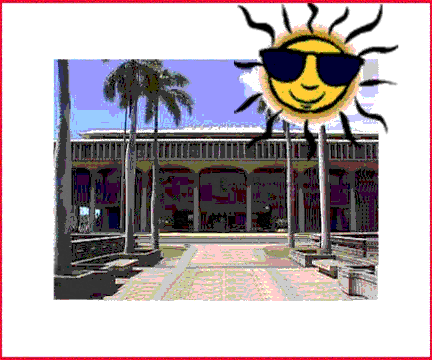 You probably already know about the Clean Elections movement (properly Voter Owned Elections) that is gaining steam. This is another piece of the reform movement.
It is possible for ordinary citizens to get results. Just a couple of years ago the Legislature was forced to give up the conference committee chair veto, which was used (abused) to kill measures that had been supported by hundreds of hours of testimony -- folks like you and me, going there over and over to support something worthwhile, only to have it clobbered by a single person's veto.
You've also read here and in Pacific Business News about embedded corporate lobbyists, paid by their companies, who as "interns" are close enough to whisper in the ears of legislators anything they want. When is the last time that you, dear citizen, got to whisper anything in a legislator's ear? Interns truly have special access, and that access comes at the expense of constituents.
So please go over to the Bring Sunshine to Hawaii website and add your name to the petition. Please also email your own particular group and tell them about it. Together, we can maybe change this.
Thanks for your support.
You probably already know about the Clean Elections movement (properly Voter Owned Elections) that is gaining steam. This is another piece of the reform movement.It is possible for ordinary citizens to get results. Just a couple of years ago the Legislature was forced to give up the conference committee chair veto, which was used (abused) to kill measures that had been supported by hundreds of hours of testimony -- folks like you and me, going there over and over to support something worthwhile, only to have it clobbered by a single person's veto.
You've also read here and in Pacific Business News about embedded corporate lobbyists, paid by their companies, who as "interns" are close enough to whisper in the ears of legislators anything they want. When is the last time that you, dear citizen, got to whisper anything in a legislator's ear? Interns truly have special access, and that access comes at the expense of constituents.
So please go over to the Bring Sunshine to Hawaii website and add your name to the petition. Please also email your own particular group and tell them about it. Together, we can maybe change this.
Thanks for your support.
Tags:


Tuesday, March 28, 2006
Disgraceful arrests of advocates for homeless by Honolulu police
You don't arrest Utu Langi, outreach worker and director of H-5 Project (Hawai'i Helping the Hungry Have Hope). You just don't. It would be like arresting Mother Theresa. But that's just what happened yesterday. And it's a disgraceful approach to solving Honolulu's chronic affordable housing shortage which results in thousands of people left without shelter.
Mufi Hannemann, mayor of Honolulu, and the police department should be ashamed of themselves. The Star-Bulletin was on the spot at City Hall where about 50 people had gathered. The story and photos recorded the arrest of Langi and other advocates for the homeless and noted that the City did nothing whatsoever to assist the people who were displaced.
Honolulu clears park before festival
In a sudden move to clear Ala Moana park before the Honolulu Centennial Festival on Magic Island this weekend, the city declared a curfew from 10 p.m. to 4 a.m. ostensibly for repairs and cleanup. There was little warning for the 200 or so people who remain in the park overnight, and no plan to accommodate them elsewhere.
It's also clear that there were alternatives, for example repairing the park in sections, that could easily have avoided this crisis, if repairs were indeed the objective of the lockout.
In the past, the City might have gotten away with this, but times have changed. Increased taxes and expenses mean that the ranks of the thousands of citizens already living in the streets, parks and on the beaches will increase. Advocates have stepped in not only to support the homeless but to reverse the conditions that resulted in the current crisis. Several bills are making their way through the legislature and city council that address different aspects of the housing situation. Awareness is high.
Except in one area: tourists have been shielded from the issue. To them, Waikiki is preserved as an idyllic paradise of sun and surf. How would they view their Hawaiian vacation if they knew that 200 people have been kicked out of Ala Moana park so they can enjoy a festival? This action can backfire on the City quite badly if the truth gets out.
Further reading: 'It's a crisis, and this is not helping the crisis'. Next stop for some: Honolulu Hale. Shame on Hawaii .
Mufi Hannemann, mayor of Honolulu, and the police department should be ashamed of themselves. The Star-Bulletin was on the spot at City Hall where about 50 people had gathered. The story and photos recorded the arrest of Langi and other advocates for the homeless and noted that the City did nothing whatsoever to assist the people who were displaced.
Honolulu clears park before festival
In a sudden move to clear Ala Moana park before the Honolulu Centennial Festival on Magic Island this weekend, the city declared a curfew from 10 p.m. to 4 a.m. ostensibly for repairs and cleanup. There was little warning for the 200 or so people who remain in the park overnight, and no plan to accommodate them elsewhere.
It's also clear that there were alternatives, for example repairing the park in sections, that could easily have avoided this crisis, if repairs were indeed the objective of the lockout.
In the past, the City might have gotten away with this, but times have changed. Increased taxes and expenses mean that the ranks of the thousands of citizens already living in the streets, parks and on the beaches will increase. Advocates have stepped in not only to support the homeless but to reverse the conditions that resulted in the current crisis. Several bills are making their way through the legislature and city council that address different aspects of the housing situation. Awareness is high.
Except in one area: tourists have been shielded from the issue. To them, Waikiki is preserved as an idyllic paradise of sun and surf. How would they view their Hawaiian vacation if they knew that 200 people have been kicked out of Ala Moana park so they can enjoy a festival? This action can backfire on the City quite badly if the truth gets out.
Further reading: 'It's a crisis, and this is not helping the crisis'. Next stop for some: Honolulu Hale. Shame on Hawaii .
Tags:
Monday, March 27, 2006
The House is hoodwinking you even as you read this
The sky was clear over Honolulu for most of the afternoon on this Monday holiday. Welcome sunlight dried up some of the puddles and made pedestrian life possible once again after this month of unusual rain.
There's no sign of sunshine in the State Capitol, though.
The House Committee on Water, Land and Ocean Resources has scheduled a hearing for Tuesday March 28 at 10:30 am on a single bill, SB1015. I received an email tip to check out this bill. Here's what I found: We're being cheated again as yet another House committee hides its actions from the public.
SB1015 was revived from the 2005 session probably to be used for another purpose. It's text is posted on the Capitol website here. If you've been following along on this blog, you'll suspect of course that the committee will be doing something "creative" with this bill, and you'd be right.
On Friday afternoon the committee sent out a hearing notice for Tuesday. The notice says "PROPOSED HD1 available in room 432." It looks like this "amendment" goes something like this:
I'm not likely to find out, of course, until Tuesday morning, and only if I choose to run over to the Capitol just before the hearing. Today is Kuhio Day, a state holiday. For three days since the notice was issued, the text of this proposed amendment has been unavailable. I couldn't prepare testimony even if I wanted to.
What's most troubling is that Tuesday is its first and last public hearing, and you can bet the chair's recommendation to his committee will be to pass it. The public will not have participated at all in the making of this new law.
What good is public notice when the public has no access whatsoever to the bill that will be heard and won't get to peek at it until a couple of hours before the hearing?
If you live on Neighbor Islands, forget it. That's the idea, actually--this House committee chair, Rep. Ezra R. Kanoho, joins his fellow chairpersons of darkness in employing this technique that locks the public out of the democratic process.
The repetition of this abuse demonstrates that committee chairs and House leadership are quite happy to trample on the public's right to participate in the making of its laws. It should have been stopped when it was first used, and it shouldn't be allowed now.
The hearing should be canceled. This abuse should be prohibited.
There's no sign of sunshine in the State Capitol, though.
The House Committee on Water, Land and Ocean Resources has scheduled a hearing for Tuesday March 28 at 10:30 am on a single bill, SB1015. I received an email tip to check out this bill. Here's what I found: We're being cheated again as yet another House committee hides its actions from the public.
SB1015 was revived from the 2005 session probably to be used for another purpose. It's text is posted on the Capitol website here. If you've been following along on this blog, you'll suspect of course that the committee will be doing something "creative" with this bill, and you'd be right.
On Friday afternoon the committee sent out a hearing notice for Tuesday. The notice says "PROPOSED HD1 available in room 432." It looks like this "amendment" goes something like this:
Gives BLNR up to 12/31/07, the authorization to reinstate a 999-year homestead lease that was canceled due to nonpayment of arrearages; provided, among other things, that the tenant-at-will has continually occupied the land and has cured all arrearages.Ok, I have no idea what this is about. It's clearly designed for some special situation.
I'm not likely to find out, of course, until Tuesday morning, and only if I choose to run over to the Capitol just before the hearing. Today is Kuhio Day, a state holiday. For three days since the notice was issued, the text of this proposed amendment has been unavailable. I couldn't prepare testimony even if I wanted to.
What's most troubling is that Tuesday is its first and last public hearing, and you can bet the chair's recommendation to his committee will be to pass it. The public will not have participated at all in the making of this new law.
What good is public notice when the public has no access whatsoever to the bill that will be heard and won't get to peek at it until a couple of hours before the hearing?
If you live on Neighbor Islands, forget it. That's the idea, actually--this House committee chair, Rep. Ezra R. Kanoho, joins his fellow chairpersons of darkness in employing this technique that locks the public out of the democratic process.
The repetition of this abuse demonstrates that committee chairs and House leadership are quite happy to trample on the public's right to participate in the making of its laws. It should have been stopped when it was first used, and it shouldn't be allowed now.
The hearing should be canceled. This abuse should be prohibited.
Tags:
Pacific Business News exposes corporate "interns" in legislative offices
Pacific Business News reporter Kristen Consillio has state legislators blinking as she shines headlights on the dark doings in their offices in an exposé in Friday's PBN.
In this front-page feature article complete with photos of some of the miscreants, Consillio describes the extent that corporations have managed to plant high-level people in the offices of willing state legislators, including (and most troubling) powerful committee chairs.
Committee chairs have the ability to kill legislation at their whim, or to switch it around behind the scenes in such a way that their own view of the issue takes precedence over public testimony. It's particularly dismaying, then, to find that the people closest to them ("interns," as we know, can get real close) are executives of companies or organizations whose issues come before the chair's committee.
It's no wonder that HMSA Executive Administrator Mark Forman evaded calls from reporter Consillio (see the article). His presence was exposed and it would be hard, I think, for him to explain why he is spending so much of the HMSA Foundation's time and money as a "lowly" intern in Rep. Herke's office. If cornered, would he say he's merely helping with the copying and stapling, or would he say that he never works on issues related to health insurance? Of course not. Wouldn't he be wasting HMSA's money if he were not working to advance their interests in some way?
Consillio exposed the shady contradiction of the House leadership around these corporate lobbyists who work with legislators. According to her interview with House Speaker Calvin Say,
The Smoking gun
Rep. Kirk Caldwell's intern, attorney Ryan Sanada, was more forthright as he shot himself in the foot describing his "internship":
The story made no mention of a labor representative working in Caldwell's office to bring him that certain perspective that only a working person can give.
No one objects to university students learning how laws are made, but aren't legislators corrupting these students by demonstrating that money and corporate influence is more important than their responsibility to the people who elected them?
Caldwell, Herkes and the others have been caught--the only way they can eliminate the perception that they are giving their ears to corporate interests instead of representing us voters is to clean their offices of embedded corporate lobbyists.
Now.
In this front-page feature article complete with photos of some of the miscreants, Consillio describes the extent that corporations have managed to plant high-level people in the offices of willing state legislators, including (and most troubling) powerful committee chairs.
Committee chairs have the ability to kill legislation at their whim, or to switch it around behind the scenes in such a way that their own view of the issue takes precedence over public testimony. It's particularly dismaying, then, to find that the people closest to them ("interns," as we know, can get real close) are executives of companies or organizations whose issues come before the chair's committee.
It's no wonder that HMSA Executive Administrator Mark Forman evaded calls from reporter Consillio (see the article). His presence was exposed and it would be hard, I think, for him to explain why he is spending so much of the HMSA Foundation's time and money as a "lowly" intern in Rep. Herke's office. If cornered, would he say he's merely helping with the copying and stapling, or would he say that he never works on issues related to health insurance? Of course not. Wouldn't he be wasting HMSA's money if he were not working to advance their interests in some way?
Consillio exposed the shady contradiction of the House leadership around these corporate lobbyists who work with legislators. According to her interview with House Speaker Calvin Say,
"Most lawmakers would not allow any interns or volunteers to dictate public policy."Most? That means that some are allowing these interns to dictate public policy.
The Smoking gun
Rep. Kirk Caldwell's intern, attorney Ryan Sanada, was more forthright as he shot himself in the foot describing his "internship":
"Part of it is to provide the perspective of management and employers with regards to the labor bills."Caldwell (taking aim at his own foot) agrees that Sanada's input contributes to his view of public policy:
Caldwell said: "In my mind it's all about doing the very best job we can, not only for our district, but on a broader level for the entire state. And if we can find assistance, support and input to help us make reasonable decisions, that only benefits the public and makes good public policy."So it's confirmed that this corporate intern influences policy in Caldwell's office. Both of them agree on why the intern is there. Again, this intern is paid full salary by Imanaka Kudo & Fujimoto, which no doubt expects a return for its investment (or why spend the money?).
The story made no mention of a labor representative working in Caldwell's office to bring him that certain perspective that only a working person can give.
No one objects to university students learning how laws are made, but aren't legislators corrupting these students by demonstrating that money and corporate influence is more important than their responsibility to the people who elected them?
Caldwell, Herkes and the others have been caught--the only way they can eliminate the perception that they are giving their ears to corporate interests instead of representing us voters is to clean their offices of embedded corporate lobbyists.
Now.
Tags:
Shame on Hawaii
Hawaii has been ranked #3 among the "meanest states" as a result of passage of a state law that allowed police to arrest homeless people if they return within a year to a spot from which they were chased out by police.
The law was modified, but police continue to conduct nighttime sweeps of parks and to otherwise harass and relocate homeless people, who in Hawaii include many children and those with jobs that don't pay well enough to cover the rent. There are inadequate services, and little progress in finding or creating affordable housing. Shelters are overflowing, and thousands are on the streets each night.
Tonight will be the meanest cut of all. Ostensibly to clear Ala Moana Park for renovation, the City of Honolulu will enforce a curfew that will displace more than 200 people from the park. A rally is planned for this evening on the grounds of City Hall.
It's widely expected that the City will make the curfew permanent, depriving these families of a place to stay, and many believe that the renovation of the park is merely an excuse to make the eviction palatable to the public.
The City had alternatives, for example, renovating the park in sections.
When people are moved around, they are separated from social services that can make a difference to them. They lose their "address" and can no longer pick up mail. Of course, they will move to another location. Social workers and faith-based groups who have been working so hard to assist will find their work thwarted by the dispersal.
And then Hawaii, home of the Aloha spirit, will send the police to sweep them into the gutter again.
Update:
Tomorrow morning (Tuesday) protests are planned for 9:00 am at City Hall. This would be a great time to go over there and give support. For those who can't make it, one can submit letters to the editor of either paper at letters@honoluluadvertiser.com or at letters@starbulletin.com. Mayor Mufi Hannemann can be reached at mayor@honolulu.gov. Maybe if enough people write, this administration can be moved to end this curfew and the shame it brings to Hawaii's image.
The law was modified, but police continue to conduct nighttime sweeps of parks and to otherwise harass and relocate homeless people, who in Hawaii include many children and those with jobs that don't pay well enough to cover the rent. There are inadequate services, and little progress in finding or creating affordable housing. Shelters are overflowing, and thousands are on the streets each night.
Tonight will be the meanest cut of all. Ostensibly to clear Ala Moana Park for renovation, the City of Honolulu will enforce a curfew that will displace more than 200 people from the park. A rally is planned for this evening on the grounds of City Hall.
It's widely expected that the City will make the curfew permanent, depriving these families of a place to stay, and many believe that the renovation of the park is merely an excuse to make the eviction palatable to the public.
The City had alternatives, for example, renovating the park in sections.
When people are moved around, they are separated from social services that can make a difference to them. They lose their "address" and can no longer pick up mail. Of course, they will move to another location. Social workers and faith-based groups who have been working so hard to assist will find their work thwarted by the dispersal.
And then Hawaii, home of the Aloha spirit, will send the police to sweep them into the gutter again.
Update:
Tomorrow morning (Tuesday) protests are planned for 9:00 am at City Hall. This would be a great time to go over there and give support. For those who can't make it, one can submit letters to the editor of either paper at letters@honoluluadvertiser.com or at letters@starbulletin.com. Mayor Mufi Hannemann can be reached at mayor@honolulu.gov. Maybe if enough people write, this administration can be moved to end this curfew and the shame it brings to Hawaii's image.
Tags:
Wednesday, March 22, 2006
Capitol Crime: Murder in the Rotunda
Come with me as we explore two tales of mystery and intrigue in the halls of Hawaii's State Capitol. First, let me set the scenes.
Readers of today's Advertiser story Sunshine law may not go to task force might be surprised that there was a bill proposing such a task force. Where did it come from? They will be more surprised if they search for clues on the Capitol website. There are none. There is no such bill. Thus our first mystery unfolds.
And tomorrow there while be a huge prize fight staged at the Legislature. Thursday at 9:00 in room 312, three House committees will hear a Gas Cap bill. This should be a raucus public event, with gasoline-hungry consumers in one corner of the ring, the oil barons in the other, and a dozen or so legislators watching to see which side will come out on top. The trouble is, it won't be a fair fight. The House has rigged the match in favor of the oil barons.
Plot 1: Hide the Murder Weapon
Some of us who attended yesterday's long session hoping to testify on the original SB1061 feel we have been used. I feel like an unwilling accomplice to a murder plot. Here's why.
The bill SB1061 on the Capitol website "Prohibits a lobbyist who lobbies the legislature, principal of a lobbyist, client or agent of lobbyist, and a political action committee on which the lobbyist sits from making a contribution to a member of the legislature, the governor, and lieutenant governor while the legislature is in session." A nice bill, a good bill, one any legislator would be happy to vote for, you'd think.
Not! Shhhh... Actually, it would be convenient if this bill somehow..., well, if it somehow could die. But that wouldn't look right, would it? Especially at the hands of a legislator who received more campaign contributions from "lawyers & lobbyists" (according to followthemoney.org for 2004) than anyone else in the House.
So the plot thickens. Hey! Why not gut this bill and put in a dummy bill that will be defeated? Simple! And fiendishly clever!
So a proposed HD1 (House Draft 1, supposedly an amendment) was created which was not an amendment at all but which was a brand new bill establishing a task force to work on the Sunshine Law--a task force made up primarily of opponents to the law. And it was arranged that few people could get a copy of it until the day before the hearing, and only if you came to pick it up from the Chair's office. Anyone on a Neighbor Island who might have wanted a copy was out of luck. And why not leave the old bill on the Capitol website, not the proposed HD1, just to confuse people? How clever!
Testimony indeed went against the new HD1. It never had a chance. Trouble is, on the record, it was the original bill that was killed. The one prohibiting contributions. The new one never existed. Hey! It worked! The computer confirms this--if you look up SB1061 you'll see that the bill prohibiting contributions was deferred. It says nothing at all about the Sunshine Law. The bill prohibiting lobbyist contributions during session wasn't deferred after being heard--it was never heard at all.
The tactic neatly skewers legislation passed unanimously by the Senate and which should have been voted up or down by the House Judiciary Committee. Like murder by a knife made of ice, no evidence is left behind.
To do the right thing, Rep. Luke should hear the original bill. Her phone number is 586-8530. If you agree, please give her a call and ask that SB1061, the bill prohibiting contributions during session, be heard. Help stop corruption and the scandals around campaign money that have plagued government this past year.
Plot 2: Highway robbery and a high-speed chase
Normally, bills are introduced at the beginning of the session, go through several hearings, cross over, and are heard by the other house. Thursday's gas cap bill just came on the scene. The chase is on, and you are the driver.
First, you have to find a copy of it of course. You can only pick up a copy of the 61-page bill (yikes!) in room 314. Tough luck if you live on another island, in Waianae or the North Shore. You're not intended to participate, sorry.
If you can get one, speed-read it, type testimony at 1000 words a minute, then rush down to the Capitol to confront the oil barons who of course know exactly what is going on. You can bet they have copies. Can you win this high speed chase?
So the oil barons are prepared, the public is not. You can imagine what might result from this imbalance. May as well kiss your wallet goodbye, or just give Chevron your second mortgage and let them take care of it for you. Highway robbery indeed.
Honest, I don't know if this bill is a good one or not, I don't have a copy yet, and I can't get one unless I go over there tomorrow. I'll never be able to read it in time to prepare testimony.
The House cannot hold a "real" public hearing because the public doesn't have access to the bill that will be debated.
Back to that prize fight. Cameras focus on the floor of the ring where the victim already lies bleeding: its name is Representative Democracy, and no one in the House seems to care.
No superheros in sight
There oughta be a law. What is happening to democracy in Hawaii anyway?
The House seems to think it can hold hearings without supplying the public with the bills it is voting on. The practice is spreading like an evil force. This needs to be stopped. Neither Superman nor Batman is on the scene--we have to stop this ourselves. No one will rescue us.
Call Speaker of the House Calvin Say at 586-6100. Don't worry, he doesn't answer the phone himself. Leave him a message. Ask him to prevent House committee chairs from hearing bills that the public has not seen and can't get a copy of.
Ask him to be sure that a copy of the gas cap law is put onto the web and that sufficient time is allowed for the public to read it and prepare testimony. Might as well ask him to get SB1061 heard as well, as long as you're on the phone.
Help restore law and order and the American Way in Hawaii's House of Representatives. Call today. It all depends on you.
Readers of today's Advertiser story Sunshine law may not go to task force might be surprised that there was a bill proposing such a task force. Where did it come from? They will be more surprised if they search for clues on the Capitol website. There are none. There is no such bill. Thus our first mystery unfolds.
And tomorrow there while be a huge prize fight staged at the Legislature. Thursday at 9:00 in room 312, three House committees will hear a Gas Cap bill. This should be a raucus public event, with gasoline-hungry consumers in one corner of the ring, the oil barons in the other, and a dozen or so legislators watching to see which side will come out on top. The trouble is, it won't be a fair fight. The House has rigged the match in favor of the oil barons.
Plot 1: Hide the Murder Weapon
Some of us who attended yesterday's long session hoping to testify on the original SB1061 feel we have been used. I feel like an unwilling accomplice to a murder plot. Here's why.
The bill SB1061 on the Capitol website "Prohibits a lobbyist who lobbies the legislature, principal of a lobbyist, client or agent of lobbyist, and a political action committee on which the lobbyist sits from making a contribution to a member of the legislature, the governor, and lieutenant governor while the legislature is in session." A nice bill, a good bill, one any legislator would be happy to vote for, you'd think.
Not! Shhhh... Actually, it would be convenient if this bill somehow..., well, if it somehow could die. But that wouldn't look right, would it? Especially at the hands of a legislator who received more campaign contributions from "lawyers & lobbyists" (according to followthemoney.org for 2004) than anyone else in the House.
So the plot thickens. Hey! Why not gut this bill and put in a dummy bill that will be defeated? Simple! And fiendishly clever!
So a proposed HD1 (House Draft 1, supposedly an amendment) was created which was not an amendment at all but which was a brand new bill establishing a task force to work on the Sunshine Law--a task force made up primarily of opponents to the law. And it was arranged that few people could get a copy of it until the day before the hearing, and only if you came to pick it up from the Chair's office. Anyone on a Neighbor Island who might have wanted a copy was out of luck. And why not leave the old bill on the Capitol website, not the proposed HD1, just to confuse people? How clever!
Testimony indeed went against the new HD1. It never had a chance. Trouble is, on the record, it was the original bill that was killed. The one prohibiting contributions. The new one never existed. Hey! It worked! The computer confirms this--if you look up SB1061 you'll see that the bill prohibiting contributions was deferred. It says nothing at all about the Sunshine Law. The bill prohibiting lobbyist contributions during session wasn't deferred after being heard--it was never heard at all.
The tactic neatly skewers legislation passed unanimously by the Senate and which should have been voted up or down by the House Judiciary Committee. Like murder by a knife made of ice, no evidence is left behind.
To do the right thing, Rep. Luke should hear the original bill. Her phone number is 586-8530. If you agree, please give her a call and ask that SB1061, the bill prohibiting contributions during session, be heard. Help stop corruption and the scandals around campaign money that have plagued government this past year.
Plot 2: Highway robbery and a high-speed chase
Normally, bills are introduced at the beginning of the session, go through several hearings, cross over, and are heard by the other house. Thursday's gas cap bill just came on the scene. The chase is on, and you are the driver.
First, you have to find a copy of it of course. You can only pick up a copy of the 61-page bill (yikes!) in room 314. Tough luck if you live on another island, in Waianae or the North Shore. You're not intended to participate, sorry.
If you can get one, speed-read it, type testimony at 1000 words a minute, then rush down to the Capitol to confront the oil barons who of course know exactly what is going on. You can bet they have copies. Can you win this high speed chase?
So the oil barons are prepared, the public is not. You can imagine what might result from this imbalance. May as well kiss your wallet goodbye, or just give Chevron your second mortgage and let them take care of it for you. Highway robbery indeed.
Honest, I don't know if this bill is a good one or not, I don't have a copy yet, and I can't get one unless I go over there tomorrow. I'll never be able to read it in time to prepare testimony.
The House cannot hold a "real" public hearing because the public doesn't have access to the bill that will be debated.
Back to that prize fight. Cameras focus on the floor of the ring where the victim already lies bleeding: its name is Representative Democracy, and no one in the House seems to care.
No superheros in sight
There oughta be a law. What is happening to democracy in Hawaii anyway?
The House seems to think it can hold hearings without supplying the public with the bills it is voting on. The practice is spreading like an evil force. This needs to be stopped. Neither Superman nor Batman is on the scene--we have to stop this ourselves. No one will rescue us.
Call Speaker of the House Calvin Say at 586-6100. Don't worry, he doesn't answer the phone himself. Leave him a message. Ask him to prevent House committee chairs from hearing bills that the public has not seen and can't get a copy of.
Ask him to be sure that a copy of the gas cap law is put onto the web and that sufficient time is allowed for the public to read it and prepare testimony. Might as well ask him to get SB1061 heard as well, as long as you're on the phone.
Help restore law and order and the American Way in Hawaii's House of Representatives. Call today. It all depends on you.
Tags:
Monday, March 20, 2006
Dems out partying, pocketing as bill to prohibit same is killed
A huge Hawaii Democratic Party Political Action Committee (PAC) fundraiser is underway as I type this post on Monday evening. House Caucus or something like that. No doubt significant amounts will be raised in this, an election year.
At the same time, Rep. Sylvia Luke, powerful chair of the Judiciary Committee and the largest recipient of lobbyist largess in the House for the last (2004) election cycle (check followthemoney.org under the "lawyer & lobbyist" category), is protecting her lobbyist pals' ability to contribute to her campaign by gutting the language in Senate Bill 1061, which now says:
Such a law would not be unique to Hawaii. A story today revealed that Kansas, for example, has a similar law in effect.
But the Legislature's chances of passing this law now are maybe zip. A hearing notice was delivered to the House Sergeant-at-Arms on Friday at 4:45 pm which included this for SB1061:

There are plenty of problems with this. Notice "Copies available in Room 302" (Rep. Luke's office). The Capitol website still contains the text of the original bill. And making the text available only from her office means you gotta wait until her office opens after the weekend, which is Monday morning, the day before the hearing.
The House has a 48-hour public notice rule. Technically, the hearing notice was sent more than 48 hours in advance, but without the text of the bill, is it really complying with the rule? In other words, the public has one day, not two, to put together its testimony. Plus a trip to the Capitol to get a copy of the text. Of course, anyone living on a Neighbor Island is left out of the picture.
Very undemocratic.
And the proposed bill not only has nothing to do with prohibiting lobbyist contributions, it attacks Hawaii's Sunshine Law by creating a task force composed mainly of opponents of the law.
This will be the last committee that SB1061 must go through before approval on the floor of the House. The new text will not have passed through the legislative process, that is, be heard and voted on by committee after committee and passed or killed. It gets just this one hearing, and judging by the stealth with which it was introduced, you can bet it will be bulldozed through.
The chance that the new bill would have made it this far had it been introduced at the beginning of the session, along with other bills, is pretty low, given the public's support of the Sunshine Law.
So the music is playing at the fundraiser. How do these things work? Do lobbyists turn in their envelopes as they enter? Are there cute waitresses? I wonder if they are clinking glasses in celebration of the imminent death of SB1061 tomorrow which will assure them another party like this next year.
Yes, we need Voter Owned Elections to end this pandering for good.
Oh, I nearly forgot to mention: I phoned to ask for a meeting with Rep. Luke last Monday and faxed confirmation of the request Tuesday morning. I live in her district, she's my representative. No reply.
I can't help but wonder if she meets with the lobbyists who are contributing money this evening whenever they call.
At the same time, Rep. Sylvia Luke, powerful chair of the Judiciary Committee and the largest recipient of lobbyist largess in the House for the last (2004) election cycle (check followthemoney.org under the "lawyer & lobbyist" category), is protecting her lobbyist pals' ability to contribute to her campaign by gutting the language in Senate Bill 1061, which now says:
Prohibits a lobbyist who lobbies the legislature, principal of a lobbyist, client or agent of lobbyist, and a political action committee on which the lobbyist sits from making a contribution to a member of the legislature, the governor, and lieutenant governor while the legislature is in session.A sensible bill, don't you think? The Senate thought so. They passed it unanimously before it crossed over to the House.
Such a law would not be unique to Hawaii. A story today revealed that Kansas, for example, has a similar law in effect.
But the Legislature's chances of passing this law now are maybe zip. A hearing notice was delivered to the House Sergeant-at-Arms on Friday at 4:45 pm which included this for SB1061:
There are plenty of problems with this. Notice "Copies available in Room 302" (Rep. Luke's office). The Capitol website still contains the text of the original bill. And making the text available only from her office means you gotta wait until her office opens after the weekend, which is Monday morning, the day before the hearing.
The House has a 48-hour public notice rule. Technically, the hearing notice was sent more than 48 hours in advance, but without the text of the bill, is it really complying with the rule? In other words, the public has one day, not two, to put together its testimony. Plus a trip to the Capitol to get a copy of the text. Of course, anyone living on a Neighbor Island is left out of the picture.
Very undemocratic.
And the proposed bill not only has nothing to do with prohibiting lobbyist contributions, it attacks Hawaii's Sunshine Law by creating a task force composed mainly of opponents of the law.
This will be the last committee that SB1061 must go through before approval on the floor of the House. The new text will not have passed through the legislative process, that is, be heard and voted on by committee after committee and passed or killed. It gets just this one hearing, and judging by the stealth with which it was introduced, you can bet it will be bulldozed through.
The chance that the new bill would have made it this far had it been introduced at the beginning of the session, along with other bills, is pretty low, given the public's support of the Sunshine Law.
So the music is playing at the fundraiser. How do these things work? Do lobbyists turn in their envelopes as they enter? Are there cute waitresses? I wonder if they are clinking glasses in celebration of the imminent death of SB1061 tomorrow which will assure them another party like this next year.
Yes, we need Voter Owned Elections to end this pandering for good.
Oh, I nearly forgot to mention: I phoned to ask for a meeting with Rep. Luke last Monday and faxed confirmation of the request Tuesday morning. I live in her district, she's my representative. No reply.
I can't help but wonder if she meets with the lobbyists who are contributing money this evening whenever they call.
Tags:
Must Hawaii repeat Louisiana's mistakes?
We knew about the dam problem (see Advertiser,Oct 23, 2005: 22 structures in dire need of repairs) but repairs were not made and lives were lost. The search for more victims continues and at least four more bodies may be discovered. How is this different from the similar situation in New Orleans? They also knew that the levees would be breached or topped in a storm. Repairs were not made.
These dams were in primarily rural areas so loss of life will be limited. When the next big storm or tsunami hits the state, how will we fare?
We counted on our state government to see to it that the dams were kept in good repair, and in very plain language, they failed us.
On September 12 and 13, 2005, the Legislature held hours-long hearings that raised additional issues related to evacuation of special needs populations, the lack of availability of shelters, shortcomings in our medical readiness, communication issues between concerned agencies, sirens that don't work, the dams, and much, much more. It's six months later now, and we the people need to know what the concerns were and what is or is not being done.
Or else we will needlessly repeat the tragedy of the Gulf Coast states.
Short of the governor convening a special group to work on this, the only venue is our press. The Advertiser article in October was an excellent beginning. But now people have been killed. I hope the two largest newspapers will dig deeply and find out where we stand. They should go beyond interviewing high officials who say everything is ok or that they have plans to fix things.
If there are plans, publish them please. What date will work be complete--for example, when will sirens be made to work, when will shelters be ready to occupy? When will nursing homes be informed of evacuation plans and agree to them? Who will transport those who need dialysis to the machines if a storm knocks out transportation?
And speaking of transportation... try evacuating yourself home from work if there is a collision on the H-1. Imagine that everyone is trying to leave town before a storm.
We need answers, detailed answers, not assurances. Do I lack faith in our government to take care of us on their own? Yes. Watch the surplus be spent on other purposes. Watch them hide from responsibility for the deaths that already resulted from understaffing and inattention. Yes, bucks were saved, and now lives were lost. J'accuse.
If Hawaii is not to repeat Louisiana's mistakes, it will be thanks to the persistence of a vigilant and dogged corps of newspaper reporters. I hope they will step forward and accept their mission.
These dams were in primarily rural areas so loss of life will be limited. When the next big storm or tsunami hits the state, how will we fare?
We counted on our state government to see to it that the dams were kept in good repair, and in very plain language, they failed us.
On September 12 and 13, 2005, the Legislature held hours-long hearings that raised additional issues related to evacuation of special needs populations, the lack of availability of shelters, shortcomings in our medical readiness, communication issues between concerned agencies, sirens that don't work, the dams, and much, much more. It's six months later now, and we the people need to know what the concerns were and what is or is not being done.
Or else we will needlessly repeat the tragedy of the Gulf Coast states.
Short of the governor convening a special group to work on this, the only venue is our press. The Advertiser article in October was an excellent beginning. But now people have been killed. I hope the two largest newspapers will dig deeply and find out where we stand. They should go beyond interviewing high officials who say everything is ok or that they have plans to fix things.
If there are plans, publish them please. What date will work be complete--for example, when will sirens be made to work, when will shelters be ready to occupy? When will nursing homes be informed of evacuation plans and agree to them? Who will transport those who need dialysis to the machines if a storm knocks out transportation?
And speaking of transportation... try evacuating yourself home from work if there is a collision on the H-1. Imagine that everyone is trying to leave town before a storm.
We need answers, detailed answers, not assurances. Do I lack faith in our government to take care of us on their own? Yes. Watch the surplus be spent on other purposes. Watch them hide from responsibility for the deaths that already resulted from understaffing and inattention. Yes, bucks were saved, and now lives were lost. J'accuse.
If Hawaii is not to repeat Louisiana's mistakes, it will be thanks to the persistence of a vigilant and dogged corps of newspaper reporters. I hope they will step forward and accept their mission.
Tags:
Saturday, March 18, 2006
Embedded lobbyists distort democracy in Hawaii
The Abramoff scandal was an eye opener on the national level, but forget Washington DC -- lobbyists are busy in state houses, and Hawaii is no exception. In fact, they've infiltrated deeply into the inner sanctum of our legislature. What's at stake is our right to control our own government and protect it against the incursion of special interests.
Lobbyists will be lobbyists, they'll probably always be with us, but they belong outside, in the lobbies. When I visited the Capitol yesterday, I learned that in Hawaii, legislator's offices have become infested with lobbyists. They have moved inside. When they do that, they are no longer referred to as "lobbyists" -- the legislature calls them "interns." Yes, interns. Like the infamous Monica Lewinsky.
I was trying to find out what happened to a bill that was to remove the sunset provision in the law regulating health insurance. This law has saved us collectively at least $18 million according to the Insurance Commissioner. I've followed one of the bills, which is headed to the House Consumer Protection & Commerce Committee headed by Rep. Robert Herkes, but not the other. I was told that Rep. Herkes killed the bill I was looking for. And now, the surviving bill is headed to his committee.
Why would Rep. Herkes kill a bill that has such wide popular support? I don't know. I did find out, however, that Rep. Herkes office has been infested with an intern who might know something about this, so I went over there. I asked for Mark Forman, but he was out. Staff did confirm that he works there as an intern, assigned via the Majority Staff Office. Now, isn't Mark Forman, the intern, also the Executive Adminstrator of HMSA Foundation? He's on their staff list. He's simultaneously embedded in Rep. Herkes office.
I visited the Majority Staff Office. It seems that there is an internship program that allows these folks to embed themselves in legislator's offices quite easily, and it's not unusual. It's a great experience for college students who can gain valuable insight into the legislative process while making an important contribution. They also get a stipend.
But I have questions: Should the Executive Administrator of HMSA Foundation be so close to the Chair of the Consumer Protection & Commerce Committee on a daily basis? What is he working on, what might he have whispered in Rep. Herkes' ear about rate regulation, which HMSA strongly opposes? I didn't get to speak with Mr. Forman, so all I can do is ponder these questions.
But tell me: if you were HMSA, wouldn't you love to have this guy working with Rep. Herkes?
I guess I'm pretty naive. I was told that HECO folks have been embedded deep inside legislative lairs and that this has been going on for years. I'm just the last to know.
I also called the Ethics Commission to find out if they have had any opinions on this. After all, an executive generally earns big bucks and has years of experience. If I contributed $2000 to Mr. Herkes (see below for more on contributions) I'd have to declare it. Or he'd have to declare it, I'm not sure how it works. Does HMSA Foundation declare the value of their executive's salary as a contribution or gift? Do they need to? I mean, look at the expertise he brings with him. On things like insurance rate regulation, perhaps. Whatever. This is no college intern, who might still be struggling with spelling, math and acne. This is one valuable person. The ethics commission will get back to me.
Here is a job for some investigative reporter. We need to find out who is, uh, close up and personal with our legislators. We need a complete list of who is embedded where in the legislature.
I find it hard to accept that a person such as an HMSA Foundation executive working so close to a legislator does not have some influence. "Access" is a given.
Of course, there's no evidence of anything irregular going on. Clinton denied and denied, but the DNA on the blue dress finally got him. There's no DNA here. There is a body--the unexplained death of a bill that regulates the premiums HMSA can charge. And I'm afraid of what might befall the second bill when it gets to the CPC committee. But there's no evidence of wrongdoing. This is standard operating procedure it seems.
Speaking of contributions
Kudos to the Hawaii Tribune-Herald for an article that looks at the influence of big money interests on legislator's actions. Remember, I'm still puzzled at why a bill important to us ordinary folks met an untimely death on the CPC committee floor. From the article:
Still, I'm worried about the other rate regulation bill headed to the CPC committee, it could die there, couldn't it. What do you think the odds are it will survive?
The bill is SB2917 Relating to Health Insurance Rate Regulation. If you want to keep insurance premiums low, please let Rep. Herkes know. His office phone is (808) 586-8400. If Mr. Foreman answers, say "Hi" from me, sorry I missed him yesterday.
If you think embedded executive "interns" might be an ethical issue, the phone number of the State Ethics Commission is (808) 587-0460.
Lobbyists will be lobbyists, they'll probably always be with us, but they belong outside, in the lobbies. When I visited the Capitol yesterday, I learned that in Hawaii, legislator's offices have become infested with lobbyists. They have moved inside. When they do that, they are no longer referred to as "lobbyists" -- the legislature calls them "interns." Yes, interns. Like the infamous Monica Lewinsky.
I was trying to find out what happened to a bill that was to remove the sunset provision in the law regulating health insurance. This law has saved us collectively at least $18 million according to the Insurance Commissioner. I've followed one of the bills, which is headed to the House Consumer Protection & Commerce Committee headed by Rep. Robert Herkes, but not the other. I was told that Rep. Herkes killed the bill I was looking for. And now, the surviving bill is headed to his committee.
Why would Rep. Herkes kill a bill that has such wide popular support? I don't know. I did find out, however, that Rep. Herkes office has been infested with an intern who might know something about this, so I went over there. I asked for Mark Forman, but he was out. Staff did confirm that he works there as an intern, assigned via the Majority Staff Office. Now, isn't Mark Forman, the intern, also the Executive Adminstrator of HMSA Foundation? He's on their staff list. He's simultaneously embedded in Rep. Herkes office.
I visited the Majority Staff Office. It seems that there is an internship program that allows these folks to embed themselves in legislator's offices quite easily, and it's not unusual. It's a great experience for college students who can gain valuable insight into the legislative process while making an important contribution. They also get a stipend.
But I have questions: Should the Executive Administrator of HMSA Foundation be so close to the Chair of the Consumer Protection & Commerce Committee on a daily basis? What is he working on, what might he have whispered in Rep. Herkes' ear about rate regulation, which HMSA strongly opposes? I didn't get to speak with Mr. Forman, so all I can do is ponder these questions.
But tell me: if you were HMSA, wouldn't you love to have this guy working with Rep. Herkes?
I guess I'm pretty naive. I was told that HECO folks have been embedded deep inside legislative lairs and that this has been going on for years. I'm just the last to know.
I also called the Ethics Commission to find out if they have had any opinions on this. After all, an executive generally earns big bucks and has years of experience. If I contributed $2000 to Mr. Herkes (see below for more on contributions) I'd have to declare it. Or he'd have to declare it, I'm not sure how it works. Does HMSA Foundation declare the value of their executive's salary as a contribution or gift? Do they need to? I mean, look at the expertise he brings with him. On things like insurance rate regulation, perhaps. Whatever. This is no college intern, who might still be struggling with spelling, math and acne. This is one valuable person. The ethics commission will get back to me.
Here is a job for some investigative reporter. We need to find out who is, uh, close up and personal with our legislators. We need a complete list of who is embedded where in the legislature.
I find it hard to accept that a person such as an HMSA Foundation executive working so close to a legislator does not have some influence. "Access" is a given.
Of course, there's no evidence of anything irregular going on. Clinton denied and denied, but the DNA on the blue dress finally got him. There's no DNA here. There is a body--the unexplained death of a bill that regulates the premiums HMSA can charge. And I'm afraid of what might befall the second bill when it gets to the CPC committee. But there's no evidence of wrongdoing. This is standard operating procedure it seems.
Speaking of contributions
Kudos to the Hawaii Tribune-Herald for an article that looks at the influence of big money interests on legislator's actions. Remember, I'm still puzzled at why a bill important to us ordinary folks met an untimely death on the CPC committee floor. From the article:
...Topping the collection list is Rep. Bob Herkes, D-Puna, Ka'u, Kona, who took in $37,967 between July 1 and Dec. 31, 2005.Ok, I guess money means nothing to him... but a committee chair has an embedded HMSA intern and a bill regulating health insurance premiums is killed. Can we prove influence there? No, we can only notice that the executive has access.
His largest donors during the reporting period included $1,500 from Island Insurance, $1,000 from Borthwick Mortuary and $500 from Hilo businessman Richard Henderson.
A recently-appointed chairman of the House Consumer Protection and Commerce Committee, Herkes earlier this month was criticized by Voter Owned Hawaii, previously called Hawaii Clean Elections, which wants only public money used for Hawaii political campaigns.
The group issued a March 3 statement claiming special interest contributions to Herkes' re-election campaign skyrocketed after he became committee chairman.
"I think that I've probably had more than I had in the past," Herkes said when asked about a connection between his House position -- he previously chaired the Economic Development and Business Concerns Committee -- and donations to his re-election campaign.
"If anybody can show me where it's influenced me, let me know," he added.
Still, I'm worried about the other rate regulation bill headed to the CPC committee, it could die there, couldn't it. What do you think the odds are it will survive?
The bill is SB2917 Relating to Health Insurance Rate Regulation. If you want to keep insurance premiums low, please let Rep. Herkes know. His office phone is (808) 586-8400. If Mr. Foreman answers, say "Hi" from me, sorry I missed him yesterday.
If you think embedded executive "interns" might be an ethical issue, the phone number of the State Ethics Commission is (808) 587-0460.
Tags:
Wednesday, March 15, 2006
Why was Kauai's dam failure not prevented?
Now is the time to provide aid and care for the people affected by the disaster that struck Kauai. There have been deaths and property loss, and the rain has not yet stopped.
At the same time, we need to examine why this disaster was allowed to happen, and I have chosen these words carefully. Hawaii's government knew of the danger and it looks like they did nothing to prevent it.
How is this different from the situation in New Orleans, when we learned after the fact that there had been plenty of warning that the levees were inadequate to protect the city in the event of a disaster?
The state legislature held hearings on September 12-13, 2005, revealing Hawaii's lack of preparedness for a future disaster of almost any kind. Schools are to be used for shelter, but many are not adequate for the purpose, and just try to find the keys to get into the rooms when disaster strikes. Highways are jammed today, what good will they be in a disaster? Some sirens don't work, and there are no provisions to alert people with hearing problems or deaf people. There are no provisions for people with special needs. I had visions of the water rising in New Orleans as people in nursing homes were drowned lying in their beds.
The dams were known to be a problem.
I attended the hearings and reviewed the `Olelo re-broadcast. It was frightening to hear Ed Teixeira, state vice director of civil defense, respond that this or that was "a work in progress." Well, too late for the work in Kauai, people are dead now.
Today's AP story quotes Mr. Teixeira: "I would characterize this as a growing crisis on Kauai". Well, yes. Someone needs to ask what he did to avert it. The crisis was predictable and in my view, predicted.
This blogger was alarmed at the possibility that Hawaii citizens may be unable to get medical care in an emergency. See here and here. I also communicated with legislators, suggesting a way to track concerns and develop action plans to be sure that problems were identified, responsible persons and resources selected, and timelines for solution developed.
Of course, legislators don't take charge of civil defense personally, but someone should.
At the same time, we need to examine why this disaster was allowed to happen, and I have chosen these words carefully. Hawaii's government knew of the danger and it looks like they did nothing to prevent it.
How is this different from the situation in New Orleans, when we learned after the fact that there had been plenty of warning that the levees were inadequate to protect the city in the event of a disaster?
The state legislature held hearings on September 12-13, 2005, revealing Hawaii's lack of preparedness for a future disaster of almost any kind. Schools are to be used for shelter, but many are not adequate for the purpose, and just try to find the keys to get into the rooms when disaster strikes. Highways are jammed today, what good will they be in a disaster? Some sirens don't work, and there are no provisions to alert people with hearing problems or deaf people. There are no provisions for people with special needs. I had visions of the water rising in New Orleans as people in nursing homes were drowned lying in their beds.
The dams were known to be a problem.
I attended the hearings and reviewed the `Olelo re-broadcast. It was frightening to hear Ed Teixeira, state vice director of civil defense, respond that this or that was "a work in progress." Well, too late for the work in Kauai, people are dead now.
Today's AP story quotes Mr. Teixeira: "I would characterize this as a growing crisis on Kauai". Well, yes. Someone needs to ask what he did to avert it. The crisis was predictable and in my view, predicted.
This blogger was alarmed at the possibility that Hawaii citizens may be unable to get medical care in an emergency. See here and here. I also communicated with legislators, suggesting a way to track concerns and develop action plans to be sure that problems were identified, responsible persons and resources selected, and timelines for solution developed.
Of course, legislators don't take charge of civil defense personally, but someone should.
Tags:
Stolen opportunity: The chance to remove the influence of money from Hawaii politics
Peter Bower wrote an excellent, upbeat letter that ran in today's Star-Bulletin:
What a great democracy we live in! A popular bill goes through the entire Senate and was apparantly approved anonymously (thanks, Senators!) only to meet an ignominious fate before it could even be heard by the House.
I'm still hopeful that the original language of SB1061 can be restored.
If this bothers you, please let Rep. Luke know. Call, fax or email asking that the original language in SB1061 be restored to the bill.
House should support honesty and trustThe House might have given its support, but the chance has been stolen from them by one person. Between the time Peter wrote his celebratory letter and the time it was printed, the cause for celebration has disappeared--the bill has been gutted and new language inserted which attacks Hawaii's Sunshine Law (and during Freedom of Information Week, to boot).
Mahalo nui to our state Senate for its unanimous support last week for Senate Bill 1061, which calls for the prohibition of contributions during the legislative session to those persons elected by the people to the legislative and executive branches of government.
This is one step in our collective effort to continually be mindful of moving away from any appearance of conflict of interest during regular or special legislative sessions. We are living in a period where a condition of these times is to consciously work toward a high level of trust in the institutions of democracy. This is a responsibility for all of us, and not simply our elected officials nor those who take advantage of the system.
As the bill now passes over, we trust our House of Representatives will give its support to this legislation as another step toward building trust and community between the people and their government.
Peter M. Bower
President, Citizen Voice
What a great democracy we live in! A popular bill goes through the entire Senate and was apparantly approved anonymously (thanks, Senators!) only to meet an ignominious fate before it could even be heard by the House.
I'm still hopeful that the original language of SB1061 can be restored.
If this bothers you, please let Rep. Luke know. Call, fax or email asking that the original language in SB1061 be restored to the bill.
Rep. Sylvia LukeIf you live in Rep. Luke's district, good to say so.
Phone 586-8530
Fax 586-8534
E-mail repluke@Capitol.hawaii.gov
Tags:
Monday, March 13, 2006
Disappearing Doctors: Hawaii looks for quick but questionable fixes
Hawaii is suffering an acute shortage of doctors, particularly in rural areas. On the Mainland it's possible to drive to a nearby city for quality medical treatment, but if you live on Molokai or the Big Island, that's not going to work.
In a well-written op-ed piece Crisis point: Don't get hurt on Big Island in the Honolulu Advertiser, Dr. Barry Blum warned:
The federal government reduces Medicare payments and for no particular reason, Hawaii's monopolistic insurance companies follow suit. With diminishing reimbursements and fewer patients in rural areas, doctors simply can't cover expenses. This is pretty much across the board, with some professions in shorter supply than others. Hospitals can't find doctors willing to be on call night after night as more of them leave the state. This can and should be fixed before the state becomes a health disaster zone.
A bill is moving through the Hawaii legislature that proposes a quick but risky fix to a shortage of psychiatrists in rural areas of the state. The bill, HB2589, calls for giving psychologists practicing at health centers prescriptive authority under a restricted formulary.
Far from solving the problem, this will condemn those who depend on these services to second-class and possibly dangerous treatment, and will limit them to a choice of drugs that may not include the ones that work best for them.
First of all, a resticted formulary is always a problem. The oldest, cheapest drugs will be the ones provided, not the newest and most effective. Many organizations have policies against restrictive formularies. See, for example, the policy posted on Kokua Council's website (pdf).
A psychiatrist is first of all a doctor and keeps up with the medical literature through journals and continuing education. Most stay connected with UH's school of medicine and attend periodic grand rounds. Medicines have differences--one may be better than another for a given condition, or one may have troublesome side effects that become known over time. Older people often take multiple drugs and interactions are not only possible but fairly common.
A psychologist, without contact with the medical community, is simply playing in a sandbox filled with medicine bottles.
From testimony at the hearings, it's clear that psychiatrists are not objecting to other professions having prescriptive authority. Advanced practice registered nurses are granted prescriptive authority by the Department of Commerce and Consumer Affairs. This was supported by the Hawaii Psychiatric Medical Association at the time the law was proposed. The bill before the legislature today does not propose similar training and is more like a free pass to prescribe, which is not in the public interest.
Advocates for the psychologists point to the Department of Defense program in which psychologists prescribe. The Hawaii bill does not provide anything approaching the level of training that the limited DOD group was given, and does not provide for the supervision by psychiatrists that the DOD requires.
Testimony gave several examples of the danger in this quick fix. A patient arriving at the emergency room has psychotic symptoms, but the psychiatrist, who is a trained medical doctor first, orders a scan and discovers that the patient has suffered a stroke. The patient is treated appropriately for the stroke.
Imagine that you were that patient and were seen only by a psychologist without medical training, and whose toolkit has only a single hammer, the ability to prescribe certain medicines.
Imagine that an elderly person required treatment, but could only see a psychologist (health centers would quickly get rid of any psychiatrists they still had around). There would be nothing to prevent a potentially deadly mix of meds from damaging rather than improving the older person's health. Geriatric psychiatry is a specialty by itself requiring additional medical training which the cheaper psychologist won't have.
It wouldn't do on the Big Island to have physical therapists doing the work of orthopedic surgeons, and it won't do to require underserved and poorer populations to be treated by psychologists instead of medical doctors.
We need to find real solutions to the problem of Hawaii's disappearing doctors, not quick and dangerous fixes.
In a well-written op-ed piece Crisis point: Don't get hurt on Big Island in the Honolulu Advertiser, Dr. Barry Blum warned:
It's probably wise for anyone who has any ongoing serious medical condition to avoid moving to the Big Island. We cannot guarantee that there will be doctors here to take care of them if they need hospitalization.Dr. Blum is an orthopedic surgeon, but the problem crosses professional boundries.
The federal government reduces Medicare payments and for no particular reason, Hawaii's monopolistic insurance companies follow suit. With diminishing reimbursements and fewer patients in rural areas, doctors simply can't cover expenses. This is pretty much across the board, with some professions in shorter supply than others. Hospitals can't find doctors willing to be on call night after night as more of them leave the state. This can and should be fixed before the state becomes a health disaster zone.
A bill is moving through the Hawaii legislature that proposes a quick but risky fix to a shortage of psychiatrists in rural areas of the state. The bill, HB2589, calls for giving psychologists practicing at health centers prescriptive authority under a restricted formulary.
Far from solving the problem, this will condemn those who depend on these services to second-class and possibly dangerous treatment, and will limit them to a choice of drugs that may not include the ones that work best for them.
First of all, a resticted formulary is always a problem. The oldest, cheapest drugs will be the ones provided, not the newest and most effective. Many organizations have policies against restrictive formularies. See, for example, the policy posted on Kokua Council's website (pdf).
A psychiatrist is first of all a doctor and keeps up with the medical literature through journals and continuing education. Most stay connected with UH's school of medicine and attend periodic grand rounds. Medicines have differences--one may be better than another for a given condition, or one may have troublesome side effects that become known over time. Older people often take multiple drugs and interactions are not only possible but fairly common.
A psychologist, without contact with the medical community, is simply playing in a sandbox filled with medicine bottles.
From testimony at the hearings, it's clear that psychiatrists are not objecting to other professions having prescriptive authority. Advanced practice registered nurses are granted prescriptive authority by the Department of Commerce and Consumer Affairs. This was supported by the Hawaii Psychiatric Medical Association at the time the law was proposed. The bill before the legislature today does not propose similar training and is more like a free pass to prescribe, which is not in the public interest.
Advocates for the psychologists point to the Department of Defense program in which psychologists prescribe. The Hawaii bill does not provide anything approaching the level of training that the limited DOD group was given, and does not provide for the supervision by psychiatrists that the DOD requires.
Testimony gave several examples of the danger in this quick fix. A patient arriving at the emergency room has psychotic symptoms, but the psychiatrist, who is a trained medical doctor first, orders a scan and discovers that the patient has suffered a stroke. The patient is treated appropriately for the stroke.
Imagine that you were that patient and were seen only by a psychologist without medical training, and whose toolkit has only a single hammer, the ability to prescribe certain medicines.
Imagine that an elderly person required treatment, but could only see a psychologist (health centers would quickly get rid of any psychiatrists they still had around). There would be nothing to prevent a potentially deadly mix of meds from damaging rather than improving the older person's health. Geriatric psychiatry is a specialty by itself requiring additional medical training which the cheaper psychologist won't have.
It wouldn't do on the Big Island to have physical therapists doing the work of orthopedic surgeons, and it won't do to require underserved and poorer populations to be treated by psychologists instead of medical doctors.
We need to find real solutions to the problem of Hawaii's disappearing doctors, not quick and dangerous fixes.
Tags:
Sunshine law under attack during Sunshine Week
Tuesday, May 14 is the day of the annual Freedom of Information Day Luncheon in Honolulu which will be attended by many advocates of access to information and the Sunshine Law. It seems that this very law will be under attack at the Legislature while advocates are celebrating it and unable to attend the hearing.
This is something we read about happening in Washington, DC, not in Hawaii.
Further, the text of the proposed bill has just been made available to this writer. The hearing is tomorrow. While the legislature has a 48-hour rule, clearly the rule has been circumvented by withholding the text until the day before. The hearing notice was sent out at 4:15:28 p.m. on Friday, and stated that the text of the proposed draft would be available in "Room 302", which turns out to be the office of Rep. Sylvia Luke, who chairs the committee hearing the bill on Tuesday. Problem is, the office was closed until about 8:00 a.m. this morning.
The original text of SB1061 was a bill that was advancing through the Legislature that would have prohibited lobbyist contributions during the session. That text is now completely gone from the new bill. Lobbyists and legislators might rejoice, but the hijacking of this bill is not good news for voters and advocates of clean elections in Hawaii.
This hijacking should be undone. The original text of the bill should be restored.
If it is not, then I hope that advocates at the FOI luncheon will take the opportunity to raise the issue and see that the public is informed about the actions of the Judiciary Committee and its chair. It will also be interesting to review political contributions that might have influenced their decision to protect lobbyists at a time when public concern about the influence of money in government is at an all-time high.
This is something we read about happening in Washington, DC, not in Hawaii.
Further, the text of the proposed bill has just been made available to this writer. The hearing is tomorrow. While the legislature has a 48-hour rule, clearly the rule has been circumvented by withholding the text until the day before. The hearing notice was sent out at 4:15:28 p.m. on Friday, and stated that the text of the proposed draft would be available in "Room 302", which turns out to be the office of Rep. Sylvia Luke, who chairs the committee hearing the bill on Tuesday. Problem is, the office was closed until about 8:00 a.m. this morning.
The original text of SB1061 was a bill that was advancing through the Legislature that would have prohibited lobbyist contributions during the session. That text is now completely gone from the new bill. Lobbyists and legislators might rejoice, but the hijacking of this bill is not good news for voters and advocates of clean elections in Hawaii.
This hijacking should be undone. The original text of the bill should be restored.
If it is not, then I hope that advocates at the FOI luncheon will take the opportunity to raise the issue and see that the public is informed about the actions of the Judiciary Committee and its chair. It will also be interesting to review political contributions that might have influenced their decision to protect lobbyists at a time when public concern about the influence of money in government is at an all-time high.
Tags:
Sunday, March 12, 2006
Sunshine Week events update- League of Women Voters
The following comprehensive list of Sunshine Week activities across Hawaii has been provided by Carol Bain, League of Women Voters coordinator for Sunshine Week 2006
March 12-18 events update:
With all the gray skies this spring, its good to know Sunshine Week is
coming. From March 12-18, League of Women Voters chapters in each county
across the State will hold events to stimulate public discussion about
why open government is important to everyone and why it is under
challenge today. This project is made possible with the support of the
League of Women Voters Education Fund.
The LWV of Hawaii is one of just fourteen Leagues chosen to host forums
during "Sunshine Week 2006." Hawaii State League received a grant of
$1,000 to support events coordinated by each county chapter. The League
of Women Voters Education Fund received funding for this project from
the John S. and James L. Knight Foundation. The Knight Foundation
promotes excellence in journalism worldwide and invests in the vitality
of 26 U.S. communities.
The forums that are being sponsored by the State's local Leagues are as
follows:
*Hawaii County:*
March 15 - Les Kondo, attorney and State director of the Office of
Information Practices, will participate in a panel discussion on the
purpose and impact of sunshine and open records laws on local
government. Other panel participants will be Lincoln Ashida, County
Attorney for the County of Hawaii, and Pat Tummins, President of the Big
Island Press Club. Moderator for the forum will be journalist Hunter
Bishop. This event will be held 9:30a.m. to 11:30 a.m. at the County
Council Chambers in the Hawaii County Building. Participation via
teleconference will also be available in Waimea and Kona. The location
of the video facility in Waimea is 641067 Mamalahoa, Kamueala, off
Kamaamalu Rd. across from the police station. In Kona; the facility is
in the Kailua Trade Center, 75-5706 Hanama Pl. Suite 109. For more
information contact Marianna Scheffer mscheffe@hilo.net
*Honolulu:*
March 14 - The topic: "Digital Democracy and Freedom of Information: Are
Technology and Civil Rights Colliding or Converging?" will be presented
by Mark Cooper, Ph.D., at the Imin Center Dining Room, East West Center,
Honolulu. The author of Media Ownership and Democracy in the Digital
Information Age, Cooper is also tentatively scheduled for various events
on March 9 and March 10. Times vary and are subject to change. Mr. Sean
McLaughlin is coordinating Dr. Cooper's visit. Contact: (808) 283-3174
cell or by email: sean808@earthlink.net or contact Jacqueline Parnell
*Kauai County:*
March 18 - The director of the Office of Information Practices, Les
Kondo, will participate in a panel discussion on the purpose and impact
of sunshine and open records laws on local government. Other panel
participants include the editor of the Garden Island newspaper, Adam
Harju. The event will be held on Saturday, March 18, 2006, 10:00 am to
noon at the Aloha Beach Resort, Alii Room. Coffee will be served. The
forum is open to the public. For more information, contact Carol Bain,
246-2111 or email KLWV@kauai.net
*Maui County:*
March 13 - "The Role of Alternative Media in Reporting the News" will be
presented by Anthony Pignataro, Editor, Maui Time s Weekly at Maui
Community College, 12:00 Noon, Hale 216
March 15 - "The Role of the Fourth Branch in Informing the Citizens"will
be presented by Don Gronning, Editor, Haleakala Times at Maui Community
College, 12:00 Noon, Hale 216
March 20 - "Reflections on Media and Democracy" presented by Chris
Conybeare at Maui Community College, 12:00 Noon, Hale 216
The events listed above, held at Maui Community College, are part of the
3rd Annual First Amendment Freedom Forum. The forum features editors of
alternative papers on Maui speaking directly to students and community
about the importance of the first amendment and sunshine laws to a
healthy and vibrant democracy. The Forum is a joint effort of the
Hawai'i Institute for Human Rights , the League of Women Voters , and
the Society of Professional Journalists of Maui Community. For more
information contact Joshua Cooper joshua@hawaii.edu
submitted by: Carol Bain Statewide Coordinator Sunshine Week 2006
email: KLWV@kauai.net
March 12-18 events update:
With all the gray skies this spring, its good to know Sunshine Week is
coming. From March 12-18, League of Women Voters chapters in each county
across the State will hold events to stimulate public discussion about
why open government is important to everyone and why it is under
challenge today. This project is made possible with the support of the
League of Women Voters Education Fund.
The LWV of Hawaii is one of just fourteen Leagues chosen to host forums
during "Sunshine Week 2006." Hawaii State League received a grant of
$1,000 to support events coordinated by each county chapter. The League
of Women Voters Education Fund received funding for this project from
the John S. and James L. Knight Foundation. The Knight Foundation
promotes excellence in journalism worldwide and invests in the vitality
of 26 U.S. communities.
The forums that are being sponsored by the State's local Leagues are as
follows:
*Hawaii County:*
March 15 - Les Kondo, attorney and State director of the Office of
Information Practices, will participate in a panel discussion on the
purpose and impact of sunshine and open records laws on local
government. Other panel participants will be Lincoln Ashida, County
Attorney for the County of Hawaii, and Pat Tummins, President of the Big
Island Press Club. Moderator for the forum will be journalist Hunter
Bishop. This event will be held 9:30a.m. to 11:30 a.m. at the County
Council Chambers in the Hawaii County Building. Participation via
teleconference will also be available in Waimea and Kona. The location
of the video facility in Waimea is 641067 Mamalahoa, Kamueala, off
Kamaamalu Rd. across from the police station. In Kona; the facility is
in the Kailua Trade Center, 75-5706 Hanama Pl. Suite 109. For more
information contact Marianna Scheffer mscheffe@hilo.net
*Honolulu:*
March 14 - The topic: "Digital Democracy and Freedom of Information: Are
Technology and Civil Rights Colliding or Converging?" will be presented
by Mark Cooper, Ph.D., at the Imin Center Dining Room, East West Center,
Honolulu. The author of Media Ownership and Democracy in the Digital
Information Age, Cooper is also tentatively scheduled for various events
on March 9 and March 10. Times vary and are subject to change. Mr. Sean
McLaughlin is coordinating Dr. Cooper's visit. Contact: (808) 283-3174
cell or by email: sean808@earthlink.net or contact Jacqueline Parnell
*Kauai County:*
March 18 - The director of the Office of Information Practices, Les
Kondo, will participate in a panel discussion on the purpose and impact
of sunshine and open records laws on local government. Other panel
participants include the editor of the Garden Island newspaper, Adam
Harju. The event will be held on Saturday, March 18, 2006, 10:00 am to
noon at the Aloha Beach Resort, Alii Room. Coffee will be served. The
forum is open to the public. For more information, contact Carol Bain,
246-2111 or email KLWV@kauai.net
*Maui County:*
March 13 - "The Role of Alternative Media in Reporting the News" will be
presented by Anthony Pignataro, Editor, Maui Time s Weekly at Maui
Community College, 12:00 Noon, Hale 216
March 15 - "The Role of the Fourth Branch in Informing the Citizens"will
be presented by Don Gronning, Editor, Haleakala Times at Maui Community
College, 12:00 Noon, Hale 216
March 20 - "Reflections on Media and Democracy" presented by Chris
Conybeare at Maui Community College, 12:00 Noon, Hale 216
The events listed above, held at Maui Community College, are part of the
3rd Annual First Amendment Freedom Forum. The forum features editors of
alternative papers on Maui speaking directly to students and community
about the importance of the first amendment and sunshine laws to a
healthy and vibrant democracy. The Forum is a joint effort of the
Hawai'i Institute for Human Rights , the League of Women Voters , and
the Society of Professional Journalists of Maui Community. For more
information contact Joshua Cooper joshua@hawaii.edu
submitted by: Carol Bain Statewide Coordinator Sunshine Week 2006
email: KLWV@kauai.net
Tags:
Saturday, March 11, 2006
Disappeared bill: "Abramoff" at work in Hawaii?
Strange things happen at the Legislature. One of them may be in progress at this very moment.
Senate bill SB1061 originally concerned:
I can imagine that lobbyists would not like it too much, it hogties them and threatens their effectiveness. The rest of us, of course should applaud.
Well, a mysterious thing happened to this bill on Friday afternoon. A hearing notice was emailed at 4:15 p.m. which contains this information:
"Room 302" is indeed Luke's office and it's closed, so no copies can be obtained until most likely Monday morning. The hearing is the very next day.
We won't know till then what changes in the Sunshine law, which has recently been under attack from the city councils and elsewhere, is being contemplated. And we won't know if the lobbyist language is still in there (wanna bet is has been removed?).
This kind of political shenanigans happens often enough. Never mind that the original bill went through public hearings and received positive testimony. Never mind that the sunshine language has been plucked from a hat and inserted without public hearings up to this point. We don't know if it's good or bad, just that something magically appeared over the weekend that's being kept from us, the public.
Rep. Luke's phone is 586-8530 and her fax is 586-8534. Why not call or fax and ask to have a copy of this proposed draft faxed to you. If you liked the idea of prohibiting lobbyist contributions, here's a chance to insist that the prohibition be retained.
Tune in right here for more information as it becomes available.
Senate bill SB1061 originally concerned:
The purpose of this measure is to prohibit lobbyists who lobby the legislature, the principal, client, or agent of such a lobbyist, and a political action committee on which the lobbyist sits from making a contribution to a member of the legislature, the governor, and lieutenant governor while the legislature is in session.A fine bill, you would think, and testimony was in favor of passage.
I can imagine that lobbyists would not like it too much, it hogties them and threatens their effectiveness. The rest of us, of course should applaud.
Well, a mysterious thing happened to this bill on Friday afternoon. A hearing notice was emailed at 4:15 p.m. which contains this information:
SB 1061 Proposed HD1Voila! Lobbyists livelihoods may be saved, since that language is probably deleted from the bill. Have lobbyists lobbied to save their own skins? Did Sylvia Luke, chair of the Judiciary Committee, get a visit from an "Abramoff" about that bill?
Copies available in Room 302
RELATING TO GOVERNMENT.
Establishes a task force for the purpose of reviewing the scope, procedures, compliance with and enforcement of Chapter 92, Hawaii Revised Statues (the "Sunshine Law").
"Room 302" is indeed Luke's office and it's closed, so no copies can be obtained until most likely Monday morning. The hearing is the very next day.
We won't know till then what changes in the Sunshine law, which has recently been under attack from the city councils and elsewhere, is being contemplated. And we won't know if the lobbyist language is still in there (wanna bet is has been removed?).
This kind of political shenanigans happens often enough. Never mind that the original bill went through public hearings and received positive testimony. Never mind that the sunshine language has been plucked from a hat and inserted without public hearings up to this point. We don't know if it's good or bad, just that something magically appeared over the weekend that's being kept from us, the public.
Rep. Luke's phone is 586-8530 and her fax is 586-8534. Why not call or fax and ask to have a copy of this proposed draft faxed to you. If you liked the idea of prohibiting lobbyist contributions, here's a chance to insist that the prohibition be retained.
Tune in right here for more information as it becomes available.
Tags:
Wednesday, March 08, 2006
What are they thinking?
Does anyone think:
Perhaps those who think we'll be better off without regulating gasoline prices also think:
Why should we all weigh in on this issue? Because without a working gas cap, money comes out of your pocket and flies directly into the bank accounts of the big oil companies serving Hawaii. That's why. It's not too complicated. They take whatever the market will bear, and are probably thrilled that their lobbying to have the law repealed has gone as far as it has.
Oil money can't be washed off
We will learn eventually what money Governor Lingle raised in Houston and from whom, and we'll also be able to trace oil company contributions to our elected legislators. It will be too late if we let the oil money do its dirty work and the law is repealed. They'll fork over twice as much to prevent a new law from ever being enacted.
Oh yes... Voter Owned Elections... please!
- If the gas cap is repealed, oil companies, out of the kindness of their corporate hearts, will keep gasoline prices in Hawaii as low as possible?
- If the law is repealed but regulating gas prices turns out to make sense, that another gas cap law could ever be passed?
(It would probably have about as much chance as another Van Cam law.)
Perhaps those who think we'll be better off without regulating gasoline prices also think:
- Diesel fuel users have it really good since there's no diesel fuel cap
- Insurance companies in Hawaii would keep their premiums down if they weren't regulated
- Power companies are giving us clean air because pollution controls have been relaxed, and they are also taking steps to avoid global warming because they love us all
- Miners are living longer and healthier lives because the mining industry has been deregulated
- Forests will thrive now that logging operations are permitted on federal land
- The tooth fairy will eliminate the need to go to dentists
Why should we all weigh in on this issue? Because without a working gas cap, money comes out of your pocket and flies directly into the bank accounts of the big oil companies serving Hawaii. That's why. It's not too complicated. They take whatever the market will bear, and are probably thrilled that their lobbying to have the law repealed has gone as far as it has.
Oil money can't be washed off
We will learn eventually what money Governor Lingle raised in Houston and from whom, and we'll also be able to trace oil company contributions to our elected legislators. It will be too late if we let the oil money do its dirty work and the law is repealed. They'll fork over twice as much to prevent a new law from ever being enacted.
Oh yes... Voter Owned Elections... please!
Tags:
Friday, March 03, 2006
Supreme Court weighs legitimacy of state tax incentives in Cuno case
The Supreme Court heard oral arguments Wednesday in Daimler Chrysler vs. Cuno, a case from Ohio which asked the Court to decide whether one state may offer tax incentives in order to lure a business from another state. Hawaii's effort to attract high-tech businesses from the Mainland may hang in the balance.
The use of tax incentives in Hawaii has been and should be controversial. Hawaii uses these corporate handouts in place of infrastructure advantages such as a quality educational system, efficient transportation network, low-cost and skilled work force, and proximity to markets and suppliers. It hasn't worked very well up to this point, and the Supreme Court decision in this case may influence whether tax incentives may be used at all in the future.
An example of how they are used: In 1989 representatives from Motorola came to Hawaii to discuss the possibility of moving a major facility into the Mililani High Technology Park, owned by Castle & Cooke. Serious negotiations included offers of tax breaks and what kind of a deal Castle & Cooke would make on a facility in their tech park.
Motorola would have been a good catch for the tech park, which is in the middle of nowhere on an island in the middle of the Pacific. Up to that point, arguments that Hawaii had advantages for high-tech companies were less than persuasive. Hawaiian Tel had put a fiber optic hub in the park but there were no takers, they just hooked everyone up with ordinary phone lines. Tech companies came and went, as economic reality set in for each of them. It didn't matter how much the CEO might want to continue to live in this island Paradise. One by one, companies moved on.
The heart of the Motorola deal would have been major tax incentives. The main beneficiary, aside from Motorola, would have been Castle & Cooke. Imagine that tax money that should have gone to other services would instead be used for a lavish subsidy for the developer. This is one of the main arguments in the Cuno case.
As it turned out, Motorola may have been playing Hawaii against Illinois, that is, trying to get a better deal to stay where it was. In the end, it stayed in Illinois.
The state of Hawaii negotiated seriously, but one wonders why a manufacturer would import parts, assemble them with high-cost labor, and ship them back across the vast Pacific in the first place.
Tax incentives, of course, might have swayed them. This would mean that we taxpayers would be providing a kind of corporate welfare, a handout, to keep Motorola in that tech park. And if the tax incentive had a time limit, one could imagine the company packing up one day and heading back to the lower-cost Mainland. Yes, reality inevitably sets in. The bean counters will come knocking at the manager's door and let him know that it is not in the stockholder's interest to keep the operation in sunny Hawaii in the absence of those massive tax incentives.
According to reports, the Supreme Court justices seemed skeptical of the taxpayer's arguments. Who knows how this case will be decided.
For the moment, the case seems to be under our radar. If it is decided in favor of the taxpayer group, it could have the impact of a sneak attack on our high-tech plans.
The use of tax incentives in Hawaii has been and should be controversial. Hawaii uses these corporate handouts in place of infrastructure advantages such as a quality educational system, efficient transportation network, low-cost and skilled work force, and proximity to markets and suppliers. It hasn't worked very well up to this point, and the Supreme Court decision in this case may influence whether tax incentives may be used at all in the future.
An example of how they are used: In 1989 representatives from Motorola came to Hawaii to discuss the possibility of moving a major facility into the Mililani High Technology Park, owned by Castle & Cooke. Serious negotiations included offers of tax breaks and what kind of a deal Castle & Cooke would make on a facility in their tech park.
Motorola would have been a good catch for the tech park, which is in the middle of nowhere on an island in the middle of the Pacific. Up to that point, arguments that Hawaii had advantages for high-tech companies were less than persuasive. Hawaiian Tel had put a fiber optic hub in the park but there were no takers, they just hooked everyone up with ordinary phone lines. Tech companies came and went, as economic reality set in for each of them. It didn't matter how much the CEO might want to continue to live in this island Paradise. One by one, companies moved on.
The heart of the Motorola deal would have been major tax incentives. The main beneficiary, aside from Motorola, would have been Castle & Cooke. Imagine that tax money that should have gone to other services would instead be used for a lavish subsidy for the developer. This is one of the main arguments in the Cuno case.
As it turned out, Motorola may have been playing Hawaii against Illinois, that is, trying to get a better deal to stay where it was. In the end, it stayed in Illinois.
The state of Hawaii negotiated seriously, but one wonders why a manufacturer would import parts, assemble them with high-cost labor, and ship them back across the vast Pacific in the first place.
Tax incentives, of course, might have swayed them. This would mean that we taxpayers would be providing a kind of corporate welfare, a handout, to keep Motorola in that tech park. And if the tax incentive had a time limit, one could imagine the company packing up one day and heading back to the lower-cost Mainland. Yes, reality inevitably sets in. The bean counters will come knocking at the manager's door and let him know that it is not in the stockholder's interest to keep the operation in sunny Hawaii in the absence of those massive tax incentives.
According to reports, the Supreme Court justices seemed skeptical of the taxpayer's arguments. Who knows how this case will be decided.
For the moment, the case seems to be under our radar. If it is decided in favor of the taxpayer group, it could have the impact of a sneak attack on our high-tech plans.
Tags:
Thursday, March 02, 2006
Following the Oil Money
The battle over Hawaii's gas cap is proving to be a great reason to pass a Voter Owned Elections law. It would be naive to think that contributions paid by or expected from the oil industry are not a factor in lawmakers' decision making on this controversial issue.
Caught in the middle are all of us who have shelled out more for gasoline than we should have, and who are faced with the prospect of paying even more should the law be repealed.
The House seems bent on repealing the law, the first in the nation, despite testimony by the state Public Utilities Commission that in using its discretion, it set prices as high as it could rather than as low as possible. You'd think that the House might work on that core problem instead of taking away what protection consumers have had.
What could be fueling this flight from logic?
Certainly, it's fair to suspect that oil industry money might be involved. In fact, in the 2004 election cycle, the industry pumped up the campaign funds of Hawaii lawmakers by a whopping $150,822 according to followthemoney.org. This includes $46,250 from Chevron/Texaco, $36,097 from Tesoro, a generous $25,000 additional from Albert DK Chee, Director of Chevron/Texaco, and other large contributions from Interisland Petroleum, Aloha Petroleum, Maui Petroleum, or people associated with those companies.
Let's keep in mind that this huge payout to politicos has been more than recovered from the wallets of Hawaii drivers and small business owners who paid more for their gasoline than they would have if the gas cap had been administered to produce the lowest prices. In other words, we all paid at the pump much more than we needed to, and part of the oil company's windfall profits can be turned into campaign contributions.
Looking over the data, a large portion of the money went to the campaigns of Republican candidates who eventually lost in the primary or the general election. Of course, there are more Democrats in the House than Republicans, but still, they did not get nearly as much per capita in the 2004 cycle from the oil lobby as did the oil-industry-friendly Republicans. Contributions have gone to a couple of legislators who indeed have voted for repeal.
This is an election year, and special interest money will help top off candidates' war chests once again. Will there be a bigger payoff if a legislator votes to repeal the gas cap law?
Here's a chance for the average person to make a difference. We've all had extra money snatched from our wallets when we buy gas. The gas cap law should have been used to lower the price, not as a political tool by an administration that wants to get it repealed. Mark down what you pay next time you fill up, then call your state representative about lowering that bill, and remind them that you, not the oil companies, vote for them.
Caught in the middle are all of us who have shelled out more for gasoline than we should have, and who are faced with the prospect of paying even more should the law be repealed.
The House seems bent on repealing the law, the first in the nation, despite testimony by the state Public Utilities Commission that in using its discretion, it set prices as high as it could rather than as low as possible. You'd think that the House might work on that core problem instead of taking away what protection consumers have had.
What could be fueling this flight from logic?
Certainly, it's fair to suspect that oil industry money might be involved. In fact, in the 2004 election cycle, the industry pumped up the campaign funds of Hawaii lawmakers by a whopping $150,822 according to followthemoney.org. This includes $46,250 from Chevron/Texaco, $36,097 from Tesoro, a generous $25,000 additional from Albert DK Chee, Director of Chevron/Texaco, and other large contributions from Interisland Petroleum, Aloha Petroleum, Maui Petroleum, or people associated with those companies.
Let's keep in mind that this huge payout to politicos has been more than recovered from the wallets of Hawaii drivers and small business owners who paid more for their gasoline than they would have if the gas cap had been administered to produce the lowest prices. In other words, we all paid at the pump much more than we needed to, and part of the oil company's windfall profits can be turned into campaign contributions.
Looking over the data, a large portion of the money went to the campaigns of Republican candidates who eventually lost in the primary or the general election. Of course, there are more Democrats in the House than Republicans, but still, they did not get nearly as much per capita in the 2004 cycle from the oil lobby as did the oil-industry-friendly Republicans. Contributions have gone to a couple of legislators who indeed have voted for repeal.
This is an election year, and special interest money will help top off candidates' war chests once again. Will there be a bigger payoff if a legislator votes to repeal the gas cap law?
Here's a chance for the average person to make a difference. We've all had extra money snatched from our wallets when we buy gas. The gas cap law should have been used to lower the price, not as a political tool by an administration that wants to get it repealed. Mark down what you pay next time you fill up, then call your state representative about lowering that bill, and remind them that you, not the oil companies, vote for them.
Tags: