Thursday, January 26, 2006
Oceanic spares CSPAN2
Many viewers were upset when Oceanic Time Warner announced it would be shutting down CSPAN2 in order to transfer a channel to `Olelo, Honolulu's public access TV service. Apparently enough of them got on the phone to change Oceanic's mind. An article in Kokua Line in yesterday's Star-Bulletin announced that CSPAN2 will be saved, although it will move to a different channel.
The Kokua Line article said that the decision had been made last Friday:
When I called Oceanic on Tuesday I could not get through to anyone important, but I was told to "call DCCA" because DCCA had issued the order to transfer the channel to `Olelo. I called DCCA and was told that the choice of channel was Oceanic's entirely, that DCCA does not get involved in business decisions.
The DCCA explanation rings true. DCCA posted the order, and they have also posted a press release. Unless there is something buried in other paperwork, it appears that the choice to discontinue CSPAN2 was made by Oceanic.
The order to provide a channel states:
What could have been Oceanic's motivation to select CSPAN2 for cancellation instead of another channel? Possibly they didn't want to lose the revenue from any of the many "shopping" and similar channels. Possibly they wanted to get the public to oppose `Olelo's request for a sixth channel. Well, if the latter, it backfired badly.
My understanding is that Oceanic received many calls during this week, and either made the decision to keep CSPAN2 in response to public pressure, or at least got their act together and let us know about the Friday decision. If indeed there actually was a Friday decision.
Thanks to June Watanabe of Kokua Line for being the champion of the people, as always.
The Kokua Line article said that the decision had been made last Friday:
The decision was made Friday and was part of a number of changes Oceanic plans to make to its lineup, Sandy Davis, Oceanic's director of customer care, told Kokua Line yesterday.Not so. Or at least, it was not communicated to staff or to the DCCA (the Department of Commerce and Consumer Affairs). Many people reported calling Oceanic this week and being told, as I was, to call DCCA.
When I called Oceanic on Tuesday I could not get through to anyone important, but I was told to "call DCCA" because DCCA had issued the order to transfer the channel to `Olelo. I called DCCA and was told that the choice of channel was Oceanic's entirely, that DCCA does not get involved in business decisions.
The DCCA explanation rings true. DCCA posted the order, and they have also posted a press release. Unless there is something buried in other paperwork, it appears that the choice to discontinue CSPAN2 was made by Oceanic.
The order to provide a channel states:
TWE [Time Warner Entertainment] shall also designate and provide for activation to the Director or the Director's designee and additional analog channel ("6th Access Channel") for a one-year period, commencing within 45 days of the date of this Order.The original order also states that Time Warner shall designate the channel.
What could have been Oceanic's motivation to select CSPAN2 for cancellation instead of another channel? Possibly they didn't want to lose the revenue from any of the many "shopping" and similar channels. Possibly they wanted to get the public to oppose `Olelo's request for a sixth channel. Well, if the latter, it backfired badly.
My understanding is that Oceanic received many calls during this week, and either made the decision to keep CSPAN2 in response to public pressure, or at least got their act together and let us know about the Friday decision. If indeed there actually was a Friday decision.
Thanks to June Watanabe of Kokua Line for being the champion of the people, as always.
Tags:


Sunday, January 22, 2006
Building the case against Case
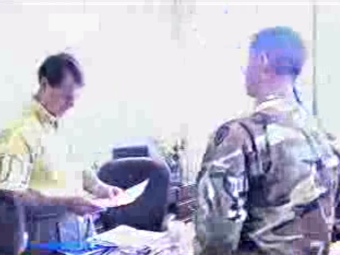 Video of parent meeting with Ed Case 4/21/2003
Congressman Ed Case's announcement that he will run for Senator Daniel Akaka's seat stirred up an immediate flurry of reaction in the press. Much of the commentary revolved around Case's offer to replace age with youth in Hawaii's congressional delegation. He also styles himself a moderate, and said he doesn't "talk and walk lock-step with my own party" (Star-Bulletin 1/22/2006).
Youth has its appeal, but so does experience, so this is something that will be debated and dissected in the press right up to election night.
Before long, pundits will get around to analyzing the voting records of both Akaka and Case. This will contrast the two based on performance, and define whether Case is indeed the moderate he claims to be or whether he is farther to the right than most democrats are comfortable with.
The press will also have to evaluate Case's relationship to the Democratic Party and to Democratic voters. While he was in the state legislature, he clashed with others in his party. Even a generally favorable article describes him thusly:
During the organization for the 2001 session, Case gave up the majority leadership. It had been a bad fit. Democrats who served with him in that period use words like stubborn, hard-headed, impatient, overbearing — even tyrannical — to describe Case.A more difficult parameter to evaluate is the quality Case's representation of his constituents. He is perhaps best known among parents in Hawaii and nationwide for writing and introducing what became known as the "Case Amendment" to H.R. 1350, a bill that was part of the reauthorization of the federal Individuals with Disabilities Education Act.
This anti-child amendment would have allowed governor Lingle and other state governors to set the fees for attorneys representing parents of special needs children. When parents find that school are not providing their children with an equal education under the law, they have little recourse but to file for a due process hearing, which they most often lose unless they have representation (the DOE always has legal advice). Hawaii's Department of Education embraced the Case Amendment as a means to greatly reduce the number of due process cases filed against them.
Parents, advocates and many others saw Case's action differently, of course. In no other civil rights cases can the defendant set fees for the plaintiff--and Governor Lingle is often the defendant, along with the Department of Education, in these suits. Given the power to limit attorneys fees, she would most certainly set them at a point which would be favorable to the DOE by making it impossible for attorneys to represent parents.
Parents protested. On April 21, 2003, a group of about two dozen parents crashed Case's office along with reporters and a video camera. In a Star-Bulletin article on the meeting, attorney Chris Parsons said that allowing the governor to set rates would "give the fox the keys to the henhouse" and drive lawyers away from such cases.
The video (which may take a bit of time to load) can be viewed here or here (turn up the computer volume a bit to hear this properly).
Case consulted with Superintendent Pat Hamamoto before introducing the amendment, but certainly not with parents of special needs students, who are his constituents. His amendment brought him tremendous negative publicity across the country.
How will parents feel about giving Ed Case additional power in the Senate? Let's see how this plays out.
Tags:
Sunday, January 15, 2006
Governor Lingle's policy advisors fail 5th-grade math test
 photo: Razvan Caliman
Innumeracy in Hawaii state government
As we enter the new year, economic pressures on many citizens of the state threaten their well-being. Due to increased costs and taxes, many will have to choose between buying food or medicine. Both the legislature and the governor will have to calculate the best way to use a projected windfall tax surplus. Will they be able to figure out how to protect those teetering on the brink of homelessness or poverty? Unfortunately, the governor has just admitted that her advisors cannot even do elementary school math.
In what might be described as her largest PR gaff so far this year, Governor Linda Lingle is reported in a Star-Bulletin article to have said that her most senior advisors could not pass a basic math test.
The curious admission was part of Lingle's address to a Hawaii State Teachers Association legislative conference held at the state Capitol on January 14, 2006. According to the Star-Bulletin:
Lingle told HSTA delegates that her own senior policy advisers took the fifth-grade Hawaii math test and could not pass it.Lingle was arguing that Hawaii should lower its academic performance standards so that the state would do better under federal No Child Left Behind mandates.
The fact is that wee little children can and do pass that test. Lingle's senior advisors could not. Go figure.
Update: Lights out in the ER--Hawaii's deteriorating medical infrastructure
 photo: Keith Syvinski
The Star-Bulletin began a three-part in-depth analysis of Hawaii's deteriorating health care infrastructure in today's paper. The series, by Helen Altonn, is a detailed look at cuts in services and programs that we warned about last week right here on Disappeared News.
Helen Altonn is the most experienced health reporter in Hawaii, and I look forward to reading her complete series on this critically important issue.
Tags:
Tuesday, January 10, 2006
Hawaii's medical infrastructure deteriorating, unready for disasters
According to the National Report Card on the State of Emergency Medicine, released today bye the American College of Emergency Physicians, Hawaii was ranked C- due to its lack of support for an emergency care system to meet the needs of its residents (via the Progressive Review).
In the face of pressures including decreasing reimbursements and increasing costs, doctors are leaving the state. On the Big Island, for example, there is no guarantee that an orthopedic surgeon will be available in an emergency to treat broken bones. In a May, 2005 op-ed in the Honolulu Advertiser, Dr. Barry Blum, an orthopedist working on the Big Island, warns readers "Don't get hurt on Big Island" because there may not be a doctor to take care of you.
Emergency rooms are often operating at capacity with no statewide emergency.
There were some bright spots in the report, but serious problems as well (only a D+ for Quality/Patient safety, for example). Recommendations included the need for additional registered nurses and emergency departments.
According to the report, Hawaii has a shortage of hospital space and trained professionals. Additionally, the state was deficient in these areas:
Hawaii needs to get its act together beforehand--when the tsunami or tropical storm hits, it's too late to plan an effective medical response system.
In the face of pressures including decreasing reimbursements and increasing costs, doctors are leaving the state. On the Big Island, for example, there is no guarantee that an orthopedic surgeon will be available in an emergency to treat broken bones. In a May, 2005 op-ed in the Honolulu Advertiser, Dr. Barry Blum, an orthopedist working on the Big Island, warns readers "Don't get hurt on Big Island" because there may not be a doctor to take care of you.
Emergency rooms are often operating at capacity with no statewide emergency.
There were some bright spots in the report, but serious problems as well (only a D+ for Quality/Patient safety, for example). Recommendations included the need for additional registered nurses and emergency departments.
According to the report, Hawaii has a shortage of hospital space and trained professionals. Additionally, the state was deficient in these areas:
- Number of registered nurses per 1,000 people (41st in the country)
- Number of hospital-staffed beds per 1,000 people (37th)
- Trauma centers per 1 million people (45th)
- Annual payments per fee-for-service enrollee in Medicare (51st)
Hawaii needs to get its act together beforehand--when the tsunami or tropical storm hits, it's too late to plan an effective medical response system.
Tags:
Sunday, January 08, 2006
FEMA still not reformed
Towards the end of September, 2005, Comedy Central displayed a chart from FEMA's website (thanks to the Presentation Zen blog). Here's that chart:
 Now, this chart is a bit amateurish and invites derision, for example, because the upside down arrow "Preparedness" leads directly to "DISASTER". Inexplicably, even after the adverse publicity, the FEMA web page is still in place, for all to see.
One would think that they must have more important work to do than fix their web page, of course. One might hope that they are busy implementing the extensive reforms needed to ensure that FEMA is prepared to do its job properly next time. Shouldn't all of us, and the press in particular, be tracking whether FEMA is indeed being reformed?
There has been plenty of discussion of FEMA's failures but little about reform. Indeed, condemnation of FEMA continues. We can read of the controversy over dumping New Orleans evacuees out of their hotel rooms without any other arrangements, evictions of tenants and unannounced bulldozing of damaged homes. FEMA is far from becoming a responsive organization, and far from being in control of the situation even so many months after the flooding.
FEMA's failures are not limited to New Orleans. The Saturday, January 7, 2006 issue of the Poughkeepsie Journal reported that FEMA has failed to provide assistance to Dutchess County and other communities around New York due to extensive damage from October's torrential rains. KOCO-TV reported today (January 8): Oklahoma Emergency Director Frustrated With FEMA Wildfire Response. The article leads with:
Looking back at New Orleans, FEMA's inaction has intentionally or unintentionally assisted developers bent on gentrification of the city. Just as the disaster of 9/11 and the outrage in its wake were used opportunistically to justify the invasion of Iraq, this disaster has been used opportunistically to change the ethnic makeup of New Orleans. Let's watch if the original residents, primarily poor and black, will be able to afford to move back into a gentrified New Orleans. How to explain the assignment of FEMA rebuilding contracts to the likes of Haliburton instead of to local firms, which could use the jobs? And in the absence of a tax base, local government is having a hard time restoring utilities and other services.
An extensive reform of FEMA is obviously critical. We're between hurricane seasons at the moment, but of course they will return. While storms are less frequent in the Pacific, there is the fear of the occasional tsunami or earthquake, and these have no seasons.
There should be considerable public scrutiny paid to whether FEMA will be up to the task.
Coverage of FEMA's falures is abundant: what has largely disappeared is news of whether FEMA itself is being fixed, and if not, why not.
Now, this chart is a bit amateurish and invites derision, for example, because the upside down arrow "Preparedness" leads directly to "DISASTER". Inexplicably, even after the adverse publicity, the FEMA web page is still in place, for all to see.One would think that they must have more important work to do than fix their web page, of course. One might hope that they are busy implementing the extensive reforms needed to ensure that FEMA is prepared to do its job properly next time. Shouldn't all of us, and the press in particular, be tracking whether FEMA is indeed being reformed?
There has been plenty of discussion of FEMA's failures but little about reform. Indeed, condemnation of FEMA continues. We can read of the controversy over dumping New Orleans evacuees out of their hotel rooms without any other arrangements, evictions of tenants and unannounced bulldozing of damaged homes. FEMA is far from becoming a responsive organization, and far from being in control of the situation even so many months after the flooding.
FEMA's failures are not limited to New Orleans. The Saturday, January 7, 2006 issue of the Poughkeepsie Journal reported that FEMA has failed to provide assistance to Dutchess County and other communities around New York due to extensive damage from October's torrential rains. KOCO-TV reported today (January 8): Oklahoma Emergency Director Frustrated With FEMA Wildfire Response. The article leads with:
A state official expressed frustration with the lack of response from the Federal Emergency Management Agency to provide aid for statewide wildfires that have scorched more than 363,000 acres.It's clear that FEMA is far from becoming a responsive organization, and far from being in control of the New Orleans situation even so many months after the flooding. How to explain this? Inquiring minds want to know. We want to understand this, not just read about FEMA's continued failures.
Looking back at New Orleans, FEMA's inaction has intentionally or unintentionally assisted developers bent on gentrification of the city. Just as the disaster of 9/11 and the outrage in its wake were used opportunistically to justify the invasion of Iraq, this disaster has been used opportunistically to change the ethnic makeup of New Orleans. Let's watch if the original residents, primarily poor and black, will be able to afford to move back into a gentrified New Orleans. How to explain the assignment of FEMA rebuilding contracts to the likes of Haliburton instead of to local firms, which could use the jobs? And in the absence of a tax base, local government is having a hard time restoring utilities and other services.
An extensive reform of FEMA is obviously critical. We're between hurricane seasons at the moment, but of course they will return. While storms are less frequent in the Pacific, there is the fear of the occasional tsunami or earthquake, and these have no seasons.
There should be considerable public scrutiny paid to whether FEMA will be up to the task.
Coverage of FEMA's falures is abundant: what has largely disappeared is news of whether FEMA itself is being fixed, and if not, why not.
Tuesday, January 03, 2006
"Windows PCs face ‘huge’ virus threat" -- but why do we put up with this?
There is news you can hardly find in your daily paper or even on the Internet: a discussion of exactly why viruses and worms can infect your computer. And how much this is hurting business and personal productivity. And what should be done differently so that we can continue to compute on our desktops without this scourge.
The latest threat, and it could be a biggie, is in this article: Windows PCs face ‘huge’ virus threat on the Financial Times website. Now any picture can be a "dirty picture", or actually a dirty bomb, dropping a virus into your computer if you just look at it.
This has really gone too far. The general assumption is that it has to be this way, that we are being victimized by all those criminals or evil people out there (many of whom may be children!). We need to search more deeply for the source of this plague, both within ourselves and within our computers. Within ourselves because the problem has been allowed to continue too long, and within our computers, because that's where the primal fault lies: the architecture that allows a child in Asia to plant a program in your computer that you don't want there and you don't control.
Imagine for a moment that you lived on another planet. Your PC could not ever be infected by viruses, worms or trojans. Your mom, uncle, or grandmother could simply buy one at the MarsUSA store, take it home, send you some interplanetary email, check the weather back on Earth, and enjoy some classical Mars music.
Well, your grammy on Earth could do the same, except that Microsoft/Intel are not bringing her the technology that we've had on this planet since the mid 1980s. In those days time-sharing computers ran 600 or more simultaneous users at once. Of course Ford could never access data in the space used by General Motors or Chrysler. If that could happen--even once--the time-sharing vendor would be out of business.
They prospered because they used hardware and software that made sure a program could only run in its own space.
Ask yourself, Earthling, why is it that some code arriving in your computer has complete access to memory and your hard disks? That is, any code, whether a valid program, malware, or a programming mistake, can read or write anywhere it likes. It can write into your Windows/system directories, and--get this--it can read your Outlook address book! Now go back to the time-sharing computer technology. Any program that tries to access memory outside of its space, or read or write hard disk it has no permission to access, will either get an error message or be booted out completely.
If this architecture were used on the PC (which still resembles most closely the original single-user IBM PC of yore), a virus arriving in your computer might be able to run, but it couldn't do anything to you. Maybe it could compute pi to a thousand digits, but that's about it.
On the mainframes, writing to disk looks something like this (for GE/Honeywell/NEC computers): the program lays out its data in a buffer space it has previously requested. It then does a MME (Master Mode Entry, pronounced "mee-mee") with stuff in the registers indicating that it wants to write that data somewhere. If it's ok to do that, the operating system takes the data and writes it. The program cannot actually write anything, there's no instruction it can execute to write. It doesn't matter what a kiddie in Korea knows, there is just no way to write outside the allowed space.
And the same for reading or writing to memory. This is actually very simple. And of course, no mere program may write anything it wants into the system area. In your PC, anything goes, and as time passes, the Windows system area gets filled up with all kinds of stuff that Microsoft had nothing to do with putting there. No program should have access to the operating system area at all--it should remain as pure as the day it was installed. Imagine that. And if it needed replacing, it just asks all running programs to hold on a microsec or two, replaces itself with the new version, and off we go.
Well, will we have to throw away all our Windows apps to evolve to this kind of a system? If so, I'd do so happily. But with processor speeds so high these days, probably current apps can run in an emulator. Maybe Windows as we know it could just be an app under the new OS.
The virus-writers are getting increasingly clever as Windows is getting dumber, with new holes opening up regularly. Now you can get a virus by viewing an image. That's crazy.
If business put Microsoft/Intel on notice, they would get results. How long will we continue to take this? It's a tremendous drain on business and individual productivity. Why don't we use the technology that's available and end this plague of viruses?
That's the story you never see discussed.
The latest threat, and it could be a biggie, is in this article: Windows PCs face ‘huge’ virus threat on the Financial Times website. Now any picture can be a "dirty picture", or actually a dirty bomb, dropping a virus into your computer if you just look at it.
This has really gone too far. The general assumption is that it has to be this way, that we are being victimized by all those criminals or evil people out there (many of whom may be children!). We need to search more deeply for the source of this plague, both within ourselves and within our computers. Within ourselves because the problem has been allowed to continue too long, and within our computers, because that's where the primal fault lies: the architecture that allows a child in Asia to plant a program in your computer that you don't want there and you don't control.
Imagine for a moment that you lived on another planet. Your PC could not ever be infected by viruses, worms or trojans. Your mom, uncle, or grandmother could simply buy one at the MarsUSA store, take it home, send you some interplanetary email, check the weather back on Earth, and enjoy some classical Mars music.
Well, your grammy on Earth could do the same, except that Microsoft/Intel are not bringing her the technology that we've had on this planet since the mid 1980s. In those days time-sharing computers ran 600 or more simultaneous users at once. Of course Ford could never access data in the space used by General Motors or Chrysler. If that could happen--even once--the time-sharing vendor would be out of business.
They prospered because they used hardware and software that made sure a program could only run in its own space.
Ask yourself, Earthling, why is it that some code arriving in your computer has complete access to memory and your hard disks? That is, any code, whether a valid program, malware, or a programming mistake, can read or write anywhere it likes. It can write into your Windows/system directories, and--get this--it can read your Outlook address book! Now go back to the time-sharing computer technology. Any program that tries to access memory outside of its space, or read or write hard disk it has no permission to access, will either get an error message or be booted out completely.
If this architecture were used on the PC (which still resembles most closely the original single-user IBM PC of yore), a virus arriving in your computer might be able to run, but it couldn't do anything to you. Maybe it could compute pi to a thousand digits, but that's about it.
On the mainframes, writing to disk looks something like this (for GE/Honeywell/NEC computers): the program lays out its data in a buffer space it has previously requested. It then does a MME (Master Mode Entry, pronounced "mee-mee") with stuff in the registers indicating that it wants to write that data somewhere. If it's ok to do that, the operating system takes the data and writes it. The program cannot actually write anything, there's no instruction it can execute to write. It doesn't matter what a kiddie in Korea knows, there is just no way to write outside the allowed space.
And the same for reading or writing to memory. This is actually very simple. And of course, no mere program may write anything it wants into the system area. In your PC, anything goes, and as time passes, the Windows system area gets filled up with all kinds of stuff that Microsoft had nothing to do with putting there. No program should have access to the operating system area at all--it should remain as pure as the day it was installed. Imagine that. And if it needed replacing, it just asks all running programs to hold on a microsec or two, replaces itself with the new version, and off we go.
Well, will we have to throw away all our Windows apps to evolve to this kind of a system? If so, I'd do so happily. But with processor speeds so high these days, probably current apps can run in an emulator. Maybe Windows as we know it could just be an app under the new OS.
The virus-writers are getting increasingly clever as Windows is getting dumber, with new holes opening up regularly. Now you can get a virus by viewing an image. That's crazy.
If business put Microsoft/Intel on notice, they would get results. How long will we continue to take this? It's a tremendous drain on business and individual productivity. Why don't we use the technology that's available and end this plague of viruses?
That's the story you never see discussed.
Tags:
Hawaii exports its prisoners to an uncertain future on the Mainland - where one has just died
An Associated Press story today carried in both the Advertiser and Star Bulletin reported that a Hawaii prisoner held at Otter Creek prison in Kentucky, Sarah Ah Mau, died of what prison authorities described as a heart attack. The reports stated that the prisoner's sister claimed that she died because needed medical care was not given to her. Hawaii state prison officials are to investigate.
KHON did much better with this story. They quoted the coroner in Kentucky:
Kudos also to KITV. They reported:
Otter Creek is run by the Corrections Corporation of America, a company with a problematic history. In Grassroots CCA Prison Report 2003:
The question that comes to mind is why Hawaii keeps sending its inmates to Mainland prisons. Separating inmates from their families and their attorneys clearly doesn't contribute to their rehabilitation, and it's clear also that Hawaii corrections officials can't control conditions in out of state private prisons.
Nor is the answer in building more prisons in Hawaii. A better solution, say drug policy experts, is to undo the harm done by the failed war on drugs which only serves to fill up our prison system while denying hope of rehabilitation and future employment.
(The most discouraging news may lie in a comment in the KITV report:
Our newspapers can dig deeper than they have on this issue. It's not as though they are not aware of the problems faced by Hawaii inmates in private Mainland prisons--Advertiser staff writer Kevin Dayton wrote a series of articles in the October 3, 2005 paper. In one of the articles, he observed:
The Advertiser article reveals little about how CCA is selected:
It's high time for further investigation into Hawaii's placement of about 1,800 inmates on the Mainland with a company that can't guarantee their safety, and time also to review how the number of inmates in custody can be reduced through more sensible drug policy including additional prevention and treatment programs designed to reduce incarceration.
KHON did much better with this story. They quoted the coroner in Kentucky:
"The prison told the coroner it was a heart attack. The coroner says no way.None of this was in the print story. KHON is to be commended for following up by contacting officials in Kentucky.
"I have a short, heavy-set Hawaiian lady who definitely did not die of a heart attack," says the coroner.
The coroner says the prison may be ignoring a contagious problem by trying to portray Ah Mau's death as a heart attack.
Kudos also to KITV. They reported:
In addition to questions about the cause of death and possible denied medication, there is also a concern about whether Ah Mau was removed from life support without her family's consent and whether an autopsy was done.KITV also added:
Hawaii inmates on the mainland are supposed to have direct access to Hawaii officials in order to complain about their conditions. That's why the public safety director is concerned that the information he's getting about Ah Mau's death is coming from third party, unofficial sources, such as her family friends and the news media.To find out why this is happening, tune back to KHON:
Last night, the security officials at the Kentucky prison told all Hawaii inmates not to talk with anyone outside of the prison about Sarah's death.Now for the rest of the story.
Otter Creek is run by the Corrections Corporation of America, a company with a problematic history. In Grassroots CCA Prison Report 2003:
During the past decade, a large portion of the newspaper and magazine articles written about CCA have focused on issues of abuse, violence, mismanagement, litigation or financial distress. Conditions in CCA's U.S. prisons are not unique: prisoners and staff also suffered from operational problems at CCA's now divested foreign joint venture operations.The report mentions a well-documented nine-hour incident at Otter Creek in July 2001 during which hundreds of prisoners staged a nine-hour riot.
The question that comes to mind is why Hawaii keeps sending its inmates to Mainland prisons. Separating inmates from their families and their attorneys clearly doesn't contribute to their rehabilitation, and it's clear also that Hawaii corrections officials can't control conditions in out of state private prisons.
Nor is the answer in building more prisons in Hawaii. A better solution, say drug policy experts, is to undo the harm done by the failed war on drugs which only serves to fill up our prison system while denying hope of rehabilitation and future employment.
(The most discouraging news may lie in a comment in the KITV report:
[Inmate rights attorney Eric] Seitz said overall, mainland prisons hired to house Hawaii inmates have done a better job of providing health care than local prisons.)
Our newspapers can dig deeper than they have on this issue. It's not as though they are not aware of the problems faced by Hawaii inmates in private Mainland prisons--Advertiser staff writer Kevin Dayton wrote a series of articles in the October 3, 2005 paper. In one of the articles, he observed:
There also have been problems at CCA prisons holding Hawai'i inmates, including violence, drug smuggling and contract violations. Still, state prison officials say CCA has generally done a good job and has been quick to make changes when deficiencies are pointed out.This seems to resemble the tactic of putting up a traffic light only after people have been killed crossing the street. In other words, there's nothing protecting Hawaii inmates being held on the mainland from abuse.
The Advertiser article reveals little about how CCA is selected:
Founded in 1983, the Nashville, Tenn.-based company has grown into a behemoth that employs 15,000 workers to oversee 62,000 inmates, including about 1,830 inmates from Hawai'i. CCA reported revenues of $1.15 billion last year, and last week became Hawai'i's sole provider of Mainland prison space.The Advertiser article goes on to detail stabbings, riots and other problems with CCA prisons. After reading the rest of the Advertiser article, it's hard to justify the conclusion that "CCA has generally done a good job."
The company is expected to collect $36 million from Island taxpayers in mostly nonbid contracts this year.
All but one of the prison contracts were awarded without formal competitive bidding because, technically, they are government-to-government agreements, which are exempt from state procurement rules.
It's high time for further investigation into Hawaii's placement of about 1,800 inmates on the Mainland with a company that can't guarantee their safety, and time also to review how the number of inmates in custody can be reduced through more sensible drug policy including additional prevention and treatment programs designed to reduce incarceration.
Tags: